Page 1 :
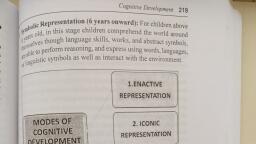
Ca) BRUNER’S THEORY OF COGNITIVE DEVELOPMENT ), , ~ The involvement of both the learner and the teacher is important in the teachinglearning process. Bruner’s theory of instruction stipulates stages and aspects for both the, learner and the teacher for systematic knowledge acquisition and process of instruction., Thus the development of cognitive abilities will take into the nature of individual learners,, “the nature of the knowledge to be acquired and the nature of knowledge getting process., - * Like Piaget, Bruneralso made a detailed study of cognitive processes and he expressed, the views, which resemble that of Piaget. His theory is summarised as under :, , , , , , (1) Stages in Development of Cognitive Abilities :, , , , , , , , , , , , ~ Bruner suggested the following three modes or stages in the development of weenie, abilities of children:, , , , , , , , id Be ocesses himself on that basis. This is the representative, the surrounding environment leaves images of the objects/, e child is able to think about the objects or images in, y now make use of graphics to represent reality., , : stage, the child expresses himself in the form of words. He, , , , Scanned with CamS«
Page 2 :
ino eh. iy’. ae, comes to have a mental sense of time and distance. At this stage language leaming alg, , begins. Language plays an important role. This is the advanced stage at which the child, represents reality of concrete objects with abstractions or language symbols. At this Stage,, , the teacher has to play an important role., To sum up, enactive stage is the stage of action, iconic stage is the stage of images of, , perceptual area, and symbolic stage is the stage of word. The child is first at the level of, - motor performance and then starts constructing the images and in the end learns the use of, , words and-his language learning begins., , , , , , (2) Aspects of tlre Process of Instruction :, , , , , , Bruner believes that the success of his theory of cognitive development and instruction, depends upon pupil-learning situation. Rapport is characterised by mutual affection, respect,, co-operation, sincerity, closeness and pleasantness. Bruner suggested-four significant factors/, , aspects of the process of instruction :, 1. Predisposition of learner : This refers to the child’s readiness to learner. Herbart, , called it “apperceptive masses”. Will to learn is intrinsic. It has to be aroused or excited. The, teacher should provide experiences or create conditions for the child to awaken his willingness, to learn. Thus the teacher should begin his instruction in such a way so as to implant in the, child a predisposition to learn., , 2. Structuring of knowledge : The second aspect is to systematically structure the, knowledge or items of content. However efficient and experienced a teacher may be, he is not, expected to teach everything of an item of the content to a specific’ grade students, within, specific period of time. He has to structure the content keeping in mind the age level and, grade level of the learners. To make the learners understand the basis of the knowledge items, related to the subject, the student should be helped to grasp a generalised set of basic ideas., Bruner used the perm ‘coding’ for such generalisation., , 3. Sequencing : Bruner suggests progression from enactive mode to iconic mode and, then to symbolic representation. Keeping this progression in mind, the teacher must take, care to evolve sequencing of content items in such a manner as to draw out maximum benefit, ‘with optimum economy. It is sometimes suggested that sequencing may be done in the form, ofa flow chart or a diagram. This will affect economy as well as lead to better understanding., , _ 4. Reinforcement : Reinforcement builds confidence and gives satisfaction. Bruner’s, theory of instruction.demands that teachers should pay adequate attention to the need for, proper reinforcement. Rewards and punishments are mode of extrinsic reinforcement. But, Bruner regards intrinsic reinforcement more useful than rewards which bring temporary, , ~ satisfaction. ., , _-Bruner’s and Piaget’s Theory: 1. Parallel : Bruner’s general description of cognitive development parallels Piagets, , description of sensorimotor, concrete operations and formal operation stages., , 2, Difference in interpretation of role of language : Bruner differs from Piaget in, interpretation of the role of language in the development of thought. Piaget theorises that, thought and language are closely related but are different systems. He believes that thinking, ‘of the child is based on a system of inner ee mt cvolerss a child organises and adapts, to experiences. In the younger child the symbols are baséd-on visual images. In Bruner's, , , , , , , |, OULAIIICU VWILIT Udall IS
Page 3 :
Relevance of Applicability of Various Theories of Development, , view thought is internalised language and that s, language can be used to explain mastery of conse, , 149, , yntactical rules of language rather than, , Tvation and other Principles., , , , , , ionale behi ,, (3) Rationale behind Bruner’s Theory of Cognitive Development and Instruction :, , , , , , Bruner supported the cognitive process in teachin, Attainment Model is the outcome of his cognitive ideas, Th, instruction is summarised as under :, , 1. Learning as cognitive process : Learning is a cognitive process which involves, three acts :, , (1) Acquisition of new knowledge or information., , (2) Transformation of new knowledge or information., , (3) Evaluation of new knowledge or information., , *0°°2. Curiosity as source : Curiosity about events, persons and things is the chief source, of cognition., , 3. Formation of concepts : Learning is forming concepts. Bruner’s Concept Attainment, , --Model helps in conceptualisation or categorisation of objects in the surrounding environment., , 4. Continuous process : Cognition is a continuous process., , 5. Self-discovery : Children should be made to discover things of their own. They, should not be put on spoon feeding or blind repetition., , 6. Teacher’s role : Teacher's role is most important. He must adhere to the process of, instruction which helps him to achieve the goals of knowledge as well as understand the, process of getting knowledge., , 4... Educational Implications of Bruner’s Theory of Cognition and Instruction :, , bees 1, Train children to become independent Iearners : Children should be trained to, | become independent learners. They should not be put on ready-made material. They should, , be trained to think independently to discover things for themselves., , on 2. Arouse curiosity : Children are curious by nature. Instinct of curiosity forces children, ~ to discover something new in the environment. Hence, children’s curiosity should be aroused, to make them independent interpreters., , : 3. Discourage mechanical repetition : The teacher should discourage practice of, mechanical repetition and blind reproduction of what the teacher presents. Children should, , be encouraged to adopt discovery approach. They should apply reasoning before accepting, , anything., 4. Identification and categorisation of items : Identification and categorisation of, , desirable content items is the practical aspect of Bruner’s Concept Attainment Model. By, : identifying and categorising items in the environment or in situation created by the teacher,, the:children are led to arrive at generalisations., , 5, Acquainting children with knowledge getting process : The teacher should acquaint, hildren with knowledge getting process. He should help children in collecting knowledge, referably by their own efforts., , 6. Structure knowledge, sequence learning material 18 provide reinforcement :, is: ere step prncedure is ie sine oon of Bruner’s theory of cognition and instruction., , ig and learning. His Concept, € rationale behind his theory of, , , , , , , , , , , , , , , , ers AG CACIN_CHITMRAL DEVELOPMENT Ss, OCArHiCU WILIT Cal lol