Page 1 :
BHARATHIDASAN UNIVERSITY, TIRUCHIRAPPALLI — 620 024, , CENTRE FOR DISTANCE EDUCATION, , , , LANGUAGE ACROSS THE, CURRICULUM, , B.Ed. IT YEAR, , (Copyright reserved) For Private Circulation only
Page 3 :
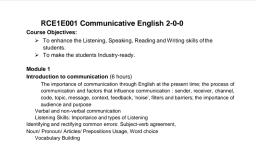
LANANGUAGE ACROSS CURRICULUM, Total Marks: 100 Duration of Examination: 3 hrs., Internal Assessment: 25, External Assessment;75, Objectives, After end of the course, student teacher will be able to, 1. Understand nature, function and role of language across the curriculum, , 2. Understand importance and use of first, second language and multi languages system, and its significance on culture in developing language skills., , 3. Acquire knowledge about the communication process and functions., , 4. acquire the knowledge about communication, types, developing communication skills, and its barriers., , 5. Understand fundamental objectives of language teaching and activities foe developing, sills on LSRW., , 6. Familiarize with of barriers to Listening, Speaking, Reading, Writing (LSRW) skills and, activities for the development skills, , 7. Understand and appreciate the various activities for developing language skills., , 8. Acquire knowledge about n the language laboratory and its importance on developing, language skills, , 9. Develop attitude being a good language teacher., UNIT-I Nature and function of Language, , Language- meaning and concepts - Functions of Language - Role of Language across, Curriculum — language learning - Theories of language learning — teaching language as skill, rather than knowledge subjects - Barriers in using language and strategies in overcome them, , UNIT-II. Language diversity in classroom, , Learning mother tongue - First language — significance of first language - role home importing, mother tongue - second language — significance teaching second language - Using first and, second language in the classroom — tri language system — Multilingualism - relation of language, with culture.
Page 4 :
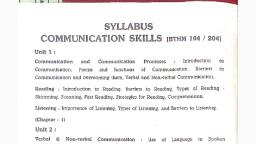
UNIT-IIL. Communication, , Communication, Meaning and concept - Elements of communication - Process of, communication - Types of communication, Verbal and non-verbal communication Interpersonal, intrapersonal, group and mass communication - Ways and means to developing, communication skills at schools — general barriers to communication., , UNIT-IV. Developing LSRW skills and its barriers, , Listening skills — sub skills of listening — listening for perception — listening for comprehension —, three phases of listening — listening materials - importance of listening skills - Barriers to, listening skills - Activities for developing listening skills: Speaking skills — importance of, speaking skills - Barriers to speaking skills: Reading skills — importance — process involved in, reading — types of reading - barriers to reading skills — Writing skills — importance —, characteristics of good writing - barriers to writing skills., , UNIT -V. Activities for LSRW skills, , Activities for developing Listening skills - listening materials — listening to specific information, and for general understanding - dictation — listening telephone call — commentaries — listening, instruction: Activities for developing Speaking skills - conversation — group discussion — debate, - interview - extempore speech: Activities for developing Reading skills — methods of teaching, reading to beginners — Alphabet — Phonetic — word — phrase and sentence method: Activities for, developing Writing skills — developing mechanical skill, grammatical skill, judgment skill and, discourse skill., , UNIT- VI. Language Laboratory, , Language laboratory -role language laboratory developing language skills - planning and, installing of language laboratory — basic materials for language laboratory — effective uses, language laboratory., , UNIT- VII. Qualities of Language teacher, , Language teacher — basic qualification — role of language teacher developing language —, language skill and knowledge— developing techno pedagogy skills — characteristics of good, language teacher - dating skills through in- service training., , Mode of Transaction: Lecture, Discussion, debate, conversation, exercise, dramatization,, assignments and language games.
Page 5 :
Practicum, , School visit to find out communication problem/Apprehension in students, , Designing games and Exercise for developing listening, speaking, writing and Reading skills, Assigning Assignment on listening skills, , Assigning Assignments on developing speaking skills, , Assigning Assignments on developing reading skills, , Assigning Assignment for developing writing skills, , Organizing debate, discussion, seminar, stage speak, public speak and drama., , REFERENCES, , Pearson,J.C.et.al.(2011). Human communication (4th ed). New York.McGraw Hill Companies, Inc., , Floyd,K.(2009). Interpersonal communication. New York.McGraw Hill Companies Inc., , Fronklin, V. Rodman,R.& Hyms, (2011) Introduction to language (9" ed).Canada. Cenganga, Learning., , Akmajain,A.ct.al. (2010). An introduction to Language and Linguistics. (6" ed) Cambridge., MITPress.., , Fasold,R.& Connor- Linton, J.(2013). An introduction to language and linguistics.(6" ed)., Cambridge. Cambridge University press., , First and second language acquisition- a Brief comparison. Retrieved from https://www. UnidueELE/FIA-SLA brief copmarision.pdf.