Notes of Applied Mechanics 2021-22, Applied Mechanics Syllabus - Study Material
Page 1 :
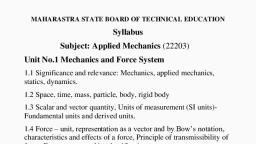
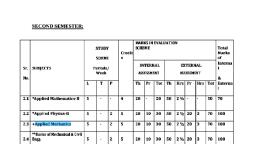
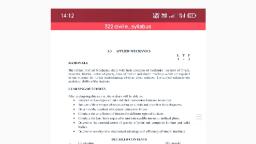
MAHARASTRA STATE BOARD OF TECHNICAL EDUCATION, , Syllabus, Subject: Applied Mechanics (22203), Unit No.1 Mechanics and Force System, 1.1 Significance and relevance: Mechanics, applied mechanics,, statics, dynamics., 1.2 Space, time, mass, particle, body, rigid body, 1.3 Scalar and vector quantity, Units of measurement (SI units)Fundamental units and derived units., 1.4 Force – unit, representation as a vector and by Bow’s notation,, characteristics and effects of a force, Principle of transmissibility of, force, Force system and its classification, , Unit No.2 Simple Lifting Machine, 2.1 Simple lifting machine, load, effort, mechanical advantage,, applications and advantages. Velocity ratio, efficiency of machines,, law of machine., 2.2 Ideal machine, friction in machine, maximum Mechanical, advantage and efficiency, reversible and non-reversible machines,, condition for reversibility, 2.3 Velocity ratios of Simple axle and wheel, Differential axle and, wheel, Worm and worm wheel, Single purchase Double purchase, crab winch, Simple screw jack, Weston’s differential pulley block,, geared pulley block., 2.4 Graphs of Load verses Effort, Load verses ideal Effort, Load, verses Effort lost in friction, Load verses MA, Load verses, Efficiency.
Page 2 :
Unit No.3 Resolution and Composition, 3.1 Resolution of a force - Orthogonal and Non Orthogonal, components of a force, Moment of a force, Varignon’s Theorem., 3.2 Composition of forces – Resultant, analytical method of, determination of resultant for concurrent, Non concurrent and, Parallel co-planar force systems – Law of triangle, parallelogram, and polygon of forces., 3.3 Graphic statics, graphical representation of force, Space, diagram, force diagram, polar diagram and funicular polygon,, Graphical method of determination of resultant for concurrent and, parallel co-planar force systems., , Unit No.4 Equilibrium, 4.1 Equilibrium and Equilibrant, Free body and Free body diagram,, Analytical and graphical conditions of equilibrium., 4.2 Equilibrium of force systems analytically, 4.3 Lami’s Theorem, 4.4 Types of beam, supports (simple, hinged, roller and fixed) and, loads acting on beam (vertical and inclined point load,UD load,, couple), span of beam., 4.5 Beam reaction for cantilever, with or without overhang subjected, to combination of Point load and UD load or Vertical Point load and, couple Simply supported beam with or without overhang –subjected, to combination of Point load and UD load or Vertical Point load and, couple, 4.6 Beam reaction graphically for simply supported beam subjected, to vertical loads only.
Page 3 :
Unit No.5 Friction, 5.1 Friction and its relevance in engineering, types and laws of, friction, limiting equilibrium, limiting friction, co-efficient of, friction, angle of friction, angle of repose relation between coefficient of friction and angle of friction., 5.2 Equilibrium of bodies on level surface subjected to force parallel, and Inclined to plane, 5.3 Equilibrium of bodies on inclined plane subjected to force, parallel to the plane only., 5.4 FBD of ladder in friction, , Unit No.6 Centroid and Centre of Gravity, 6.1 Centroid of geometrical plane figures (square, rectangle,, triangle, circle, semicircle, quarter circle), 6.2 Centroid of composite figures composed of not more than three, geometrical figures, 6.3 Centre of Gravity of simple solids (Cube, cuboid, cone, cylinder,, sphere, hemisphere), 6.4 Centre of Gravity of composite solids composed of not more, than two simple solids.



 Learn better on this topic