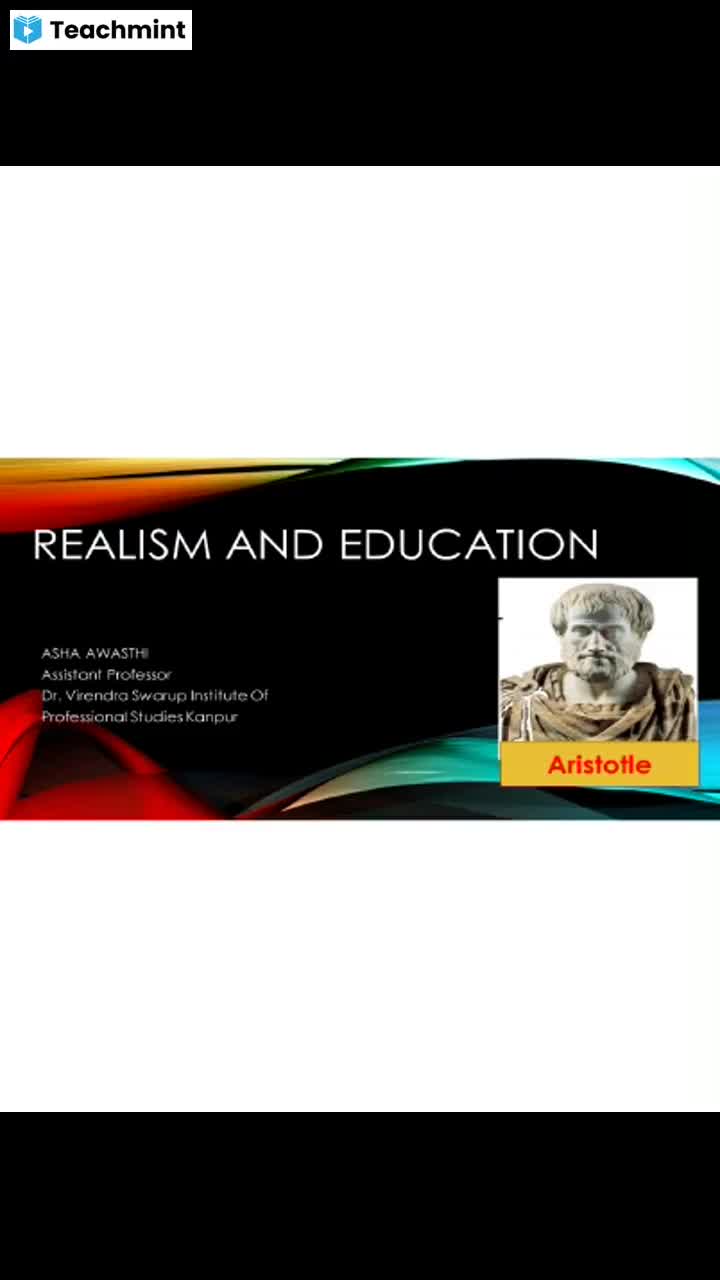
Notes of B.Ed. 1st Year, 1st Paper Philosophy REALISM AND EDUCATION-pdf - Study Material
Page 2 :
MEANING AND DEFINITION OF REALISM, • The Realism is that school of western philosophy, which considers matter as real and true., • Then we find that the word ‘realism’ has been, derived from the word ‘real’ and the word ‘real’, has been derived from the Greek word ‘res’ which, means matter., • So the etymological meaning of the word ‘realism’, comes to the ideology concerning the existence, of matter.
Page 3 :
• Greek philosopher Aristotle {384-322 B.C.} is, considered the founder of realism., • Aristotle , at first, accepted the independent, existence of matter., • As an independent philosophy, realism is, considered to have developed from the, fifteenth century., • By the 18th century it reached its peak and it, influenced education., • The main philosopher of realism are-
Page 4 :
• Erasmus of Holland, Rabelais and Lord Montaigne of, France, Richard Mulcaster, Francis Bacon and John, Milton of England, Ratke of Germany, and Comenius, of Czechoslovakia., • BUTLER- “Realism is the reinforcement of our, common acceptance of the world as it appears to, us.”, • SWAMI RAM TIRTH- “Realism means a belief or theory, which looks Upon the world as it seems to us”., J.S.ROSS- “The doctrine of realism assert that there is a, real world of things behind and corresponding to the, objects of our perception.”
Page 5 :
METAPHYSICS OF REALISM, • According to realism, this universe is made from matter and, matter has its existence . They consider matter as the basic, element of the universe and as the ultimate reality ., EPISTEMOLOGY OF REALISM, , • The sense organs [eyes, ears , nose ,skin and tongue ] are, the means of attaining knowledge . They argue that the, knowledge of the matter that we get through sense organs, is the true knowledge . Realists emphasize on the, knowledge got through words to be accepted only after it, has been experienced through sense organs .
Page 6 :
AXIOLOGY AND ETHICS OF REALISM, • Realism consider this material world is true ., According to them , protection of one,s life, and living happily are the aims of human life ., • HERE man symbolizes all men of the world and, not an individual . It is not definite which, person would get happiness how and at what, place and time . So neither similar values can, be determined for all persons nor similar rules, of conduct can be formed for them all .
Page 7 :
FUNDAMENTAL PRINCIPLES OF REALISM, 1. Phenomenal world is true., 2. Senses are the gateway of knowledge., 3. Theory of Organism., 4. Opposition of Idealism., 5. Development of man is according to regularity of the world., 6. Man is a part of material world., 7. Knowledge of material world is essential for happy living., 8. Emphasis on experiment and observation., 9. Emphasis on the present practical life of man., 10.The aim of human life is to live happily.
Page 8 :
Humanistic, Realism, , Neo, Realism, , Forms, of, Realism, , Sense, Realism, , Social, Realism
Page 9 :
HUMANISTIC REALISM, , • It studies the present solution to each problem of life., • Education must prepare one for life in the real world., • Humanistic except the happy living as the aim of, human life. Some of these realists consider that man, can get bliss from the knowledge of ancient Roman, and Greek literature because it discusses the means, of happiness.
Page 11 :
SOCIAL REALISM, • Socialistic Realism considered that man can get real, happiness only when he adjusts in the society., • The purpose of education, according to social realists to, prepare the practical man of the world., • Social realists follow the method of travel of journey, method., • He emphasized a teaching method which was, according to the natural tendencies and development, of a child., • He was against expressionistic discipline.
Page 13 :
SENSE REALISM, • Sens Realists consider that man can get real happiness, by real knowledge of matter and the real knowledge, of matter can be got through sense organs., • The sense realism in education emphasizes the training, of the senses., • It has preferred education of nature, observation,, science in place of language and literature., • Teaching methods should be scientific inductive,, based on observation, analysis, synthesis., • Inductive method is given by Bacon.
Page 14 :
•, , Some Formula propounded by –Ratke., , 1. Teach only one subject at a time., 2. The medium of instruction should be mother tongue, 3. Follow Nature., 4. Learning should not be based on Rote memory., 5. Knowledge should be through senses and, experience., 6. Things should be introduced first than words., 7. Students should not be repressed., , Comenius is called the father of modern education.
Page 15 :
Sense Realism
Page 16 :
NEO REALISM, • New Realism a really philosophical thought., • It appears the methods and results of modern, development in Physics., • They do not consider the scientific principles, everlasting while they express the, changeability in them., • They support the education of art with the, science and analytical system of education, with the humanistic feelings.
Page 18 :
REALISM AND EDUCATION, CONCEPT OF EDUCATION, • Realist consider education as the process of, development ., • Realists have opposed 'knowledge for, knowledge sake' and 'knowledge for, emancipation’., • They have propounded the principle of, ‘knowledge for life. ‘
Page 19 :
"Education is, the creation of, sound mind in, a sound body.“, ARISTOTLE
Page 21 :
"I call a complete, and generous, education that, which fits a man to, perform justly, skillfully and, magnanimous all, the offices both, private and public, at peace and war.”, JOHN MILTON
Page 22 :
REALISM AND AIMS OF EDUCATION, 1. To prepare the child for a real life., 2. To prepare the child for a happy life., 3. To acquaint the child with natural and social, environment ., 4. Development of scientific attitude., 5. Development of mental power., 6. Development and training of senses., 7. Providing Vocational Education.
Page 23 :
REALISM AND CURRICULUM, Realism want to prepare man for this life by, education., • Therefore the realists in the curriculum have, emphasized the following points1. Extensive Curriculum, 2. Freedom to choose subjects, 3. Emphasis on education through mother tongue, 4. Interrelationship between subjects, 5. Child centred social curriculum, 6. Most emphasis on vocational education, •
Page 24 :
• Subjects of curriculum - In the curriculum, determined by them they have given an, important place to science subjects, secondary, place to history, geography, law; and the lowest, place to literature, art and music., • BACON has given the most, important place to science, in the curriculum; and after, that to Literature and Philosophy.
Page 25 :
REALISM AND METHODS OF TEACHING, • Realism consider the sense organs as the gateways of, knowledge, so they emphasize on the training of sense, organs of the children., • Milton emphasised on excursion and tour; LOCK, emphasised on learning by observation, excursion and, experience ., • Realistic lays emphasis on learning by doing and learning, by self-experience, which has increased the importance of, workshop and laboratory methods in the field of, education., • Realism consider the objects as the basis of experience, so, they started to use these objects as means of teaching.
Page 26 :
• As a result of this, audio-visual aids, excursion and co-curricular, activities are accepted as significant for teaching learning., • Encouraged the correlation method in the field of education., • Inductive method- The child himself learns by observation and, testing., , TEACHING FORMULA, 1., 2., 3., 4., 5., 6., , Proceed, Proceed, Proceed, Proceed, Proceed, Proceed, , from simple to complex., from known to unknown., from concrete to abstract., from indefinite to definite., from empirical to rational knowledge., from direct to indirect.
Page 27 :
REALISM AND DISCIPLINE, • According to them, a discipline student abides by the rules, of the school, does not flee in the face of difficulties, rather, makes himself able to overcome them; but they oppose, any type of discipline imposed from outside by the use of, punishment or force., • They want to give the children such an environment in, which they may learn to maintain an order and it becomes, their habit., • Realism does not believe in soft Pedagogy., • Education is labor-intensive work, and it needs to be done, seriously., • The discipline itself is to harmonize with scientific materialism.
Page 28 :
REALISM AND TEACHER, A realistic teacher should have the following, characteristics1. Try to understand everything from a scientific, point of view and try to develop scientific attitude, in the students also., 2. He prefers objective and useful knowledge over, imagination., 3. He is a true explorer. He believes only in the, knowledge discovered by the scientific method., 4. He becomes familiar with the needs, interests and, desires of his students and verify them, scientifically.
Page 29 :
5- He does not impose his scientific beliefs on his students,, but he interprets things in a neutral way., 6- He is familiar with child psychology and adolescent, psychology., 7- The realistic teacher uses the principle of conditioning to, help the students adjust to their environment., 8- Realistic teacher presents objects and actions to, students in their real form and gives them opportunities to, observe and experience and make decisions., According to them , each teacher should know what,, when and how he has to teach the children. For it,they, emphasize on teacher training.
Page 30 :
REALISM AND STUDENTS, • The realist thinker Lock considered the child a plain, slate. He considered that the children become, according to the environment given to them., • Comenius emphasized on behaving with the children, with love and sympathy. According to him the children, should be made to perform activities according to their, physical and mental capabilities and interests., • Realists provide them education to students for, keeping their needs in view., • They consider the student to be the focal point of the, educational process.
Page 31 :
REALISM AND SCHOOL, • Realists take school as workshops for creation of man., • Realists feel the need of schools, where trained teachers, make opportunities available to the students to develop, according to their interests, aptitude and abilities., • Realism do not support any one type of school. They, argue that there is a great difference in the needs of, children, so there should be different types of schools for, different types of children., • Realists want to keep schools away artificially and want, to maintain real environment in them.
Page 32 :
• School organization would be based on the real, needs of society., • The opening of science classes in every school is a, must., • Co-education is a natural happening so it cannot, be rejected., • So they supported co-education., • School is the mirror of the society. It is a miniature, from of society and it presents the real picture of, the society.
Page 33 :
CONTRIBUTION OF REALISM TO EDUCATION, 1. Emphasis on practical education., 2. Emphasis on liberal and vocational education., 3. Emphasis on scientific subjects., 4. Emphasis on co- education., 5. New teaching methods and teaching formulas were, given., 6. Introduced the concept of teacher training., 7. Emphasis on the social nature of the school., 8. Equal Importance to individual and society.



 Learn better on this topic