Page 2 :
DNA
Page 3 :
DNA, Deoxyribonucleic acid, DNA - a polymer of deoxyribonucleotides., Usually double stranded., And have double-helix structure., found in chromosomes, mitochondria, and chloroplasts., It acts as the genetic material in most of, the organisms., Carries the genetic information
Page 4 :
A Few Key Events Led to the, Discovery of the Structure of DNA, DNA as an acidic substance present, in nucleus was first identified by, Friedrich Meischer in 1868., He named it as ‘Nuclein’., , Friedrich Meischer
Page 5 :
In, , 1953 , James Watson and Francis Crick,, described a very simple but famous Double, Helix model for the structure of DNA.
Page 6 :
FRANCIS CRICK AND JAMES WATSON
Page 7 :
, , The scientific framework for their, breakthrough was provided by other, scientists including, Linus Pauling, Rosalind Franklin and Maurice Wilkins, Erwin Chargaff
Page 8 :
Rosalind Franklin, She worked in same laboratory as Maurice Wilkins., She study X-ray diffraction to study wet fibers of DNA., , X-ray diffraction, of wet DNA fibers, , The diffraction pattern is interpreted, (using mathematical theory), This can ultimately provide, information concerning the structure, of the molecule, , X Ray, Crystallography, Rosalind, Franklin’s photo
Page 9 :
, , , , She made marked advances in X-ray, diffraction techniques with DNA, The diffraction pattern she obtained, suggested several structural features of DNA, , , , , , Helical, More than one strand, 10 base pairs per complete turn
Page 10 :
Rosalind Franklin, , Maurice Wilkins
Page 11 :
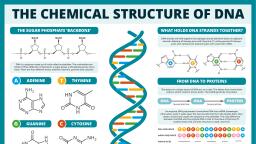
DNA Structure, , , DNA structure is often divided into four, different levels primary, secondary,, tertiary and quaternary., , DNA, , has three main components, , , , 1. Deoxyribose (a pentose sugar), , , , 2. Base (there are four different ones), , , , 3. Phosphate
Page 12 :
A, G, C or T, , O, , Base, , O P, O–, , O CH2, 5′, 4′, , Phosphate, , H, , H, 3′, , A, G, C or U, , O, , Base, , O P, , O, H, , 1′, , H, , 2′, , OH, H, Deoxyribose, , DNA Nucleotide, , O CH2, , O–, , 5′, , 4′, , Phosphate, , H, , H, 3′, , O, H, , 1′, , H, , 2′, , OH, OH, Ribose, , RNA Nucleotide
Page 13 :
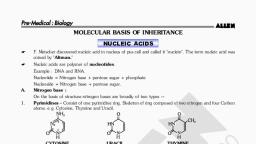
The Nitrogenous Bases, THEY ARE DIVIDED INTO TWO GROUPS, , , Pyrimidines and purines, , PYRIMIDINES (MADE OF ONE 6 MEMBER RING), Thymine, Cytosine, PURINES (MADE OF A 6 MEMBER RING, FUSED, TO A 5 MEMBER RING), Adenine, Guanine, THE RINGS ARE NOT ONLY MADE OF CARBON
Page 14 :
Nitrogenous bases of DNA & RNA
Page 15 :
Nucleotide Structure, Nucleotides, , are formed by the condensation of a, sugar, phosphate and one of the 4 bases, The following illustration represents one nucleotide, Phosphate, Nitrogenous, Bases, , Deoxyribose
Page 16 :
O, O P, O–, , Base, O, , CH2, , 5′, 4′, , Phosphate, , H, , H, 3′, , O, , 1′, , H, , H, , 2′, , OH, H, Deoxyribose, , DNA nucleotide
Page 19 :
Nucleotides are linked together by covalent bonds called, phosphodiester linkage., A chemical bond that, involves sharing a pair of, electrons between atoms in, a molecule., P, 5, , 1, , 4, , Base, , Sugar, , 3, , 2, , P, 5, , 1, , 4, , Sugar, , 3, , 2, , Base
Page 20 :
Backbone, , Bases, O, , 5′, , CH3, , N, , Thymine (T), H, , –, , O, O, , P, , O, –, , O, , CH2, 5′, 4′, H, H, , O, , N, , O, 1′, H, 2′, H, H, , 3′, , NH2, N, , Phosphodiester, linkage, , N, , Adenine (A), , H, N, , O, O, , P, , O–, , O, , CH2, 5′, 4′, H, H, , O, 1′, H, 2′, H, H, , 3′, , P, , O, –, , O, , NH2, H, , N, , H, , O, O, , N, , CH2, 5′, 4′, H, H, , Cytosine (C), O, , N, , O, 1′, H, 2′, H, H, , 3′, , Guanine (G), O, H, , N, , N, , H, N, , O, , Single, nucleotide, , O, , P, , O, , CH2, 5′, O, 4′, H, Phosphate H, –, , 3′, OH, , 3′, , O, 1′, H, 2′, H, H, , Sugar (deoxyribose), , N, , NH2
Page 21 :
DNA Double Helix & Hydrogen bonding, Salient features of the Double-helix structure of DNA:, It is made of two polynucleotide chains, where the backbone, is constituted by sugar-phosphate, and the bases project inside., The two chains have anti- parallel polarity. It means, if one chain, has the polarity 5’ 3’, the other has 3’ 5’., 5’, , 3’, , G, , C, , T, , A, , C, , G, , A, , T, , 3’, , 5’
Page 23 :
DNA Double Helix & Hydrogen bonding, The bases in two strands are paired through hydrogen bond (H-bonds), forming base pairs (bp). Adenine forms two hydrogen bonds with, Thymine from opposite strand and vice-versa. Similarly, Guanine is, bonded with Cytosine with three H-bonds., Based on the observation of Erwin Chargaff that for a double stranded, DNA, the ratios between Adenine and Thymine; and Guanine and, Cytosine are constant and equals one., Hydrogen bond:-A chemical bond consisting of a hydrogen atom, between two electronegative atoms (e.g., oxygen or nitrogen) with, one side be a covalent bond and the other being an ionic bond., , 3 Hydrogen bonds, , 2 Hydrogen bonds
Page 24 :
Erwin Chargaff’s Experiment, Chargaff pioneered many of biochemical technique for, the isolation, purification and measurement of nucleic acids, from living cells., It was known that DNA contained the four bases: A, G, C & T., Chargaff analyzed the base composition DNA isolated from, many different species., THE HYPOTHESIS, An analysis of the base composition of DNA in different, species may reveal important features about structure, of DNA.
Page 25 :
y, Conceptual level, , Experimental level, , 1. For each type of cell, extract the, chromosomal material. This can be, done in a variety of ways, including the, use of high salt, detergent, or mild alkali, treatment. Note: The chromosomes, contain both DNA and protein., , Solution of, chromosomal, extract, , DNA +, proteins, , Protease, , 2. Remove the protein. This can be done in, several ways, including treament with, protease., , DNA, , Acid, , 3. Hydrolyze the DNA to release the bases, from the DNA strands. A common way, to do this is by strong acid treatment., , G, , A, , Individual, bases, , T, , A, C, , C, , G, , T, , C, G, , 4. Separate the bases by chromatography., Paper chromatography provides an easy, way to separate the four types of bases., (The technique of chromatography is, described in the Appendix.), , AA, , A A, C, , C, , C, , A, , C CC C, , G, G G GG G, 5. Extract bands from paper into solutions, and determine the amounts of each base, by spectroscopy. Each base will absorb, light at a particular wavelength. By, examining the absorption profile of a, sample of base, it is then possible to, calculate the amount of the base., (Spectroscopy is described in the, Appendix.), 6. Compare the base content in the DNA, from different organisms., , A, , G, , Origin, TT, , T, , T, , T, , T
Page 26 :
The Data
Page 27 :
Interpretation of Data, The compelling observation was that:, Percentage of adenine=percentage of thymine, Percentage of Cytosine=percentage of Guanine, This observation became known as a Chargaff’s Rule.
Page 29 :
DNA Double Helix & Hydrogen bonding, The two strands are coiled in a right-handed fashion(Clockwise)., The pitch of the helix is 3.4 nm (a nanometer is one billionth of a, meter, that is 10-9 m) and there are roughly 10 bp in each turn., Consequently, the distance between a bp in a helix is, approximately equal to 0.34 nm., , The plane of one base pair stacks over the other in double helix., This, in addition to H-bonds, confers stability of the helical structure.
Page 31 :
DNA Double Helix & Hydrogen bonding, There are two asymmetrical grooves on the outside of the helix:, a) Major groove, b) Minor groove, Groove:-any furrow(slight depression in the smoothness of a surface), or channel on a bodily structure or part., , Certain proteins can bind within these groove, They can thus interact with a particular sequence of bases., , Minor, groove, Minor, groove, , Major, groove, , Major, groove, (a) Ball-and-stick model of DNA, , (b) Space-filling model of DNA
Page 32 :
Structure of Double-helix, Three major forms:, B-DNA, A-DNA, Z-DNA, , B-DNA, , is biologically THE MOST COMMON, It is a -helix meaning that it has a Right handed, or, clockwise, spiral., Complementary base pairing, • A-T, • G-C, Ideal B-DNA has 10 base pair per turn(360o rotation of helix), So each base is twisted 36o relative to adjacent bases., Base pair are 0.34 nm apart., So complete rotation of molecule is 3.4 nm., Axis passes through middle of each basepairs.
Page 33 :
B-DNA, Minor Groove is Narrow, Shallow., Major Groove is Wide, Deep., This structure exists when plenty, of water surrounds molecule and, there is no unusual base sequence, in DNA-Condition that are likely to, be present in the cells., B-DNA structure is most stable, configuration for a random, sequence of nucleotides under, physiological condition.
Page 34 :
A-DNA, Right-handed helix, Wider and flatter than B-DNA, 11 bp per turn, Its bases are tilted away from, main axis of molecule, Narrow Deep major Groove and, Broad, Shallow minor Groove., Observed when less water is, present. i.e.Dehydrating condition., A-DNA has been observed in, two context:, , , , , , •, •, , Active site of DNA polymerase, (~3bp), Gram (+) bacteria undergoing, sporulation
Page 35 :
Z-DNA, A left-handed helix, Seen in Condition of High salt, concentration., In this form sugar-phosphate, backbones zigzag back and, forth, giving rise to the name, Z-DNA(for zigzag)., 12 base pairs per turn., A deep Minor Groove., No Discernible Major Groove., Part of some active genes form, Z-DNA, suggesting that Z-DNA, may play a role in regulating, gene transcription.
Page 36 :
Property, , B-DNA, , A-DNA, , Z-DNA, , Strand, , Antiparallel, , Antiparallel, , Antiparallel, , Type of Helix, , Right-handed, , Right-handed, , Left-handed, , Overall shape, , Long and, narrow, , Short and, wide, , Elongated, and narrow, , Base pair per turn, , 10, , 11, , 12, , Distance between, adjacent bases, , 0.34 nm, , 0.23 nm, , 0.38 nm, , Pitch/turn of helix, , 3.40 nm, , 2.82 nm, , 4.56 nm, , Helical Diameter, , 2.0 nm, , 2.3 nm, , 1.8 nm, , 10, , 200, , 90, , Tilt/inclination of bp to, axis
Page 37 :
Property, Major Groove, , Minor Groove, , B-DNA, , A-DNA, , Z-DNA, , Wide & Deep, , Narrow &, Deep, , No, discrenible, , Narrow,, shallow, , Broad,, Shallow, , Narrow,, Deep
Page 38 :
DNA Supercoiling, DNA supercoiling refers to the over or under-winding, of strands., DNA supercoiling is important for DNA packaging, within all cells. Because the length of DNA can be, of thousands of times that of a cells, packaging this, material into the cell or nucleus (in Eukaryotes) is a, difficult feat., Supercoiling of DNA reduces the space and allows, for much more DNA to be packaged.
Page 41 :
Nucleosome Structure, Nucleosome are the basic unit of the chromatin organization., In Eukaryotes DNA associated with Proteins., (In prokaryotes DNA is naked), Nucleosomes= basic bead like unit of DNA packing, Made of segment of DNA wound around a protein core, that is composed of 2 copies of each 4 types of Histones., Nucleosomes have:, 8 Histones in the core, DNA wrapped twice around, the core, One Histone holding the, Nucleosome together, A DNA ‘linker’ continues, towards the next nucleosome., The DNA has a negatively charged, backbone(because of PO43- group), The Protein(Histones) are positively, charged., The DNA and Protein are, Electromagnetically attracted to, each other to form chromatin.
Page 42 :
RNA
Page 43 :
RNA, Ribonucleic Acid, RNA is a polymer of ribonucleotides linked together by, phosphodiester linkage., RNA was first genetic material., In 1967 Carl Woese found the catalytic properties of RNA and, speculated that the earliest forms of life relied on RNA both, to carry genetic information and to catalyse biochemical, reactions., Their theories were not validated until the work of Nobel Prize, laureate Thomas R. Cech. In the 1970s, Cech was studying, the splicing of RNA in a single-celled organism, Tetrahymena, thermophila, when he discovered that an unprocessed RNA, molecule could splice itself. He announced his discovery in, 1982 and became the first to show that RNA has catalytic, functions., Usually single stranded and helical in structure., But double stranded also present in some viruses.
Page 44 :
RNA exists in several different single-stranded structures, most of, which are directly or indirectly involved in protein synthesis or its, regulation., It also acts as the genetic material in some viruses., It function as messenger(mRNA), adapter(tRNA), structural(rRNA), and in some cases as a catalytic molecule(Ribozyme)., RNA strands are typically several hundred to several thousand, nucleotides in length.
Page 45 :
RNA V/S DNA
Page 46 :
RNA structure, There are also three main component, a) Phosphate Group, b) Sugar(Ribose), c) And Nitrogenous base, , The Nitrogenous Bases, , They are divided into two groups:, , i. Purine, ii. Pyrimidine, Purines (made of a 6 member ring, fused to a, 5 member ring), Adenine, Guanine, Pyrimidine (made of a 6 member ring), Cytosine, Uracil
Page 47 :
RNA Structure, Nucleotide, Nucleotides are formed by, the condensation of a, sugar, phosphate and one of, the 4 bases, The following illustration, represents one nucleotide, , A, G, C or U, , O, , Base, , O P, , O CH2, , O–, , 5′, , 4′, , Phosphate, , H, , H, 3′, , O, H, , 1′, , H, , 2′, , OH, OH, Ribose, , RNA Nucleotide
Page 50 :
Covalent bonding B/W Nucleotides, Nucleotides are linked together by covalent bonds called, phosphodiester linkage., A chemical bond that, involves sharing a pair of, electrons between atoms in, a molecule., P, 5, , 1, , 4, , Ribose, , Base, , Sugar, , 3, , 2, , P, 5, , 1, , 4, , Ribose, , Sugar, , 3, , 2, , Base
Page 51 :
Backbone, , Bases, , 5′, , O, H, O–, O, , P, O–, , O, , CH2, 5′, 4′, H, H, , H, , N, , H, , Uracil (U), O, , N, , O, 1′, H, 2′, OH, H, , 3′, , NH2, , N, , Phosphodiester, linkage, , N, , H, N, , O, O, , P, O–, , O, , CH2, 5′, 4′, H, H, , N, , O, 1′, H, 2′, OH, H, , 3′, , P, , O, –, , O, , NH2, H, , N, , H, , O, O, , Adenine (A), H, , CH2, 5′, 4′, H, H, , Cytosine (C), O, , N, , O, 1′, H, 2′, OH, , Guanine, (G), , H, , 3′, , O, , N, , N, , H, N, , O, , RNA, nucleotide, , O, , P, , O, , CH2, 5′, O, 4′, H, Phosphate H, –, , 3′, OH, , 3′, , O, 1′, H, 2′, OH, H, , Sugar (ribose), , N, , H, , NH2
Page 52 :
Hydrogen bonding, , , Usually RNA is single stranded, But in some viruses RNA, present in double stranded form., , , , The bases in two strands are paired through hydrogen, bond (H-bonds) forming base pairs (bp). Adenine forms, two hydrogen bonds with Uracil from opposite strand, and vice-versa. Similarly, Guanine is bonded with, Cytosine with three H-bonds.
Page 53 :
dsRNA Structure, There are double-stranded RNA structures, , RNA can fold back on itself, Depends on base sequence, Gives stem (double-strand) and loop (single-strand structures), , ds RNA has an A-like conformation, , Steric clashes between 2’-OH groups prevent the B-like, conformation.
Page 54 :
Complementary regions, Held together by, hydrogen bonds, , U, U A, , A, A U, U A, , A, , C, , U, , G, , G C, C, , C G, , C G, A U, , A, C, , (a) Bulge loop, , U, G, , U A, , A U, , C G, , C G, , C G, , G, , U, , C, , C, , C, U, , U A, C G, , C, G, A A G, C G U U C, , C, A, , G, C C, G A A, G G C U U, , G C, , C G, , A U, , C G, , A U, , (b) Internal loop, , U, , C, , (c) Multibranched junction, , Non-complementary regions, Have bases projecting away, from double stranded regions, , C G, , U, , G C, A U, A U, , C G, , G, , A, G, , U, , G C, A U, , A, , C, U, A, G, U G C A, , (d) Stem-loop, , Also called, hair-pin, , C, G G, A, C C G U
Page 55 :
Types of RNA, In all prokaryotic and eukaryotic organisms, three main, classes of RNA molecules exist1) Messenger RNA(m RNA), 2) Transfer RNA (t RNA), 3) Ribosomal RNA (r RNA), The other are –, small nuclear RNA (SnRNA),, micro RNA(mi RNA) and, small interfering RNA(Si RNA) and, heterogeneous nuclear RNA (hnRNA).
Page 56 :
Messenger RNA (m-RNA), , , , , All members of the class function, as messengers carrying the, information in a gene to the, protein synthesizing machinery, , Structure, The 5’ terminal end is capped by 7- methyl guanosine, triphosphate cap., The cap is involved in the recognition of mRNA by the, translating machinery., It stabilizes m RNA by protecting it from 5’ exonuclease., The 3’end of most m-RNAs have a polymer of Adenylate, residues( 20-250)., The tail prevents the attack by 3’ exonucleases., On both 5’ and 3’ end there are non coding sequences which, are not translated (NCS)
Page 57 :
The intervening region between non coding sequences, present between 5’ and 3’ end is called coding region., This region encodes for the synthesis of a protein.
Page 58 :
Heterogeneous nuclear RNA (hnRNA) [Precursor mRNA], , In mammalian nuclei , hnRNA is the immediate, product of gene transcription, The nuclear product is heterogeneous in size, (Variable) and is very large., 75 % of hnRNA is degraded in the nucleus,, only 25% is processed to mature m RNA., Mature m –RNA is formed from primary transcript, by capping, tailing, splicing and base modification.
Page 59 :
Transfer RNA (t-RNA), Transfer, , RNA are the smallest of three major species, of RNA molecules, They have 74-95 nucleotide residues, They transfer the amino acids from cytoplasm to the, protein synthesizing machinery, hence the name t, RNA., They are also called Adapter molecules, since they, act as adapters for the translation of the sequence, of nucleotides of the m RNA in to specific amino, acids, There are at least 20 species of tRNA one, corresponding to each of the 20 amino acids, required for protein synthesis., tRNA is the only RNA species that contains the, nucleoside thymidine.
Page 60 :
Structure, 1) Primary structure- The nucleotide, sequence of all the t RNA molecules, allows, extensive, intrastand, complementarity that generates a, secondary structure., 2) Secondary structure- Each single, t- RNA shows extensive internal base, pairing and acquires a clover leaf, like structure. The structure is, stabilized by hydrogen bonding, between the bases and is a, consistent feature., Secondary structure (Clover leaf, structure), All t-RNA contain 5 main arms or, loops which are as followsa) Acceptor arm, b) Anticodon arm, c) D HU arm (DihydroUracil), d) TΨ C arm Thymidine Pseudouridine Cytosine, e) Extra arm
Page 61 :
Secondary structure of tRNA. CCA tail in yellow, Acceptor, stem in purple, Variable loop in orange, D arm in, red, Anticodon arm in blue with Anticodon in black, T, arm in green.
Page 62 :
3) Tertiary structure of t-RNA, The, , L shaped tertiary structure is, formed by further folding of the, clover leaf due to hydrogen bonds, between T and D arms., The base paired double helical, stems get arranged in to two, double helical columns, continuous, and perpendicular to one another.
Page 65 :
Differences between RNA and DNA, S.No., , RNA, , DNA, , 1), , Single stranded mainly, except when self, complementary sequences, are there it forms a double, stranded structure (Hair pin, structure), , Double stranded (Except, for certain viral DNA s which, are single stranded), , 2), , Ribose is the main sugar, , The sugar moiety is deoxy, ribose, , 3), , Pyrimidine components differ. Thymine is always there but, Thymine is never found, uracil is never found, (Except tRNA), , 4), , Being single stranded, structure- It does not follow, Chargaff’s rule, , It does follow Chargaff's, rule. The total purine, content in a double, stranded DNA is always, equal to pyrimidine, content.
Page 66 :
S.No., , RNA, , DNA, , 5), , RNA can be easily, destroyed by alkalies to, cyclic diesters of mono, nucleotides., , DNA resists alkali action, due to the absence of, OH group at 2’ position, , 6), , RNA is a relatively a labile, molecule, undergoes easy, and spontaneous, degradation, , DNA is a stable molecule., The spontaneous, degradation is very too, slow. The genetic, information can be stored, for years together without, any change., , 7), , Mainly cytoplasmic, but, also present in nucleus, (primary transcript and, small nuclear RNA), , Mainly found in nucleus,, extra nuclear DNA is, found in mitochondria,, and plasmids etc, , 8), , The base content varies, from 100- 5000. The size is, variable., , Millions of base pairs are, there depending upon, the organism
Page 67 :
S.No., , RNA, , DNA, , 9), , There are various types of, RNA – mRNA, rRNA, tRNA,, SnRNA, SiRNA, miRNA and, hnRNA. These RNAs, perform different and, specific functions., , DNA is always of one type, and performs the function, of storage and transfer of, genetic information., , 10), , No variable physiological, forms of RNA are found., The different types of RNA, do not change their forms, , There are variable forms, of DNA (A, B and Z), , 11), , RNA is synthesized from, DNA, it can not form, DNA(except by the action, of reverse transcriptase). It, can not duplicate (except, in certain viruses where it is, a genomic material ), , DNA can form DNA by, replication, it can also, form RNA by transcription., , 12), , Many copies of RNA are, present per cell, , Single copy of DNA is, present per cell.