Page 3 :
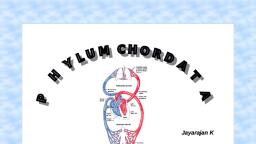
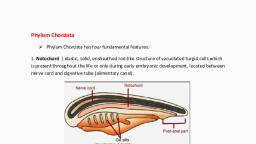
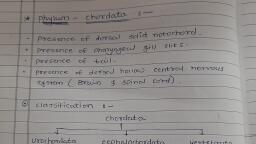
Characteristics Of Phylum Chordata, Phylum Chordata possesses the following characteristic features:, Notochord , It is a solid un-jointed, stiff but flexible rod-like structure situated on the dorsal side between the dorsal hollow nerve cord and the alimentary canal. It acts as a support for the nerve cord and is replaced by the vertebral column after the embryonic stage in all vertebrates., Dorsal Hollow Nerve Cord, It is a bundle of nerves running along the “back” and splits into the brain and the spinal cord. It is hollow and lies dorsal to the notochord., Pharyngeal Gill Slits, They are the openings which allow the entry of water through the mouth without entering the digestive system viz. they connect mouth and throat. All Chordates have these openings on the lateral sides of the pharynx at some stage of their life., Post anal Tail, It is an extension of the body to the anus. In chordates, the tail is composed of skeletal muscles which help in locomotion in fish-like species. It is absent in most of the adult Chordates.
Page 7 :
Subphylum - Urochordata (Tunicata) , General characters (Gr. uros, tail; chorda, cord) , Exclusively marine and cosmopolitan, found in all seas and at all depths. , Mostly sedentary (fixed), some pelagic or free-swimming. , Simple (solitary), aggregated in groups or composite (colonial). , Size (0.25 to 250 mm), shape and colour variable. , About body degenerate, sac-like, unsegmented, without paired appendages and usually without tail. , Body covered by a protective tunic or test composed largely of tunicine, (C6H10O5)n similar to cellulose, hence the name Tunicata. , A terminal branchial aperture and a dorsal atrial aperture usually present. , Coelom absent. Instead, an ectoderm-lined atrial cavity present which opens to outside through atrial aperture.
Page 8 :
Notochord present only in larval tail, hence the name Urochordata. , Alimentary canal complete. Pharynx (branchial sac) large, with endostyle and two to several pairs of gill-slits. Ciliary feeders. , Respiration through test and gill-slits. , Blood-vascular system open. Heart simple, tubular and ventral. Flow of blood periodically reversed. Special vanadocytes in blood extract vanadium from sea water. , Excretion by neural gland, pyloric gland and nephrocytes. , Dorsal tubular nerve cord only in larval stage, reduced to a single dorsal nerve ganglion in adult. , Mostly hermaphrodite. Fertilization cross and external. , Development indirect including a free-swimming tailed larva with basic chordates characters. Metamorphosis retrogressive. , Asexual reproduction by budding common.
Page 12 :
Subphylum - Cephalochordata, A. General Characters (Gr., kephal, head; chorde, cord), 1. Marine, widely distributed in shallow waters., 2. Mostly sedentary and buried with only anterior body end, projecting above bottom sand., 3. Body small, 5 to 8 cm long, slender, fish-like, metameric and transparent., 4. Head lacking. Body has trunk and tail., 5. Paired appendages lacking. Medium fins present., 6. Exoskeleton absent. Epidermis single-layered., 7. Muscles dorso-lateral, segmented into myotomes. , 8. Ceolom enterocoelous, reduced in the pharyngeal region by development of atrial cavity., 9. Notochord rod-like, persistent, extending from rostrum to tail, hence the name cephalochordata.
Page 13 :
10. Digestive tract complete. Pharynx large, perforated by numerous persistent gill-slits opening into atrium. Filter feeders., 11. Respiration through general surface. No special organs for respiration present. , 12. Circulatory system well developed, closed and without heart and respiratory pigment. Hepatic portal system developed., 13. Excretion by protonephridia with solenocytes., 14. Nerve cord dorsal, tubular, without ganglia and brain. Dorsal and ventral nerve roots separate., 15. Sexes separate, gonads numerous and metamerically repeated. Gonoducts lacking. No asexual reproduction., 16. Fertilization external in sea water., 17. Development indirect, including a free-swimming larva., 18. The Cephalochordata comprise about 30 species mostly of the genus Branchiostoma and Asymmetron all put in the singleclass Leptocardii, single family Branchiostomidae.