Page 1 :
SHAHEED MAHENDRA KARMA VISHWAVIDYALAYA, BASTAR, JAGDALPUR, SESSION 2021-22, , Syllabus of, , M.Sc. ZOOLOGY, 2 Year/4 Semester Postgraduate Degree Programme/Course, Under the Faculty of Life Science, For Affiliated Colleges of Shaheed Mahendra Karma Vishwavidyalaya, Bastar, Jagdalpur, FIRST SEMESTER, Paper No. Title of Papers, , FIRST, SEMESTER, , I, II, III, IV, LC-I, LC-II, , Marks, External, Internal, 80, 20, 80, 20, 80, 20, , Biosystematics, Taxonomy and Biodiversity, Structure and Function of Invertebrates, General and Comparative Endocrinology of, Vertebrates, Gamete Biology & Reproductive Physiology in, Human Beings, Lab Course I (Based on Paper I & II), Lab Course II (Based on Paper III & IV), Total, , 80, , 20, , 80, 80, 480, , 20, 20, 120, , SECOND SEMESTER, , SECOND, SEMESTER, , Paper No. Title of Papers, I, II, III, IV, LC-I, LC-II, , Molecular Cell Biology and Biotechnology, Tools and Techniques in Biology, Quantitative Biology and Computer Application, Immunology and Development Biology, Lab Course I (Based on Paper I & II), Lab Course II (Based on Paper III & IV), Total, , Marks, External, Internal, 80, 20, 80, 20, 80, 20, 80, 20, 80, 20, 80, 20, 480, 120, , THIRD SEMESTER, Marks, External, Internal, 80, 20, 80, 20, 80, 20, 80, 20, 80, 20, 80, 20, 480, 120, , Comparative Anatomy of Vertebrates, Animal Behaviour, Environment Physiology and Population Ecology, Population Genetics and Evolution, Lab Course I (Based on Paper I & II), Lab Course II (Based on Paper III & IV), Total, FOURTH SEMESTER, ELECTIVE A: FISH AND FISHERIES AND AQUACULTURE, , I, II, III, IV, LC-I, LC-II, , Paper No. Title of Papers, , FOU, RTH, SEM, ESTE, R, , THIRD, SEMESTER, , Paper No. Title of Papers, , I, , Limnology and Ecotoxicology, , Syllabus M.Sc. Zoology Semester-I, II, III & IV, , Marks, External, Internal, 80, 20, Page 1 of 35
Page 2 :
SHAHEED MAHENDRA KARMA VISHWAVIDYALAYA, BASTAR, JAGDALPUR, SESSION 2021-22, , FOURTH, SEMESTER, , II, III, IV, LC-I, LC-II, , Ichthyology, Capture Fisheries, Aquaculture and Culture Fisheries, Lab Course I (Based on Paper I & II), Lab Course II (Based on Paper III & IV), , 80, 80, 80, 80, 80, 480, 1920, , 20, 20, 20, 20, 20, 120, 480, , Total, Grand Total Semester I+II+III+IV = 2400, FOURTH SEMESTER, ELECTIVE B: INSECT BIOLOGY AND PHYSIOLOGY, Paper No. Title of Papers, Marks, External Internal*, *, Characteristics, Classification and Types of Insects, I, 80, 20, Gross Morphology of Insects, II, 80, 20, Insect Physiology, III, 80, 20, Behavior and Economic Importance of Insects, IV, 80, 20, Lab Course I (Based on Paper I & II), LC-I, 80, 20, Lab Course II (Based on Paper III & IV), LC-II, 80, 20, Total, 480, 120, Grand Total Semester I+II+III+IV = 2400, 1920, 480, , Syllabus M.Sc. Zoology Semester-I, II, III & IV, , Page 2 of 35
Page 3 :
SHAHEED MAHENDRA KARMA VISHWAVIDYALAYA, BASTAR, JAGDALPUR, SESSION 2021-22, , M. Sc. ZOOLOGY, SEMESTER - I, PAPER – I, BIOSYSTEMATICS, TAXONOMY AND BIODIVERSITY, Max. Marks - 80, Important Note:, Each theory will have five questions of equal marks. First question [Multiple choice type or short, answer type] will be based on all units [complete syllabus] with no internal choice, whereas, remaining question will be unit wise with internal choice., UNIT-I, 1.1., Definition and basic concepts of biosystematics and taxonomy., 1.1.1., Historical resume of systematics., 1.1.2., Importance and applications of biosystematics in biology, 1.2., Trends in biosystematics concepts of different conventional and newer aspects, 1.2.1., Chemotaxonomy, 1.2.2., Cytotaxonomy, 1.2.3., Molecular taxonomy, UNIT-II, 2.1., Dimensions of speciation and taxonomic characters, 2.2., Mechanisms of speciation in panmictic and apomictic species, 2.3., Species concepts and species category., 2.4., Theories of biological classification., 2.5., Taxonomic characters and different kinds., UNIT-III, 3.1., Procedure keys in taxonomy., 3.1.1., Taxonomic procedures-taxonomic collections, preservation, curetting, 3.1.2., Taxonomic keys-different kinds of taxonomic keys, their merits and demerits., 3.1.3., Process of typification and different Zoological types., 3.1.4., International code of Zoological Nomenclature (ICZN), UNIT-IV, 4.1., Biodiversity, 4.1.1., Types of Biodiversity, 4.1.2., Hot spots of Biodiversity, 4.1.3., Threats to Biodiversity, 4.1.4., Conservation of Biodiversity, 4.2., Evaluation of biodiversity indices, 4.2.1., Shannon-Weiner index., SUGGESTED READING MATERIALS (ALL LATEST EDITION), 1. Biosystematics & Taxonomy, Dr. R. C. Tripathi, University Book House JAIPUR., 2. Theory & Practice of Animal Taxonomy V.C. Kapoor, 5th Edition Oxford & IBH Publishing, Co., 3. Principle of Animal Taxonomy G.G. Simpson, Oxford & IBH Publishing Co., 4. Elements of Taxonomy Earnst Mayer, 5. Biodiversity E.O. Vilson, Acadmic Press Washington, 6. The Biology of Biodiversity M. Kato, Springer, 7. Molecular Markers - Natural History & Evolution J.C. Avise, , Syllabus M.Sc. Zoology Semester-I, II, III & IV, , Page 3 of 35
Page 4 :
SHAHEED MAHENDRA KARMA VISHWAVIDYALAYA, BASTAR, JAGDALPUR, SESSION 2021-22, , M. Sc. ZOOLOGY, SEMESTER - I, PAPER – II, STRUCTURE AND FUNCTION OF INVERTEBRATES, Max. Marks - 80, Important Note:, Each theory will have five questions of equal marks. First question [Multiple choice type or short, answer type] will be based on all units [complete syllabus] with no internal choice, whereas, remaining question will be unit wise with internal choice., UNIT-I, 1.1. Organization of coelom, 1.1.1. Acoelomates and Pseudocoelomates, 1.1.2. Coelomates: Protostomia and Deuterostomia., 1.2. Locomotion, 1.2.1. Flagellar and ciliary movement in Protozoa., 1.2.2. Hydrostatic movement in Coelenterata, Annelida and Echinodermata., UNIT-II, 2.1. Nutrition and Digestion, 2.1.1. Patterns of feeding and digestion in Protozoa, 2.1.2. Filter feeding in polychaeta., 2.2. Respiration, 2.2.1. Organs of respiration Gills, lungs and trachea., 2.2.2. Respiratory pigments., UNIT-III, 3.1. Excretion, 3.1.1. Organs of excretion., 3.1.2. Excretion and osmoregulation, 3.2. Nervous System, 3.2.1. Primitive nervous system: Coelenterata and Echinodermata., 3.2.2. Advanced Nervous system: Annelida, Arthropoda (Crustacea and insecta) and, Mollusca (Cephalopoda), UNIT-IV, 4.1. Invertebrate larvae, 4.1.1. Larval forms of free-living and parasitic invertebrates, 4.2. Minor Phyla, 4.2.1. Organization and general characters of (Ctenophore, Rotifera, Ectoprocta, Endoprocta), SUGGESTED READING MATERIALS (ALL LATEST EDITION), 1. Invertebrate Structure and function, E.J.W. Barrigton English language Book society UK., 2. Invertebrate Zoology: Robert Barnes IVth Edition Holt Saunders International Edition Japan., 3. The Cambrige Natural History Vol 1 – 9 S F Harmer, A.E. Shipley. Todays & Tomorrows, Book agency, N Delhi India., 4. A Text book of Zoology Invertebrate: Parker Hasvell, Marshall & Williams. AITBS, Publishing & Distributers, Delhi, 5. The Invertebrates Vol. 1 – 9 Libbic Henrietta Hyman, McGraw Hill Book Company, , Syllabus M.Sc. Zoology Semester-I, II, III & IV, , Page 4 of 35
Page 5 :
SHAHEED MAHENDRA KARMA VISHWAVIDYALAYA, BASTAR, JAGDALPUR, SESSION 2021-22, , M. Sc. ZOOLOGY, SEMESTER - I, PAPER – III, GENERAL AND COMPARATIVE ENDOCRINOLOGY OF VERTEBRATES, Max. Marks - 80, Important Note:, Each theory will have five questions of equal marks. First question [Multiple choice type or short, answer type] will be based on all units [complete syllabus] with no internal choice, whereas, remaining question will be unit wise with internal choice., UNIT I, 1. Aims and Scope of Endocrinology: Types of chemical messengers, Discovery of hormones,, Classification of endocrine glands and hormones, Experimental methods of hormones research, 2. Comparative Morphology of Endocrine Tissue: Hypothalamus, Pituitary gland Thyroid,, parathyroid, Adrenal, Gastrointestinal tract, Juxta-glomerular apparatus (kidney), Heart, UNIT II, 1. Life History of Hormones: Biosynthesis of hormones, Biosynthesis of simple peptide, hormone, Biosynthesis of amino acid derived small size hormone (T3, T4, epinephrine, and nor-epinephrine, Biosynthesis of steroid hormone, (cortisol, cortisone, corticosterone,, progesterone, Release of hormone from endocrine gland Releasing stimuli, Pulsatile, release of hormone, Releasing mechanism Concentration and transport of hormone in, the blood, 2. General Mechanism of Hormone Action: Plasma membrane hormone receptor and its, action, Systolic hormone receptor and its action, 3. Termination of Hormone Action and Metabolism of Hormone, UNIT III, 1. Neuroendocrine System: types of neurohormones, synthesis and function of endorphins,, encephalin etc., 2. Synthesis, function and disorder of following endocrine gland hormones: Pituitary, hormones, Adrenal hormones, Thyroid and parathyroid hormones, Gastro- intestinal hormones,, Juxta-glomerular hormones, Hormones of heart, Synthesis and function of ecosanoid specially, Prostaglandin and Luketerineand its hormonal role, UNIT IV, 1. Hormonal regulation and its metabolic activity: Role of hormone in – Carbohydrate, metabolism, Protein metabolism, Fat metabolism, Calcium metabolism, Role of hormone in, fasting, 2. Hormone & behaviour, 3. Role of hormone in growth & development, SUGGESTED READING MATERIALS (ALL LATEST EDITION), 1. General & comparative Endocrinology: E.J.W. Barrington, oxford, Clarendon Press, 2. Text book of Endocrinology: R.H. Williams, W.B Saunders, 3. Endocrine Physiology: C.R Martin, Oxford Univ. Press, 4. Comparative Endocrinology: A. Gorbman et al, John Wiley and sons, 5. Medical Physiology: W.F. Ganong (1981) 10th edition Lange Medical Publications, Syllabus M.Sc. Zoology Semester-I, II, III & IV, , Page 5 of 35
Page 6 :
SHAHEED MAHENDRA KARMA VISHWAVIDYALAYA, BASTAR, JAGDALPUR, SESSION 2021-22, , 6. Principles of anatomy and physiology: Torota Grabowski, 9th edition, John Wiley & sons, 7. Reproductive Physiology of vertebrates: Van Tienhoven A. (1983) 2nd edition Cornell Univ., Press, NY, 8. The pituitary gland: Imura H. (1994) 2ndeditionCompreshensive Endocrinology revised series, Raven, NY, 9. Comparative Vertebrate Endocrinology: Bentley P.J. (1976), Cambridge Univ. press,, Cambridge, 10. Comparative Vertebrate Endocrinomental: Bentley P.J. (1976) Cambridge Univ. press,, Cambridge, 11. Invertebrate Endocrinology. Temblare, Himalaya Publishing house, 12. Endocrinology: Hadley, 13. Endocrinology: Negi, , Syllabus M.Sc. Zoology Semester-I, II, III & IV, , Page 6 of 35
Page 7 :
SHAHEED MAHENDRA KARMA VISHWAVIDYALAYA, BASTAR, JAGDALPUR, SESSION 2021-22, , M. Sc. ZOOLOGY, SEMESTER - I, PAPER – IV, GAMETE BIOLOGY & REPRODUCTIVE PHYSIOLOGY IN HUMAN BEINGS, Max. Marks - 80, Important Note:, Each theory will have five questions of equal marks. First question [Multiple choice type or short, answer type] will be based on all units [complete syllabus] with no internal choice, whereas, remaining question will be unit wise with internal choice., UNIT I, 1. Endocrinology of Sex Differentiation & Judgment: Chromosomal (genetic) basis of sex, determination, Gonadal sex, phenotypic sex differentiation of the internal and external genitalia, Brain, sex differentiation, , 2. Reproductive Cycle: Adrenarche, Pubarche and puberty, ovarian cycle, Formation of ova,, Luteal cycle, Uterine cycle, Menstruation cycle, Menopause, Estrous cycle, UNIT II, 1. Male Reproductive System: Anatomy, physiology and morphology of male reproductive, system, Spermatogenesis and development of spermatozoa, Biochemistry of semen, Phallus, erection, Ejaculation, Y-specific probes, 2. Endocrine Function in Male: Endocrine control of testicular function, Chemistry and, biosynthesis of androgens, Secretion transport and metabolism of testis hormone, Physiological, role of androgens-Role in spermatogenesis, Nervous system, Secondary sex characteristics,, Anabolic function, Aging, Physiological roles of estrogens in male, Fertility, Male behaviour,, Epiphyseal fusion, Cardio vascular function, Mechanism of androgen action and, Pathophysiology, UNIT III, 1. Female Reproductive System: Anatomy of female reproductive system-Ovary, Fallopian, tube, Uterus, Oogenesis, 2. Ovarian Hormones: Chemistry, biosynthesis, secretion, transport, function, action and, metabolism of Estrogens Progesterone and Relaxin, Control of ovarian function Abnormalities, of ovarian function, UNIT IV, 1. Fertilization: Pre-fertilization event, Biochemistry of fertilization, Post-fertilization event, 2. Collection and cryopreservation of gametes and embryo, 3. Formation and development of placenta and its endocrine function, 4. Role of hormone in Parturition and Lactation, 5. Hormonal and immune contraception, SUGGESTED READING MATERIALS (ALL LATEST EDITION), 1. Developmental Biology, 2ndedition, Leon, W.B Saunders College publishing, 2. Current topics in Developmental Biology eds. R.A. Pederson and G.P. Schatten, 3. Principles of animal development biology: S.C. Goel, Himalaya Publishing house, 4. Developmental biology, S.F Gilbert, 4th edition, Sinauer Assoc. Inc. Publishers, 5. An introduction to Developmental Biology: D.A. Ede, Syllabus M.Sc. Zoology Semester-I, II, III & IV, , Page 7 of 35
Page 8 :
SHAHEED MAHENDRA KARMA VISHWAVIDYALAYA, BASTAR, JAGDALPUR, SESSION 2021-22, , 6. Principles of Developmental Biology: Paul Weiss edited by Hafner Publishng Co. NY, 7. Cells into organs: 2nd edition the forces that shape the embryo John Phillip Trinkaused, Tom, Aloisi, 8. Principles of development: Lewis Wolpert et al 1998. Oxford Univ. Press, 9. Foundations of embryology; B.M Pattern & B.M. Carlson, Tata McGraw Hill Publications,, New Delhi, 10. An introduction to embryology: Balinsky 1981 5th ed. (CBS College publishing), 11. Embryonic and foetal development Cambridge Univ press. By Austin and Short 1982, 1992, 2nd Ed., 12. Marshall physiology of reproduction: Longmont Green and Co. London Vol1 and 2, lamming, 1984,2000, 13. Developmental biology: Gudrick, 14. Endocrinology: Hadley, 15. Endocrinology: Negi, , Syllabus M.Sc. Zoology Semester-I, II, III & IV, , Page 8 of 35
Page 9 :
SHAHEED MAHENDRA KARMA VISHWAVIDYALAYA, BASTAR, JAGDALPUR, SESSION 2021-22, , M. Sc. ZOOLOGY, SEMESTER-I, LAB COUSE-I, PRACTICAL BASED ON PAPER I & II, Max. Marks: 100, BIOSYSTEMATICS AND TAXONOMY, 1., 2., 3., 4., 5., 6., 7., , Study of biodiversity among various invertebrates and vertebrates (Listing of all the animals, found in and around your house and also try to find out their Zoological names)., Collection of various insect species., Visits to a local animal park or zoo to identify and study the captive fauna and preparation of, report., Study of adaptive characteristics of various invertebrates and vertebrates in different climate., Taxonomic key formation and conversion., Study of biodiversity in grassland and pond water by using Shannon -Weiner index, Other exercise related to theory paper, , STRUCTURE AND FUNCTION OF INVERTEBRATES, 1. Identification, classification and study of distinguishing features of important representatives, from various groups (Protozoa to Hemichordata)., 2. Study of permanent prepared slides (from Protozoa to Hemichordata)., 3. Dissection; Reproductive, Excretory, nervous and haemocoelomic systems of leech., 4. Dissection Reproductive system of cockroach; general anatomy, nervous and reproductive, systems of grasshopper; nervous system of crab; nervous and reproductive systems of, scorpion., 5. Nervous system of Mytilus, Sepia and Aplysia, general anatomy of Aplysia., 6. Study of sections of the arm of a starfish; general anatomy of a Holothurian; Aristotle’s, lantern of a sea urchin complete as well as disarticulated parts of the Aristotle's lantern., 7. Permanent preparations of different materials to be provided for study., 8. Wonder invertebrates, 9. Other exercise related to theory paper., * UGC guideline should be followed., , SCHEME OF PRACTICAL EXAMINATION, S. No., 1, 2, 3, 4, , Details, Practical Based on Paper I (minimum 3 exercise 15+10+10), Practical Based on Paper II (minimum 3 exercise 15+10+10), Viva, Seminar/Sessional, Total, , Syllabus M.Sc. Zoology Semester-I, II, III & IV, , Marks, 35 marks, 35 marks, 10 marks, 20 marks, 100 marks, , Page 9 of 35
Page 10 :
SHAHEED MAHENDRA KARMA VISHWAVIDYALAYA, BASTAR, JAGDALPUR, SESSION 2021-22, , M. Sc. ZOOLOGY, SEMESTER-I, LAB COUSE-II, PRACTICAL BASED ON PAPER III & IV, Max. Marks: 100, GENERAL & COMPARATIVE ENDOCRINOLOGY OF VERTEBRATES, 1. Dissection of various endocrine glands of vertebrates (Fishes, Amphibians, Reptiles, Birds,, Mammals, any available animals/ Virtual), 2. Dissection of various endocrine glands of insects (Cockroach/any other insect, any available, animals/study through alternative methods of dissection virtual or methods any other method), 3. Study of microscopic slides of endocrine and related structures-T.S. Pituitary, T.S. of Thyroid,, T.S. of Parathyroid, T.S. of Adrenal, T.S. of Testes, T.S. of Ovary, T.S. Thymus, T.S. of, Kidney, T.S. of Heart, T.S. of Stomach, T.S. of Intestine, 4. Effect of epinephrine on chromatophores of fishes, 5. Biochemical estimation of cholesterol content in adrenal tissue, glycogen in uterine tissue, 6. Microtomy-block preparation, section cutting, stretching and straining Gamete biology and, reproductive physiology in human beings, 7. Study of Estrous cycle in mouse or rat, 8. Preparation on Blastodisc of hen’s egg, 9. Formation of egg window in chicken egg, 10. Collection of developmental stages of eggs of Lymnea or any gastropod, 11. Collection of developmental stages of insects/ fishes, 12. Study of development stages of frog through slides and whole mounts., 13. Study of development stages of chick through slides and whole mounts., 14. Slide preparation (earthworm ovary, amphibian, reptiles, birds and mammals’ testes & ovary), Note: 1. Use of animal for dissection and practical work is subject to the conditions that they are not, banned under the wildlife protection act, 2. External features and anatomy should be studied by digital techniques and the alternatives., Wherever live animals are studied it should be either pest or culturable species without paining, them., SCHEME OF PRACTICAL EXAMINATION, S. No., 1, 2, 3, 4, 5, 6, 7, , Details of Practicals, Dissection of Endocrine glands /virtual, Spotting (Endocrine glands & Embryology), Cytological preparation/preparation of estrogen cycle, Microtomy, Preparation of egg window and Blastodisc, Viva, Seminar/Sessional, Total, , Syllabus M.Sc. Zoology Semester-I, II, III & IV, , Marks Distribution, 10 marks, 20 marks, 10 marks, 20 marks, 10 marks, 10 marks, 20 marks, 100 marks, , Page 10 of 35
Page 11 :
SHAHEED MAHENDRA KARMA VISHWAVIDYALAYA, BASTAR, JAGDALPUR, SESSION 2021-22, , M. Sc. ZOOLOGY, SEMESTER - II, PAPER – I, MOLECULAR CELL BIOLOGY AND BIOTECHNOLOGY, Max. Marks - 80, Important Note:, Each theory will have five questions of equal marks. First question [Multiple choice type or short, answer type] will be based on all units [complete syllabus] with no internal choice, whereas, remaining question will be unit wise with internal choice., UNIT-I, 1.1. Bio-membranes, 1.1.1. Molecular composition and arrangement Transport across membrane, 1.1.2. Structure and Function Mitochondria, 1.1.3. Golgi complex Lysosome Ribosome, 1.2. Cytoskeleton-Microfilaments and microtubules-structure and dynamics, Role of, microtubules in mitosis, Cell movements- intracellular transport role of kinesin and dynein,, Signal transduction mechanism, 1.3. Cilia and flagella, UNIT-II, 2.1. DNA replication, 2.2. Transcription, 2.3. Translation, 2.3.1. Genetic code, 2.3.2. Mechanisms of initiation, elongation and termination, 2.3.3. Regulation of translation, UNIT-III, 3.1. Genome organization, 3.1.1. Chromosomal organization: morphological and structural types., 3.1.2. Non-coding DNA, 3.2. Molecular mapping of genome, 3.2.1. Genetic and physical maps, 3.1.2. Polymerase Chain Reaction (PCR) and blotting techniques, 3.1.3. Molecular markers in genome analysis., UNIT-IV, 4.1. Transgenic animals and knock-outs, 4.1.1. Production and applications, 4.1.2. Embryonic stem cells, 4.2. Application of genetic engineering, 4.2.1. Medicine, 4.2.2. Agriculture, 4.2.3. Industry, SUGGESTED READING MATERIALS (ALL LATEST EDITION), 1. Molecular Cell Biology: Lodish, W.H. Freeman & Co. Newyork, 2. Lehninger Principles of Biochemistry, Fourth Edition - David L [1]. Nelson, Michael M. Cox, 3. Molecular Cell Biology: Lodish M. Baltimore, Scientific American Books, 4. Essentials of Cell & Molecular Biology: Roberties & Roberties, Halt Saunders International., 5. Cell & Molecular Cell Biology: Gerald Karp, Willey & Sons Co., 6. Medical Cell Biology: Flickinger E.J. Brown J.C. Halt Saunders International Edition., 7. Cell Biology: Powar C.B. Himalaya Publishing House, Syllabus M.Sc. Zoology Semester-I, II, III & IV, , Page 11 of 35
Page 12 :
SHAHEED MAHENDRA KARMA VISHWAVIDYALAYA, BASTAR, JAGDALPUR, SESSION 2021-22, , M. Sc. ZOOLOGY, SEMESTER - II, PAPER – II, TOOLS AND TECHNIQUES IN BIOLOGY, Max. Marks - 80, Important Note:, Each theory will have five questions of equal marks. First question [Multiple choice type or short, answer type] will be based on all units [complete syllabus] with no internal choice, whereas, remaining question will be unit wise with internal choice., UNIT-I, 1.1., Principles and application of, 1.1.1. Ultracentrifugation, 1.1.2. Electrophoresis, 1.1.3. Chromatography (various types), 1.1.4. Lambert-Beers Law and colorimetry and spectrophotometry, 1.1.5. Flow cytometry., UNIT-II, 2.1., Principles and Application of, 2.1.1. Light Microscopy and micrometry, 2.1.2. Phase Contrast microscopy, 2.1.3. Interference microscopy, 2.1.4. Fluorescence microscopy, 2.1.5. Transmission Electron microscopy., 2.1.6. Scanning Electron microscopy., UNIT-III, 3.1., Assay, 3.1.1. Chemical assays, 3.1.2. Biological assays-in vivo and in vitro, 3.2., Principles of cytological and cytochemical techniques, 3.2.1. Fixation: chemical basis of fixation by formaldehyde, gluteraldehyde, chromium salts,, mercury salts, osmium salts, alcohol and acetone, 3.2.2. Chemical basis of staining of carbohydrate, protein lipids and nucleic acids, UNIT-IV, 4.1. Principle and techniques of, 4.1.1. Nucleic acid hybridization and cot curve, 4.1.2. Sequencing of proteins and nucleic acids, 4.2. Freeze techniques, 4.3. Media preparation and sterilization, 4.4. Inoculation and growth monitoring, SUGGESTED READING MATERIALS (ALL LATEST EDITION), 1. Introduction to Instrumental Analysis: Robert Braun, McGraw Hill International Edition, 2. A biologist guide to principles and techniques of practical biochemistry: K Wilson and K. H., Goulding ELBs Edition, 3. Instrumentation: Upadhyay and Nath, Meerut Publications, 4. Instrumentation and Techniques: R.C. Bajpayee, Himalayan Publications, , Syllabus M.Sc. Zoology Semester-I, II, III & IV, , Page 12 of 35
Page 13 :
SHAHEED MAHENDRA KARMA VISHWAVIDYALAYA, BASTAR, JAGDALPUR, SESSION 2021-22, , M. Sc. ZOOLOGY, SEMESTER - II, PAPER – III, QUANTITATIVE BIOLOGY AND COMPUTER APPLICATION, Max. Marks - 80, Important Note:, Each theory will have five questions of equal marks. First question [Multiple choice type or short, answer type] will be based on all units [complete syllabus] with no internal choice, whereas, remaining question will be unit wise with internal choice., UNIT-I, 1.1. Introduction to digital computer and application, 1.1.1. Basic knowledge of hardware and software, 1.1.2. CPU (Central Processing Unit), 1.1.3. Input and Output devices, 1.1.4. Auxiliary storage system, 1.1.5. Operating system and Binary number system, UNIT-II, 2.1. Computer application, 2.1.1. Introduction to MS office, 2.1.2. Word, 2.1.3. Excel, 2.1.4. Power point, 2.2. Computer application in biostatistics, 2.3. Simple computation and elementary knowledge of flow chart, UNIT-III, 3.1. Types of biological data, 3.2. Representation of data, 3.3. Sample and sampling, 3.4. Measures of central tendency, 3.5. Measures of dispersion, 3.6. Hypothesis testing: Null and alternate hypothesis, UNIT-IV, 4.1. Tests of significance, 4.2. Chi-square test, 4.3. Student’s t-test, 4.4. Analysis of Variance, 4.5. Simple linear regression, 4.6. Correlation, 4.7. Probability distribution: normal and binomial, SUGGESTED READING MATERIALS (ALL LATEST EDITION), 1. Bataschelet. E. Introduction to Mathematics for site scientist Springer Verlag Berlin, 2. Lenderen D. Modelling in Behavioral Ecology. Chapman & Hall London U.K., 3. Snedecor, G.W. and W.G. Cochran, Statistical Methods, Affiliated East, West Press New Delhi, 4. Murray, J.D. Mathematical Biology, Springer Verlag Berlin, 5. Pelon, E.C. The interpretation of Ecological Data: A promer on classification and ordivation., A. Lewis. Biostatics, 6. B.K. Mahajan, Methods in Biostatics, 7. Georg’s & William’s, Statistical method, Syllabus M.Sc. Zoology Semester-I, II, III & IV, , Page 13 of 35
Page 14 :
SHAHEED MAHENDRA KARMA VISHWAVIDYALAYA, BASTAR, JAGDALPUR, SESSION 2021-22, , M. Sc. ZOOLOGY, SEMESTER - II, PAPER – IV, IMMUNOLOGY AND DEVELOPMENT BIOLOGY, Max. Marks - 80, Important Note:, Each theory will have five questions of equal marks. First question [Multiple choice type or short, answer type] will be based on all units [complete syllabus] with no internal choice, whereas, remaining question will be unit wise with internal choice., UNIT-I, 1.1. Innate and Acquired immunity, 1.2. Cell and Organs of Immune System, 1.3. Organization and Structure of Lymphoid organs, 1.4. Cells of the immune system & their differentiation, 1.5. Lymphocyte traffic, 1.6. Nature of Immune response, Nature of Antigens, 1.7. Antigenicity and Immunogenicity, Factor influencing immunogenicity, 1.8. Antigenic determinates/epitopes and heptens., UNIT- II, 2.1. Antibodies (Immunoglobulin's),, 2.2. Structure & Function of antibodies,, 2.3. Immunoglobulin Classes & Subclasses,, 2.4. Antigen- Antibody interaction,, 2.5. B-Cell Maturation, Activation and Differentiation, B-Cell Receptors, B-Cell Activation and, Proliferation, Humoral Immune Response Kinetics,, 2.6. T- Cell maturation activation and differentiation, T- Cell Receptors, T- Cell Activation and, Proliferation, T- Cellular Immune Response, UNIT- III, 3.1. Compliment System, Complement Component, Regulation of Compliment System,, Consequence of Compliment Activation,, 3.2. Major and Minor Histocompatibility Complex, Inheritance of HLA System, Location and, Function,, 3.3. Structure of MHC molecule, Peptide interaction with MHC molecule, Cellular distribution, and regulation of MHC expression, MHC & Susceptibility to infectious disease,, 3.4. Hyper sensitivity and immune responses to infectious agents especially intra cellular, parasites, UNIT- IV, 4.1. The development of Primitive Embryonic form, Cleavage (Segmentation) and Blastulation,, 4.2. Chordate Blastula and its Significance, the late Blastula in relation to Certain Innate, Physiological Conditions,, 4.3. Twinning Gastrulation,, 4.4. Tabulation and extension of the Major Organ forming Areas,, 4.5. Development of Primitive body form Basic Feature of Vertebrate Morphogenesis,, 4.6. Histogenesis and Morphogenesis of the Organ System, The Cardio Vascular System, The, Nervous System,, 4.7. Teratology, SUGGESTED READING MATERIALS (ALL LATEST EDITION), 1., Immunology by Kuby, W. H. Froeman USA, Syllabus M.Sc. Zoology Semester-I, II, III & IV, , Page 14 of 35
Page 15 :
SHAHEED MAHENDRA KARMA VISHWAVIDYALAYA, BASTAR, JAGDALPUR, SESSION 2021-22, , 2., 3., 4., 5., 6., 8., 9., 10., 11., , Fundamental of Immunology by W. Paul, Essential Immunology by M. Rohit, ELBs Edition, Immunology by Richard M. Hyde, Robert A. Patnode, A Wiley Medical Publications, Reproductive Physiology by Guyton, Animal Gametes, Vishmanath, Asia Publishing House, Foundation Of Embryology Bradley M.Patten, McGrow Publication, Fertilization in Animals Brain Dale, Arlond Heiniman, Gulab Vazerani Publication, Development Biology N.J. Berril, Tata McGraw Hill Publication N. Delhi, Embryology of Vertebrates - Nelson, , Syllabus M.Sc. Zoology Semester-I, II, III & IV, , Page 15 of 35
Page 16 :
SHAHEED MAHENDRA KARMA VISHWAVIDYALAYA, BASTAR, JAGDALPUR, SESSION 2021-22, , M. Sc. ZOOLOGY, SEMESTER-II, LAB COUSE-I, PRACTICAL BASED ON PAPER I & II, Max. Marks: 100, MOLECULAR BIOLOGY AND BIOTECHNOLOGY, 1. Isolation of DNA/RNA, 2. Study of mitochondria from buccal epithelium by staining with supravital stains., 3. Culture of amoeba, paramecium, euglena., 4. Study of cell division mitosis/meiosis by squash and smear preparation of root tip and, cockroach/grasshopper testis., 5. Study of giant chromosome in the salivary gland of Chironomous larvae or Drosophila., 6. Study of Barr body and human chromosome., 7. Culture and study of drosophila., 8. Preparation of culture media and culture of bacteria., 9. Other exercise related to theory paper., , TOOLS AND TECHNIQUES IN BIOLOGY, 1., 2., 3., 4., 5., 6., 7., 8., 9., , Parts study, principles and use of following instruments for different techniques:, pH meter: Determination of pH of different soil and water samples., Spectrophotometer: Preparation of absorption spectrum., Chromatography: Paper and thin layer chromatography., Centrifuge: Extraction proteins and carbohydrates from tissues., Electrophoresis: Paper and gel electrophoresis., Microscope: Parts study and principles of various microscopes., Demonstration of cryostat., Other exercise related to theory paper., , SCHEME OF PRACTICAL EXAMINATION, S. No., 1, 2, 3, 4, , Details, Practical Based on Paper I (minimum 3 exercise 15+10+10), Practical Based on Paper II (minimum 3 exercise 15+10+10), Viva, Seminar/Sessional, Total, , Syllabus M.Sc. Zoology Semester-I, II, III & IV, , Marks, 35 marks, 35 marks, 10 marks, 20 marks, 100 marks, , Page 16 of 35
Page 17 :
SHAHEED MAHENDRA KARMA VISHWAVIDYALAYA, BASTAR, JAGDALPUR, SESSION 2021-22, , M. Sc. ZOOLOGY, SEMESTER-II, LAB COUSE-II, PRACTICAL BASED ON PAPER III & IV, Max. Marks: 100, QUANTITATIVE BIOLOGY AND COMPUTER APPLICATION, 1., 2., 3., , Preparation of frequency tables and graphs., Calculation of standard deviation, variance and standard error of mean., Calculation of probability and significance between means using t-test, Chi-square test,, ANOVA, 4. Calculation of correlation, regression and probability distribution., 5. Computer software use for computational tasks, data presentation, design task and, communication, 6. Other exercises related to theory paper., IMMUNOLOGY AND DEVELOPMENTAL BIOLOGY, 1. Dissection of Primary and secondary immune organ from mice, a. Preparation of single suspension from bone marrow, b. Cell counting and viability testing of the spleenocytes prepared, 2. Preparation and study of phagocytosis by splenetic peritonealmacrophage., 3. Raising polyclonal antibody in mice, serum collection and estimating antibody titre in serum, by following method- (a) Ouchterlony (double diffusion) assay for antigen-antibody, specificity and titre (b) ELISA, 4. Antibody purification from the serum collected from immunized mice, affinity purification, chromatography, 5. Blood group testing A, B, O, AB and Rh factor, 6. Induced Breeding in Frog, 7. Culture of chick Embryo in Vitro, 8. Study of chick embryos by vital staining, 9. The Technique for the whole mount preparation of chick embryo, 10. Demonstration of Cell death, 11. Study of Mitosis (a) Techniques for chromosomes preparation (b) Preparation of Meiotic, chromosomes for Grasshopper testis (c) Auto Radiography, 12. Study of slides of development of frog., 13. Study of development of Hen’s egg, by cover glass window method, staining and mounting, of blastodisc., 14. Study of caudal regeneration in Teleost (Meal time effect)., 15. Study of embryological slides: spermatogenesis, oogenesis, histology of gonads., 16. Study of effect of NaF/urea on growth of fish fingerlings., 17. Study of effect of thyroid hormone on metamorphosis of tadpole, 18. Other exercises related to theory paper, SCHEME OF PRACTICAL EXAMINATION, S. No. Details, Marks, 1, Practical Based on Paper III (minimum 3 exercise 15+10+10), 35 marks, 2, Practical Based on Paper IV (minimum 3 exercise 15+10+10), 35 marks, 3, Viva, 10 marks, 4, Seminar/Sessional, 20 marks, Total, 100 marks, Syllabus M.Sc. Zoology Semester-I, II, III & IV, , Page 17 of 35
Page 18 :
SHAHEED MAHENDRA KARMA VISHWAVIDYALAYA, BASTAR, JAGDALPUR, SESSION 2021-22, , M. Sc. ZOOLOGY, SEMESTER - III, PAPER – I, COMPARATIVE ANATOMY OF VERTEBRATES, Max. Marks - 80, Important Note:, Each theory will have five questions of equal marks. First question [Multiple choice type or short, answer type] will be based on all units [complete syllabus] with no internal choice, whereas, remaining question will be unit wise with internal choice., UNIT-I, 1.1. Origin of Chordates, 1.2. Amphibians, Reptiles, Birds and Mammals., 1.3. Classification of Vertebrates, 1.4. Amphibians, 1.5. Reptiles, 1.6. Birds, 1.7. Mammals., UNIT-II, 2.1. Vertebrate integument and its derivatives., 2.2. General structure and functions of Integument., 2.3. Structure and functions of glands, scales, horns, claws, nails, hoof, feather and hair., 2.4. Skeletal system in vertebrates., 2.5. Comparative account of (i) Jaw suspensorium, (ii) Limbs and Girdles., UNIT-III, 3.1. Respiration in Vertebrates., 3.2. Comparative account of respiratory organs (structure and functions)., 3.3. Circulation in Vertebrates., 3.4. Structure and function of blood., 3.5. Evolution of heart., 3.6. Evolution of aortic arches., UNIT-IV, 4.1. Nervous System – Central, Peripheral and Autonomic., 4.2. Sense organs., 4.3. Comparative account of Sensory Receptors., 4.4. Evolution of Urinogenital system in vertebrates., SUGGESTED READING MATERIALS (ALL LATEST EDITION), 1., Vertebrate life: William N. Ferland, F. Harvey pough, Tom J Gode, John B. Heiser, Collier MacNillem International edition, 2., Chordate Morphology: Malcom Jollie Reinhold Publishing Corporation NewYork, 3., Chordate Structure & Function: Arnold G. Khage, B.E. Fry Johanson Mc Millan Publishing, Co. INC. NewYork, 4., Comparative Animal Physiology: Orosser Satish Book Enterprises, Agra, 5., The Vertebrate Body: Alfred Sherwood Romer Vakils, Feffer & Simons Publications Ltd., Syllabus M.Sc. Zoology Semester-I, II, III & IV, , Page 18 of 35
Page 19 :
SHAHEED MAHENDRA KARMA VISHWAVIDYALAYA, BASTAR, JAGDALPUR, SESSION 2021-22, , M. Sc. ZOOLOGY, SEMESTER - III, PAPER – II, ANIMAL BEHAVIOUR, Max. Marks - 80, Important Note:, Each theory will have five questions of equal marks. First question [Multiple choice type or short, answer type] will be based on all units [complete syllabus] with no internal choice, whereas, remaining question will be unit wise with internal choice., UNIT- I, 1.1. Historical perspectives- Ethology, 1.2. Behavioural patterns, 1.3. Innate behaviour, 1.4. Biological rhythms, 1.5. Types of biological rhythm, 1.6. Biological clock, UNIT- II, 2.1. Communications, 2.2. Auditory, 2.3. Visual, 2.4. Chemical, 2.5. Learning and Memory, 2.6. Conditioning, 2.7. Habituation, 2.8. Reasoning, 2.9. Reproductive behaviour., UNIT-III, 3.1. Orientation, 3.2. Echolocation in bats, 3.3. Bird migration and navigation., 3.4. Fish migration., 3.5. Neural and hormonal control of behaviour, UNIT-IV, 4.1. Hormonal effect on behavioural patterns., 4.2. Social behaviour, 4.3. Social organization in insects and primates, 4.4. Schooling in fishes and Flocking in birds, 4.5. Homing, territoriality, dispersal, 4.6. Altruism, 4.7. Host–parasite relation, SUGGESTED READING MATERIALS (ALL LATEST EDITION), 1., Animal Behavior – Mc Farland, English Language Book Society, 2., Animal Behavior – Arora M.P., Himalaya Publishing House, Mumbai, 3., Animal Behavior - Reena Mathur, Rastogi Publications, Meerut), , Syllabus M.Sc. Zoology Semester-I, II, III & IV, , Page 19 of 35
Page 20 :
SHAHEED MAHENDRA KARMA VISHWAVIDYALAYA, BASTAR, JAGDALPUR, SESSION 2021-22, , M. Sc. ZOOLOGY, SEMESTER - III, PAPER – III, ENVIRONMENT PHYSIOLOGY AND POPULATION ECOLOGY, Max. Marks - 80, Important Note:, Each theory will have five questions of equal marks. First question [Multiple choice type or, short answer type] will be based on all units [complete syllabus] with no internal choice,, whereas remaining question will be unit wise with internal choice., UNIT-I, 1.1. Population dynamics, 1.2. Demography, life table, reproductive rates, reproductive values, 1.3. Population growth, exponential, non-overlapping, 1.4. Stochastic and time lag models of population growth, 1.5. Population density, 1.6. Population evolution, 1.7. Community dynamics: Characteristics, development and classification, UNIT-II, 2.1. Adaptations, 2.1.1. Levels of adaptation, 2.1.2. Mechanisms of adaptation, 2.2. Adaptations to different environments, 2.2.1. Marine, shores and estuaries, 2.2.2. Freshwater, 2.2.3. Terrestrial Life, UNIT-III, 3.1. Stress Physiology: Basic concepts of environmental stress and strain, Concept of elastic, and plastic strain., 3.2. Stress avoidance, stress tolerance and stress resistance., 3.3. Acclimatization, acclimation and adaptation., 3.4. Endothermic and physiological mechanism of regulation of body temperature., UNIT -IV, 4.1. Stress physiology in different conditions, 4.2. Osmoregulation in aqueous and terrestrial habitats., 4.3. Physiological response to oxygen deficient stress., 4.4. Physiological response to body exercise., 4.5. Effect of meditation and yoga, SUGGESTED READING MATERIALS (ALL LATEST EDITION), 1., Ecology with special reference to animal & man, S. Charles, Kendeigh Prentice hall of, India Pvt. Ltd. NewDelhi, 2., Elements of Tropical Ecology, Yanney Ewusie (English language Book Society, Heine, Mann Educational Book Publication), 3., Fundamentals of Ecology, Odum P., 4., Animal Physiology, Mechanism and Adaptation, Eckert R., W.H. Freeman and Co., 5., Biochemical Adaptation, Hochachka P.W, and Somero S.N, Princeton, New Jersey, 6., Animal Physiology, Adaptation and Environment, Schiemidt Nielsen, Cambridge, 7., General & Comparative Animal Physiology, Hoar W.S. Princeton Hall of India, 8., Environmental Physiology, Willmer, P.G. Stone & Johansan I, Blackwell Science Oxford, , Syllabus M.Sc. Zoology Semester-I, II, III & IV, , Page 20 of 35
Page 21 :
SHAHEED MAHENDRA KARMA VISHWAVIDYALAYA, BASTAR, JAGDALPUR, SESSION 2021-22, , M. Sc. ZOOLOGY, SEMESTER - III, PAPER – IV, POPULATION GENETICS AND EVOLUTION, Max. Marks - 80, Important Note:, Each theory will have five questions of equal marks. First question [Multiple choice type or, short answer type] will be based on all units [complete syllabus] with no internal choice,, whereas remaining question will be unit wise with internal choice., UNIT-I, 1.1. Concepts of evolution and theories of organic evolution: Lamarckism, Darwinism and, Synthetic theory of evolution, 1.2. Evidences of evolution: anatomical, embryological, palaentological, physiological and, Bio-chemical, Unit-II, 2.1. Hardy-Weinberg law of genetic equilibrium, 2.2. Detailed account of destabilizing forces., 2.3. Natural selection, 2.3.1. Mutation, 2.3.2. Genetic drift, 2.3.3. Meiotic drive, 2.4. Phenotypic variation, UNIT-III, 3.1. Patterns and mechanisms of reproductive isolation, 3.2. Phylogenetic and biological concepts of species, 3.3. Gene Evolution, Evolution of gene families, 3.4. Factors affecting human disease frequency, UNIT-IV, 4.1. Origin of higher categories, 4.2. Micro-and Macro-evolution, 4.3. Evolution of horse, elephant, camel, man, SUGGESTED READING MATERIALS (ALL LATEST EDITION), 1., Gene & Evolution, Jha A.P. John Publication, New Delhi, 2., Evolution & Genetics, Merrel D.J. Holt rinchert & Wiston INC., 3., The Genetics & Origin of Species, Dobzhansky, Columbia University Press., 4., Evolution, Dobzhansky, Ayala F.J., Stebbins G.L. & Valentine J.M. Surjeet Publication, New Delhi., 5., Species Evolution - The Role of Chromosomal Change, King M. Cambridge University, Press Cambridge, 6., A Primer of Population Genetics, Hartl D.L. Suinaer Associates INC, Massachusetts, 7., Evolutionary Genetics, Smith J.M. Oxford University Press, NewYork, 8., Evolutionary Biology, Futuyama, D.J. Suinaer, Associates, INC, publishers, Dunderland, 9., Evolution, Strikberger M.W. Johns & Bartett Publishers, Boston London, , Syllabus M.Sc. Zoology Semester-I, II, III & IV, , Page 21 of 35
Page 22 :
SHAHEED MAHENDRA KARMA VISHWAVIDYALAYA, BASTAR, JAGDALPUR, SESSION 2021-22, , M. Sc. ZOOLOGY, SEMESTER-III, LAB COUSE-I, PRACTICAL BASED ON PAPER I & II, Max. Marks: 100, COMPARATIVE ANATOMY OF VERTEBRATES, 1. Identification, classification and study of distinguishing features of important, representatives, museum specimens and slides (Protochordates and Chordates), 2. Comparative studies of integumentary, skeleton and reproductive system of major, vertebrate classes., 3. Dissections: fowl/snake cranial nerves, 4. Wonder vertebrates, 5. Other exercise related to theory paper., , ANIMAL BEHAVIOUR, 1. To study the phototactic response in earthworm or grain/pulse pest., 2. To study the geotaxis behaviour of earthworm., 3. To study the food preference and cleaning behaviour of housefly., 4. To study the food preference in Tribolium or grain/pulse pests., 5. To study the web construction and habituation in spider., 6. Estimation of body temperature and pulse rate on daily time scale., 7. Estimate the time perception among various individuals at two different time points on, daily time scale., 8. Determination of effect of time on schooling behaviour in fish., 9. Toxicological response of fish opercular and surfacing activity., , SCHEME OF PRACTICAL EXAMINATION, S. No., 1, 2, 3, 4, , Details, Practical Based on Paper I (minimum 3 exercise 15+10+10), Practical Based on Paper II (minimum 3 exercise 15+10+10), Viva, Seminar/Sessional, Total, , Syllabus M.Sc. Zoology Semester-I, II, III & IV, , Marks, 35 marks, 35 marks, 10 marks, 20 marks, 100 marks, , Page 22 of 35
Page 23 :
SHAHEED MAHENDRA KARMA VISHWAVIDYALAYA, BASTAR, JAGDALPUR, SESSION 2021-22, , M. Sc. ZOOLOGY, SEMESTER-III, LAB COUSE-II, PRACTICAL BASED ON PAPER III & IV, Max. Marks: 100, POPULATION GENETICS AND EVOLUTION, 1. Problems on genetics (complete and incomplete linkage; dominance, sex-linked, inheritance) Demonstration of Hardy-Weinberg law, 2. Preparation of human chromosomes map, demonstration of chromosomal deficiencies., 3. Experiments based on population genetics, pedigree analysis., 4. Study of evolution of horse by way of models., 5. Study of evolution through homologous and analogous organs., 6. Other exercises related to theory paper., ENVIRONMENTAL BIOLOGY, POPULATION ECOLOGY, 7. Study of biotic community in a pond/grassland ecosystem., 8. Study of population growth rate (curve) in protozoan culture., 9. Population dynamics of Tribolium sp., 10. Study of biogeochemical cycles by way of models., 11. Visit to some natural habitats and man-made habitats to study the human impact on, environment., 12. Water analysis for fresh and waste water (Dissolve oxygen and chloride)., 13. Other exercises related to theory paper., SCHEME OF PRACTICAL EXAMINATION, S. No., 1, 2, 3, 4, , Details, Practical Based on Paper III (minimum 3 exercise 15+10+10), Practical Based on Paper IV (minimum 3 exercise 15+10+10), Viva, Seminar/Sessional, Total, , Syllabus M.Sc. Zoology Semester-I, II, III & IV, , Marks, 35 marks, 35 marks, 10 marks, 20 marks, 100 marks, , Page 23 of 35
Page 24 :
SHAHEED MAHENDRA KARMA VISHWAVIDYALAYA, BASTAR, JAGDALPUR, SESSION 2021-22, , M. Sc. ZOOLOGY, SEMESTER – IV, ELECTIVE A: FISH AND FISHERIES AND AQUACULTURE, PAPER – I, LIMNOLOGY AND ECOTOXICOLOGY, Max. Marks - 80, Important Note:, Each theory will have five questions of equal marks. First question [Multiple choice type or, short answer type] will be based on all units [complete syllabus] with no internal choice,, whereas remaining question will be unit wise with internal choice., UNIT - I, 1. Physical characteristics of water, 2. Chemical characteristics of water, 3. Lotic ecosystem, 4. Lentic ecosystem, 5. Eutrophication, UNIT - II, 1. Phyto and Zooplanktons of water, 2. Scope and basic deviation of toxicology, 3. Classification of toxicants, 4. Toxic agents and mode of action, (a) pesticide (b) metals (c) solvents (d) radiation (e) carcinogens, UNIT - III, 1. Toxicological testing methods, 2. Toxicity curves, 3. Statistical concepts of toxicity, 4. Toxicity of chemical mixture (dose effect response relationship), 5. Xenobiotics (absorption, distribution and excretion), UNIT - IV, 1. Biomagnification, 2. Biotransformation, 3. Giomonitorin, 4. Environmental legislation, 5. Chemical safety evaluation, SUGGESTED READING MATERIALS, 1. Fundamentals of Limnology- Arvind Kumar, APH Publishing, 2005, 2., Limnology, Third Edition: Lake and River Ecosystems- Robert G. Wetzel, Elsevier, Academic Press, 2001, 3., Freshwater Ecology, Second Edition: Concepts and Environmental Applications of, Limnology (Aquatic Ecology), 4., Walter K. Dodds, Matt R Whiles, , , Syllabus M.Sc. Zoology Semester-I, II, III & IV, , Page 24 of 35
Page 25 :
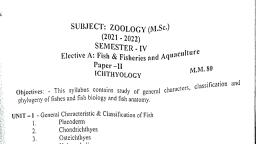
SHAHEED MAHENDRA KARMA VISHWAVIDYALAYA, BASTAR, JAGDALPUR, SESSION 2021-22, , M. Sc. ZOOLOGY, SEMESTER – IV, ELECTIVE A: FISH AND FISHERIES AND AQUACULTURE, PAPER – II, ICHTHYOLOGY, Max. Marks - 80, Important Note:, Each theory will have five questions of equal marks. First question [Multiple choice type or, short answer type] will be based on all units [complete syllabus] with no internal choice,, whereas remaining question will be unit wise with internal choice., UNIT - I, 1., General characteristics and classification of Pisces, 2., Characteristics, phylogeny and affinities of Placoderms and Acanthodes, 3., Characteristics, phylogeny and affinities of Chondrichthyes, 4., Characteristics, phylogeny and affinities of Osteichthyes, 5., Dipnoi and Crossopterygii, UNIT - II, 1., Early and post embryonic development of an Indian carp, 2., Integument (skin and derivatives), 3., Median and paired fins of fishes, 4., General anatomy of fish, 5., Swim bladder in fishes, UNIT - III, 1., Coloration and adaptive significance, 2., Osmoregulation and ionic balance, 3., Structure and functional divisions of brain, 4., Sense organs of fishes, 5., Acoustic lateralis system, UNIT – IV, 5., Endocrine glands, 6., Luminous organs, 7., Electric organs, 8., Electro receptors, 9., Structural modification in hill stream and deep sea fishes, SUGGESTED READING MATERIALS, 1., An Introduction to Fishes by S. S. Khanna,, 2., Fish and Fisheries by R.P. Parihar, 3., Fisheries and Aquaculture by R.C. Gupta and P. K. Gupta, 4., Biology of Fishes by Jhingran, , , , , , , Syllabus M.Sc. Zoology Semester-I, II, III & IV, , Page 25 of 35
Page 26 :
SHAHEED MAHENDRA KARMA VISHWAVIDYALAYA, BASTAR, JAGDALPUR, SESSION 2021-22, , M. Sc. ZOOLOGY, SEMESTER – IV, ELECTIVE A: FISH AND FISHERIES AND AQUACULTURE, PAPER – III, CAPTURE FISHERIES, Max. Marks - 80, Important Note:, Each theory will have five questions of equal marks. First question [Multiple choice type or, short answer type] will be based on all units [complete syllabus] with no internal choice,, whereas remaining question will be unit wise with internal choice., UNIT - I, 1. Fish as food commodity (composition and nutritional value), 2. Systematic and bionomics of some fresh water fishes, 3. Fishing gears and crafts, 4., Unconventional fishing methods (electro fishing, light fishing, ecosounder and, sonar)., UNIT - II, 1., Marine fisheries of India (fishery, yield assessment, gear and crafts and, conservation), 2. Estuarine fisheries of India (estuary, types and fishery), 3. Riverine fisheries (river system and fisheries), 4. Cold water fisheries (indigenous and exotic), 5. Fisheries of reservoir and ponds, UNIT - III, 1. Ecology of aquatic ecosystem, (a) Rivers and streams (b) Reservoirs (c) Lakes (d) Brackish water (e) Sea, (f) Fish farm pond, 2. Planktons and their economic use, UNIT - IV, 1., Pollution of water bodies, 2. Effect of pollutants on fish life, 3. Control and abatement of pollution, 4., Aquarium and aquarium fishes, SUGGESTED READING MATERIALS, 1., Source book for the inland fishery resources of Africa -J.P. Vanden, Bossche, G.M., Bernacsek, 2., Capture based Aquaculture- F. Ottolenglin, F. Silvestri, 3., Gloom and doom the future of marine capture fisheries- S. M. Garcia and Grainger, 4., Technological trends in capture fisheries- J.W. Walde, Marsen 2001, , , , , , , , Syllabus M.Sc. Zoology Semester-I, II, III & IV, , Page 26 of 35
Page 27 :
SHAHEED MAHENDRA KARMA VISHWAVIDYALAYA, BASTAR, JAGDALPUR, SESSION 2021-22, , M. Sc. ZOOLOGY, SEMESTER – IV, ELECTIVE A: FISH AND FISHERIES AND AQUACULTURE, PAPER – IV, AQUACULTURE AND CULTURE FISHERIES, Max. Marks - 80, Important Note:, Each theory will have five questions of equal marks. First question [Multiple choice type or, short answer type] will be based on all units [complete syllabus] with no internal choice,, whereas remaining question will be unit wise with internal choice., UNIT - I, 1., 2., 3., 4., 5., , Aquaculture (aims, objectives, strategies adopted), Physico-chemical and biological characteristics of fish ponds, Fish ponds (planning, construction, layout), Maintenance and improvement of the fish farm, Control of weed fish and predators, , UNIT - II, 1., 2., 3., 4., , Principal cultivable fisheries, Fish seed (collection, identification and transportation), Induced breeding in fishes, Composite fish culture, , UNIT - III, 1. Paddy field fish culture, 2. Sewage fed fisheries, 3. Larvicidal fishes (characteristics, propagation and introduction in water bodies), 4. Exotic fishes, 5. Open water stocking and ranching, UNIT-IV, 1., Harvesting the fishes (harvesting, sorting, preservation and processing), 2. Fish production and by-products, 3. Transportation and marketing, 4. Fish disease and their control, 5. Prawn fisheries (capture and culture), 6., Molluscan fisheries of India (capture and culture), SUGGESTED READING MATERIALS, 1., Aquaculture and fisheries - Wageningen, U.R., 2., Fish farming Aquaculture Commerical fishing - www.ftai.com, 3., Aquaculture fisheries and fish Science - Wiley, , , , , , , , Syllabus M.Sc. Zoology Semester-I, II, III & IV, , Page 27 of 35
Page 28 :
SHAHEED MAHENDRA KARMA VISHWAVIDYALAYA, BASTAR, JAGDALPUR, SESSION 2021-22, , M. Sc. ZOOLOGY, SEMESTER – IV, ELECTIVE A: FISH AND FISHERIES AND AQUACULTURE, LAB COURSE-I, PRACTICAL BASED ON PAPER I & II, Max. Marks 100, , 2., 3., 4., , 7., , 1. Study of the toxicity of given chemical, EC 50, time dependent value (response), Estimation of EC 50 & LC 50 against mosquito larva or another test organism, To analyze intake effect of substance on lungs, gastrointestinal tracts or, sub cutaneous tissue, Chemical analysis of pond water (DO, free CO2, pH, BOD, COD,, Conductivity, Turbidity and Alkalinity), 5. Study of representative fishes from museum specimens, 6. Study of osteology of fish, Study of histology through permanent slide of fish, 8. Dissection of fish to show anatomy, cranial nerves and accessory respiratory organs, 9. Qualitative and quantitative analysis of stomach content of fish, SCHEME OF PRACTICAL EXAMINATION, , S. No., 1, 2, 3, 4, 5, , Details, Dissection of Fish (Major + Minor), Spotting (from S. No. 5, 6, 7, 9), Two experiments from S. No. 1, 2, 3, 4, Viva, , Seminar/Sessional, Total, , Syllabus M.Sc. Zoology Semester-I, II, III & IV, , Marks, 15 + 10 = 25 marks, 20 marks, 25 marks, 10 marks, 20 marks, , 100 marks, , Page 28 of 35
Page 29 :
SHAHEED MAHENDRA KARMA VISHWAVIDYALAYA, BASTAR, JAGDALPUR, SESSION 2021-22, , M. Sc. ZOOLOGY, SEMESTER – IV, ELECTIVE A: FISH AND FISHERIES AND AQUACULTURE, LAB COURSE-II, PRACTICAL BASED ON PAPER III & IV, Max. Marks 100, 1., 2., 3., 4., 5., 6., 7., 8., , Identification of phyto and zooplanktons, Study of aquatic weeds and aquatic insects, Identification of fish, Identification of fish egg, fry and fingerlings, To determine the age of fish by reading scale, Estimation of number of eggs (fecundity and counting of eggs), Study of histology through permanent slide of fish, To determine the state of maturity of fish (Nikolsky, 1963), SCHEME OF PRACTICAL EXAMINATION, , S. No., 1, 2, 3, 4, 5, 6, , Details, Fish identification, Spotting (10), Local fish collection, Age determination, Viva, , Seminar/Sessional, Total, , Syllabus M.Sc. Zoology Semester-I, II, III & IV, , Marks, 25 marks, 20 marks, 10 marks, 15 marks, 10 marks, 20 marks, , 100 marks, , Page 29 of 35
Page 30 :
SHAHEED MAHENDRA KARMA VISHWAVIDYALAYA, BASTAR, JAGDALPUR, SESSION 2021-22, , M. Sc. ZOOLOGY, SEMESTER – IV, ELECTIVE B: INSECT BIOLOGY AND PHYSIOLOGY, PAPER – I, CHARACTERISTICS, CLASSIFICATION AND TYPES OF INSECTS, Max. Marks - 80, Important Note:, Each theory will have five questions of equal marks. First question [Multiple choice type or, short answer type] will be based on all units [complete syllabus] with no internal choice,, whereas remaining question will be unit wise with internal choice., UNIT - I, 1. General characteristics of insects, 2. Classification of different groups of insects with important examples, UNIT - II, 1. Study of the morphology and various organ systems of Periplaneta, UNIT - III, 1. Study of the morphology and various organ systems of Grasshopper, UNIT - IV, 1. Reproductive organs and fertilization in insects, 2. Growth and development of insect (pre-embryonic and post-embryonic), SUGGESTED READING MATERIALS, 1., Insect Structure and Function - R.F. Chapman, 2., General and Applied Entomology - Little, 3. Insect Physiology- Wiggilsworth, , , Syllabus M.Sc. Zoology Semester-I, II, III & IV, , Page 30 of 35
Page 31 :
SHAHEED MAHENDRA KARMA VISHWAVIDYALAYA, BASTAR, JAGDALPUR, SESSION 2021-22, , M. Sc. ZOOLOGY, SEMESTER – IV, ELECTIVE B: INSECT BIOLOGY AND PHYSIOLOGY, PAPER – II, GROSS MORPHOLOGY OF INSECTS, Max. Marks - 80, Important Note:, Each theory will have five questions of equal marks. First question [Multiple choice type or, short answer type] will be based on all units [complete syllabus] with no internal choice,, whereas remaining question will be unit wise with internal choice., UNIT - I, 1. Appendages of insects (head, thoracic and abdominal), 2. Integument in insect, 3. Respiratory structure of insects, UNIT - II, 1. Blood, blood vessels and pumping organ in insects, 2. Nervous system of insects (primitive and advance), 3. Sense organ of insects, UNIT - III, 1. Structure of simple eye in insects, 2. Compound eye, 3. Mechanism of image formation, UNIT - IV, 1. Reproductive system in insects, 2. Metamorphosis (types), 3. Endocrinal regulation of metamorphosis, SUGGESTED READING MATERIALS, 1., An Introduction to the study of Insects - Borrer and Delong, 2., Imms Entomology - Imms, 3., General and Applied Entomology - Nayer, 4. Entomology Text Book - Jack De Angelis, , Syllabus M.Sc. Zoology Semester-I, II, III & IV, , Page 31 of 35
Page 32 :
SHAHEED MAHENDRA KARMA VISHWAVIDYALAYA, BASTAR, JAGDALPUR, SESSION 2021-22, , M. Sc. ZOOLOGY, SEMESTER – IV, ELECTIVE B: INSECT BIOLOGY AND PHYSIOLOGY, PAPER – III, INSECT PHYSIOLOGY, Max. Marks - 80, Important Note:, Each theory will have five questions of equal marks. First question [Multiple choice type or, short answer type] will be based on all units [complete syllabus] with no internal choice,, whereas remaining question will be unit wise with internal choice., UNIT - I, 1. Physiology of nutrition, digestion in insects, 2. Intermediary metabolism, 3. Physiology of circulation and Haemocyte in insect, UNIT - II, 1. Physiology of terrestrial respiration, 2. Physiology of aquatic respiration, 3. Physiology of respiration in parasitic insect, UNIT - III, 1. Regulation of salt and water in insect, 2. Muscular system and movement, 3. Physiology of sonification in insect, UNIT - IV, 1. Mechanism of vision in insect, 2. Physiology of chemical communication, 3. Neuroendocrinal physiology and its influence, 4. Pheromones, SUGGESTED READING MATERIALS, 1. Physiology of Insecta by Barrington, 2. General and Applied Entomology by K.K. Nayer, 3. Medical Physiology by Bijlani, , Syllabus M.Sc. Zoology Semester-I, II, III & IV, , Page 32 of 35
Page 33 :
SHAHEED MAHENDRA KARMA VISHWAVIDYALAYA, BASTAR, JAGDALPUR, SESSION 2021-22, , M. Sc. ZOOLOGY, SEMESTER – IV, ELECTIVE B: INSECT BIOLOGY AND PHYSIOLOGY, PAPER – IV, BEHAVIOUR AND ECONOMIC IMPORTANCE OF INSECTS, Max. Marks - 80, Important Note:, Each theory will have five questions of equal marks. First question [Multiple choice type or, short answer type] will be based on all units [complete syllabus] with no internal choice,, whereas remaining question will be unit wise with internal choice., UNIT - I, 1. Social behavior in insect, 2. Innate and learned behaviour and waggle dance, 3. Neuro- physiological basis of behavior, UNIT - II, 1. Adaptive value of insect behavior, 2. Insect pests of crop, 3. Insect pest management, UNIT - III, 1. House hold insects, parasitic insects, 2. Mites, ticks and their control, 3. Life cycle of moth and ants, UNIT - IV, 1. Apiculture, 2. Sericulture, 3. Lac-culture, , Syllabus M.Sc. Zoology Semester-I, II, III & IV, , Page 33 of 35
Page 34 :
SHAHEED MAHENDRA KARMA VISHWAVIDYALAYA, BASTAR, JAGDALPUR, SESSION 2021-22, , M. Sc. ZOOLOGY, SEMESTER – IV, ELECTIVE B: INSECT BIOLOGY AND PHYSIOLOGY, LAB COURSE-I, PRACTICAL BASED ON PAPER I & II, Max. Marks 100, 1. Study of insect through museum specimens, 2. Identification of insects, 3. Dissection to show different organs, SCHEME OF PRACTICAL EXAMINATION, S. No., 1, 2, 3, 4, 5, 6, 7, , Details, Major Dissection, Minor Dissection, Spotting, Identification of insects, Slide preparation of Organ, Viva, Seminar/Sessional, Total, , Syllabus M.Sc. Zoology Semester-I, II, III & IV, , Marks, 20 marks, 5 marks, 20 marks, 10 marks, 15 marks, 10 marks, 20 marks, 100 marks, , Page 34 of 35
Page 35 :
SHAHEED MAHENDRA KARMA VISHWAVIDYALAYA, BASTAR, JAGDALPUR, SESSION 2021-22, , M. Sc. ZOOLOGY, SEMESTER – IV, ELECTIVE B: INSECT BIOLOGY AND PHYSIOLOGY, LAB COURSE-II, PRACTICAL BASED ON PAPER III & IV, Max. Marks 100, , 2., 3., 4., 5., , 1., Dissection to show endocrinal bodies of insects, Identification of insects of economic importance (assign taxonomic position), Spots of insects (museum specimen), Histological preparation through microtomy, Slide preparation, SCHEME OF PRACTICAL EXAMINATION, , S. No., 1, 2, 3, 4, 5, 6, 7, , Details, Dissection (Endocrine glands), Identification of insects, Spots (museum specimen), 10 no., Histology through microtomy, Slide preparation, Viva, Seminar/Sessional, Total, , Syllabus M.Sc. Zoology Semester-I, II, III & IV, , Marks, 15 marks, 10 marks, 20 marks, 10 marks, 10 marks, 10 marks, 25 marks, 100 marks, , Page 35 of 35