Notes of B.Sc.I,Practical Batch-B3, Zoology life cycle of Ascaris - Study Material
Page 1 :
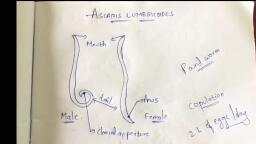
54, Study of Life cycle of Ascaris, Ascaris is endoparasite of Human; it inhibits the intestine of man, it does not require an, intermediate host or secondary host. Its life cycle is only completed in body of human and, stages are as follows., 1) Copulation and Fertilization, 2) Liberation of Eggs, 3) Development, a) Development of zygote, b) Early Larval stage, c) Second stage Rhabditiform larva, d) Infection to new host, 4) Hatching, 5) Migration, 1) First migration, 2) Second migration, 1) Ascaris is dioceous; sexes are separates. Copulation of adult male and female takes place in, intestine of human., 2) Fertilization is internal, Fertilization of sperm with ovum takes place in oviduct or proximal, portion of uteri and zygote is formed.
Page 3 :
55, 1) Egg of Ascaris:▪, ▪, ▪, ▪, ▪, ▪, , The given specimen is egg of Ascaris, It measures about 40 micron in diameter., It is microscopic, oval in shape and yellowish in colour., Single mature female lays about 2.7 million eggs, These eggs are passes through the vulval opening in to the intestine of host(man) and, along with faecal matter of host eggs come outside., Eggs remains alive under adverse condition remain in soil for several years., , 2) Structure of Zygote:-▪, ▪, ▪, ▪, ▪, ▪, ▪, ▪, ▪, ▪, , The given specimen is zygote of Ascaris., The fertilized egg is called zygote;, It measures about 45 to 75 microns in length and 35 to 50 microns in width., Zygote receives yolk and becomes covered with tough protective shell., It is microscopic, oval in shape and yellowish or brownish in colour., Each zygote is surrounded by a tough, thick and transparent shell, The shell consist of three layers i.e. an inner lipid layer, a middle chitinus layer and outer, protein layer., The shell is very resistant to chemical and low temperature., Newly laid zygotes require a low temp (85 degree F or 29.4 degree centigrade) than that, of man (98.6 degree F or 37 degree centigrade)., Zygote undergoes successive cleavage, blastulation and gastrulation and a Juvenile larva, formed.
Page 4 :
Chitinous, layer, , Unfertilized egg, , Fertilized egg(zygote)
Page 5 :
56, 3) Early Larval stage or juvenile larva, ▪ The given specimen is juvenile larva of Ascaris., ▪ The juvenile larva develops in shell within 10 to14 days., ▪ The larva of Ascaris looks like Rhabditids of Nematode, so it is also known as, Rhabditiform larva or First stage Rhabditoid larva., ▪ It shows a presence of an alimentary canal, a nerve ring and larval excretory canal., ▪ It is non- infective., ▪ The juvenile larva is converted into Rhabditiform larva., , 4)Rhabditiform larva:▪ The given specimen is Rhabditiform larva of Ascaris., ▪ After another week (7 days), first stage rhabditoid undergoes moulting inside the egg, shell and get converted in to second stage rhabditoid larva., ▪ It is infective larva., ▪ For hatching and farther development of second stage rhabditoid larva (infective stage), requires higher temp 98.6 degree F or 37 degree centigrade., ▪ An infection of human host is direct because it does not require an intermediate host or, secondary host., ▪ If rhabditoid larva containing egg is swallowed by susceptible man, it causes infection., ▪ An infection may be caused by swallowing the embronated eggs containing the second, stage rhabditoid larva get swallowed along with contaminated food, water and raw, vegetables., ▪ In the intestine of susceptible host, the egg shell is dissolved by digestive juice; larva in, the egg comes out of the egg shell and get free., ▪ It measures about 0.2 to o.3 mm in length., ▪ In first migration, the infective larva bore the Intestine and enters in the hepatic portal, system and they carried to liver, heart and through pulmonary artery to lung., ▪ In second migration, fourth stage larva reaches the pharynx through trachea and finally, again reach the intestine within10days., ▪ In intestine, they feed, grow and become adult Ascaris., ▪ Thus, the average life span of Ascaris is 9 to 12 month in human being.
Page 6 :
Structure of Juvenile Larva, , Structure of Second stage Rhabditiform larva
Page 7 :
57, Parasitic adaptation in Ascaris, •, , Parasite is a living organism which receives nourishment, protection and shelter from, other animal., , •, , Parasitism is an association in which the parasite obtains benefit and the host gets, nothing in return., , •, , For the better survival and life cycle, the parasite has to undergo many adaptations, (modifications developed to face unfavorable conditions). it is known parasitic, adaptation., , •, , Parasite has to develop some modification to face life, bahaviour, metabolisms,, reproduction, and respiration.etc. Ascaris is an endoparasite of human being, it, inhibits or found in intestine of human being .Ascaris causes a disease known as, Ascariasis., , Ascaris shows no. of morphological, anatomical and physiological adaptations, , A) Morphological Adaptations, ▪, , The cuticle is tough, resistant against the digestive enzymes and antitoxins of host., , ▪, , Its locomotion by bending of body. It is achieved by powerful contraction and, relaxation of muscle fibers in body wall., , ▪, , It counteracts the peristaltic movement of intestine of host., , ▪, , Adult Ascaris prevent its elimination and remains stay in the intestine of host., , ▪, , The adhesive suckers and setae are absent., , ▪, , The sense organs are simple and parasites remains well protected in the host intestine, because predators are absent in intestine of host., , ▪, , Females are numerous than male (100: 1) and acts as egg laying machinery., , ▪, , Egg containing embryos are covered with tough, protective shell and eggs on ground, remains viable for years even under unfavorable conditions., , ▪, , Eggs are very minute and easily dispersed widely in water, soil and on vegetables.
Page 8 :
58, B) Anatomical Adaptations, 1. Pharynx of Ascaris is muscular; it helps in ingestion of food by suction action., 2. Digested food available continuously, so an alimentary canal is simple and without, provision of storage of food that means stomach and rectum are absent., 3. Food is predigested, so that digestive glands are not developed., 4. The pseudocoelomic fluid is present in pseudocoelom i.e. body cavity, that help for, the absorption, transport and distribution of oxygen and water. So there is no, circulatory system., 5. Female Ascaris produces large number of eggs (2.7 millions) to ensure greater, chances for survival; it also compensates lack of asexual reproduction and, hermaphrodism.
Page 9 :
59, C) Physiological adaptations, 1. Ascaris secretes an enzyme which acts as antienzyme that protect the worm from the, digestive enzymes of host, 2. Metabolic rate is very slow., 3. Free oxygen is not available in the lumen of host intestine so, it respires, unaerobically., 4. Infection to new host (susceptible) is direct, it does not require intermediate or, secondary host, so that developmental stages (second stage larva)are transferred from, one host to another susceptible host very easily safely., 5 An infective juvenile requires high temperature for their further development so,, they remains alive (stay) in external environment



 Learn better on this topic