Notes of B.Sc. III, Zoology & Zoology & Zoology Freshwater ecosystem.pdf - Study Material
Page 1 :
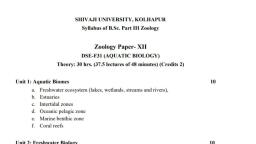
Biomes, A biome can be defined as a large biological community or an ecosystem where, different types of living organisms including plants, animals, birds, insects, and humans, are used to living in a certain type of climate., Kinds of Biomes, The two different types of biomes are:, 1. Terrestrial Biomes or Land Biomes, 2. Aquatic Biomes or Water Biomes, , 1. Terrestrial Biomes or Land Biomes, The terrestrial or the land biomes are categorized and termed according to the climatic, conditions and the climax vegetation of the region in which they are found. The climax, vegetation also called the biological community of plants, animals, birds and other, living species that is stable and dominant after the numerous years of evolutionary, development., Since plants are an important source of nutrition and are the producers in the ecosystem,, they determine the nature of the inhabiting animal population. Therefore, the climax, vegetation governs the animal population., The major types of terrestrial biomes in the world are as follows:, •, •, •, •, •, •, •, •, •, •, •, •, , Tundra, Desert, Savana, Mountains, Grasslands, Rain forest, Polar region, Tropical forest, Taiga (Boreal Forest), Northern Conifer Forest, Mediterranean scrub forest, Temperate Deciduous Forest, 2. Aquatic Biomes or Water Biomes, , Global waters cover about three quarters of the earth's surface. It is either as fresh water, where salt content is less than 0.5 per cent or as saline water where the salt content is
Page 2 :
more than 3.5 per cent or as brackish water where salt content is intermediate between, fresh water and saline water., On the basis of their salt content aquatic ecosystems can be divided in saline water, bodies and fresh water bodies. The salt content of fresh bodies is very low, always less, than 5 ppt (parts per thousand). As against this the water bodies containing salt, concentration equal to or above that of sea water (i.e., 35 ppt or above) are called as, saline water bodies or marine water bodies. Seas and oceans of the world come under, this category., Estuaries and brackish water bodies have salt content somewhere in between 5 to 35, ppt. Because of their salt content estuaries and oceans bear different kinds of organisms, It is on this basis, that aquatic ecosystems are categorised into, I) Fresh water ecosystems- lakes. ponds, swamps, pools, springs, streams, and rivers, 2) Marine ecosystems - shallow seas and open ocean and, 3) Brackish water ecosystems-estuaries, salt marshes, mangrove ~swamps and forests., Water salinity based on dissolved salts in parts per thousand (ppt), Freshwater, Brackish water, Saline water, Brine, < 0.5, , 0.5 – 30, , 30 – 50, , > 50, , Freshwater biomes / Ecosystem, Freshwater ecosystems cover 0.78% of the Earth's surface and inhabit 0.009% of its, total water. They generate nearly 3% of its net primary production. Freshwater, ecosystems contain 41% of the world's known fish species. The subject of study of, freshwater ecosystems is known as limnology., The freshwater ecosystems are generally classified into two major groups as, lentic and, lotic ecosystems. The term Lentic ecosystems is given to standing water bodies or still, water bodies., The Lentic Ecosystems, Lentic aquatic bodies contain stagnant waters. These are formed usually in large or, small depressions formed on earth's surface where water is trapped and has no exit flow., Ponds, lakes, swamps etc. are few such water bodies. Therefore, the lentic systems are, closed systems i.e. most of the aquatic forms that enter these systems rarely get out., They have to persist, decay and decompose within the lentic body. In due course of, time, they change into swamps or marshy wetlands and finally into dry lands.
Page 3 :
Characteristics of Lentic Ecosystem, Some important features of a lentic water body of water are summarized below:, (a) Stability in the physicochemical characteristics of water quality: Most of the, water in the lentic system derives from surface runoffs, rains or from underground water, sources. These sources undergo very little change in their compositions over the years., Therefore, the quality of water in lentic systems remains virtually unchanged for long, duration of time., (b) Impact of Seasonal change: The productivity of a lentic body is influenced by its, positive correlation with the seasonal changes in physicochemical characteristics of, water. The seasonal fluctuation of the water quality greatly affects the composition of, the living community. During the periods of bright sunshine, a rich growth of, phytoplankton is observed which is also associated with a remarkable decline in the, concentration of many plant nutrients., (c) Impact of area Vs volume of water on assessment of productivity: In the, assessment of the productivity of a lentic water body, the total surface area of the water, body is more important than volume of water or the depth of the water body. The total, stretch of the littoral and limnetic zones determines the productivity. Even the profundal, zones are nutrient rich in some lentic bodies, productivity is hardly affected due to lack, of enough sunshine, (d) Lentic systems are closed systems: Since there is no outlet for the water body,, substances with persistent nature, products of decomposition and mineralization of the, organic matter as well as the degraded or semi degraded products of pollutants that are, discharged in these aquatic bodies, persist in the system. This has a significant impact, on the biotic communities., (e) Thermal and nutritional Stratification: The phenomenon of stratification, also, known as vertical donation, is one of the most important features of a lentic water body., This is observed in lakes and ponds which usually have deeper static waters having a, depth of more than 6 to 8 meters. Stratification results in different layers of a lentic, water having different temperature, oxygen content and the nutrient status., Stratification develops mainly due to following reasons:
Page 4 :
Lakes and Wetlands, Lentic ecosystems include all those systems which have a static body of water. Lakes,, impoundments and wetlands are all lentic ecosystems. Let us see how do they differ, from each other., Lakes:, Lakes are the perfect habitats for studying the ecosystem dynamics which shows the, distinct biological, physical and chemical processes., Though lakes contain only 0.01% of all the water on the earth‟s surface, they contain, 98% of the total fresh water on the land surface., Water sheds from land influence the lake ecosystem, therefore, the biological, chemical, and geological processes occurring on the land and the streams lying uphill influence, the characteristic of the lake ecosystem. Deposition of detritus, movement of chemicals, and many organisms is unidirectional in the direction of watershed to the lake, whereas, the migration of some fishes can happen upstream and many aquatic insects can, disperse on land. For this reason, a lake and its watershed are sometimes considered as, a single ecosystem forming a flow-through system., You should be aware that lakes are not evenly distributed on the earth but are grouped, in certain regions called 'lake districts'. However, in a given area all-natural lakes have, the same geological origin and same characteristics, though they may represent several, stages of succession due to varying depths at the time of origin., Types of Lakes, Lakes across the world can be classified in various categories on different basis., Classification on the basis of primary productivity:, a. Oligotrophic lakes: These are deep with hypolimnion larger than epilimnion and, have low primary productivity. Littoral plants are scarce and plankton density is low,, although the number of species may be large; algal/planktonic bloom is rare,, hypolimnion is not subjected to oxygen depletion; hence stenothermal. These lakes are, considered as geologically young lakes. Cold water fishes are limited and characteristic, to the hypolimnion. E.g., Great Lakes and Finger Lakes of New York., b. Eutrophic lakes: These are shallower and have great primary productivity. Littoral, vegetation is more abundant, plankton populations are denser, and „blooms‟ are, characteristics. Because of heavy organic content, summer stagnation may be severe, enough to exclude cold water fishes. E.g., Lake Mendota., Classification on the basis of the water circulation patterns:, a. Dimictic Lakes: Two seasonal periods of free circulation or overturns., b. Cold monomictic Lakes: Water temperature is never above 40C (e.g. lakes of the, Polar Regions); seasonal overturn in summer., c. Warm monomictic Lakes: Water temperature is never below 40C (e.g. lakes of warm, temperate or subtropical regions); one seasonal overturn in winter. d. Polymictic Lakes:, More or less continually circulating with only short stagnant periods. E.g. lakes of high
Page 5 :
altitude and equatorial regions. e. Oligomictic Lakes: Rarely or very slowly mixed,, thermally stable. E.g., Tropical lakes. f. Meromictic Lakes: Permanently stratified, most, commonly as a result of chemical difference in hypo and epilimnion waters. E.g. Big, Soda Lake in Nevada., Wetlands:, Wetlands are permanently or periodically water covered areas. They can be defined as, submerged or saturated lands either artificially or naturally, and either periodically or, permanently up to a depth of six metres by water which may be fresh brackish or saline., These wetlands may be classified into two categories Inland wetlands which occur, inland and contain fresh water e.g. bogs, swamps, etc. Coastal wetlands which occur, near the coast and contain saline or brackish waters, e.g. mangrove swamps, mangrove, forests. You will read about these in Section 8.6 in greater detail., T YP E S O F W E T L AN DS, There are many different types of wetlands, each determined by its hydrology, water, chemistry, soils, and the plant species found there. Wetlands may be characterized as, dominated by trees, shrubs, or herbaceous vegetation. They may be fed by precipitation,, runoff, or groundwater, with water chemistry ranging from very acidic to alkaline., Below are some of the major wetland types found in the Upper Midwest., Marshes are wetlands that are permanently flooded or flooded during high water, periods at the edges of rivers, streams, lakes, or ponds. Marshes may be dominated by, submersed, floating-leaved, or emergent vegetation, including cattails, pondweeds,, water lilies, and various sedges, rushes, spike rushes, grasses, and forbs (broad-leaved, flowering plants). Marshes can be subcategorized into emergent marsh and hemimarsh., Sedge meadows (or wet meadows) are wetlands with permanently or near-permanently, saturated soils. They may form a transitional zone between marshes and other wetlands, with less-saturated soils, or occur in wet depressions and swales or around groundwater, discharge zones. The meadows are wet grasslands often dominated by sedges and, grasses with relatively few forbs (broad-leaved flowering plants). Birds frequenting this, habitat include the King Rail, Sandhill Crane, Northern Harrier, and Sedge Wren., Reptiles such as the northern water snake and amphibians like the pickerel frog and, cricket frog are also common. The Wetlands Initiative is restoring healthy sedge, meadow habitats at Midewin National Tallgrass Prairie in partnership with the U.S., Forest Service., Wet prairie is an ecosystem that is usually intermediate in wetness between sedge, meadows and mesic prairies. Wet prairies are herbaceous wetlands dominated by a, mixture of graminoids and forbs such as little bluestem, northern drop seed, prairie, Indian plantain, marsh phlox, and foxglove beardtongue. Wetland areas that are, intermediate between wet prairie and mesic prairie can be characterized as wet-mesic, prairie, the driest type of wetland in the Midwest. Animals that may be found in wet
Page 6 :
prairies include Henslow's Sparrow, Short-eared Owl, eastern hog-nosed snakes, and, coyotes., Fens and seeps are wetlands that are fed by groundwater that “seeps” out to the soil’s, surface. The type of vegetation found within these wetlands is dependent upon the water, chemistry and pH level., Bogs are basin wetlands for which precipitation is the only source of water; they are, typically not fed by surfacing groundwater or streams. Bogs are generally dominated, by sphagnum mosses, which may form a floating mat over deeper water that supports, a rich assortment of specially adapted species. Sphagnum mosses acidify the water, down to pH levels as low as 3.0, comparable to that of acid rain. Bogs also have a cool, micro-climate, are nutrient-poor, and have very low oxygen levels. Some of the plants, found in these unique, acidic conditions include carnivorous plants such as sundews, and pitcher plants, as well as such economically important species as blueberry and, cranberry., Swamps are wetlands dominated by woody vegetation that typically have standing, water during at least certain times of the year. They are often found in low-elevation, floodplains along rivers or slow-moving streams. Unlike bogs, they are a nutrient-rich, environment. Their shallow standing water provides important habitat for wildlife like, Wood Duck, Prothonotary Warbler, river otters, cottonmouth snakes, freshwater, shrimp and crayfish, and more. Forested swamps and shrub swamps are the two major, classes of this wetland type., LOTIC ECOSYSTEMS The lotic or flowing water habitats include rivers. streams, brooks etc. The most, outstanding features of such habitats is the continuously flowing water which moulds, the characteristics of the water bed and influences the distribution of organisms within., In order to differentiate between the lotic and lentic habitats let us see how rivers (lotic, habitats), differ from lakes that represent the lentic habitat., Characteristics of River Systems, The basic function of the rivers is to convey surplus rain water from land to sea., Annually the rivers carry freshwater, equivalent to 25 cm of rain, evenly distributed ', over the whole land surface., The point of origin of the river is the 'source'; the path it takes, is the 'course'; the streams, which pin it along the course are the 'tributaries'; and the channel within which it flows, is the 'bed'. Its point of entry into the sea or lake or estuary is called its mouth., Classification of the river zones, The course of a river can be classified in two ways, (A) firstly, by its physical characteristics and, (B) secondly by the presence or absence of fish species which indicate differing, physical, chemical and biological features of the river.



 Learn better on this topic