Notes of B.Sc.II, Zoology Paper VI and VII ENZYMES.pdf - Study Material
Page 1 :
1, ENZYMES, , , Introduction, , , , Chemical nature of enzymes, , , , Nomenclature and classification of enzymes, , , , Structure of enzymes, , , , Mechanism of enzyme action, , , , Factors influencing enzyme action, , , , Inhibition of enzyme Action, , Introduction:Enzyme is a Greek word meaning “in yeast”. This is called so because first time it is found in, the yeast cell juice. Enzymes are chemically proteins specialized to catalyze biological reactions. First, time the word was is used by W . Kuhne in 1878. Enzymes are found in cells of particular tissues. If, these enzymes are used by the same cells then known as intracellular enzymes, while the enzymes, produced by the cells of one tissue and used by cells of the other tissue called extra cellular enzymes ., If the enzyme secreted is directly used without any modifications as catalysts called active form of, enzymes , while the secreted enzyme undergoes proper modification in it’s structures and then, becomes active called passive form or pre-enzymes ., A complex chemical protein or polypeptides produced in living cells which catalyzes, biochemical reactions are called enzymes. All enzymes are proteins but all proteins are not enzymes., The enzymes have extra ordinary catalytic power and have high degree of specificity for it’s substrate, . Enzymes accelerates the rate of biochemical reactions. Pure enzyme can catalyze the transformation, of as many as 10,000 --- 10,00,000. moles substrate / minutes/moles of enzymes. Study of enzyme, and their native mechanism of action has got more practical importance in life . Many drugs exerts, their biological effect through enzyme interaction. Enzyme are important tools in medicine , chemical, industry , food processing and agriculture., , B.Sc.II/Sem.III/Zoology Paper VI/Biochemistry-Enzymes/Dr.Shivaji Vibhute, SBDM Atpadi.
Page 2 :
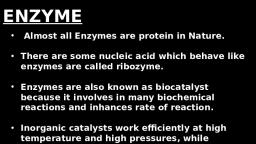
2, Intracellular cellular enzymes are localized and distributed in the different structures of cell, such as plasma membrane, cytoplasmic matrix, mitochondria, lysosomes and endoplasmic reticulum, .In glandular cells of salivary gland ,gastric gland , pancreas. Golgi body plays important role to, secrete enzymes out side the cells., Chemical nature of enzymes :, All enzymes are proteins with exception of some RNA enzymes or ribozymes. They are broadly, broadly classified into two types depending on their chemical composition and they are,, I., , Simple enzymes, , II., , Conjugated enzymes or holoenzymes., , I. Simple Enzymes :, Simple enzymes are pure proteins made of chain of amino acids., II.Conjugated enzymes or Holoenzymes :, These enzymes are formed of two parts, a protein part called as apoenzymes and nonprotein part is, called as co-factor. The apoenzymes and nonprotein part together is called as holoenzyme or, conjugated enzyme., The cofactors are of three types i.e. prosthetic group, coenzyme and metal ions., Prosthetic group – These are nonprotein group of chemical tightly attached to apoenzyme. Ex. Heme, in Hemoglobin, biotin in carboxylase pyridoxal phosphate, etc., Coenzyme – These are nonprotein organic molecules attached to apoenzyme. Ex. Riboflavin,, thiamine and folic acid like vitamin B1,B2,B12 etc. Coenzymes like NAD and NADP contains, vitamin niacin., Metal ions - These are inorganic cofactors. They usually functions as activators by forming one or, more coordination bonds with in the substrate and active site of enzymes. Ex. Fe+++,Cl-,Zn++,etc., , B.Sc.II/Sem.III/Zoology Paper VI/Biochemistry-Enzymes/Dr.Shivaji Vibhute, SBDM Atpadi.
Page 3 :
3, Nomenclature and Classification of Enzymes:This is nothing but naming of enzymes and classifying them. Enzymes are named after, studying them for several aspects. They are usually designated by suffix ase to the name of substrate,, where enzyme works as catalyst. Such as sucrase , Urease, lactase , lipase maltase etc. There are, several enzymes in which we do not find this generalised concept of naming in which we do not get, any information of substrate on which it acts e.g. Pepsin, Trypsin , and catalases. Some lytic or slitting, enzymes are named on common group of compound such as lipids proteins and carbohydrates as, lipolytic , proteolytic and sarcolytic respectively. Some enzymes are named after the species in, which they are present more e.g. papain ( Papaya),ficin ficus. As the number of newly discovered, enzyme is increasing rapidly and to avoid confusion in naming the enzymes. The International, Enzyme commission and IUB ( international union of Biochemistry) came out with a systematic, method of classification which is now adopted for naming and classification the enzyme., There are main six classes of enzymes based on their reaction specificity and later into sets of, sub classes, 1. Oxidio - reductases:- The enzymes concerned with oxidation and reduction reactions ,these, reactions involves the transfer of an electron from donor to an acceptor, , e.g., , Succinic, , dehydrogenage, alcohol dehydrogenage glucose oxidases etc., 2., , Transferases:-They catalyse the transfer of some group or radical, R, from one molecule , A, to, another molecule , B., , A.R + B, 3. Hydrolyases, , A + B.R, :-, , Enzymes catalyzing hydrolysis of ester, ethers ,peptides glycosyles, acid, , anhydrades by addition of water. this group includes extra cellular digestive enzymes and many, intra cellular enzymes., 4. Isomerases:-These enzymes catalyse inter conversions of optical, geometrical, positional isomers., here enzymes actually catalyse to redistribution of atoms or chemical group with in molecules., B.Sc.II/Sem.III/Zoology Paper VI/Biochemistry-Enzymes/Dr.Shivaji Vibhute, SBDM Atpadi.
Page 4 :
4, 5. Lyases:- the enzymes that catalyse the removal of groups from substrates by mechanism other, than hydrolysis leaving double bonds. these enzyme separates C-C , C-N, C-O and C-S., 6. Ligases :- This group includes enzymes catalysing the linking of two compounds. these enzymes, catalyse bond formation with hydrolysis of ATP and other tri phosphates. These enzymes are also, called synthatases., Structure of enzymes :, 1., , Enzymes are folded long chains of amino acids so produces 3D structures., , 2. The enzymes are substrate specific, pH specific and temperature specific., 3. Enzymes are generally globular proteins, acting alone or in larger complexes., 4. The sequence of the amino acids specifies the structure which in turn determines the catalytic, activity of the enzyme., 5., , Although structure determines function, a novel enzymatic activity cannot yet be predicted, from structure alone., , 6., , Enzyme structures unfold (denature) when heated or exposed to chemical denaturants and this, disruption to the structure typically causes a loss of activity., , 7., , Enzyme denaturation is normally linked to temperatures above a species' normal level; as a, result, enzymes from bacteria living in volcanic environments such as hot springs are prized by, industrial users for their ability to function at high temperatures, allowing enzyme-catalysed, reactions to be operated at a very high rate., , 8. Enzymes are usually much larger than their substrates. Sizes range from just 62 amino acid, residues, for the monomer of 4-oxalocrotonate tautomerase, to over 2,500 residues in the, animal fatty acid synthase., 9., , Only a small portion of their structure (around 2–4 amino acids) is directly involved in, catalysis: the catalytic site. This catalytic site is located next to one or more binding sites where, residues orient the substrates. The catalytic site and binding site together compose the, enzyme's active site. The remaining majority of the enzyme structure serves to maintain the, precise orientation and dynamics of the active site., , 10. In some enzymes, no amino acids are directly involved in catalysis; instead, the enzyme, contains sites to bind and orient catalytic cofactors. Enzyme structures, , may also, , contain allosteric sites where the binding of a small molecule causes a conformational, change that increases or decreases activity., , B.Sc.II/Sem.III/Zoology Paper VI/Biochemistry-Enzymes/Dr.Shivaji Vibhute, SBDM Atpadi.
Page 5 :
5, 11. A small number of RNA-based biological catalysts called ribozymes exist, which again can act, alone or in complex with proteins. The most common of these is the ribosome which is a, complex of protein and catalytic RNA components., Mechanism of Enzyme Action:I), , Formation of enzyme-substrate complex During enzyme action, enzymes combines with the substrate at specific sites to form an, , intermediate product called enzyme-substrate complex. This complex then breaks down into end, product and enzyme. The enzyme released again combines with fresh substrate to produce end, product., Enzyme + Substrate=Enzyme-Substrate Complex =End product +Enzyme., II), , Lowering of activation energy –, , The enzyme lowers the activation energy of the reaction and allows large number of, molecules to react at a time. Most of the reactions do not start automatically due to energy, barrier to become active. For reaction to occur sufficient number of collisions of substrate, and enzyme are required., There are two hypotheses to explain the mechanism of enzyme action. They are, 1) Lock and Key hypothesis-, , This hypothesis was proposed by Emil Fisher in 1914. According to this hypothesis the, enzyme molecule has one or more specific points. These points are called active sites or, catalytic points or active centers. The active sites are provided by the hydroxyl group serine, or phenolic group of cystein or imidacolyl group of histidine. During enzyme Action the, substrate fits into the active site of the enzyme as key fits into the lock. Now the substrate, undergoes the chemical change and the product is formed. The products are released and, enzyme is freed., , B.Sc.II/Sem.III/Zoology Paper VI/Biochemistry-Enzymes/Dr.Shivaji Vibhute, SBDM Atpadi.
Page 6 :
6, 2) Induced fit hypothesis -, , This hypothesis was proposed by Koshland in1963. According to this hypothesis the active, site of an enzyme consists of contact amino acid residues, which are close to each other in the, enzyme of three dimensional folding. Other amino acids act as auxiliary residues and are, responsible to maintain the stability of three-dimensional structure and to bind the site of the, substrate on which they should act. A positional change is brought about when the enzyme, reacts with the substrate. This change results in the development of attraction between, catalytic substrate complexes is formed. At that time contact amino acid residues tightly hold, the substrate. As reaction is completed the substrate is split into end products and enzyme is, released., Factors Influencing enzyme action:, 1. Concentration of enzyme –, The rate of biochemical reaction increases with increase in concentration of enzyme up to, certain point called as saturation or limiting point. Beyond this point increase in enzyme, concentration has small effect on reaction., 2. Concentration of substrate –, The increase in substrate concentration gradually increases the speed of biochemical reaction, with in the limited range., 3. Effect of temperature –, The enzymes are functional with in narrow range of temperature. The optimum temperature is, the temperature where the enzymes show maximum activity. Temperature below or above, optimum temperature slows down enzyme activity. For most of enzymes the optimum, temperature ranges between 25 0C to 350C., 4. Effect Of pH –, , B.Sc.II/Sem.III/Zoology Paper VI/Biochemistry-Enzymes/Dr.Shivaji Vibhute, SBDM Atpadi.
Page 7 :
7, Each enzyme has optimum pH at which the biochemical reaction show maximum activity., The pH below or above normal pH the enzyme activity slows down and at extreme pH the, enzymes becomes completely inactive., 5. Effect of Product Concentration –, The increase in amount of product production decreases the rate of enzyme action. In some, enzymatic reactions the product binds with enzyme forming a loose complex and inhibits, enzyme action., 6. Effect of light and radiation –, The exposure of enzymes to ultraviolet, Beta, Gamma and X-Ray radiations inhibits certain, enzymatic reactions., 7. Effect of activators –, Some enzymes shows their optimum activity in presence of some inorganic cations like, Mg++, Mn++, Zn++, Ca++, Co++, Na++, K++, etc., Inhibition of Action of Enzymes, Reduction or stopping enzyme activity due to presence of unfavorable conditions or chemicals is, called as enzyme inhibition. It may be reversible or irreversible. In irreversible inhibition the inhibitor, tightly binds with enzyme hence dissociation is not possible while in reversible inhibition due to loose, bonding dissociation of enzyme and inhibitor is possible., 1. Competitive Inhibition –, , Here the inhibitor resembles substrate so upon binding at active site enzyme – inhibitor, complex is produced. This prevents binding of enzyme with substrate. It is a reversible, inhibition because upon addition of more substrate the reaction can be catalyzed., , B.Sc.II/Sem.III/Zoology Paper VI/Biochemistry-Enzymes/Dr.Shivaji Vibhute, SBDM Atpadi.
Page 8 :
8, 2. Noncompetitive Inhibitors –, , Here the substrate and inhibitor binds with enzyme at different sites. When inhibitor, binds with enzyme on site other than active site, it changes structure of enzyme, molecule which leads loss of catalytic power of enzyme. It is a irreversible, inhibition., 3. Uncompetitive Inhibition –, , In this type of inhibition, the inhibitor only binds with enzyme substrate complex. It can’t be, corrected so it is a irreversible inhibition., 4. Allosteric inhibition It is a reversible inhibition found in allosteric enzymes. It is also called as feedback inhibition, and the inhibitors are called as modulators. Modulator is a substrate that attaches with an, allosteric enzyme at site other than active site and it shows either inhibiting or activating, effect., , ***********************************END************************************, , B.Sc.II/Sem.III/Zoology Paper VI/Biochemistry-Enzymes/Dr.Shivaji Vibhute, SBDM Atpadi.



 Learn better on this topic