Page 1 :
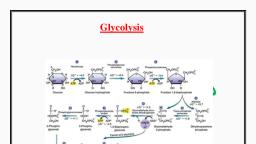
1, , Carbohydrate metabolism., Carbohydrate metabolism is a fundamental biochemical process that ensures a constant, supply of energy to living cells. The most important carbohydrate is glucose, which can be broken down, via glycolysis, enter into the Kreb's cycle and oxidative phosphorylation to generate ATP. Metabolism, is broadly divided into Catabolism and Anabolism. Catabolism is breakdown of complex carbohydrate, molecules to simple molecules and Anabolism is formation of Complex carbohydrate molecules from, simple ones. The carbohydrate metabolism involves following major pathways…., A. Glycolysis, B. Krebs Cycle, C. Pentose Phosphate Pathway, D. Gluconeogenesis, E. Glycogenolysis, F. Electron Transport Chain., GLYCOLYSIS ( Embden-Mayerhof- Parnas Pathway), , Glycolysis is a cytoplasmic pathway which breaks down glucose into two three-carbon, compounds and generates energy. Glycolysis is used by all cells in the body for energy, generation. The final product of glycolysis is pyruvate in aerobic settings and lactate in, anaerobic conditions. Glycolysis is a metabolic pathway that does not require oxygen. In most, organisms, glycolysis occurs in the liquid part of cells, the cytosol because all enzymes, required for glycolysis are present in cytoplasm of cells. The most common type of glycolysis, is the Embden–Meyerhof–Parnas (EMP) pathway., The sequence of reactions in glycolysis are as below…., 1. Glucose to Glucose-6-Phosphate: This reaction is catalysed by enzyme Hexokinase., , ATP acts as Phosphate donar in presence of Mg ions and Glucose is converted to, Glucose-6-Phosphate., 2. Glucose-6-Phosphate to Fructose-6-Phosphate : This reaction is catalysed by enzyme, , Phospho Glucose Isomerase and it converts Glucose-6-Phosphate to Fructose-6Phosphate., 3. Fructose-6-Phosphate to Fructose-1-6-Diphosphate : This reaction is catalysed by, , the enzyme Phospho fructo kinase in presence of MG++ ions. Here ATP acts as, phosphate donar., 4. Fructose-1-6-Diphosphate to triose sugars: This reaction is catalysed by aldolase, , enzyme. Here Fructose-1-6-Diphosphate splits into two interconvertible triose sugars, B.Sc.II/Sem.III/Zoology Paper VI/Biochemistry/Dr.Shivaji Vibhute/SBDM, Atpadi.
Page 3 :
3, 9. Phosphoenol pyruvate to Pyruvate : Here by releasing high energy containing phosphate, phosphoenol pyruvate is converted to pyruvate or pyruvic acid. The phsphate is accepted by, ADP and it becomes ATP. The reaction is catalysed by enzyme pyruvate kinase., ENERGETICS OF GLYCOLYSIS, 1. From a single glucose molecule interconvertible Dihydroxy acetone phosphate and, Glyceraldehyde-3-phosphates are produced., 2. Each Glyceraldehyde-3-phosphates is later converted to pyruvate., 3. Thus each glucose produces two molecules of pyruvates., 4. 2 ATP molecules are used in reaction Glucose to Glucose-6-Phosphate and Fructose-6Phosphate to Fructose-1-6-Diphosphate, 5. 6 ATP molecules are produced from 2 NADH2 ( Krebs Cycle ) in reaction Glyceraldehyde-3Phosphate to 1,3-diphosphoglycerate., 6. 2 ATP molecules are generated in reaction 1,3-diphosphoglycerate to 3-phosphoglycerate., 7. 2 ATP molecules are generated in reaction Phosphoenol pyruvate to Pyruvate., 8. Thus ATP production in glycolysis is 6+4=10 while 2ATP are used., 9. Thus net ATP gain is 10-2= 8ATP., **************************************************************************, , KREBS CYCLE/TCA CYCLE/CITRIC ACID CYCLE, , B.Sc.II/Sem.III/Zoology Paper VI/Biochemistry/Dr.Shivaji Vibhute/SBDM, Atpadi.
Page 9 :
9, , Lactate to Glucose :, , Fig.- Cori Cycle, 1. Lactate is produced in muscles by anaerobic respiration., 2. This lactate is tranported to liver by blood., 3. The conversion of lactate to glucose and glycogen takes place in liver ( Cori Cycle )., 4. Liver glycogen is then broken to glucose which is tranported back to muscles., , Amino Acid To Glucose :, , 1. The major source of glucose produced in gluconeogenesis comes from amino acids., 2. Glucogenic amino acids are converted to either citric acid intermediates or pyruvate., 3. Pyruvate is carboxylated to form oxaloacetate by pyruvate carboxylase and ATP in, mitochondria., 4. In further reaction formation of glucose takes place in cytoplasm., B.Sc.II/Sem.III/Zoology Paper VI/Biochemistry/Dr.Shivaji Vibhute/SBDM, Atpadi.
Page 10 :
10, , 5. As oxaloacetate cant pass through mitochondrial membranes to enter into, cytoplasm, it is converted to malate which readily passes through mitochondrial, membranes., 6. Oxaloacetate is then decarboxylated to form phosphoenol pyruvate by enzyme, phosphoenolpyruvate carboxykinase and ATP., 7. The conversion of Phosphoenol pyruvate to Frctose -1-6-diphosphate is carried out by, enzymes of glycolysis in cytoplasm of cells., 8. The conversion of fructose-1-6-diphophste to fructose-6-phosphate takes place by, hydrolysis and enzyme fructose diphosphatase only present in liver and kidney cells., 9. Fructose-6-phosphate is converted to glucose-6-phosphate., 10. Glucose-6-phosphate is converted to glucose by enzyme glucose-6-phosphatase in, cytoplasm of liver cells., Glycerol to Glucose :, 1. Glycerol is produced from triglycerides., 2. Glycerol is phosphorylated to produce glycerol-3-phosphate in presence of enzyme, glycerol kinase., 3. Glycerol-3-phosphate then enters into gluconeogenesis using glycerol phosphate, dehydrogenase enzyme., , B.Sc.II/Sem.III/Zoology Paper VI/Biochemistry/Dr.Shivaji Vibhute/SBDM, Atpadi.
Page 11 :
11, , Glycogenolysis, The breakdown of glycogen to glucose ia called as glycogenolysis. It occurs in liver and, muscle cells. Glycogen is essentially stored energy in the form of a long chain of glucose, and, glycogenolysis takes place in muscle and liver cells when more energy needs to be produced., , 1. The breakdown of glycogen to glucose-1-phosphate is carried out by phosphorylase, and debranching enzyme amylo-1,6-glucosidase.., 2. Glucose-1-phosphate is converted to glucose-6-phosphate and the enzyme involved, is phosphoglucomutase., 3. Glucose-6-phosphate is converted to glucose dephosphorylation and the enzyme, involved is glucose-6-phosphatase., , B.Sc.II/Sem.III/Zoology Paper VI/Biochemistry/Dr.Shivaji Vibhute/SBDM, Atpadi.
Page 12 :
12, , REVIEW OF ELECTRON TRANSPORT SYSTEM, , The energy rich carbohydrates, fatty acids and amino acids undergoes various matabolic, reactions and finally gets oxidised into CO2 and H2O. The high energy electrons from various, intermediate metabolytes are tranfered to coenzymes like NAD and FAD to produce NADH2, and FADH2. These coenzymes are later reduced in electron tranport chain (ETC) or respiratory, chain and energy is released in the form of ATPfrom ADP and iP., 1. As ATP is produced in mitochondria, it is called as power house of cell., 2. The ETC is present on inner membrane of mitochondria., 3. The inner mitochondrial membranes has 5 enzyme complexes as complex I,II,III,IV,and, V., 4. Complex I to IV are electron carriers while complex V synthesises ATP., 5. Along with 5 enzyme complexes certain electron carriers like NADH2, Coenzyme Q,, Cytochrome C and Oxygen are also present., , 6. Complex I, also known as ubiquinone oxidoreductase, is made up of NADH dehydrogenase,, flavin mononucleotide (FMN), and eight iron-sulfur (Fe-S) clusters. The NADH donated from, glycolysis, and the citric acid cycle is oxidized here, transferring 2 electrons from NADH to, FMN. Then they are transferred to the Fe-S clusters and finally from Fe-S to coenzyme Q., During this process, 4 hydrogen ions pass from the mitochondrial matrix to the, intermembrane space, contributing to the electrochemical gradient., B.Sc.II/Sem.III/Zoology Paper VI/Biochemistry/Dr.Shivaji Vibhute/SBDM, Atpadi.
Page 13 :
13, , 7. Complex II, also known as succinate dehydrogenase, accepts electrons from succinate (an, intermediate in the citric acid cycle) and acts as a second entry point to the ETC. When, succinate oxidizes to fumarate, 2 electrons are accepted by FAD within complex II. FAD passes, them to Fe-S clusters and then to coenzyme Q, similar to complex I., , 8. Complex III, also known as cytochrome c reductase, is made up of cytochrome b, Rieske, subunits (containing two Fe-S clusters), and cytochrome c proteins. A cytochrome is a protein, involved in electron transfer that contains a heme group. The heme groups alternate between, ferrous (Fe2+) and ferric (Fe3+) states during the electron transfer. Because cytochrome c can, only accept a single electron at a time, this process occurs in two steps (the Q cycle), in, contrast to the single-step complex I and II pathways. Complex III also releases 4 protons into, the intermembrane space at the end of a full Q cycle, contributing to the gradient. Cytochrome, c then transfers the electrons one at a time to complex IV., , 9. Complex IV, also known as cytochrome c oxidase, oxidizes cytochrome c and transfers the, electrons to oxygen, the final electron carrier in aerobic cellular respiration. The cytochrome, proteins a and a3, in addition to heme and copper groups in complex IV transfer the donated, electrons to the bound dioxygen species, converting it into molecules of water. The free, energy from the electron transfer causes 4 protons to move into the intermembrane space, contributing to the proton gradient., , 10. Complex V :ATP synthase, also called complex V, uses the ETC generated proton gradient, across the inner mitochondrial membrane to form ATP. ATP-synthase contains up of F0 and, F1 subunits, which act as a rotational motor system. F0 is hydrophobic and embedded in the, inner mitochondrial membrane. It contains a proton corridor that is protonated and, deprotonated repeatedly as H+ ions flow down the gradient from intermembrane space to, matrix. The alternating ionization of F0 causes rotation, which alters the orientation of the F1, subunits. F1 is hydrophilic and faces the mitochondrial matrix. Conformational changes in F1, subunits catalyze the formation of ATP from ADP and Pi., , **************************************END**********************************, , B.Sc.II/Sem.III/Zoology Paper VI/Biochemistry/Dr.Shivaji Vibhute/SBDM, Atpadi.