Page 2 :
INDEX, Exercise, No., , Title, , Pg.no., , 1., , Preparation of Nursery Beds and Seed, Sowing for Raising Healthy Seedlings, of Horticultural Crops, , 3-5, , 2., , Identification of Important Vegetable, Crops on the basis of Different, Morphological Traits, , 6-18, , 3., , To Study Economics of Vegetables and, Spices Cultivation, , 19-20, , 4., , To study the methods of Vegetable, seed extraction., , 21-22, , 5., , Fertilizer doses for various vegetable, crops as per recommendation for N, P, and K, , 23-24, , 2|Page, , Date, , Signature
Page 3 :
Exercise No. 1, Objective: Preparation of Nursery Beds and Seed Sowing for Raising Healthy Seedlings of, Horticultural Crops, Introduction: Horticultural crops are propagated either through seeds or vegetative plant parts., Vegetable crops propagated through seeds are either directly seeded or are transplanted in the, field by raising the seedlings in the nursery beds. A nursery could be considered as a location, where plants are cared for during the early stages of growth by providing optimum conditions for, germination and subsequent growth until they become strong enough for planting in the open, field conditions, Theory:, Factors to be taken into consideration for raising nursery, Location of the nursery:, , , Nursery should be situated near the main field for transplanting., , , , Nursery area should receive sunlight right from morning till evening i.e. south-west, aspect is most suitable as this aspect is very sunny., , , , Area must be free from water stagnation i.e. proper drainage must be provided., , , , Area should be well protected from stray animals and strong winds., , , , The area should be near the water source for continuous supply of good quality water., , Soil, , , Soil should have good organic matter., , , , Soil texture should be neither too coarse nor too fine., , , , Soil should be sufficiently porous and adequately aerated., , , , It should have a fair degree of water holding capacity., , , , Soil pH of nursery bed should be in the range of 6 to 7., , , , Acidic and alkaline soils are not suitable for raising nursery rather, neutral soils are, suitable., , 3|Page
Page 4 :
, , Soil should normally be rich in all essential nutrient elements. Preferably soil testing of, nursery area should be done so as to mix additional nutrients accordingly for improving, its soil fertility status., , Procedure for nursery bed preparation:, ● The soil of the nursery area should be fine and fertile with good water holding capacity. For, the preparation of beds, the field should be ploughed and levelled well. Soil should be worked, thoroughly to obtain a fine textured soil free of clods and debris., ● Prepare raised beds to facilitate proper drainage of excess water. The level of the bed surface, should be made little slanting on the two sides., ● The length of nursery bed should be 3-5 m but it can be increased or decreased according to, the availability of land and requirement of plants but the breadth of the beds should not be more, than 1.00 -1.2 m and the beds should be 15-20 cm raised from the ground surface., ● The standard size of nursery bed is 3m × 1m × 15 cm., ● A space of 30-45 cm should be left between two beds. This space can be utilized to perform, intercultural operations such as weeding, disease and insect-pest management and also for, draining out the excess rain water from the nursery beds., ● Add 20-25 kg well rotten farmyard manure in each standard size nursery bed along with 200g, single super phosphate and 15-20 g each of fungicides and insecticides such as mancozeb and, dusts like methyl parathion., ● The number of nursery beds depends on the particular crop, season and growing area of crop, for transplanting., ● The beds should be prepared in the east and west direction and lines/ rows for sowing of seeds, should be made from north to south direction on the beds., Seed Sowing in nursery bed, , , Treat the seed with fungicides like bavistin or thiram or captan @ 3g/kg of seed to check, the infection of soil borne diseases., , , , Make rows at a spacing of 5 cm., , , , Sow the seeds at 1 cm depth. The general rule for sowing depth is 2-3 times of the, thickness of seed., , , , Mix a little of sand in the seed for uniform distribution in the rows and cover it with soil, or farmyard manure., , 4|Page
Page 5 :
, , Avoid broadcasting seeds in the nursery-bed. Thick sowing or sowing with broad casting, also leads to increase in an incidence of damping off disease, , , , If seeds are sown too deep, nutrient reserves will be exhausted before the plant emerges, or emerging plants will be weak or liable to die. If sown too shallow, then it is likely to, be eaten by birds or washed away by the splash of rains or irrigation water., , 5|Page
Page 6 :
Exercise No.2, Objective:Identification of Important Vegetable Crops on the Basis of Different Morphological, Traits, Theory:Vegetables are the products of herbaceous plants which are annuals, biennial and, perennials (mostly annual) whose plant parts such as fruits, leaves, roots, stems, petiole, flower, etc. are used for culinary purposes or consumed as raw. The vegetable plants differ with respect, to each other in their morphologicalcharacters. Keen and frequent observations on vegetative and, reproductive parts of the plants help in easyand clear identification. It is essential to know the, different parts of the plants before undertaking theidentification. The knowledge of different, plant parts serve as the foundation for identifying the vegetable crop plants at different growth, stages. In this practical you will learn how to identify a vegetable keepingin mind their, characteristic morphological features. The important distinguishing characters of, importantvegetable crops have been discussed here under which may help the students in, distinguishing them even atearly stages of their growth. It takes time and exposure to learn to, identify vegetable plants., Materials Required:Forceps, hand lens, paper sheet, paper and pen., Procedure:, 1. Critically observe the morphological characteristics of the specimen. To identify plants in, garden,look for morphological features such as size, shape and color of the leaves as well, as unusual characteristicslike aroma or hair., i) Root system:, ● Adventitious, ● Tap root system., ii) Stem characteristics:, ● Hollow or pithy, ● Number and length of internodes, ● Branched or single stem, ● Smooth or ridged, ● Leaf arrangement on the stem- alternate or paired, ● Presence or absence of any specific characters like tendrils, spines etc., iii) Leaf characteristics: Identify vegetables by their leaves. Vegetables with large and, succulent leavesthat emerge directly from the ground and are eaten as greens include, lettuce, cabbage, kale and spinach.Fruiting vegetables, such as tomatoes, peppers,, eggplant and melons, produce clusters of leaves on thestems. Root vegetables usually, have straight and vertical leaves. Vegetables of the cole group, such ascabbage and, 6|Page
Page 7 :
cauliflower, produce leaves close to the ground followed by a single head/curd, developingin the center of the plant. Broccoli produces multiple heads., ● Shape of leaf- long narrow or ovate or lanceolate, ● Presence or absence of pubescence, ● Type of leaf – simple or compound leaf, petiolated or sessile, ● Presence or absence of leaf sheath, ● Leaf margins: serrated or smooth, ● Texture of leaf- smooth or rough., iv) Inflorescence: Fruiting vegetables such as melons, squash, beans, tomatoes,, eggplants and peppers produce flowers followed by fruits., ● Colour of flowers, ● Type of inflorescence., v) Economic part, ● Colour, ● Size, ● Shape, 2. Draw the sketch of each plant., 3. Record the observations with respect to root, stem, leaf, inflorescence and fruit, characteristics in thedata sheet., 4. Identify the vegetable crop on the basis of morphological characters discussed as under., , Tomato (Solanum lycopersicum), ● Examine the stems of the plant. They have short, fine, white hair on them i.e. slightly, fuzzy. Observe the growth habit of plants which may be determinateor indeterminate., Indeterminate type bears inflorescence cluster at every thirdinternode., ● Notice the leaves on the tomato plant. Tomato bears compound leaves with multiple, leaflets (5-9) growing along a common stem (called rachis). Leaves aregreen, hairy,, serrated/oval/pointed and have visible veins., ● Sniff your fingers after touching a tomato plant leaf. Tomato leaves have a pungent, odour that remain on the skin., ● Observe the flowers on the plant. Tomato flowers are bright yellow with pointed petals., ● Notice the fruits growing on the plant. After pollination, a flower of tomato grows as a, single small, round, green fruit. Colour of the fruit changes with the onset of maturity., ● Cut open the fruit you will see the locules filled with jelly like substance containing, seeds., , 7|Page
Page 8 :
Brinjal (Solanum melongena), ● See the stem of the plants. They are branched, erect, have fine hair and some varieties, may have spines., ● Notice the leaves which are usually large, lobed, ovate, thin and relatively hairy on the, under surface. Leaves also bear sharp spines. Petiole is about one fourthas long as the leaf, blade., ● Observe the flowers of the plant. Flowers are violet in colour, borne solitary and forms, cluster of two or more in lateral cymes. Flowers are deeply lobed with toothed calyx., Calyx is five lobed and covers thebase of the fruit on enlargement. Fruit is berry with, numerous seeds., Bell pepper (Capsicum annuum), ● Observe the plants. They have straight main stem which bear secondary branches, forming „V‟. Flowers are white in colour and star shaped. Fruitsare juiceless berries, which vary in shape and size., ● Observe the shape of the peppers. A standard bell pepper form blocky fruits in shape, with three or four lobes at the bottom of the fruit. Skin of fruit (pericarp) is thick and, glossyin appearance., ● Check color of the fruits. Bell peppers are usually green in colour and change color to, red, orange or yellow on maturity., Potato (Solanum tuberosum), ● The potato plant is leafy, herbaceous and spreading type. The leaves are compound, with 7-15 leaflets., ● Study the flower of the potato. Potato flowers are star-shaped, white, lavender, pink or, light blue with yellow centers and borne in clusters., ● Look at the fruits of the potato plant. The fruits are like small green tomatoes, about an, inch in diameter and contain several hundred seeds., ● Dig out the potato plant, you will see tubers growing underground which are round to, oval in shape and in general light brown in colour., , Cucurbits:, Cucumber (Cucumis sativus), ● Observe the growth habit of the plant in question. Summer and winter squash plants, grow very fast in the early days of summer while cucumber plants take afew days more to, grow., , 8|Page
Page 9 :
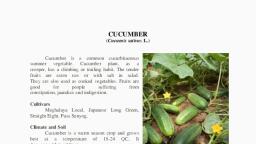
● Cucumber plants along with its leaves are usually smaller than squash plants and the, stems are not as thick as squash plant., ● A cucumber vines grow vertically with the help of strong tendrils that make grip with, staking material and provide upward growth., ● Cucumber leaves are triangular in shape with pointed lobes. The leaves are large, dark, green and have a slightly rough texture., ● See the stem of cucumber, it is delicate and has tender spines., ● Cucumber bears male and female flowers separately on the same plant (monoecious, flowers). Flowers are small and yellowish coloured. Cucumbers usually form long thin, fruits., Bitter gourd (Momordica charantia), ● Observe the growth habit of the plant. Plant vine may grow upto the height of 15 feet., The stems have twining tendrils and are slender, green and hairy., ● The leaves are green, hairy, alternate, deeply palmate and lobed with 5 coarsely toothed, lobes., ● The flowers are monoecious and yellow in colour with 5 erect, egg-shaped petals., ● The fruits may be egg-shaped to oblong (10-20 cm long), green, tapering at the ends, and covered with blunt tubercles (swellings)., ● Taste the fruit. It is bitter in taste., Bottle gourd: (Lagenaria siceraria), ● Observe the plant habit. The bottle gourd is a vigorous, annual, running or climbing, vine with large leaves and lush in appearance. The vine is branchedand climb by means, of tendrils along the stem. The foliage is covered with softhair and has a foul musky, odour when crushed., ● Look at the leaves. The leaves are circular in overall shape with smooth margins, a few, of them may have broad lobes or undulating margins. Leaves have a velvety texture, because of thefine hair, especially on the undersurface., ● Look at the flower of bottle gourd. The bottle gourd flowers are borne singly on the, axils of the leaves, the males on long peduncles and the females on short peduncles. The, flowers are white and attractive withspreading petals. The ovary is in the shape of the, fruit. The anthers are borne on short filaments groupedat the center of the flower., ● It bears two types of fruits namely, long and round. The size of the fruit varies from 2, to 12 inches in diameter and from 4 to 40 inches in length., Summer squash:, ● The summer squash plant has bush type growth and no vine formation is there., , 9|Page
Page 10 :
● The plant has separate male and female flowers on the same plant. The female flowers, can be easily identified as they bear miniature fruit (ovary) at the base.Flowers are showy, and yellow in colour., ● Feel the outside skin of summer squash fruit which is tender (not hard)., ● Look at the color of the squash. It looks bright green and have a shiny gloss., Musk melon (Cucumis melo), ● A muskmelon plant has trailing prostrate stems generally upto 10 m in length and often, forming large mats. Stems are viny, herbaceous, slender, angled incross-section,, branched near the base and rough in texture with short stiff hair., ● Observe the leaves of the plants. Leaves are alternate more or less palmate, angled or, shallowly 3-7 lobed and covered with very short stiff hair (scabrous). Tendrils are, unbranched and borne singly per node fromthe base of the leaf petioles., ● Flowers are axillary, monoecious, with 1 or more male flowers per node and single, female flowers at few nodes. Corolla is yellow and deeply 5-lobed, with petals fused at, the base to form a shallow cup-like tube.Male flowers have 3 separate stamens. Female, flowers have an inferior ovary., ● The fruits of the musk melon are oblong to round. Surfaces are net-veined or covered, with minute stiff hair and lack prickles. Immature fruits are green, but become mottled or, striped with yellow or orange, or aresolid yellow or orange at maturity., Water melon (Citrullus lunatus), ● Watermelon grows on vines which usually sprawl across the ground in a sunny, location. At maturity, each vine is 10 to 15 feet in length and has tiny tendrils orthreadlike curling stems at leaf bases., ● Look at the vine‟s foliage and feel its texture. Watermelon leaves are light green with, silvery white tinge. The leaves are deeply lobed having three to five fingerlikelobes that, have coarse rounded teeth., ● The flowers are yellow and occur singly, with five united petals. Flowers appear on the, young vines, usually at the tips. Fruits are large in size, green, smooth and round., ● Cut open a fruit. The flesh of a water melon fruit is easily recognizable both at mature, and immature stages. Mature or near ripening fruits have red flesh and black seeds while, the flesh of young developingfruits is pale green to white with small white seeds., Root vegetables:, Carrot (Daucus carota), ● Note the stem of the plant. The stem at its vegetative state is just above ground and is, greatly compressed as a result internodes are not visible.The stem apex is slightly convex., , 10 | P a g e
Page 11 :
● Observe the leaves. Leaves are dark green and shiny, the lowest being broadly linearlanceolate toothedleaflets. Leaf blades are two to three pinnate, the leaflets being, repeatedly divided - pinnatifid. Leaves andthe basal rosette are alternate and compound., ● Uproot the plant and observe the roots. The root length of most of the cultivars ranges, between 10 to 25 cm. Roots are orange, yellow, red, purple and white - fleshed. Root, shape of many carrot cultivars isconical, but the extent of tapering varies as per cultivars., ● Generally carrot flowers are perfect, small or white or occasionally greenish white or, light yellow. Flowers consist of five petals, five stamens and an entire calyx. Flowers, usually open first at the periphery of theprimary umbel. The primary umbel is produced, at the terminal end of the main floral stem., Radish (Raphanus sativus), ● The plant of the radish is erect, herbaceous that grow up to 40 inches., ● Leaves are arranged in a rosette, with size ranging from 10–15 cm in small cultivars to, up to 45 cm in large cultivars. Leaves have a lyrateshape i.e. divided pinnately with an, enlarged terminal lobe and smallerlateral lobes., ● Radishes make the swollen part of the roots which is edible. Roots are round to, cylindrical with a color ranging from white to red., ● The white flowers are borne on a racemose inflorescence. The flower of the radish has, four white petals with rose, purple, or yellowish veins. The flower are usually bisexual, with four sepals, four petals, sixstamens (2 outer shorter than the 4 inner ones i.e., tetradynamous), two carpels and superior ovary withparietal placentation., ● The fruit of the radish is a round pod-like structure called as siliqua., Turnip (Brassica rapa), ● The leaves grow directly from the above-ground shoulder of the root, with little or no, visible crown or neck. The edge of leaf blade has lobes. Leaves are lightto medium green,, hairy or bristly and lyrate-pinnatifid., ● Turnip root is mostly white-skinned apart from the upper portion which protrudes, above the ground and are purple, red, or greenish wherever sunlighthas fallen. This, above-ground part develops from stem tissue, but is fused withthe root. The root is, roughly conical to globular with interior white flesh., ● Flowers are yellow in colour. Sepals are spreading with petals. Sex form is similar as, that of radish., ● Fruit bearing seed is called as siliqua which is 4–6.5 cm long with long tapering beak., Cole vegetables:, Cauliflower (Brassica oleracea var. botrytis), , 11 | P a g e
Page 12 :
● Look at the cauliflower plant. The stem/stalk varies from short to medium in length., Leaves are produced close to the ground which are longer, narrowerand brighter green in, color than cabbage and broccoli leaves. The leaf petioleis long and broad that looks flat, on the upper surface and is little raised on thelower side., ● The edible portion of cauliflower is called curd which is formed in the centre of the, leaves. The inner leaves curve inwards to cover the curd in mid and late group varieties, and keep curd blanched (white)., ● Curd is white to creamish in colour and compact., Cabbage (Brassica oleracea var. capitata):, ● Cabbages have very short stem joints and in some varieties the heads are practically, coreless. It grows rosette on a short stalk with the broad outer leavesclose to the ground, and the “wrapper” leaves form the heads. The leaves havewavy edges. Upper leaves are, sessile while those on the base are much fleshierand petiolated with lobules., ● As the plant grows, the leaves increase in number and form a ball-shaped “head” in the, center of the plant., ● The leaves of cabbages can range from smooth to crinkled, green to red. They are, usually very broad and cupped, with a network of veins that connect to a large central, mid-vein., ● Observe the head of the plant. The head of the cabbage plant is made up of several, layers of overlapping leaves. Head cabbage and head lettuce are similar in appearance,, but cabbage leaves are usually moretightly wrapped to form the head. The head is very, solid. The cabbage heads are glossy light green incolour. The red cabbage is purple in, colour., ● Flowers are yellow in colour, grouped in loose racemes., Broccoli (Brassica oleracea var. italica), ● Broccoli leaves have elongated petiole, somewhat round in shape. Leaves are green, grey in colour with very curly deep lobes. Broccoli leaves are alsobroader than, cauliflower leaves and have a lobe-like structure(s) at the base ofthe leaf., ● It has succulent, loose, leafy edible stem, which support large and compact heads of, thickly clustered flower buds which are green in colour., ● The main group of florets or “head” grows in the centre of the leaves. After the harvest, of the main head, shoots may arise from the stem which is called as spears., Bulb crops:, Onion (Allium cepa):, ● Observe the leaves of the onion. Leaves arise from underground part of the stem. The, leaves are bluish green and grow alternately in a flattened fan-shaped swathe., 12 | P a g e
Page 13 :
● Leaves are fleshy, hollow and cylindrical with one flattened side. The base of each leaf, is a flattened usually white sheath that grows out ofa basal disc., ● From the underside of the disc, a bundle of fibrous roots extends to ashallow depth into, the soil., ● As the onion plant grows, food reserves begin to accumulate in the leaf bases and the, bulb of the onion swells., ● Look at the inflorescence of the onion. Inflorescence of onion is called cyme. Each, individual flower is made up of six stamens, three carples, united with one pistil and six, perianth segments. The pistil containsthree locules, each containing two ovules., ● Onion bulbs are pungent when chopped and contain certain chemical substances which, irritate the eyes., ● At maturity, the foliage dries up and the outer layers of the bulb become dry and brittle., Garlic (Allium sativum), ● Observe the garlic plant. The leaves are long, narrow and flat like grass. This plant has, narrow foliage with long, narrow and flat grasslike leaves., ● Taste the plant parts. All parts of this vegetable have a very strong taste and it is widely, used for culinary purposes., ● Look at the bulb of the plant. The bulb is of a compound nature, consisting of, numerous „cloves,‟ which are grouped together between the membraneous scales and, enclosed within a whitish skin, which holds themas in a sac., Leafy vegetables:, Amaranthus (Amaranthus tricolor or Amaranthus bicolor), ● Observe the plant of amaranthus. They are erect-growing plants., ● Its stems are vigorous, cylindrical and fibrous. On maturity, stems becomes hollow, inside. The plant has the stripes on the stem and shades of green, red, pink, brownor, purple depending upon the variety., ● Look at the leaves of the amaranthus plant. The leaves are stalked, compound,, alternate, long or oval and green or dark red at the base and bright yellow, orange, orflorescent pink at the top., ● You will find tiny green, red or purple flowers clustered densely together, sometimes, slightly drooping at the head of the plant. The flowers last for a long time., Fenugreek- Trigonella foenum-graecum (Common methi) and Trigonella corniculata, (Kasuri methi), ● Fenugreek is of two types viz., common methi and kasuri methi. The common methi, has quick growing upright plants whereas kasuri methi is slow growing andremains in, rosette condition., 13 | P a g e
Page 14 :
● Carefully observe the leaves they are alternate, trifoliate and lanceolate and leaflets are, shortly stalked blunt and oblong., ● Leaves of common methi are light green in colour and that of kasuri methi are, darkgreen in colour., ● Observe the flowers of the fenugreek. Flowers are sessile, solitary in the axils of the, leaves. Flowers of kasuri methi are yellow in colour and that of common methi are white, or light violet., ● Taste of the leaves is bitter with peculiar odour., ● The pods of common methi are straight, long and slender with a prominent beak and, that of kasuri methi are sickle shaped., Spinach (Spinacia oleracea), ● Observe the plant of the spinach. It forms clumps of long-stemmed leaves that can, grow up to 12 inches long and 18 inches wide at maturity., ● Look at the leaves of the spinach. The edible leaves are arranged in a rosette from, which a seed-stalk emerges. The leaves are alternate, simple, ovate to triangular-based, with very variablein size, ● Observe the flowers of the spinach. The flowers are inconspicuous, yellow-green, 3-4, mm diameter, maturing into a small, hard, dry, lumpy fruit cluster 5-10 mm across, containing several seeds., Legume vegetables:, French bean (Phaseolus vulgaris), ● Observe the plant of the French bean. It is erect or twine annual herb., ● Look at the leaves of the plant. The leaves are trifoliate, compound. The edge of the, leaf blade is entire (has no teeth or lobes)., ● Study the flowers of French bean. Flowers white to violet-purple. Flowers are, bilaterally symmetrical. There are 5 petals and 5 sepals in the flower ofFrench beans., ● Look at the pods of the French beans. Pods are slender, 10-26 cm long, straight or, slightly curved, the surface may be glabrous or faintly pubescent with prominent beak., Garden pea (Pisum sativum), ● Observe the plant. Garden pea plant may be dwarf or vining/ tall types., ● Stem of pea plant is round and hollow covered with a waxy bloom., ● Observe the leaves of garden pea. The leaves are compound (made up of two or more, discrete leaflets). The edge of leaf blade has teeth. Leaves consist of oneor more pairs of, opposite leaflets borne on petioles together with several pairsof tendrils (which are, essentially modified leaves) and a single or compoundterminal tendril., ● Leaflets are broad and ovate with distinct ribs which may be slightly toothed or entire., 14 | P a g e
Page 15 :
● The two (pseudo) stipules at the base of the leaf are also ovate but much larger than the, leaflets., ● In semi-leafless types, the leaflets are replaced by tendrils but the stipules are still, present while in leaflesstypes the leaflets are also replaced by tendrils but the stipules are, stunted., ● Study the flower of the plant. Flower is white coloured which consists of five petals,, five sepals, 10 stamens (9 fused in a staminal tube and 1 stamen is free), and one carpel,, which develops into a pod. Petalsare separate., Cluster bean, ● Study the pods of the pea. Pods containing several seeds, flattened when young but, becoming roundish at later stages and are dehiscent along two sides., Cowpea (Vigna unguiculata), ● Observe the growth habit of the plant. Plants are herbaceous annual with twining stems, varying in erectness and bushiness., ● Study the leaves of the plant. Leaves are alternate and trifoliolate. The lateral leaflets, are opposite and asymmetrical, while the central leaflet issymmetrical and ovate., ● Look at the flowers of the plant. Flowers are white, cream, yellow, mauve or purple in, colour., ● Look at the pods of the cowpea. Pod is pendulous, smooth, 10-23 cm long with a thick, decurved beak and contains10- 15seeds., Guar or cluster bean (Cyamopsis tetragonoloba), ● Study the growth habit of the plant. Plant grows upright, reaching a maximum height of, up to 2–3 m. It has a main single stem with eitherbasal branching or fine branching along, the stem., ● Look at the leaves of the plant. Leaves are elongated oval in shape (5 to 10 cm length), and borne on alternate position. The leaves and stems aremostly hairy., ● Check the flowers of the plant. Clusters of flowers grow in the plant axil and are white, to bluish in colour., ● Look at the pods of the cluster bean. The developing pods are rather flat and slim, containing 5 to 12 small oval seeds., Okra (Abelmoschus esculentus), ● Observe the growth habit of the plant. The plant is erect herb up to 2 m tall. Stems are, succulent with scattered stiff hair., , 15 | P a g e
Page 16 :
● Observe the leaves. Leaves are about 50 cm wide and 35 cm long, deeply lobed with, toothed margins, hairy on both surfaces especially, on the nerves.Each leaf is borne on a, petiole., ● Look at the flower of the okra. Flowers are showy, usually yellow with a darkred,, purple or mauve centre, borne on a stout peduncle. Stamens (male parts) are united into a, white, hairless column up to 2.5 cm long. Stigma (female part) is dark purple. Both calyx, (whorl of sepals) andepicalyx (whorl of bracts) are present., ● The fruits of okra are 6–20 cm long (at harvesting stage), roughly circular in crosssection with a pointed end, usually 5-ribbed, borne at the leaf axils. Immature fruit is dark, green or pale green., , Exercise No. 5, Objective: Study of Maturity Indices, Harvesting, Grading and Packing of Horticultural Crops, Introduction: The time of harvest, among other factors is determined by maturity and quality., Good quality of fruits and vegetables is a combination of flavour, texture appearance and food, value which given pleasure or satisfaction to the consumer. Good quality in ornamentals is, dependent on appearance and longevity. Good quality is thus extremely important to all phases, of the harvest and post-harvest period., Theory:, Maturity and time of harvest: Maturity can be described as the state of ripeness. However, it, may have different meanings. For uniformity of definition maturity can be considered the stage, of development which results in maximum quality of the product., Fruits such as peaches will have a different standard of maturity if picked for shipment to a, distant market. For immediate use fully ripe or tree ripened fruits are harvested. L If the same, peaches are shipped to a distant market, even under good refrigeration and handling their, changes of reaching the consumer in good quality are quite remote. They must therefore be, harvested under a different standard of maturity, for maximum quality at the destination., Therefore, they are harvested at an earlier state of ripeness. Sweet potatoes or yams may be, harvested over a relatively long period. They are not marketed immediately. Since they must be, “curved” to make the skin more firm, less easily bruised and more resistant to invading disease, organisms. Flowers for sale or for home bouquet and arrangements are cut before fully opened to, prolong their period of beauty. Fruits, vegetables and ornamentals thus vary widely in their, maturity standards at harvest., Fruits: Fruits maturity can be determined by firmness, coloration, tasting sample fruits and by, familiar varietal characteristics. Each of these factors will vary with the kind or type of fruit., 16 | P a g e
Page 17 :
Firmness in peach or plum can be readily detected by feel and is a reliable guide to maturity. The, apple and pear are more difficult to judge by hand pressure. Since they are quite firm up to the, point of ripeness. A pressure tester is sometimes used to determine maturity of representative, fruits, (Avocado). Colour is the sole guide in the harvest of many fruits. Grapes for fresh market, are harvested as they acquire complete coloration. However, for juice, jams, jellies, raisin and, wine the sugar content is sampled and the grapes may be left on the vines for increase sugar, content even after full colour development., Citrus fruits are harvested for market when there are still traces of green colour in the skin. If the, green colour persists they may be artificially colored before being placed on the retail market., Strawberries may be picked before they have turned completely and for less spoilage on distant, shipments. Colour of seeds is a guide of maturity in pears and certain winter apples. Similarly, in, mango, papaya and pine apple. Tasting of sample fruits can be used effectively with apples,, plums and white grapes., Vegetables: Vegetables may be harvested as mature or immature depending on which is, considered the edible stage. The salad crops depend on rapid growth under favourable conditions, for their tender. Cauliflwer left in the field beyond the full head stage will discolour and become, more fibrous., The root crops should be harvested when minimum acceptable retail size is reached if an early, market is the goal. If high yields of late crop are desired, they can be left to grow until greater, size is attained, provided the quality remains at an acceptable level. White Potatoes should be, mature when harvested to avoid skinning (to remove skin) and bruising., Pumpkins and winter squash are harvested when they mature on vine. Immature fruits are, harvested in respect of summer squash, beans, bhendi, cowpea, ridge gourd, radish, cucumber,, carrot etc. Musk melons (cantaloupes) are ready for eating at the full slip stage of the item. For, shipping the half slip stage and refrigeration in transit is the best combination. Water melons are, harvested for shipping when a metallic sound results from thumping. For immediate use, a dull, hollow sound indicates ripeness., Sweet corn and peas should be harvested at their peak sugar content and before toughening of the, seed coat occurs. The use of an instrument called the Tenderometer or Puncture Tester is a guide, to processors., Ornamentals: Ornamentals may be divided into flowers and nursery stock. Since these are not, food crops, maturity and quality have different meaning. Flowers are usually ready for harvest, before the blooms are fully opened. Rose buds with the colour showing, but yet in a tight whorl, is ideal for shipping or holding. For immediate use, they may be picked as the bloom expands to, show individual petals. They will finish opening in the vase or arrangements and last for several, , 17 | P a g e
Page 18 :
days. Nursery stock should be mature in that the tissue is hardened to water loss and shrinkage., Similarly, other maturity indices are;, 1. Number of days after fruit setting (Banana), 2. Shape of transversely cut fruit (Banana), 3. Ratio between sugar and acids, 4. Minimum juice volume (Citrus), 5. Loss of chlorophyll (Banana), 6. TSS – Grapes (TSS – Total soluble solids) are the maturity indices for deciding the harvesting, time., In some crops the time required to reach the harvestable stage may be expressed with, temperature time values called heat units by calculating time in relation to temperatures above a, certain minimum. For example if the minimum temperature for growth of a particular crop is, 50oF (10oC) then day with an average temperature of 68oF (20oC) would provide 18 degree, days F (10 degree days C) of heat units. KA day with an average temperature of 40oF (5oC), would provide 0 degree days of heat units. The harvest date can be ascertained by an accounting, of accumulated heat units. Assuming that, all temperature above a minimum has similar effects, on growth, Limitation: Soil temperature more accurately indicates early growth than do air temperature., Difference between day and night stages of plant growth also affects the results. Temperature, above a minimum may not have similar effect on growth. Every 10oC rise in temperature may, double many physiological processes. The precise determination of harvest date by the, accumulation of temperature data depends upon knowledge of the general climate of an area and, upon experience., , 18 | P a g e
Page 19 :
Exercise No- 3, Objective: To Study Economics of Vegetables and Spices Cultivation, Theory:, , Crop, , Field, preparation, , Nursery and, planting /, sowing, , Weeding, , Plant, protection, , Fertilizers, , Wages, , Staking,, transport &, other expenses, , Total, , Tomato, Chilli, Paprika, Capsicu, m, Brinjal, Bhendi, Cabbage, Cauliflo, wer, Tapioca, Waterme, lon, Muskmel, on, Ribbed, gourd, Bottle, gourd, Gherkins, Turmeric, Coriande, r, Banana, , 6000, 6000, 6000, 6000, , 7000, 7000, 8000, 8000, , 10000, 10000, 10000, 10000, , 12000, 12000, 12000, 12000, , 8000, 6000, 8000, 8000, , 13000, 5000, 5000, 5000, , 5000, -, , 61000, 46000, 49000, 49000, , 6000, 6000, 6000, 6000, , 7000, 12000, 10000, 10000, , 10000, 5600, 10000, 10000, , 10000, 5000, 12000, 12000, , 7000, 6000, 8500, 8500, , 10000, 6000, 5000, 5000, , -, , 50000, 40600, 51500, 51500, , 6000, 6000, , 5000, 10000, , 8000, 10000, , 2000, 8000, , 3000, 8000, , 6000, 8000, , -, , 30000, 50000, , 6000, , 14000, , 10000, , 8000, , 8000, , 8000, , 2000, , 56000, , 6000, , 8000, , 8000, , 8000, , 7000, , 5000, , -, , 42000, , 6000, , 8000, , 8000, , 8000, , 7000, , 5000, , -, , 42000, , 6000, 6000, 6000, , 8000, 10000, 6000, , 7000, 8000, 6000, , 9000, 8000, 6000, , 7000, 8000, 4000, , 6000, 5000, 4000, , 5000, -, , 48000, 45000, 32000, , 6000, , 8000, , 8000, , 10000, , 10000, , 6000, , 8000, , 56000, , 19 | P a g e
Page 20 :
Cost & Benefits of Vegetables & Spices, Crop, Tomato, Chilli, Paprika, Capsicum, Brinjal, Bhendi, Cabbage, Cauliflower, Tapioca, Watermelon, Muskmelon, Bottle gourd, Gherkins, Turmeric, , 20 | P a g e, , Cost of, cultivation, 61000, 46000, 49000, 49000, 50000, 40600, 51500, 51500, 30000, 50000, 56000, 42000, 48000, 45000, , Yield (MT/ha), 50, 22, 37, 18, 60, 10, 75, 32000 flowers, 30, 40, 22, 40, 20, 5, , Net income (Rs.) (at the, lowest price), 39000 (@ Rs. 2/kg), 64000 (@ Rs.5/kg), 136000 (@ Rs. 5/kg), 95000 (@ Rs. 8/kg), 70000 (@ Rs. 2/kg), 19400 (@ Rs.6/kg), 173500 (@ Rs. 3/kg), 108500 (@ Rs. 5/flower), 54000 (@ Rs. 2.8/kg), 50000 (@ Rs. 2.5/kg), 54000 (@ Rs.5/kg), 78000 (@ Rs. 3/kg), 72000 (@ Rs. 6/kg), 55000 (@ Rs. 2000/Q), , Market price range, (Rs.), 2 - 30/kg, 5 - 15/kg, 5 - 20/kg, 8 - 25/kg, 2 - 30/kg, 6 - 15/kg, 3 - 10/kg, 5 - 15/flower, 2.8 - 5/kg, 2.5 - 10/kg, 5 - 25/kg, 3 - 15/kg, 6 - 12/kg, 2000 - 4000/Q
Page 21 :
Exercise No. 4, Objective: To study the methods of Vegetable seed extraction., Theory:, Methods of seed extraction in tomato, 1. Juice and seed extraction:, The whole lot of tomato fruits of a particular variety is taken to some processing unit, where, in juice is removed for other processing purposes and seed is extracted separately., , , This is the method being followed by National Seed Corporation and other seed companies as, the seed cost is reduced in this way., , 2. Fermentation method:, The selected ripe fruits are crushed by hand., , , Keep entire mass for 24-72 hours depending upon the temperature conditions., , , , The pulp will float at the top and the seed will settle at the bottom., , , , Remove the fermented mass and clean the seeds with fresh water., , , , Dry the seeds., , , , Long fermentation period may damage the seed., , , , Seed cost is very high in this method and usually followed for nucleus seed or maintenance, of seed stocks by the institutions., , 3. Acid treatment:, Cut the selected fruits into two halves and scoop out the slimmy mass containing seed in a, vessel., , , Treat the mass with HCl @ 75-100ml/12 kg of material. Seed is separated in 15-30 minutes, from the slimmy mass., , , , Wash the seeds and dry them., , 4. Alkali method:, Cut the selected fruits into two halves and scoop out the slimmy mass containing seed in a, vessel., , , Treat the mass with equal volume of washing soda (300g dissolved in 4 litres of water)., , , , The mixture is allowed to stand overnight., , , , Next day all the seeds will settle down at the bottom., , , , Seeds are washed thoroughly and dried., , Seed Extraction in Brinjal :, Isolation distance: 50-100m., Fully Ripe fruits are harvested for seed extraction., The outer covering is peeled off and the flesh with the seed is cut into thin slices., , 21 | P a g e
Page 22 :
, , , , , , These are then softened by soaking till the seed is separated from the pulp to which water is, added gradually., Keep the material to stand overnight which make the separation of seed from the pulp easier., After separation, dip the seed into the water and reject those seeds which float on the water., Seeds should be dried in partial shade before storing., Seed Yield: 100-120kg/ha, , 22 | P a g e
Page 23 :
Exercise No. 5, Objective: Fertilizer doses for various vegetable crops as per recommendation for N, P and K, Handouts/material required: Paper sheet and pen to note down the calculation procedure., Introduction:, Vegetable crops require nutrients for its growth and development which are absorbed from the, soil. The most important nutrients are nitrogen (N), phosphorus (P) and potassium (K) and soils, do not have enough of these three nutrients to meet the crop requirement. Hence, these are, required in relatively large amounts for plant growth. The recommendation of these nutrients is, available from various sources. Recommendations are always made in terms of nutrients and not, in terms of fertilizers directly because different fertilizers contain nutrients in different amounts., We have to calculate the amount of a particular fertilizer based on the recommended dose of NP-K nutrients to a particular crop on the basis of nutrient status of the soil of a particular, area/state. It is always advisable to go for soil testing and accordingly N-P-K or other additional, nutrient requirement can be made. Fertilizer bags are labelled by providing information with, regards to percentage of nitrogen (N), available phosphate (as P2O5) and soluble potash (as, K2O) and represent nitrogen, phosphorous and potassium, commonly referred to as N-P-K., These elements are symbolically represented as N-P2O5-K2O., Table: Represents recommended dose of nutrient for important vegetable crops (the doses may, vary according to growing area, varieties and cultural practices)., Table : Recommendation of primary nutrients (NPK) for different vegetable crops, Crop, Solanaceous, vegetables, Potato, Onion, Pea, Cole Crops, Cucurbits, French Bean, Root Vegetables, Leafy Vegetables, Okra, , Recommended dose of primary nutrients (kg/ha), N, P2O5, K2O, 75-100, 50-75, 50-60, 120, 60-150, 20-50, 120-180, 60-100, 30-50, 50-90, 40-70, 60-75, , Procedure/methodology:, 23 | P a g e, , 80, 35-150, 30-60, 75-80, 50-75, 60-100, 40-80, 30-50, 50-60, , 60, 25-120, 30-60, 60-75, 50-85, 30-60, 40-80, 30-50, 50-60
Page 24 :
Before calculating the fertilizer dose, one should have the knowledge about, 1. The recommended dose of N-P2O5-K2O for a crop for which the fertilizer doses have to be, calculated., 2. Different growth stages of the crop at which fertilizers are to be applied., 3. The source of fertilizers from which the N-P-K requirements have to be met e.g. CAN/Urea,, SSP, MOP etc., 4. Per cent nutrient available in that fertilizer e.g. urea contain 46% N., Source of fertilizers supplying nutrients: Different fertilizer grade refers to the guaranteed, minimum percentage of N, P2 O5, and K2O contained in the fertilizer material. For example, Fertilizer, , Composition (%), N, 46, ammonium 25, , Urea, Calcium, nitrate, Single, super, phosphate, Double, super, phosphate, Diammonium, phosphate, Muriate of potash, , P2O5, -, , K2O, -, , -, , 16, , -, , -, , 32, , -, , 16, , 48, , -, , -, , -, , 60, , Calculation, If the recommended dose of nutrient and the percentage content of that nutrient in the fertilizer, are known,, the quantity of fertilizer required can be calculated by using following formula., Quantity of fertilizer required (kg) =(Recommended dose of nutrient application)×100, (% Nutrient content present in the fertilizer), , 24 | P a g e