Page 1 :
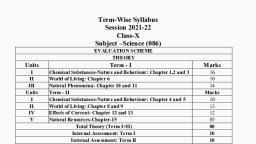
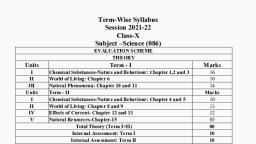
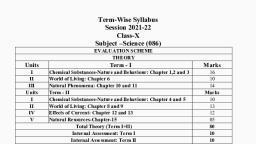
COURSE STRUCTURE, , , , , , , , , , , , , , , , , , , , , , , , , , , , , , , , , , , , , , , , , , CLASS X, EVALUATION SCHEME, THEORY, Units Term -I Marks, I Chemical Substances-Nature and Behaviour: Chapter 1,2 and 3 16, II World of Living: Chapter 6 10, Il Natural Phenomena: Chapter 10 and 11 14, Units Term - II Marks, I Chemical Substances-Nature and Behaviour: Chapter 4 and 5 10, Il World of Living: Chapter 8 and 9 13, IV Effects of Current: Chapter 12 and 13 12, V Natural Resources: Chapter 15 05, [Total Theory (Term I+II) 80, Internal Assessment: Term I 10, Internal Assessment: Term II 10, (Grand Total 100, TERM -I, , , , Theme: Materials, , Unit I: Chemical Substances - Nature and Behaviour, , Chapter -1 Chemical reactions and equations, Chemical reactions: Chemical equation, Balanced chemical equation, implications of a balanced, , chemical equation, types of chemical reactions: combination, decomposition, displacement, double, displacement, precipitation, neutralization, oxidation and reduction., , Chapter — 2 Acids, Bases and Salts, , Acids, bases and salts: Their definitions in terms of furnishing of H* and OH ions, General properties,, examples and uses, concept of pH scale (Definition relating to logarithm not required), importance of, pH in everyday life; preparation and uses of Sodium Hydroxide, Bleaching powder, Baking soda,, Washing soda and Plaster of Paris., , Chapter — 3 Metais and non — metals, , Metals and nonmetals: Properties of metals and non-metals; Reactivity series; Formation and, , properties of ionic compounds.
Page 2 :
Theme: The World of the Living, Unit II: World of Living, , Chapter — 6 Life processes, Life processes: ‘Living Being’. Basic concept of nutrition, respiration, transport and excretion in plants, , and animals., , Theme: How Things Work, , Unit ITI: Natural Phenomena, , Chapter — 10 Light — Reflection and Refraction, Reflection of light by curved surfaces; Images formed by spherical mirrors, centre of curvature,, , principal axis, principal focus, focal length, mirror formula (Derivation not required), magnification., Refraction; Laws of refraction, refractive index., , Refraction of light by spherical lens; Image formed by spherical lenses; Lens formula (Derivation not, required); Magnification. Power of a lens., , Chapter — 11 Human eye and colourful world, Refraction of light through a prism, dispersion of light, scattering of light, applications in daily life., , TERM - II, Theme: Materials, , Unit I: Chemical Substances - Nature and Behaviour, , Chapter — 4 Carbon and its compounds, , Carbon compounds: Covalent bonding in carbon compounds. Versatile nature of carbon.Homologous, , series., , Chapter — 5 Periodic classification of elements, , Periodic classification of elements: Need for classification, early attempts at classification of elements, (Dobereiner’s Triads, Newland’s Law of Octaves, Mendeleev’s Periodic Table), Modern periodic table,, , gradation in properties, valency, atomic number, metallic and non-metallic properties., , Theme: The World of the Living, Unit I: World of Living, Chapter — 8 How do organisms reproduce?, Reproduction: Reproduction in animals and plants (asexual and sexual) reproductive health-need and, methods of family planning. Safe sex vs HIV/AIDS.Child bearing and women’s health., Chapter — 9 Heredity and Evolution, , Heredity: Heredity; Mendel’s contribution- Laws for inheritance of traits: Sex determination: brief, , introduction;
Page 3 :
Theme: Natural Phenomena, Unit IV: Effects of Current, , Chapter — 12 Electricity, Ohm’s law; Resistance, Resistivity, Factors on which the resistance of a conductor depends. Series, combination of resistors, parallel combination of resistors and its applications in daily life. Heating, , effect of electric current and its applications in daily life. Electric power, Interrelation between P, V, I, and R., , Chapter — 13 Magnetic effects of current, , Magnetic effects of current: Magnetic field, field lines, field due to a current carrying conductor, field, due to current carrying coil or solenoid; Force on current carrying conductor, Fleming’s Left Hand, Rule, Electric Motor, Electromagnetic induction. Induced potential difference, Induced current., Fleming’s Right Hand Rule., , Theme: Natural Resources, Unit V: Natural Resources, Chapter — 15 Our Environment, Our environment: Eco-system, Environmental problems, Ozone depletion, waste production and their, , solutions. Biodegradable and non-biodegradable substances., , RE RR, , ONLY FOR INTERNAL ASSESSMENT, , Note: Learners are assigned to read the below listed part of Unit V. They can be encouraged to, , prepare a brief write up on any one concept of this Unit in their Portfolio. This may be an, , assessment for Internal Assessment and credit may be given (Periodic assessment/Portfolio)., This portion of the Unit is not to be assessed in the year-end examination., , Chapter — 16 Management of natural resources: Conservation and judicious use of natural, resources. Forest and wild life; Coal and Petroleum conservation.Examples of people’s participation for, , conservation of natural resources. Big dams: advantages and limitations; alternatives, if any. Water, , harvesting.Sustainability of natural resources.
Page 4 :
PRACTICALS, , Practical should be conducted alongside the concepts taught in theory classes., TERM-I, , LIST OF EXPERIMENTS, |. A. Finding the pH of the following samples by using pH paper/universal indicator:, , (i) | Dilute Hydrochloric Acid, , (ii) | Dilute NaOH solution, , (iii) Dilute Ethanoic Acid solution, , (iv) Lemon juice, , (v) Water, , (vi) Dilute Hydrogen Carbonate solution, , B. Studying the properties of acids and bases (HCI & NaOH) on the basis of their reaction with:, , a) Litmus solution (Blue/Red), b) Zinc metal, c) Solid sodium carbonateUnit-I:(Chapter-2), , Ze Performing and observing the following reactions and classifying them into:, , Combination reaction, Decomposition reaction, Displacement reaction, Double displacement reaction, , DOM,, , (i) Action of water on quicklime, , (ii) Action of heat on ferrous sulphate crystals, , (iii) Iron nails kept in copper sulphate solution, , (iv) Reaction between sodium sulphate and barium chloride solutions., Unit-I:(Chapter-1), , a A. Observing the action of Zn, Fe, Cu and Al metals on the following salt solutions:, , (i) ZnSO4(aq), (ii) FeSO4(aq), (iii) CuSO4(aq), (iv) Al2 (SO4)3(aq), , B. Arranging Zn, Fe, Cu and Al (metals) in the decreasing order of reactivity based on the, above result.Unit-I :(Chapter-3), ne Experimentally show that carbon dioxide is given out during respiration., Unit-II:(Chapter-6), a, Determination of the focal length of (i) Concave mirror and (ii) Convex lens by obtaining the, image of a distant object. Unit-I1:(Chapter- 10), 6. Tracing the path of a ray of light passing through a rectangular glass slab for different angles of, incidence. Measure the angle of incidence, angle of refraction, angle of emergence and, , interpret the result. Unit-I1:(Chapter-10), , Scanned with CamScanner
Page 5 :
4 Tracing the path of the rays of light through a glass prism. Unit-III:(Chapter-11), , TERM-I, LIST OF EXPERIMENTS, 1. Studying the dependence of potential difference (V) across a resistor on the current (I) passing, , through it and determining its resistance. Also plotting a graph between V and I., Unit-IV:(Chapter-12), 2. Studying (a) binary fission in Amoeba, and (b) budding in yeast and Hydra with the help of, prepared slides. Unit-II:(Chapter-8), PRESCRIBED BOOKS:, , Science-Textbook for class IX-NCERT Publication, , Science-Text book for class X- NCERT Publication, , Assessment of Practical Skills in Science-Class [IX - CBSE Publication, Assessment of Practical Skills in Science- Class X- CBSE Publication, Laboratory Manual-Science-Class IX, NCERT Publication, , Laboratory Manual-Science-Class X, NCERT Publication, , Exemplar Problems Class IX —- NCERT Publication, , Exemplar Problems Class X —- NCERT Publication, , Assessment Areas (Theory) 2021-22, (Class X), Science (086), Theory TotalMaximum Marks: 80, , , , Competencies Marks, , , , , , , , , , Demonstrate Knowledge and Understanding 46%, , , , Application of Knowledge/Concepts 22 %, , , , , , , , , , , , , , , , Analyze, Evaluate and Create 32%, , , , , , Note:, , ° Internal choice would be provided., , Internal Assessment — Term I and II (10 Marks each), , 2 Periodic Assessment - 03 marks, , e Multiple Assessment — 02 marks, , 4 Subject Enrichment (Practical Work) - 03 marks, © Portfolio - 02 marks