Page 1 :
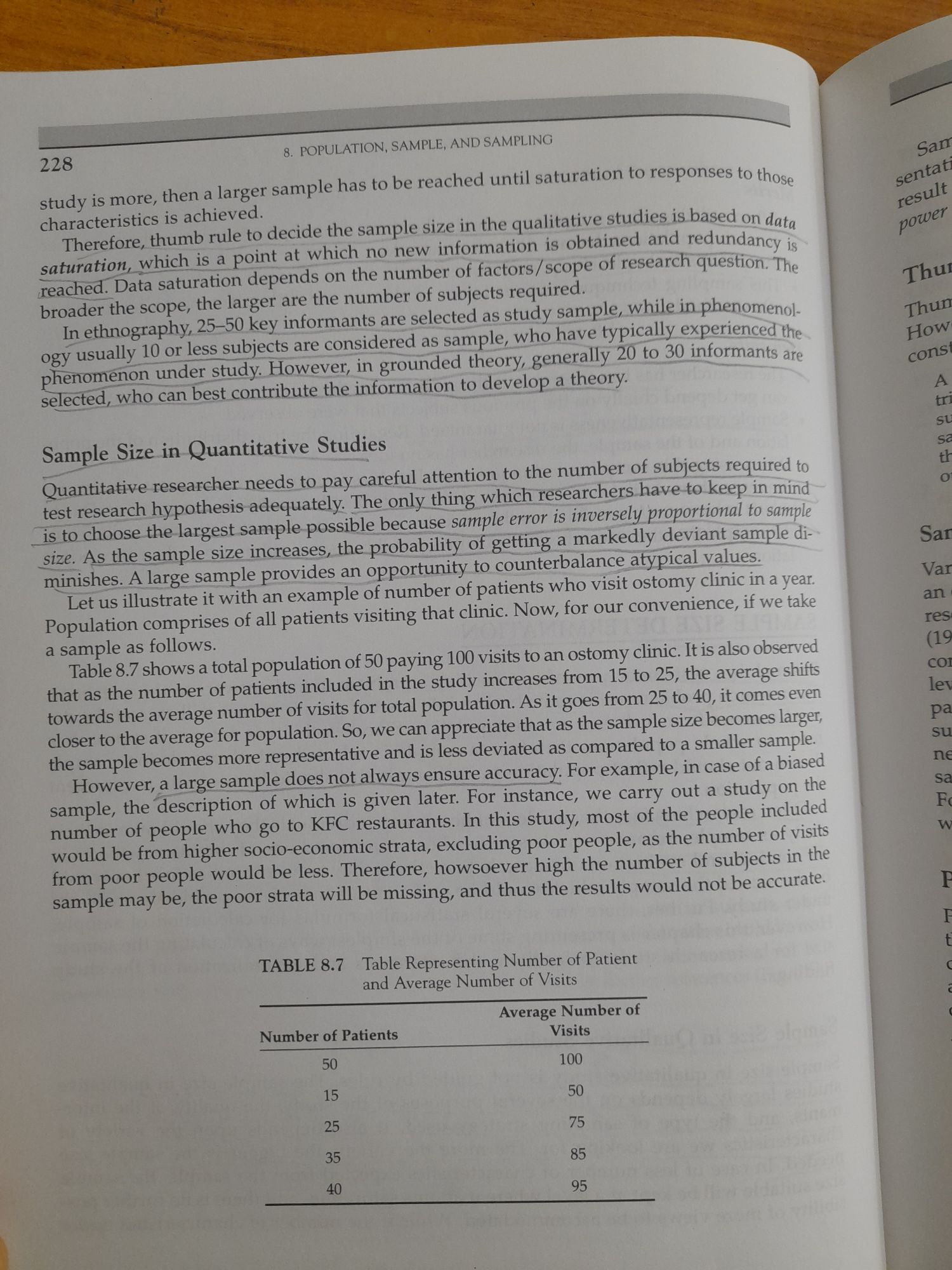
. POPULATION, SAMPLE, AND SAMPLING, , 228 8, study is more, then a larger sample has to be reached until saturation to responses to thos., characteristics is achieved. ae, Therefore, thumb rule to decide the sample size in the qu, saturation, which is a point at which no new information is, reached. Data saturation depends on the number of factors /scope, broader the scope, the larger are the number of subjects required., In ethnography, 25-50 key informants are selected as study sam ple,, bjects are considered as sample, who have typically experienced the, , ogy usually 10 or less su, phenomenon under study. However, in grounded theory, generally 20 to 30 informants are, , selected, who can best contribute the information to develop a theory., , alitative studies is based on dat,, obtained and redundancy ;., of research question: Th,, , while in phenomeno|, , Sample Size in Quantitative Studies, , Quantitative researcher needs to pay careful attention to the number of subjects required to, test research hypothesis adequately. The only thing which vesearchers have-to-keep in mind, “is to choose the largest sample-possible because sample error is inversely proportional to sample, size. As t the sample size increases, the probability of getting a markedly deviant sample diminishes. A large sample provides an opportunity to counterbalance atypical values., , Let us illustrate it with an example of number of patients who visit ostomy clinic in a year, Population comprises of all patients visiting that clinic. Now, for our convenience, if we take, a sample as follows., , Table 8.7 shows a total population of 50 paying 100 visits to an ostomy clinic. It is also observed, that as the number of patients included in the study increases from 15 to 25, the average shifts, towards the average number of visits for total population. As it goes from 25 to 40, it comes even, closer to the average for population. So, we can appreciate that as the sample size becomes larger, the sample becomes more representative and is less deviated as compared to a smaller sample., , However, a large sample does not always ensure accuracy. For example, in case of a biased, sample, the description of which is given later. For instance, we carry out a study on the, number of people who go to KFC restaurants. In this study, most of the people included, would be from higher socio-economic strata, excluding poor people, as the number of visits, from poor people would be less. Therefore, howsoever high the number of subjects in the, sample may be, the poor strata will be missing, and thus the results would not be accurate., , TABLE 8.7. Table Representing Number of Patient, and Average Number of Visits, , Average Number of, , , , Number of Patients Visits, 50 100, iS: 50, 25 75), 35 85, 40 05, , —_—, , , , B, , ex42I0FBCg, , i er), , pa a ed al fe