Page 1 :
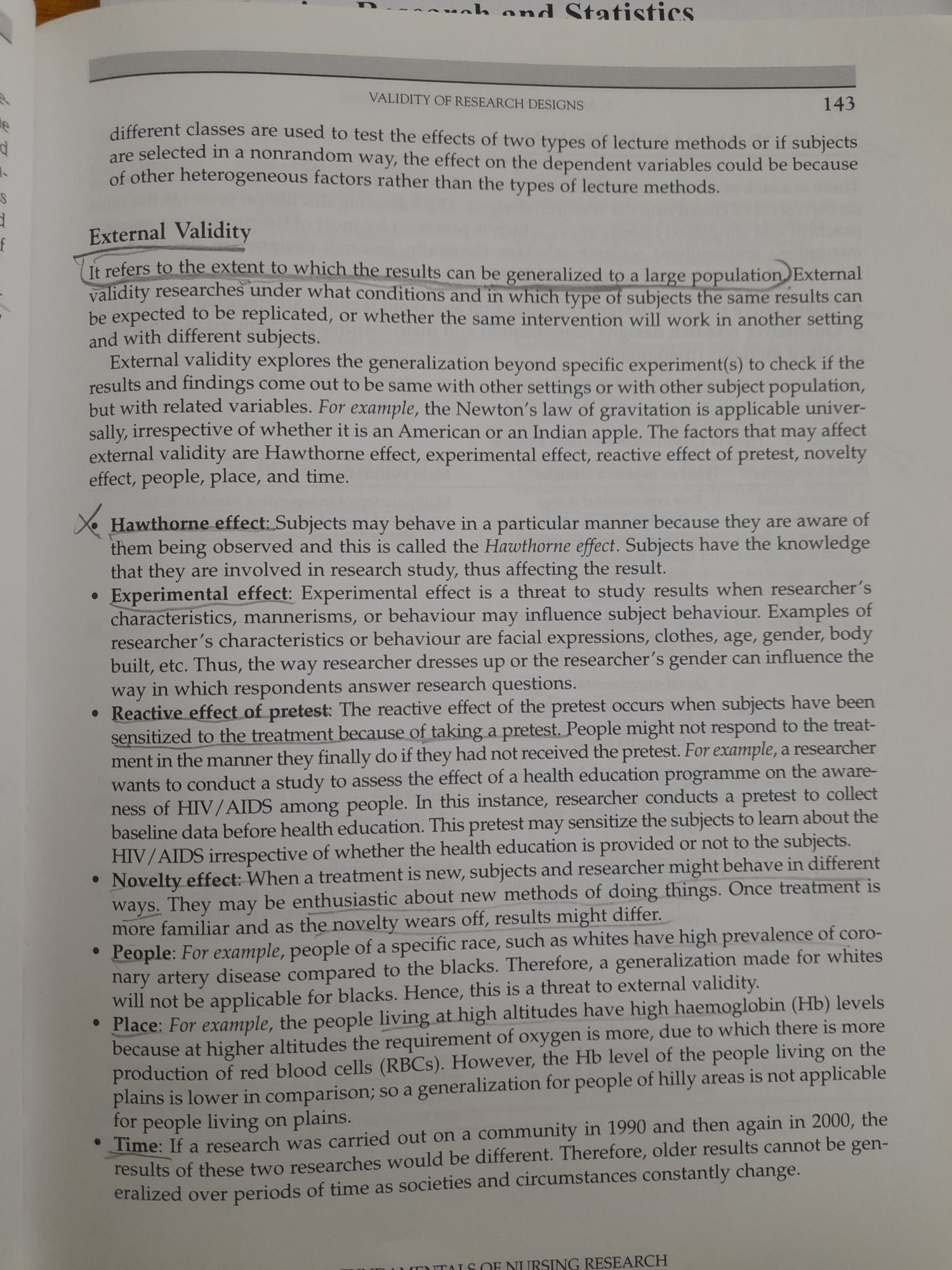
eo F, , oO 0 hu, , , , , , , , ap ww = an-enh and Ctatistics, , VALIDITY OF RESEARCH DESIGNS, SEARCH DESIGNS 143, , ifferent classes a, diff Te used to test the effects of two types of lecture methods or if subjects, , re selected in a nonr, z a eee aie may, the effect on the dependent variables could be because, actors rather than the types of lecture methods., , External Validity, , Ge,, Ucrefges tothe catent.te which the results can be generalized to a large population) External, , i ots venice nen and in which type of subjects the same results can, 4 , ot Whether the same inte i i i i, Bie fi different subjects, a intervention will work in another setting, , es ed explores the generalization beyond specific experiment(s) to check if the, resu ? DR come out to be same with other settings or with other subject population,, but wi re ate variables. For example, the Newton’s law of gravitation is applicable universally, irrespective of whether it is an American or an Indian apple. The factors that may affect, , external validity are Hawthorne effect, experimental effect, reactive effect of pretest, novelty, effect, people, place, and time., , e Hawthorne effect: Subjects may behave ina particular manner because they are aware of, them being observed and this is called the Hawthorne effect. Subjects have the knowledge, that they are involved in research study, thus affecting the result., , ° xperimental effect: Experimental effect is a threat to study results when researcher’s, characteristics, mannerisms, or behaviour may influence subject behaviour. Examples of, researcher’s characteristics or behaviour are facial expressions, clothes, age, gender, body, built, etc. Thus, the way researcher dresses up or the researcher’s gender can influence the, way in which respondents answer research questions., , ° Reactive effect of pretest: The reactive effect of the pretest occurs when subjects have been, sensitized to the treatment because of taking.a pretest. People might not respond to the treatment in the manner they finally do if they had not received the pretest. For example, a researcher, wants to conduct a study to assess the effect of a health education programme on the awareness of HIV/AIDS among people. In this instance, researcher conducts a pretest to collect, baseline data before health education. This pretest may sensitize the subjects to learn about the, HIV/AIDS irrespective of whether the health education is provided or not to the subjects., , ° Novelty effect: When a treatment is new, subjects and researcher might behave in different, ways. They may be enthusiastic about new methods of doing things. Once treatment is, more familiar and as the novelty wears off, results might differ., , ° People: For example, people of a specific race, such as whites have high prevalence of coronary artery disease compared to the blacks. Therefore, a generalization made for whites, will not be applicable for blacks. Hence, this is a threat to external validity. —, , © Place: For example, the people living at high altitudes have high haemoglobin (Hb) levels, because at higher altitudes the requirement of oxygen is more, due to which there is more, production of red blood cells (RBCs). However, the Hb level of the people living on the, , plains is lower in comparison; so a generalization for people of hilly areas is not applicable, , = ut on a community in 1990 and then again in 2000, the, uld be different. Therefore, older results cannot be gen, f these two researches wo, | over periods of time as societies and circumstances constantly change., , a a a ALINTETRGING RESEARCH