Page 1 :
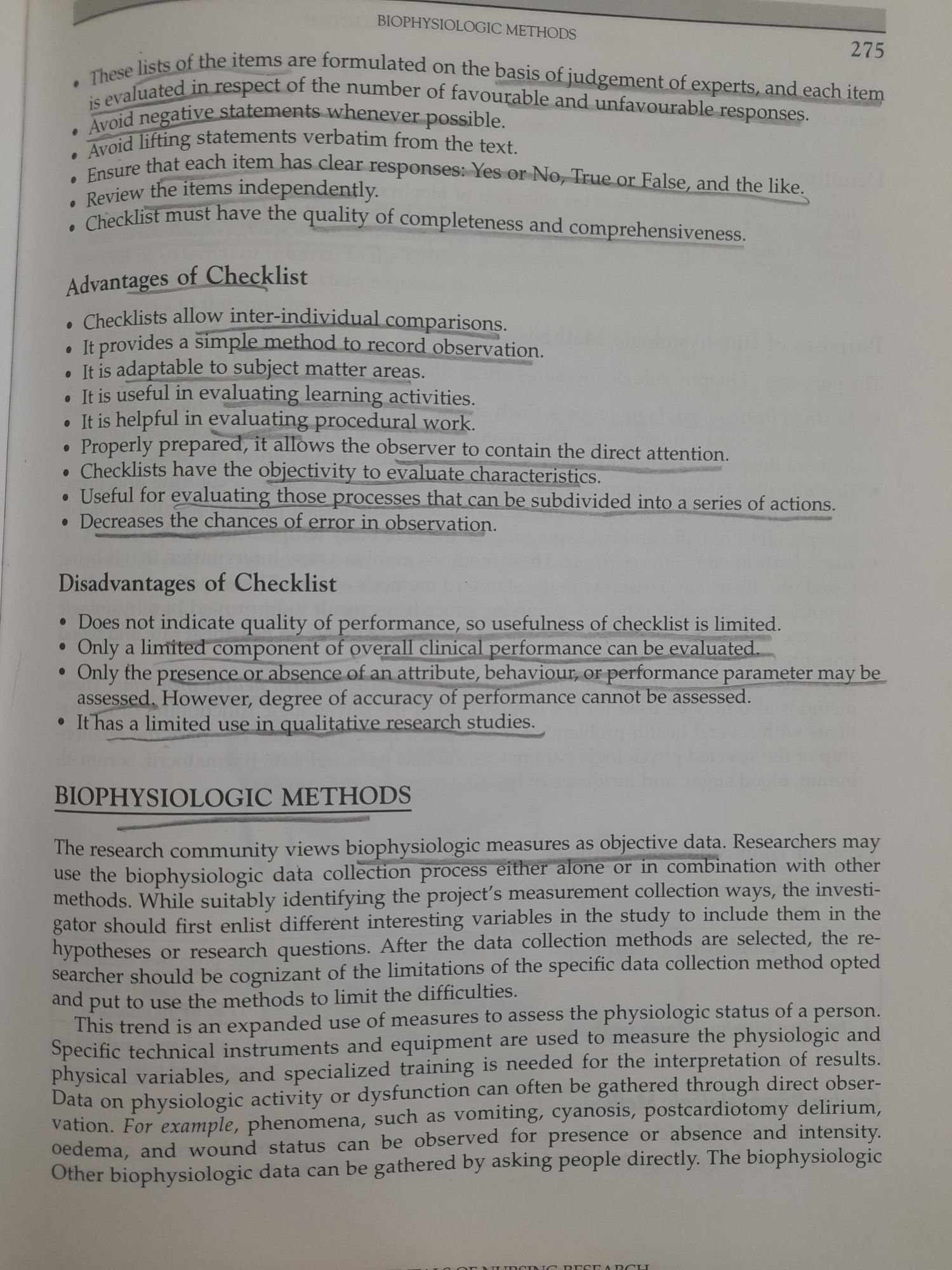
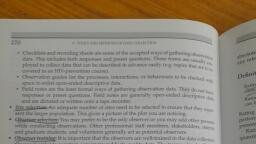
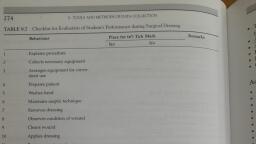
| —— BIOPHYSIOLOGIC METHODS, , S lists of the items are formulated on the basis of j em ., , es 3 ec arable and 7, , * evaluated pect of the number of favourable and en expe and ach =, S.., , Si rgsive statements whenever.possible., e oid fitting statements verbatim from the text., ee that each item has clear responses:-Yes ~ i, peview the items independently. ceils, * ae cklisf must have the quality of completeness and comprehensiveness, , Advantages of Checklist, , » Checklists allow inter-indivi comparisons., , « It provides a simple method to record observation., , It is adaptable to subject matter areas. q, , It is useful in evaluating learning activities., , It is helpful in evaluating procedural work., , Properly prepared, it allows the observer to contain the direct attention., , ¢ Checklists have the objectivity to evaluate characteristics., , * Useful for evaluating those processes that can be subdivided into a series of actions., + Decreases the chances of error in observation. ‘ nace, , Disadvantages of Checklist, , * Does not indicate quality of performance, so usefulness of checklist is limited., * Only a lintited"component of overall clinical performance can be evaluated., , * Only the presence or absence ofan attribute, behaviour, or-performance parameter may be_, asses, However, degree of accuracy of performance cannot be assessed., , * Ithas a limited use in qualitative research studies., , BIOPHYSIOLOGIC METHODS, a, data. Researchers may, , ; i i i i bjective, The research community views biophysiologic measures as 0b}, , Mn process either alone or In combination with other, , use the biophysiologic data collectio h othe, methods. While suitably identifying the project’s measurement collection ways, the investigator should first enlist different interesting variables in the study to include them in the, hypotheses or research questions. After the data collection methods are selected, the researcher should be cognizant of the limitations of the specific data collection method opted, an ds to limit the difficulties. : 5;, , se auinegre me Pree use of measures to assess the physiologic status of a person., Specifi hnical i Feancdis and equipment are used to measure the physiologic and, ee ns the interpretation of results., , i i ‘alized training is needed for, ae ety = dysfunction can often be gathered through direct obser, i ch as vomiting, cyanosis, postcardiotomy delirium,, a. er Nee — observed for presence or absence and intensity., Other | esate data can be gathered by asking people directly. The biophysiologic, , , , a A nel ee cine