Page 1 :
Eysenck Personality Questionnaire
Page 2 :
How you see yourself and how others see you may be quite different. It is hard to be objective about oneself - after all, one is being oneself and therefore there is no distance from which to view.
Page 3 :
EPQ is intended to provide this objectivity. It is based on tried and tested principles, the result of research by renowned Professor of human psychology, Hans Eysenck, and described in his popular book 'Know Your Own Personality' published first in 1972.


Page 4 :
introversion and extraversion, combined with the degree of emotional stability and self-determinism, determine the personality traits that result in much of an individual's behavior.
Page 5 :
Eysenck, believed that personality, like intelligence, is determined to a large extent by a person's genes and is unchangeable beyond an effort to cover up negative traits through learned behavior.
Page 6 :
The Questionnaire is grouped into Categories, each with a number of psychological Traits. Each Trait is presented on a separate page. Nearly 1000+ question.
Page 7 :
It may be that you score higher than the norm in some extravert traits and at the same time higher in some introvert traits. That's to be expected; many people are ambivert - in some circumstances extraverted and in others introverted, depending on their needs and corresponding fears, and other factors like conditioning.
Page 8 :
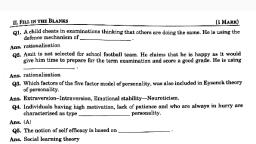
Eysenck initially conceptualized personality as two biologically-based independent dimensions of temperament, E and N, measured on a continuum, but then extending this to include a third, P., E - Extraversion/Introversion:, N - Neuroticism/Stability:, P - Psychoticism/Socialisation:
Page 9 :
Stable extraverts (sanguine qualities such as outgoing, talkative, responsive, easy going, lively, carefree, leadership), , Unstable extraverts (choleric qualities such as touchy, restless, excitable, changeable, impulsive, irresponsible), , Stable introverts (phlegmatic qualities such as calm, even-tempered, reliable, controlled, peaceful, thoughtful, careful, passive), , Unstable introverts (melancholic qualities such as quiet, reserved, pessimistic, sober, rigid, anxious, moody)
Page 16 :
Know Your Own Mind Questionnaire - Page 1 - ACTIVITY (trans4mind.com)