Page 1 :
The term counselling is very vast and widespread., , It is used in various areas of Psychology., , Professional counselling can be defined as “…The application of mental health ,psychological or human development principles ,through cognitive , affective, behavioral or systematic interventions , strategies that address wellness ,personal growth , or career development, ,as well as pathology.”, simply it can be defined as “ counselling is a process where clients are helped in dealing with their personal &, interpersonal conflicts by a third party therapist”.
Page 2 :
Educational Counselling mainly refers to providing assistance and guidance to students �in making the right choices in their studies, �be it their educational plans, �career aspirations, �choice of stream �and� specialization �as well as �the selection of college or university �as per their interests and preferences.
Page 3 :
An Educational Counselor mainly works with school and college students in academic environments.��educational counsellors also assist students in dealing with the personal issues impacting their academic journey.
Page 4 :
Educational Counselling has an important role in every student’s life as it helps them make informed decisions at every step of their academic and professional journey. Many of us think that we don’t need any professional guidance in our educational or career quest but the right mentor can actually transform your life.
Page 5 :
Educational Counsellor also interacts with the student’s parents or guardian or teachers to help them in figuring out the best solutions for the student’s problems.
Page 7 :
Elementary/Primary school counselling:, Elementary professional counsellors are set to meet the developmental need of young children . They use a variety of media like crayons, paints, puppets , clay . Children’s book and toys to facilitate this counselling procedures. Elementary professionals also spend 35-40%in classroom guidance . and using, “special area “ teachers like music , art, physical education etc..
Page 8 :
Middle school counselling, In middle school counselling ,the professional counsellor typically is less engaged in classroom instruction than in individual planning (high school and beyond). Middle school counsellors must address the social / emotional issues that arise among this age group , especially peer pressure ,bullying, depression & academic challenges.
Page 9 :
High school / Secondary school counselling, In high school counselling continues to provide responsive services and provides fewer classroom guidance strategies. Some high school counsellors, spend time developing the school’s class schedule etc..
Page 10 :
Educational Counsellors need to take care of:�Family Issues�Puberty related questions�Advice on educational and career choices�Providing familial support�Transportation problems�Concerns regarding grades�Bullying or Fighting
Page 11 :
It is a counsellor who understands your complex emotions and helps you channelize your thoughts in a direction where you are able to make a life-changing decision.
Page 12 :
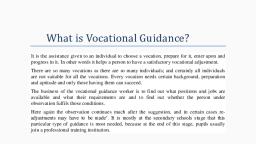
Vocational Counselling is similar to career counselling but focuses more on finding the right occupation or job opportunity for an individual as per their interests and demands in the sector or industry they want to work in.
Page 13 :
Career Counselling is more of a holistic combination of educational and vocational counselling as it focuses on both students and working professionals and provides them with the right mentorship they need at every step of their academic and professional journey!
Page 14 :
Career Counselling for Students��Finding what you are interested in studying or pursuing as a career��Clarifying your academic goals��Taking informed steps towards your educational aspirations
Page 15 :
Create a career plan as per your interests and preferences��Finding academic options under your budget��Self-Evaluation��Become confident about your academic choices��Mentor students to achieve their dream education
Page 16 :
Educational Counselling for Working Professionals��Guidance for higher studies or continuing education��Leveraging the right skills and education to land your dream job��Mentor in navigating a career change
Page 17 :
Locating the best possible career opportunities��Preparation for interviews��Understanding your personality, strengths and weaknesses to find the right career��Facilitating mid-career change or switching jobs
Page 18 :
Benefits of Educational Counselling��It helps you in realizing your passion and the things you are good at.��Using SWOT analysis, you get to know about your weaknesses and strengths. (‘Strength’ ‘Weaknesses’ ‘Opportunities’ and ‘Threats’.)��It develops confidence and assists you in making informed decisions.
Page 19 :
It helps you foresee the challenges that are likely to come in your way and lets you prepare for that in advance. ��Counselling brings clarity in thought and reduces career-related stress.�� �It gives an opportunity to improve behaviour by helping you pick out the negative traits.
Page 20 :
Professional school counsellors implement a comprehensive school, counselling programe in, order to promote & enhance student achievement through a guidance curriculum, individual planning strategies, responsive services., The major attention of these counsellors is focused on the developmental stages of the student’s growth including the needs, tasks and the interest of the students related to those stages.
Page 21 :
The counsellors mainly attend to the needs of the students and take care that these need are met in the 3 basic domains; Academic development, Career development, Personal and Social development etc., Professional school counsellors may lead classroom guidance on a variety of topics within three domains such as personal or group to addres some common issues amongstudents.ie; marriage,divorce,death.. and also brought outside groups to help through stage programes ,drama etc.
Page 22 :
Infatuation or love affairs:, It is the fact that attraction towards the opposite sex in adolescence is a natural phenomenon . now- a- days not only the children of age 14-15 but also that 8-10are facing the issue . consequently, it gives birth to numerous problems like, disinterested in studying, bunking classes in schools , running away from home, , and the chances getting infected with HIV or other sexually transmitted disease
Page 23 :
Stress management:, Stress is the body’s normal responses to a challenge , threat or excitement., Adolescents face a variety of situations in their daily life which can prove to stressful situations . like related to pressure of achievement , admission in reputed colleges, ,ambitious career and job, problems with peers(including Romance), family issues and other school problems ., conflicts with the peers ,teachers , parents sometimes these, conflicts becomes violent , ragging etc..
Page 24 :
Depression:, Certain factors such as history of depression , suicide in the family , alcoholism , or drug abuse, sexual or physical abuse patterns in the family, chronic illness in oneself or family , history of psychiatric disorders such as eating disorders , schizophrenia, manic-depressive disorders , conduct disorders , delinquency , death or serious loss in the family , learning disabilities , absent or divorced parents, poor child –parent relationship.
Page 25 :
Anger management:, anger and the related problems are a challenge for the youngsters. Anger may towards friends ,family, relatives , acquaintances and sometimes on unknown people as well. Youngsters are not bothered about their weakness. they also want to control their emotions and thus it is essential to teach them anger management
Page 26 :
Child abuse/ Harassement, It is an evil that prevails in the society . it is required to spread awareness among children , especially adolescents . Many students approaches the counsellor with the problem of child abuse., Memory & Concentration, Adjustment with the parents, The teenage years can prove to be an emotional assault course . it’s time of rapid physical development and deep emotional changes which are exciting , but can also confusing and uncomfortable for the child as well as parents.
Page 27 :
Adjustment in schools, Career Guidance, Issues which are related to their career are asked frequently . they want to know their capabilities , intelligence, interests , job opportunities available for them, scholarship facilities , job market value of their subjects based & how to choose career etc.., , Self Awareness, Many of the students are unable to realize their potential & capabilities . they know about their whole world but very less about their self.
Page 28 :
Impatient Child, students can be impatient in many ways . they are eager to find solutions for difficult questions , anxious to develop satisfying friendships and prone to selecting but difficult but immediate alternatives for complex decisions., Domestic Violence, Eating problems
Page 29 :
Gambling:, Due to many reasons child gets involved in the gambling and stealing . In particular , money , enjoyment , excitement & social reasons are the primary motivators. More adolescents gamble to escape problems , to alleviate depression, to cope with loneliness, to relax & to interact socially with others., Substance Abuse
Page 30 :
Truancy, It often happens that the students bunk classes , run away from the school along with their friends to escape studies and to enjoy . This may due to the school environment. i.e., the teachers may not be well equipped or that the subjects are disinteresting or they don’t value education.
Page 31 :
Self Harm:, I t refers to hurting oneself to relieve emotional pain & distress. The most common form of this behavior are cutting and burning. The least common form of self- harm include pulling out body hair, punching walls, & ingesting toxic substances or sharp objects. Self-harming adolescents are rarely suicidal.