Page 1 :
UNIT 7, , CLASSICAL REALISM AND NEOREALISM*, , Classical Realism &, Neorealism, , Structure, 7.0 Objectives, 7.1 Introduction, 7.2 Basic Assumptions of Realism, 7.3 Classical Realism, 7.3.1, 7.3.2, 7.3.3, 7.3.4, 7.3.5, , Thucydides, Kautilya, Machiavelli and Hobbes, E H Carr, Morgenthau, , 7.4 Neo-Realism or Structural Realism, 7.4.1, 7.4.2, 7.4.3, , Differences between Classical Realism and Neo-Realism, Defensive Realism, Offensive Realism, , 7.5 Assessment, 7.6 Let Us Sum Up, 7.7 References, 7.8 Answers to Check Your Progress Exercises, , 7.0, , OBJECTIVES, , Realism has been one of the dominant perspectives in international relations, since the Second World War. This unit would shed light on Realist perspective in, international politics. After studying this unit, you should be able to:, Explain the meaning of Classical and Neo-Realism, Know the difference between these two perspectives, Describe major thinkers associated with them and, Analyze some of the limitations of Classical and Neo-Realism, , 7.1, , INTRODUCTION, , Realism has been one of the main theoretical perspectives in international relations, which gained prominence after the Second World War and continues to remain, relevant even in the globalized world of 21st century. As the name suggests,, Realism explains the reality of international politics (what is), in contrast to Idealist, school of thought which focuses on ‘what ought to be’. Thus, as Morgenthau has, claimed, realism is an empirical paradigm rather than being a normative one., Realism explains the status quo in international relations, how the order is, established and maintained. The wider acceptance of realism is because of its, ability to explain why states compete and go to war in international relations., Since the signing of Treaty of Westphalia in 1648, there have been over 200 wars, *, , Dr Raj Kumar Sharma, Consultant, Faculty of Political Science, IGNOU, New Delhi, , 103
Page 2 :
Theoretical Perspectives, , and conflicts. in international system. Realism is often also called study of power, politics as it gives centrality to power in its analysis of international politics., However, there are many variants of Realism. In fact, it is best to describe realism, as a set of theories which give importance to factors like national interest, state, and military in world politics. It should be mentioned that apart from political, thinkers, rulers, diplomats, military strategists and generals have also contributed, to growth of realism as a theoretical tradition. The names include military theorist, and Prussian general Carl Von Clausewitz, French diplomat Charles Maurice de, Talleyrand-Perigord, Austrian statesman Klemens von Matternich, former French, President Charles de Gaulle and former US Secretary of State, Henry Kissinger., Realism has never been a single theory, however, in all its variants, there is, centrality of power and military means that states try to achieve through their, policies. Realism in general, is pessimistic about the chances of radical reform, in international system. There is close relationship between Realism and security, studies as both of them study conflict, war and survival. Charles Darwin’s ‘survival, of the fittest’ is echoed in international politics by theory of realism. Mainly, three distinct schools of thought exist in realism, namely, classical, neo-realism, or structural realism and neo-classical realism. This unit would discuss classical, and neo-realism in detail., , 7.2, , BASIC ASSUMPTIONS OF REALISM, , Realism is an academic approach to study international relations which is not a, single, unified theory. As Jonathan Haslam points out in his No Virtue Like, Necessity: Realist Thought in International Relations since Machiavelli (2002),, realism is a spectrum of ideas rather than as a fixed point of focus with sharp, definition. Duncan Bell has argued that Realism is possibly best defined in, negative terms – in what realists reject instead of what they endorse in positive, terms. Realists are united in their collective rejection of morality or ethics in, international politics. They would go on to argue that justice does not operate in, international relations since they are marked by potential or active competition, and conflict among different states. Irrespective of the differences in various, strands of realist theories, most of them share some core beliefs and assumptions, which are below., Realists believe that states are primary actors in international relations and, hence, they try to explain behavior of states while giving less importance to, other factors., International relations are mainly a study of power and security as survival, of state is paramount. This is why; states build their hard power (military, power). Realism also accepts a distinction between matters of high politics, and low politics. High politics includes the areas that are necessary for, survival of a state like security. Areas of low politics like trade and social, affairs are the ones which are not absolutely necessary for survival of a, state., , 104, , Human nature is dominated by ego and like humans, groups and states also, have an ego. Politically, states are rational actors which are driven by their, narrow self-interest. Moral and ethical considerations make way to raison, d’état or reasons of state – a situation in which a state’s foreign policy is, justified on the basis that its national interest is of utmost importance.
Page 3 :
There is lack of government in international relations leading to anarchy., This means there is no authority to protect interests of the global community, and ensure rule of law at the global level. The possibility of moral behavior, rests upon the existence of an effective government that can deter and punish, illegal actions. Hence, states need to rely on themselves to safeguard their, national interest., , Classical Realism &, Neorealism, , To ensure their survival, states resort to balance of power (BoP). BoP does, not allow a single state to gain so much military power that it can dictate, terms to other countries. Balancing is of two types – external and internal., External balancing is done through building alliances while internal balancing, is done by enhancing one’s own military power. For instance, India has been, balancing China through both, internal and external measures. India is, building its military strength on one hand while on the other, it is building, close relations with countries like the US, Japan and France to balance China., Under anarchic international relations, there exists a security dilemma or, spiral mode. The steps taken by one country to enhance its own security, would decrease the security of other states. In such zero-sum situation, it is, difficult for any state to improve its own survival without threatening the, survival of other states. The threatened states then would take steps to increase, their own security and this ends up in a perpetual competitive cycle., Check Your Progress Exercise 1, Note: i) Use the space given below for your answer., ii) See the end of the unit for tips for your answer., 1), , What do you understand by Security Dilemma?, ......................................................................................................................., ......................................................................................................................., ......................................................................................................................., ......................................................................................................................., ......................................................................................................................., , 7.3, , CLASSICAL REALISM, , Classical realism has emerged as a major approach in the study of international, relations after the Second World War. This approach is mainly reflected in the, writings of E H Carr, Reinhold Niebuhr and Hans Morgenthau. Classical realism, explains state behaviour from vantage point of human nature and holds human, nature responsible for conflicts among states. However, even before realism, existed as a theory, its tenets can be found in Western and non-Western political, thinkers from ancient to medieval period. In an informal manner, tenets of realism, can be traced to the works of ancient Greek philosopher, Thucydides in the 5th, century BC. The other prominent realist thinkers in the West include Machiavelli, and Hobbes. There have been non-Western thinkers like Kautilya from India and, Sun Tzu and Han Feizi from China whose views would fall under the realist, paradigm in international politics. Some of the main thinkers in classical realism, are discussed below., , 105
Page 4 :
Theoretical Perspectives, , 7.3.1 Thucydides, Views of Thucydides, Athenian historian and general in 5th century BC, are very, often seen as the starting point of realist school in international politics. As a, participant in the war between Delian League (led by Athens) and Peloponnesian, League (led by Sparta), Thucydides wrote his experiences in a collection of eight, books called History of the Peloponnesian War. Some of the prominent realist, conceptions are reflected in his book which has prompted realists to claim that, Thucydides was a realist. One of the central ideas echoed by Thucydides is that, the strong should rule the weak as they have the power to do so. This was an, articulation of politics based on power. In the words of Thucydides, “The strong, do what they can; the weak suffer what they must”. In book 5, Thucydides covers, the Melian Dialogue which is a dramatised version of conversation between, Athenians and representatives from Melos (a small island which tried to be neutral, in the Peloponnesian war). The Melians represent the idealist thought compared, to the realist, strategic and pragmatic Athenians. When Melians resort to ideals, of morality and justice while facing an invasion from Athens, Athenians argue, that the powerful have a right to rule the weak (might is right) and independent, states can survive only if they are powerful enough to protect their independence., They also say that justice can only exist between equals not between unequals., The moral of the dialogue is that whenever there is power imbalance between, two sides, the stronger would assert itself as per its own interests. This is human, nature., Around the same time, a similar and radical view of justice had been expressed, by Thrasymachus, a Sophist and a renowned teacher of rhetoric. In Plato’s, Republic, Thrasymachus, just like Thucydides, has defined justice as the interest, of the stronger. According to realist thinker Robert Gilpin, Thucydides is a realist, as he argued that men are motivated by honour, greed and fear. Other values like, beauty, goodness and truth will be lost unless there are provisions for one’s security, in the power struggle among social groups., , 7.3.2 Kautilya, , 106, , Despite having intrinsic theoretical value in international politics, Kautilya’s, famous work, Arthashastra has been largely ignored not only in India but outside, as well which reflects the Eurocentric view of international relations. Kautilya, can be easily considered as the pre-modern founding father of theory of Political, Realism. Roger Boesche in his book The First Great Realist: Kautilya and His, Arthashastra (2002) has argued that Kautilya was the first great, unrelenting, political realist. Max Weber saw no role for any type of ideology in Arthashastra, and talked about Kautilya’s trained ability to relentlessly gaze at realities of life., Supremacy of national interest, anarchic nature of inter-state relations and, centrality of power in international politics are some of the ideas that are clearly, reflected in Arthashastra. Classic realist, Morgenthau identifies ancient political, philosophy from Greece, China and India as the starting point of his theory. The, methods discussed by him to maintain a favourable balance of power include, divide and rule, compensation, armaments and alliances which are similar to, four upayas given by Kautilya. Henry Kissinger saw Kautilya as a combination, of Machiavelli and Clausewitz. Another important point is that Arthashastra is, generally perceived as a realist treatise but it is very often forgotten that, Arthashastra frequently uses the word dharma which stands for morality or
Page 5 :
righteousness. It is not possible for a text not to have normative and moral, foundations which cites dharma as part of governance and daily life. Kautilya’s, approach comes out as a holistic mix of idealism and realism., , Classical Realism &, Neorealism, , 7.3.3 Niccolo Machiavelli and Thomas Hobbes, Italian diplomat and philosopher, Niccolo Machiavelli (15the century) and English, philosopher Thomas Hobbes (16th century) too used realism and pragmatism as, a backdrop in expressing their views. Machiavelli was born at a time when values, like virtue and ethics were seen as an integral part of politics and inter-state, relations. He ushered in modernity by changing this belief and separated politics, from ethics and morality. He went on to say that all means (immoral and moral), are justified to attain certain political ends and it’s the ends that justify means., Since the Greek Sophists, such rejection of morality had not been seen in Europe., In the 15th chapter of his book, The Prince, he refers to the effective truth – the, reality that is felt and experienced opposed to imagined and utopian truth of, Christians and Greeks. During his life, Machiavelli saw instability and wars and, through his book, The Prince, advised the King to maintain power, order and, stability. Survival of the state is the main theme of his work as he says that the, state has no higher duty than of maintaining itself. Primacy of state and its survival, is one of the main tenets of realist approach in IR., Like Machiavelli, Thomas Hobbes did not focus on international relations. But, his book Leviathan had a deep impact on Classical realists like Hans Morgenthau, and Neo-realist, Kenneth Waltz. Hobbes was part of the intellectual thinking, that wanted to break the tradition of classical political philosophy. Idealism was, part of this philosophy which believes that individuals are rational and moral, having the capability to distinguish between right and wrong. Hobbes refutes, this claim saying human beings are selfish, egoistic, nasty and brutish who are, restless to acquire power until they die. He referred to the hypothetical situation, of ‘state of nature’ in which individuals stayed before societies were formed. It, was a situation in which there was no government to protect individuals and, everyone has a right to everything. They attack each other for gain and to secure, themselves, can invade others pre-emptively. It is a situation of war of all against, all. Hobbes has said that such a state of nature also exists among all the, independent nations at all times. This leads to anarchy at international level in, absence of a world government. Views of Hobbes on human nature, anarchy in, international relations and power politics became important pillars of realist, tradition. However, a careful reading of Hobbes reveals that his approach to, international relations is pacifist and he envisioned that cooperation and peace, were possible in international politics., , 7.3.4 E H Carr, The realist approach can be categorized in four main generations. First, the, interwar and wartime generation represented by E H Carr and Reinhold Niebuhr., Second, the post-war and early Cold War generation that includes Hans, Morgenthau and Raymond Aron. Third is the detente generation represented by, Kenneth Waltz and Robert Gilpin. The last, post-cold war generation has names, like John Mearsheimer, Steven Walt and Charles Glaser. Led by E H Carr, British, historian and diplomat, realism emerged as an approach in IR in response to, liberal idealist approach that dominated international studies and policy after the, First World War. The realists vs idealists debate is often described as the first, , 107
Page 6 :
Theoretical Perspectives, , great debate in IR, however, some scholars negate these claims. Idealists or the, Liberal Internationalists argued that conflict can be averted by international, institutions and respect for international law. Some of the famous idealists include, British politician and Nobel laureate Philip Noel Baker, former US President, Woodrow Wilson and British academic Alfred Zimmern. From India, Mahatma, Gandhi and Jawaharlal Nehru too had an idealist approach to international politics., Idealism, in general sense, is an idea that is impractical, too perfect to be true., Idealists in IR focused on growing interdependence, unity of human beings and, establishing multilateral platforms like the League of Nations. They argued that, war was not the result of imperfect human nature but faulty political and social, conditions which can be improved. However, with the outbreak of the Second, World War in 1939, the idealist approach to IR lost acceptance. In his book, The, Twenty Years Crisis (1939), E H Carr launched an academic attack on the idealists,, calling them deluded and dangerous. He argued that morality is not universal but, relative. He highlighted the importance of power by saying that order is achieved, through power not morality. In words of Carr, morality is product of power. He, was therefore critical of the British and the American intellectuals and statesmen, for ignoring the role of power in international politics. He argued that states care, greatly but not exclusively about power. He rejected pure realism and recognised, that there is an idealist dimension to international relations but in case of a conflict, between power and ideals, states choose power in policy making., , 7.3.5 Hans Morgenthau, E H Carr did not intend to explain the theory of realism and instead, he was more, interested in giving a critical analysis of idealism and undermines its influence., The credit for expanding realism into a theoretical perspective goes to Hans J, Morgenthau, a realist from early Cold War period. Morgenthau was a Jew who, reached the US as a refugee having faced fascism in Germany. Due to his personal, experiences, he was strongly against totalitarianism and weak foreign policy, methods to deal with such tendencies as reflected in idealist approach to IR., Morgenthau was influenced by Niebuhr and Hobbes and argued that the human, desire to dominate is the main cause of conflict. In his 1948 book, Politics Among, Nations: The Struggle for Power and Peace, Morgenthau proclaimed that, international politics is a struggle for power. American writings on international, politics before the Second World War neglected importance of national power., Morgenthau’s views on realism can be understood through his six principles of, political realism as explained below., Politics is governed by objective laws which have their roots in unchanging, human nature., Realism perceives the world through the concept of ‘interest defined in terms, of power’., Universally, interest is to be defined in terms of power; however, its meaning, and interest may change., Realism is a perspective which is aware of moral importance of political, action., Moral aspirations of a community or state may not find universal acceptance., As a tradition of thought, realism was distinct in its focus on the autonomy, of the political realm and the decisions made within it., 108
Page 7 :
However, there has been a selective reading of Morgenthau as the ethical, dimension of his thought has remained neglected which he considered equally, important. By mid-1960s, Morgenthau was convinced that the lesson of realism, had been overlearned in the US. He argued that realism minus ethical, considerations was the reason behind American intervention in Vietnam and that, is why; he opposed this move in American foreign policy., , Classical Realism &, Neorealism, , Check Your Progress Exercise 2, Note: i) Use the space given below for your answer., ii) See the end of the unit for tips for your answer., 1), , Discuss E H Carr’s critique of idealism?, ......................................................................................................................., ......................................................................................................................., ......................................................................................................................., ......................................................................................................................., ......................................................................................................................., , 7.4, , NEO-REALISM OR STRUCTURAL REALISM, , Neo-realism attempted to transform classical realism with application of methods, and language of modern social sciences. It was impact of behaviouralism that, attempts were made to use concepts of science and reasoning in IR theory to, replace the normative approach used by classic realists like Morgenthau. In 1950s, and 1960s, scholars from diverse backgrounds came to study IR and new research, methods like game theory and quantitative research began to creep in the study, of international relations. Moreover, in the 1970s, the detente between the US, and Soviet Union led to a decline in tensions between the two superpowers. At, the same, new actors like the Non-alignment movement, international economic, institutions and other non-governmental organisations emerged as prominent, actors in international politics. As a result of these developments, pluralism and, liberalism once again began to gain influence in the international studies. It is in, this context that Kenneth Waltz wrote his book, Theory of International Politics, (1979). In this book which was greatly influenced by theories and models of, microeconomics, Waltz addressed the defects of classical realism. Drawing a, parallel between the market and international relations, Waltz agued that they, both operate without any defined order. States are like firms in a domestic market, and the primary aim of both (state and firm) is to survive through competition in, a system where self-help is the rule., Neo-realism explains why states despite variation in their internal factors behave, in similar ways and why the notion of interdependence is not going to succeed in, international politics. Similar behaviour of states is due to the structure of, international relations which is anarchic in nature. Absence of any central authority, in international politics leads to anarchy which is the ordering principle in IR., Anarchy and egoism impede cooperation between states. States are the primary, units in the international system and each unit performs the same function of, survival. Hence, there is no functional differentiation between the units. In an, anarchic system, each unit (state) performs the same function of survival. In, , 109
Page 8 :
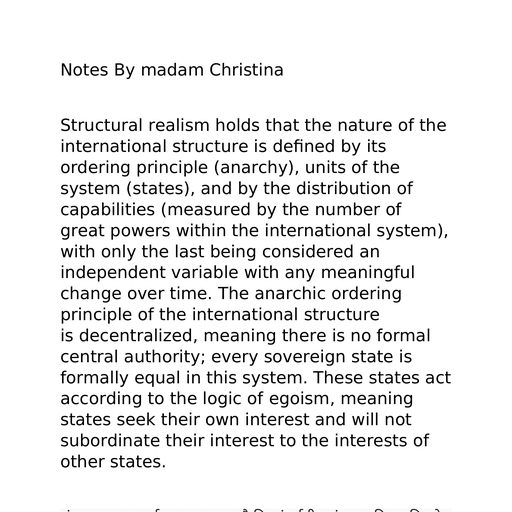
Theoretical Perspectives, , such a scenario, their relative capability (power) becomes important to perform, the same function. A more powerful state has more chances to survive. According, to Waltz, there are two main factors which impede cooperation in anarchic, international system – insecurity and relative gains. Every state remains concerned, about the intentions of the other state leading to insecurity. For instance, since, arms control agreements cannot be independently verified, states would engage, in costly arms race. A state would also consider whether its own gains under, interdependence outweigh those of the others. This would limit the possibility of, cooperation. Analysing the nature of America-Soviet Union relations, neo-realists, would argue that the US opposed the Russian Revolution and remained hostile, to USSR for two decades after it. However, Nazi Germany under Hitler emerged, as a common enemy and despite their internal (ideological) differences and history, of enmity; both the US and the USSR cooperated against the common enemy., After the Second World War, both the superpowers again became adversaries, leading to the Cold War. The rivalry between the two countries was induced by, the structure of international politics and not their domestic factors (although, they may have intensified it). In a bipolar system, both powers see each other as, a threat and would balance against each other. Hence, the Cold War was a natural, result of bipolarity., , 7.4.1 Differences between Classical Realism and Neo-Realism, The differences between Classical Realism and Neo-Realism are explained below., The first difference pertains to the question – why states want power?, According to the classic realists, the answer is human nature. They would, argue that great powers are led by individuals who want to accumulate power, and have their state dominate its rivals. Neo-realism traces it to the structure, of international system. In an anarchical international system, states cannot, trust each other’s intentions and it makes sense for them to be powerful, enough to protect themselves in case they are attacked. Neo-realism is also, called structural realism as it gives central importance to the anarchical, structure of international politics., Second, for classic realists, power is an end in itself while for the neo-realists,, power is a means to an end and the ultimate end for a state is survival., Third, neo-realism followed a different methodology as it relied on methods, drawn from microeconomics. It, therefore, claims to be more systematic, and scientific than classic realism. Neo-realism was influenced by the, behaviouralist revolution of the 1960s while classic realism is based on, subjective interpretation of international politics., , 7.4.2 Defensive Realism, , 110, , There are differences within structural realists on how much power is enough for, a state. There are two views on this question. The first one is given by the defensive, realists and the main proponents include Kenneth Waltz, Jack Snyder and Stephen, Van Evera. Defensive realists argue that since states want security, it is possible, to have an international equilibrium that is stable through balancing. They reject, the argument of offensive realists that states seek hegemony and say that it is, strategically foolish to pursue hegemony. States want an appropriate amount of, power, not hegemony due to a number of factors. First, if any state becomes too
Page 9 :
powerful, other states will balance against it. Second, conquest is feasible but it, would not pay as its costs outweigh the benefits. Due to nationalism, it is difficult, to subdue the conquered. These factors would limit the appetite for power of a, state, otherwise, they risk threatening their own survival., , Classical Realism &, Neorealism, , 7.4.3 Offensive Realism, John Mearsheimer in his The Tragedy of Great Power Politics (2001), has, portrayed offensive realism as the successor to Kenneth Waltz’s neo-realism. He, argues that states seek to maximize power instead of security. States constantly, seek opportunities to maximise their power and hegemony is their ultimate goal., This makes it harder to achieve equilibrium in international politics through, balancing. Offensive realists argue that often, balancing is inefficient which allows, an aggressor to take advantage of its adversaries. Threatened states sometimes, resort to buck passing instead of joining a coalition against an adversary. This, means that they remain on the sidelines while depending on other states to check, the potential adversary. Such behaviour encourages aggression. Offensive realists, have also argued that more often than not, history shows that a side that initiates, war wins. Hegemony may be difficult to achieve but the US had gained hegemony, in the western hemisphere in 19th century., Check Your Progress Exercise 3, Note: i) Use the space given below for your answer., ii) See the end of the unit for tips for your answer., 1), , What are the differences between classical realism and neo-realism?, ......................................................................................................................., ......................................................................................................................., ......................................................................................................................., ......................................................................................................................., ......................................................................................................................., , 2), , Explain the differences between defensive and offensive realism., ......................................................................................................................., ......................................................................................................................., ......................................................................................................................., ......................................................................................................................., ......................................................................................................................., , 7.5, , ASSESSMENT, , The rise of international relations as a discipline and realist approach to IR has, been synonymous with each other. With all its shortcomings, realism has been, the most dominant theory in IR which has profoundly influenced the other, approaches in the discipline. Critics have argued that realism takes an extreme, view of human nature by treating humans as selfish and nasty. Realism would, , 111
Page 10 :
Theoretical Perspectives, , fail to explain why peace and cooperation exists between various states., Responding to neo-realism, Robert Keohane and Joseph Nye have given their, concept of complex interdependence. They have argued that complex, interdependence is closer to reality of world politics than realism. Further, they, state that states are not the only actors in international politics and there is presence, of multinational corporations and international non-governmental organizations, which connect societies. Neo-liberals have accepted that the international system, is anarchic but they do not believe it will lead to conflict and emphasis centrality, of cooperation in international politics. Realism would not have predicted the, fall of Soviet Union and the end of Cold War as it gives more focus to state as a, unit and ignores certain actions of citizens that can threaten the survival of a, state. One of the main reasons for the fall of USSR was that in many of its, republics, citizens revolted against the Soviet leadership and demanded freedom, and independence. Realist approach does not address the new threats to a state –, climate change and terrorism. Terrorist groups like the Islamic State or Al Qaeda, are also called non-state actors and realism does not have much to say about, non-state actors. Critical perspective has challenged the inequality and injustice, in IR and raised issues that are often ignored by mainstream theories like realism., For instance, feminists have argued that the role of women in creating and, sustaining international politics has remained on the fringes and feminist approach, tries to analyze international politics from the eyes of women. J N Tickner’s, critique of Morgenthau has been discussed in Unit 10 of this course. Contrary to, materialist and individualist interpretation of IR given by realism, constructivism, gives more importance to ideational factors like norms, rules and identity. They, argue that identity is socially constructed. Instead of focusing on distribution of, power, constructivism gives importance to distribution of identities. Despite all, the criticism, realism has an important role to caution policymakers against high, idealism and morality so that they do not lose touch with the real picture based, on power and national interest. However, if it becomes a dogmatic practice,, realism can be used to justify aggression and war., , 7.6, , LET US SUM UP, , Realism as an approach has many strands. However, the realists agree on a number, of issues. They agree that international politics is power politics and states are, the main actors in IR. They also stand united in saying that anarchy exists at, international level and there is security dilemma that states face. Classical realism, and neo-realism have certain differences while the neo-realists are further divided, in two camps – defensive realism and offensive realism. Realism has an important, role to caution policymakers against high ideals but too much emphasis on realism, can lead to war and aggression., , 7.7, , REFERENCES, , Aron, Raymond. (1966). Peace and War: A Theory of International Relations., trans. Richard Howard and Annette Baker Fox. Garden City. New York:, Doubleday., Bell, Duncan. (2017). Realism. Encyclopedia Britannica. URL: https://, www.britannica.com/topic/realism-political-and-social-science, 112
Page 11 :
Bell, Duncan. (ed.). (2008). Political Thought in International Relations:, Variations on a Realist Theme. Oxford. Oxford University Press., , Classical Realism &, Neorealism, , Carr, E. H. (1946). The Twenty Years’ Crisis, 1919–1939: An Introduction to the, Study of International Relations. 2nd edition. New York. St Martin’s Press., Donnelly, J. (2005). Realism in Andrew Linklater et. al. (eds) Theories of, International Relations. 3rd Edition. Palgrave. Macmillan., Gilpin, R. G. (1981). War and Change in World Politics. Cambridge. Cambridge, University Press., Korab-Karpowicz, W Julian. (2017). Political Realism in International Relations., Stanford Encyclopedia of Philosophy. URL: https://plato.stanford.edu/entries/, realism-intl-relations/, Mearsheimer, J. J. (2001). The Tragedy of Great Power Politics. New York., Norton., Mearsheimer, J. J. (2016). Structural Realism in Tim Dunne et. al. (eds), International Relations Theories: Discipline and Diversity. Oxford. OUP., Morgenthau, Hans. (1960). Politics Among Nations: The Struggle for Power, and Peace. 3rd ed. New York. Knopf., Niebuhr, Reinhold. (1932). Moral Man and Immoral Society: A Study of Ethics, and Politics. New York. Charles Scriber’s Sons., Thucydides. (1954). History of the Peloponnesian War. trans. Rex Warner., London. Penguin Books., Waltz, K. N. (1979). Theory of International Politics. Reading MA. AddisonWesley., Wohlforth, William C. (2008). Realism in Christian Reus-Smit and Duncan Snidal, (ed) The Oxford Handbook of International Relations. Oxford. OUP., , 7.8, , ANSWERS TO CHECK YOUR PROGRESS, EXERCISES, , Check Your Progress Exercise 1, 1) Your answer should highlight following points: i) Exists under anarchic, international relations, ii) Also called spiral mode, iii) Steps taken by one, country to enhance its own security would decrease the security of other, states , iv) Threatened states then would take steps to increase their own, security , v) This ends up in a perpetual competitive cycle, Check Your Progress Exercise 2, 1) Your answer should highlight following points: i) E H Carr launched an, academic attack on the idealists, ii) Called them deluded and dangerous , iii), Argued morality is not universal but relative, iv) Highlighted the importance, of power, v) Morality is product of power., 113
Page 12 :
Theoretical Perspectives, , Check Your Progress Exercise 3, 1) Your answer should highlight following points: i) Differences over why states, want power (human nature vs anarchy), ii) Differences over the concept of, power, iii) Neo-realism influenced by microeconomic theory, more scientific., 2) Your answer should highlight following points i) Defensive realists believe, it stable international equilibrium is possible via balancing, ii) Offensive, realists argue states want maximum power and want hegemony, balancing, is not possible., , 114