Page 1 :
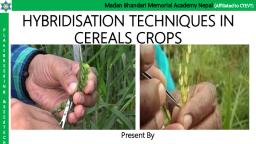
HYBRID SEED PRODUCTION IN MAIZE, Crossing technique, , :, , Manual emasculation by detasseling, , Detasseling, , :, , Removal of male, monoecious crop, , Time for detasseling, , :, , inflorescence, , from, , the, , The time taken for shedding of pollen from the, tassel in 1-2 days after emergence. Hence the, tassel should be removed before the shedding of, pollen., , Detasseling, Detasseling is the removal of tassel from female parent. Detasseling is done, when the tassel emerged out of the boot leaf, but before anthesis have shed pollen., Anthers take 2-4 days to dehisce after complete emergence. Only in few cases, the, anthers start dehisce before its complete emergence. In such case detasseling, should be done earlier. Detasseling is done every day from the emergence of tassel, upto 14 days., Method, , Hold the stem below the boot leaf in left hand and, the base of the basal in right hand and pull it out, in a single pull., , Grasp entire tassel so that all the pollen parts are, fully removed., , Do not break or remove leaves as removal will, reduce yields and will result in lower quality of, seed., , Precautions to be adopted during detasseling
Page 2 :
No part should be left on the plant as it causes contamination., It should be uniform process done daily in the morning in a particular direction., Donot break the top leaves as the field may be reduced due to the earning of, source material to accumulate in sink [seed ] as removal of 1 leaf course 1.5%, loss 2 leaves 5.9% loss and 3 leaves 14% loss in yield., , Detassel only after the entire tassel has come out and immature detasseling, may lead to reduced yield and contamination., , Mark the male rows with marker to avoid mistake in detasseling, Look out for shedders [shedding tassel] in female rows as the may cause, contamination., , After pulling out the tassel drop it there itself and bury in soil. Otherwise late, emerging pollen from detasseled tassel may cause contamination., , Do not carry the tassel through the field as any fall of pollen may lead to, contamination., , Donot practice, improper, immature and incomplete detasseling., Improper detasseling: A portion of the tassel is remaining in the plant while, detasseling., , Immature detasseling: Carrying out detasseling work when the tassel is, within the leaves., , Incomplete detasseling: The tassel is remaining in lower or unseen or, unaccounted in within the whole of leaves., , There should not be any shedding tassel., Shedding tassel: Either full or part of tassel remain in female line after, detasseling and shedding pollen which may contaminate the genetic purity of, the crop.
Page 3 :
System of Hybrid seed production, , Detasseling ( Manual creation of male sterility ), Types of hybrids, Single cross hybrid, It is a cross between 2 inbreds. A x B. A genotype will be detasseled and, crossed with B genotypes., COH 1- UMI 29 x UMI 51, COH 2- UMI 810 x UMI 90, CoH(M) 5-UMI 285 X UMI 61, Double cross, , , It is a cross between two single crosses., , , , It is a cross between 2 hybrids (A x B) x (C x D) (A x B) single cross, hybrid will be produced by detasseling A and by crossing with B (C x D), hybrid will be produced by detasseling C and crossing with D., , Then (A x B) will be detasseled and crossed with (C x D) hybrid.
Page 4 :
Example, Ganga 2 : (CM 109 x CM 110) x (CM 202 x CM 111), Ganga 101 : (CM 103 x CM 104) x (CM 201 x CM 206), COH3 : ( UMI 101 x UMI 130 ) x (UMI 90 x UMI 285 ), , Three way cross, It is a cross between a single cross and an inbred., It is first generation resulting from the crossing of on approved inbred line, and a certified open pollinated variety A x variety), A will be detasseled and allowed for crossing in the variety., Example, , Ganga -5, , (CM 202 x CM 111) x CM 500., , COH (M) 4 : (UMI 90 x UMI 285) x, Double top crosses, , :, , UMI 112, , The first generation resulting from the controlled, crossing of a certified single cross and a certified, open pollinated variety., , :, , (A x B) x variety, , :, , (Ax B) will be detasseled and crossed with a variety, , Seed production technology, Season - November- December, Mid July, Jan. Feb and Sep. Oct, , Isolation distance, Foundation seed (m), , Certified seed (m), , 1. Inbreds, , 400, , -, , 2. Single cross hybrid, , 400, , -
Page 5 :
Field standards for isolation (modification based on situation), For (foundation single crosses and hybrid of certified class), Foundation, , Certified stage, , stage, •, , Same kernal color, , •, , Different kernal colour, , 600, , 300, , •, , Field of single cross / inbreds not, , 400, , 200, , 5, , 5, , 400, , 200, , 400, , 200, , confirming to varietal purity, •, , Single cross with same male parent, confirming to varietal purity, , •, , Single cross with other male parent, not confirming to varietal purity, , Differential blooming dates are permitted for modifying isolation distance, provided 5.0% or more of the plants in the seed parent do not have receptive, silk when more than 0.20% of the plants in the adjacent field within the, prescribed isolation distance are having shedding pollen., In hybrid seed production (certified seed stage) alone the isolation distance (less, than 200 meter) can be modified by increasing the border rows of male parent,, if the kernal colour and texture of the contaminant are the same as that of the, seed parent., The number of border rows to be planted all around the seed field to modify, isolation distance less than 200 m shell also be determined by the size of the field, and its distance from the contaminant as shown below.
Page 6 :
Area in ha., , Isolation distance, (m), , Border rows, , < 4 ha, , 200, , 1, , < 4 ha, , 150, , 5, , < 4 ha, , 100, , 9, , < 4 ha, , 50, , 13, , 10-12 ha, , 180, , 1, , 10-12 ha, , 130, , 5, , 10-12 ha, , 80, , 9, , 10-12 ha, , 30, , 13, , > 16 ha, , 165, , 1, , > 16 ha, , 115, , 5, , > 16 ha, , 65, , 9, , > 16 ha, , 15, , 13, , Seed production stages and production of parental lines / hybrids, , Single, cross, , Double, cross, , Three way, cross, , Double top, cross, , Top, cross, , Breeder seed, , A, B, , A, B, C, D, , A, B, C, , A, B,, variety, , A, variety, , Foundation, seed, , A, B, , (AxB), (CxD), , (AxB), C, , (AxB), variety, , A, variety, , AXB, , (AxB) x, (CxD), , (AxB) x, variety, , (AxB) x, variety, , Ax variety, , Stage of seed, , Certified seed
Page 7 :
Spacing, Seeds are sown in ridges and furrows, Hybrids, , :, , 60x 25 cm, , Seed rate, , :, , Female : 7 -10 kg ha-1, , :, , Male : 3 -4 kg ha-1, , :, , Female : 60 x 20 to 75 x 30 depending on the, , Spacing, area., , Male :45 x 30 cm, Planting ratio, Single cross, , 4:2, , Double cross, , 6:2, , 3 way cross, , 6:2, , Border rows, , a. Inbreds & single cross - 4 rows, b. Others, , - 3 rows, , Fertilizer, NPK kg / ha, , :, , 200 : 100 : 100, , Basal, , :, , 100 : 100 : 50, , 1st Top, , :, , 50 : 0 : 0 (20th days -vegetative phase), , 2nd Top, , :, , 50 : 0 : 50 (Boot leaf stage at 45 days), , Foliar, , :, , DAP 2% at 50% flowering, , In Zn deficient soil, , :, , ZnSO 4 @ 25 kg ha-1, , Roguing, Should be done periodically based on position of cob, colour of silk,, arrangements of seeds in cob, leaves etc. Shedding tassels are to be removed in, roguing . It refers to the tassels in female parents rows, shedding pollen or that has, shed pollen in hybrid maize plots. During field inspection a tassel whose main spike, or any side branch or both have shed pollen or shedding pollen in more than 5 cm
Page 8 :
of branch length is counted as a shedding tassel during inspection the shedding, tassels are taken into count for acceptance or rejection of production plot., , Field standard (%), FS, , CS, , Off types, , 0.2, , 0.5, , Shedding tassel, , 0.5, , 1.0 (when receptive silk, is 5% or more), , Inseparable other crop, , :, , Nil (both stage), , :, , Nil (both stage), , Designated diseases :, , Nil (both stage), , Objectionable weed, , Field standards –specific, Specific factors, Off types shedding pollen when 5 % or more of seed, parent, , Certified stage, 0 .50 %, , in receptive silk, , Seed parent shedding pollen when 5 % of the seed, , 1.0 %, , parent is having receptive silk, Total of pollen shedding tassel including tassel that, , 2 .0 %, , had shed pollen for all 3 inspections conducted during, flowering on different dates, Off types in seed parent at final inspection, , Number of inspection, , :, , Four, , (Seed certification officers), , :, , One : Before flowering, , :, , Three : During flowering, , 0 .5 %, , Harvest, Harvest when the moisture content falls to 20-25%, Harvest male first and remove from the field and then harvest female
Page 9 :
Threshing, a. Dehusking, , - The husks are removed manually., , b. Cob sorting, , - Remove ill filled, diseased cobs and cobs having, kernel colour variation., , Zenia, The direct/visible effects of pollen on endosperm and related tissues in the, formation of a seed colour. e.g. seed colour. In maize, the gene present in sperm, cell contributes in the expression of colour of hybrid seeds., Matazenia, Is the effect of pollen on the maternal tissues of fruit., Shelling, Cob sorting should be the first operation it is a post harvest, evaluation for genetic, purity. The sheath is removed and check for kernel colour, shank colour, diseased, cobs, kernel arrangement. The cobs are shelled either mechanically or manually at, 15-18% moisture content. Improper shelling leads to48% damage to kenel Growth, of storage fungal Pericarp damage. Crack on pericarp can be identified by FeCl 3 or, Tz test. Shelling is done mechanically using cob sheller and manually by rubbing, with stones., Drying, Seeds are dried to 12% moisture content., Grading, Grade the seeds using 18/64" (7.28 mm) sieve., Seed treatment, Slurry treat the seeds with 8% moisture content either with captan or thiram, 75% W.P. @ 70 g/100 kg with 0.5 litre of water. Treated seeds can be stored for 1, year in cloth bag., Others: As in varietal seed production, Seed yield, , :, , 2.5 - 3.6 t/ha
Page 10 :
Seed standard inbred, varieties and hybrids, , Hybrids, , Parameters, , Inbreds, , FS, , CS, , 1. Physical purity (%) (min), , 98, , 98, , 98, , 2. Inert matter (%) (max), , 2, , 2, , 2, , 3. Other crop seed (max), , 5 /kg, , 5 kg-1, , 10 kg-1, , 4. ODV seeds (max), , 5/kg, , 5 kg-1, , 10 kg-1, , 5 Germination % (min), , 80, , 80, , 90, , 6. Moisture content (%) (max), a. Moisture pervious, , 12, , 12, , 12, , b. Moisture vapour proof, , 8, , 8, , 8, , Production of Synthetic cultivars, Breeding of cereal and other agronomic crops has contributed significantly to, the growth of agribusiness worldwide. In, , normally, , self, , fertilized, , crops,, , new, , variability may be created by hybridisation, followed by the selection of desired, cultivars in which desirable characteristics from two or more parents are combined., The type of hybrid cultivar obtained will depend upon the genetic background of the, chosen parents as well on the method of selection used. A similar situation arises, when new variability is artificially induced through mutations., In pure-line theory of classic plant breeding, a pure line is defined as all the, descendants of single homozygous individual by continued self-fertilization,, resulting in a homogeneous cultivar. Hybridization, however, results in significant, heterogenity. The multiplication of such heterogenous progeny in bulk to select, homozygous individuals would be gigantic task. Most modern hybrid cultivars are,, therefore, selected at an early stage (F 2 ) as subsequent lines and probably, released at the F 8 and F 12 generations. These are obviously not as homogeneous, as a pure line.
Page 11 :
Cultivars can also be selected by producing multilines. Whereas normal line, selection seeks to produce a new cultivar on the basis of one line or a few lines, that are very similar, multiline cultivars are essentially different from each other in, their characteristics, such as resistance to pests and diseases or environmental, stresses. Thus, by incorporating different sources of resistance, the newly, synthesized cultivar is buffered against changes brought about by virulent, pathognes. These cultivars are however, not very stable compared to those, produced by the conventional methods of selection. A change in the prevalence of, a virulent pathogen may eliminate certain lines from the cultivar. It is, therefore,, necessary to return the cultivar to the plant breeder for its reconstitution. This may, be advantageous, because it enables plant breeders to substitute new sources of, resistance in the material., Alternatively, the plant breeder can create a composite cross by bulking the, F 2 generations of several crosses. The composite is allowed to develop for several, generations during which natural selection may occur. If the composite is grown at, more than one location, a locally adapted cultivar may be developed in time. The, composite constitutes a gene pool from which the plant breeder can select a, cultivar with desirable characteristics for further multiplication., An alternative to the composite is the synthetic or artificial method of plant, breeding in which a number of lines are put together by the plant breeder in, predetermined proportions. A synthetic line generally has a limited life, because the, proportions of the constituent lines are likely to change over number of, generations. The plant breeder must plan for seed production of limited generation, basis. This system can be extended by using mixtures of cultivars claimed to be, advantageous in some species over a single cultivar, especially if different resistant, genes are present in each cultivar. This method adds to the cost of mixing, which, can be reduced by growing a seed crop for one or two generations after mixing, before using it for crop production., A hybrid cultivar results from a controlled cross between a male and female, parent, the seed being harvested from female parent only and used for crop, production.
Page 12 :
In self fertilized crop species, it is easy to produce hybrid cultivars if male, sterile lines are available that can be used as female parents. There are certain, substsnces that act as a gametocides, destroying the pollen of desired female, parent, or as inhibitors that prevent pollen produced by the female parent from, effecting fertilization. The advantage of the synthetic hybrid cultivar lies in, heterosis. Special expensive measures are required to produce seed that is, harvested from the female parent only. The resultant heterosis therefore must have, a profitable effect to compensate for the cost of production of synthetic hybrid, cultivars in the self pollinating crop species., In the cross pollinated crop species, plant breeders look for parent plants, that have good combining ability. These plants, when allowed to multiply together,, produce a desirable combination of characteristics. Cross fertilization results in, greater heterozygosity in these plants than in the self fertilized plants and therefore, less homogeneity. Each generation of an open pollinated cultivar is thus a mixture, of hybrids. The open pollinated cultivars are generally grown for a limited number, of generations and returned to the plant breeder’s maintenance material after each, cycle of seed production to produce commercial quantities of seeds., Putting together a large number of parent plants and allowing random, pollination to occur can create composites. A composite in a cross fertilized species, is generally the product of the first generation of such random pollination., Production of synthetic cultivars begins with a limited number of specific, parents, which are permitted to interpollinate. The number of generations of, multiplication is strictly limited so as to recreate the synthetic/artificial cultivar at, the end of each multiplication cycle. As with the self fertilized species, synthetic, hybrid cultivars of cross fertilized species are created by controlling pollination to, ensure that seed is produced from a desired crossing. This can be achieved by the, following methods., 1) By emasculating the female parent, as is done in monoecious plants like maize,, by removing the male flowers before the release of pollens., 2) By using male sterility in the female line, so as to avoid the physical removal of, male flowers.
Page 13 :
3) By using self incompatibility. In this system, the seed crop is harvested as a, whole,, , since, , all, , plants, , are, , contributing, , and, , receiving, , pollen., , The, , self, , incompatibility, however, is not always complete, and there may be production of, some inbred plants. With the excessive production of such plants, the advantage of, heterosis in the subsequent crop is diminished., The advantage of the synthetic hybrid cultivar in cross pollinated species is, not restricted only to heterosis. Most hybrids are based upon inbred lines. Normally,, cross fertilized plants require inbreeding for several generations to reduce, heterozygosity and to include desirable genes in synthetic cultivars. A controlled, cross between two such inbreds produces heterosis and desirable combination of, genes in the form of a synthetic cultivar., The major disadvantage of the production of synthetic cultivars is the higher, cost of plant breeding and seed production, requiring considerable time consuming, work to produce desirable inbreds, which alone can be used to synthesize new, artificial hybrids. The final seed crop is not fully productive when male sterility or, emasculation is used, because only the female parent is harvested for seed., Therefore various other hybrids have been produced. The hybrid resulting, from the cross of two inbred lines is a single cross, whereas the F1 resulting from, the cross of two single cross hybrids as parents is known as a double cross. In a, three way cross, an inbred is mated with an f1 hybrid. A top cross is the F1, resulting from a cross between an inbred or a single cross and an open pollinated, cultivar. All of the forms of hybrid cultivars require a particular cycle of seed, production to produce the seed used in crop production.