Notes of Class XI/Sc Physics, Physics XI Ch.12.pdf - Study Material
Page 1 :
fe, , *, , 2,, te, , Heat engines, , Heat engine is a device in which a system undergoes a, cyclic process resulting in conversion of heat into work., (1) It consists of a working substance-the system. For, example, a mixture of fuel vapour and air in a gasoline, or diesel engine or~steam in a steam engine are the, working substances., , (2) The working substance goes through a cycle, consisting of several processes. In some of these, , processes, it absorbs a total amount of heat Q, from an, external reservoir at some high temperature T,, , (3) In some other processes of the cycle, the working, , substance releases a total amount of heat Q, to an, external reservoir at some lower temperature T,., , (4) The work done (W)by the system in a cycle is, , transferred to the environment via some arrangement, , , , =a Cees ee, (e.g. the working substance may be in a cylinder with a, moving piston that transfers mechanical energy to the, wheels of a vehicle via a shaft)., , The cycle is repeated again and again to get useful work, for some purpose., , The efficiency (n) of a heat engine is defined by, , W Q,, , or n= 1-—=, , ™ OQ Q,, , where Q, is the heat input i.e., the heat absorbed by, the system in one complete cycle, (Q, ) is the amount of, , heat rejected to the environment and W is the work, , done on the environmentin a cycle.
Page 2 :
2, —, , 2, od, , 2, ee, , Refrigerators and heat pumps, , In a refrigerator or a heat pump, the system (the, working substance) extracts heat Q, from the cold, , reservoir at temperature T,, some external work W is, done on it and heat Q, is released to the hot reservoir, at temperature T,., , A heat pump is the same as a refrigerator., , In a refrigerator the working substance (usually, in, gaseous form) goes through the following steps:, , (a) sudden expansion of the gas from high to low, pressure which cools it and converts it into a vapour, liquid mixture,, , , , io, ee, , cas a es, (b) absorption by the cold fluid of heat from the region, to be cooled converting it into vapour,, , (c) heating up of the vapour due to external work done, on the system, and, , (d) release of heat by the vapour to the surroundings,, bringing it to the initial state and completing the cycle., , The co-efficient of performance (a) of a refrigerator is, , given by, = Se,, , WwW Q-Q,, , where Q, is the heat extracted from the cold reservoir, , a, , and W is the work done on ‘the system., , The co-efficient of performance (a)for heat pump is, , defined as, , x., Ww, , where Q, is the heat released to the hot reservoir and, , a, , W is the work done on the system.
Page 3 :
*, , Second Law of Thermodynamics, , It states, Kelvin-Dlanck statement, , , , No process is possible whose sole result is the, , , , , , No process is possible whose sole result is the transfer, of heat from a colder object to a hotter object., , The Second Law implies that no heat engine can have, efficiency n equal to 1 or no refrigerator can have coefficient of performance a equal to infinity., , It can be proved that the two statements above are, , completely equivalent., , ", , Reversible and irreversible processes, , , , A thermodynamic process is goearble if the process, can be turned back such that both the system and the, surroundings return toStheir” original states, with no, other change anywhere else in the universe., , The spontaneous processes of nature are irreversible., A reversible process is an idealised notion., , A process | is. reversible only if it is quasi-static (system, in equilibrium with the surroundings at every stage), and there are no dissipative effects such as friction,, , viscosity, etc.
Page 4 :
Carnot engine, Carnot engine is a reversible engine operating between, , two temperatures T, (source) and T, (sink). The, , working substance of the Carnot engine is an ideal gas., , , , = _ i ei, Carnot engine have a sequence of steps constituting, one cycle, called the Carnot cycle., , The Carnot cycle consists of two isothermal processes, connected by two adiabatic processes., , (a) Step 1 > 2 Isothermal expansion of the gas taking, its state from (P,, V,, T,) to (P,, V2, T,)., , The work done (W,_,,) by the gas is, , Wi2 = Q =RT, in ¥2], , 1, , (b) Step 2-3 Adiabatic expansion of the gas from, (P,, V2, T,) to (P3, V3, Tp), , Work done (W,_,,) by the gas is, , T, - T,, y-1, , , , W243 =R, , (c) Step 3 +4 Isothermal compression of the gas from, (P;, V3; Ty) to (P;; V4.5 T,)., The work done (W;_,,) on the gas, , W3_,4 = Qo = RTyIn-V2, , 4, , (d) Step 4 +1 Adiabatic compression of the gas from, (P,, V4, T2) to (P,,V,, T,)., , Work done on the gas is, , , , | Gas Gua, T, _ T,, , y-l1, Total work done by the gas in one complete cycle is, , , , Wi.4= R, , W= W..2+ Wo3 — W344 - Wa., , V. V., = pR’T, In| 2: |-—pREIn—, buN 1) (%} HUNT. V, , 1 4
Page 5 :
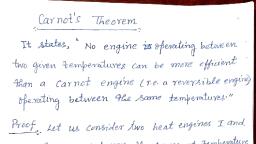
The efficiency of a Carnot engine is given by, , , , y ret onl = Qo wis, Q, Q,, V., ws., T, mY,, nHl- 3, Ty, ia ¥2 |, V,, , Now since step 2—.3»is an adiabatic process,, , T,Vz" =T,V3", , 1/(y-1), i.e: we = 4g ond, V3 T, Similarly, since step 4— 1 is an adiabatic process, T,Vz" =T,Vy rs, 1/(y-1), ie. Mi co 3, Ve, From Eqs. (2) and (3),, Vs _ Va ‘, Vv, V,, , , , Carnot's theorem, (a) No engine operating between two temperatures can, have efficiency greater than that of the Carnot engine, and, (b) The efficiency of the Carnot engine is independent of, , the nature of the working substance.



 Learn better on this topic