Page 1 :
Consider two surfaces S, and S2 very close to each other on which th, rate of change p with respect to the space variables and has the, Hence the magnitude of the vector Vo is equal to the maximum, (1) Line integral. Let PQ be any curve, drawn in a vector field and dl, The integrals, which we generally come across in Vector Algebra a, an element of length along this curve at any point B. Let A represent the, vector at B in a direction making anngle 0 with dl. In general if A varies, the line integral, the surface integral and the volume integral., scalar, it converts the scalar into a vector. This vector (V ) is called, орerated, 36 MECIHANICS, in, poi, gradient of the scalar., For example, the scalar quantities,, such as temperature and electric potential,, can be represented from point to point in, space by a scalar function o (x, y, z) and we, say that a scalar field is present in the o, space. The scalar field can be mapped out, by level surfaces, upon each of which, $(r,y,z) has a constant value., dn, Unit, Nom, dr, the, + do, Fig. 1.37, values of scalar function are and + dp respectively. If dn, the distance along the normal from the point P (on surface S, surface S2, we may write, represenk, dn = dr cos 0 =n dr, where n is the unit normal to the surface S, at P., The rate of increase of o at P in the direction of n is'greatest and is, equal to dp/an. Therefore,, do, n dr, an, But Vo dr =, (1 + + R(î de +f dy + k dz), dy +, dz =dp, %D, dx+, %3D, dz, dp =, n dr Vo dr, ...(5), 2, on, Therefore Vo, ..(76), %3D, n., direction of that change., In particular, if dr lies on the surface S, we have, do =Vo dr =, which means that the vector Vo is normal to the surface =cons, 1.23. Vector Integration., are, be, a
Page 2 :
VIECTORS | 37, in magnitude and direction from point to, point along the curve, the integral, A d-SA cos 0 dl, is defined as thc line integrat of A along, the curve PQ., In terms of cartesian components,, ...(77), ... (78)., If a force F is acting on a moving particle, then the line integral J F.dl over the path, described by the particle is the work done by the force., (2) Surface integral. Consider any clement of, infinitesimal arca ds upon a suríace S in a vector, field. If A be the value of the vector at the middle, point of the element, then the integral over the, surface, Fig. 1.38, V., SSA ds =SSA cos 0 ds, is defined as the surface integral or total flux, of vector A through the whole surface S., In cartesian components,, ... (79), %3D, S., Fig. 1.39, SSA ds = SS, (Ax dsx+Ay dsy+Az dsz), .(80), %3D, ..., If V denotes the vector velocity of a moving fluid, in which a fixed, surface S is drawn, then fS, V ds will represent the rate of flow of liquid, through the surface S., (3) Volume integral. If we consider a closed surface in space enclosing a, volume V, then, SSS, AdV = SSS,(4zî+ Ayf + Azk) dx dy dz ... (81), %3D, is defined as the volume integral., 1.24. Divergence., If A (x, y, z) is a vector field, the scalar product of the vector, operator V andA is a scalar and is called the divergence of A, i.e.,, -(+ + - (î As + ĵ Ay + k Az), div A =V A =, ax, dy, dAx Ay đAz, ... (82), V.A, div A, %3D, or, %3D, ax, ду
Page 3 :
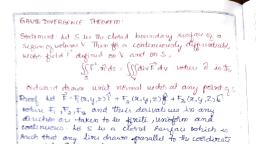
VECTORS 39, per unit volume from that point. If A is denoting the velocity of the, moving fluid, then V A tells the rate at which the fluid is diverging from, the point per unit volume., If the divergence is positive at a point in a fluid, then cither the fluid, is expanding and its density at that point is falling with time or the point is, a source of fluid. In case, if the divergence is negative, then cither the fluid, is contracting and its density is rising at the point or the point is a negative, source, i.e, sink., If the flux, entering any clement of field space is exactly balanced by, that leaving it, the quantity div A 0. Then, there is no source or sink,, nor its density is changing, i.e., the fluid is incompressible. If the fluxes, entering and leaving an element are equal, the lines of flow of the vector, A should form cither closed curves (e.g., in case of magnetic field of a, current) or extend to infinity. A vector which satisfies this condition is, called solenoidal., 1.25. Gauss's Theorem., According to this theorem, the volume integral of the divergence of a, vector field A taken over any volume V is equal to the surfacc integral of, A taken over the closed surface surrounding the volume. That is, SSS, (V-A) dV = SS A ds, .(83), %3D, Proof. In cartesian coordinates,, V.A = (++- (4. î + 4y ĵ + Az Î), %3D, aAz, dy, az, dV, dx dy dz,, %3D, A•ds = (Aî + Ayf + A, k). (dszî + dsy ĵ + dsz k), = Ax dsx + Ay dsy + Az dsz, = Ax dy dz + Ay dr dz + Az dx dz., and, %3D, Hence, Gauss's theorem in cartesian coordinates is, aAy dAz, +., dr dy dz, dy, az, = SS, (Ax dsx+Ay dsy+Az dsz), (84), %3D, Let us consider the first part of the left-hand side integral. As shown
Page 4 :
VECTORS 43, PcA di (curl A).d s2 k, Now, if we consider any infinitesimal plane arca os ds, îtds,+os, k, at P oriented in any direction with a boundary C, then evidently, PcA dl = curl A ds, ... (94), %!, The maximum value of A dl | curl A | Os., Thus, the magnitude of curl A at a point may be defined as the, %3D, maximum value of the line integral of A along a boundary C (9 A dl) per, unit area; this boundary C is that of an infinitesimal plane area (delta s) at, the point under consideration., 1.28. Stoke's Theorem., This theorem states that the line integral of a vector A around any, closed curve C is equal to the surface integral of curl A taken over any, surface S of which the curve is a boundary cdge, i.e.;, $c A dl = SS, curl A ds = SS (VXA). ds, (95), %3D, %3D, Proof. If a vector A be a function of position, then its linc integral, along a closed curve C is given by, $c A di, where dl is the small element of the path. Now, divide the enclosed area into, two parts by a line pq so as to form two closed curves C, and C2. If L, and L2, are the line integrals for the two paths C, and C, then their sum (L, + L), will be equal to L for the curve C. The reason lies in the fact that the part pq, is traversed from p to q for the curve C, and from q to p for the path C, so, that its contribution is cancelled. Thus, if we divide the area enclosed by the, L=, C1, IP, Fig. 1.43
Page 5 :
VECTOR INTEGRATION, 155, 135, 4.5 Stokes' Theorem, Statement. IfA has continuous derivatives and if S is a surface, hounded by a curve C, then, SA. dr J curl A.n dS = J [ (v x A). n ds,, 50, !!, %3D, C, S., where the unit normal vector n at any point of S is drawn in the sense in, which a right handed screw would move when rotated in the sense of descrip-, tion of C., The proof is omitted., Remark 1. Stokes' theorem can be stated in words as follows:, The line integral of the tangential component of a vector A taken, uround a simple closed curve C is equal to the surface integral of the normal, component of curl A taken oven any surface S having C as its boundary., Remark 2. The cartesian form of Stokes' theorem is:, at, ctor, SA, dx+A2 dy + A3 dz = !, dy, cos a+, dz, cos B, dx, C, dx, dy, cos y dS., .(1), Let A A, i+ A2 j+ A, k, n=cos a i+ cos Bj + cos y k,, dr = dx i+ dy j+ dz k. Then A. dr A, dx +A2 dy + Az dz .(2), s ar, j, curl A = 0/dx /0y /0z, and, %3D, = 0., A1, A2, A3, dy, dz, dx, ду, .. curl A.n =, dy, Cos a+, dz, cos B, dz, DA2 DA, COS Y., dy, .(3), We obtain the expression (1) on using (2) and (3) in the vector form, of Stokes' theorem., por, EXAMPLES, Example 56. Evaluate J J (Vx A). n ds,, where A= (x+y-4) i+3.xy j+ (2xz+z) k and S is the surface of the, (a) hemisphere x +y² + z² = 16, (b) paraboloid z= 4- (x+ y) above the xy-plane., %3D