Page 1 :
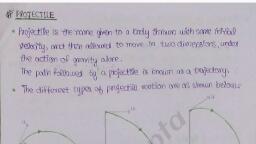
PROJECTILE FIRED AT AN ANGLE WITH HORIZONTAL, , een angle 8 with the horizontal from the, of the projectile can be resolved into the, , Consider that a projectile is fired with velocity u and makin;, point O on the ground. [Fig. 4.06]. The velocity of Projection ¢, following two components :, , () ux = u cos @ along OX and (ii) uy = u sind along OY, , As the projectile moves, it covers distance along the horizontal due to the horizontal component, u cos 6 of the velocity of projection andy, along the vertical due to the vertical component u sin 8. Suppose that at any time f,, the projectile reaches the point P so that, its positions along the X and Y-axis are, given by x and y respectively., , Motion along horizontal. lf we neglect, friction duc to air, then horizontal component of the velocity ie. u cos @ will “y, remain constant. Thus,, , , , , , initial velocity along the horizontal, c ‘ My x >, Uy =u cos 6; K, acceleration along the horizontal, Fig. 4.06, a,=0, The position of the projectile along X-axis at any time ¢ is given by, , A, \, ', ', ', ', ', ', ', B, R, , , , 1, xeuglt5ae, , Setting uy =ucos@ and a, =.0, we have, , x= (woos) 1+ 5(0)? or x = (ucos6)t, , or t=— (4.22), u cos 6, , Motion along vertical. The velocity of the projectile along the vertical goes on decreasing due to the, effect of gravity., Initial velocity along vertical, uy =u sin 8 ; acceleration along vertical, a, = —g, , The position of the projectile along Y-axis at any time ¢ is given by, , , , yewt+ sae, Setting uy =usin@ and a,= — g, we have, , y= (usin) +3 (-8)?, or y=(usin6)t - See
Page 2 :
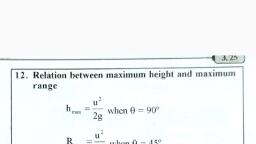
(i) Equation of trajectory. The equation of the trajectory of the projectile can be obtained by, substituting the value of f from equation (4.22) in the equation (4.23). Therefore, we have, , 2, , x lox x, y = (usin) x T5628 u cos @, , g 2, or yaxind ~ (ata), , , , , , (4.24), 2u* cos*6, , As equation (4.24) is the equation of a parabola, it follows that a projectile fired at some angle with, the horizontal moves along a parabolic path., , | Gi) Time of flight. /t is the time taken by the projectile fo return to ground or the time for which the, projectile remains in air above the horizontai plane from the point of projection. It is denoted by T. ., , As the motion from the point O to A and then from the point A toQ are symmetrical, the time of, , ascent (for journey from the point O to A) and the time of descent (for journey from the point A to Q), , will be each equal to ft Further, on reaching the highest point A, the vertical component of the velocity, Of the projectile must become zero ie. vy = 0., , The velocity of the projectile at any time f along the Y-axis is given by, vy = uy + ayt, , Setting uy =u sind; ay = ~git=7 and vy = 0, we have, , O=usind +(-g) 7, , or T= 2using (4.25), (iii) Maximum height attained. It is the greatest height to which a projectile rises above the point of, Projection. It is denoted by H., , The distance covered by the projectile in time ¢ along the Y-axis is given by, . ySuyt+ 54 P, , , , =e and y=H, we have, H = (using) x 4828 4 3 (_ py (usin y2, & 2 &, , Setting uy =u sin@ dys —gstay nee, , , , 2 pin?, u* sin“ @, or H =——, , 26 : ++-(4.26), (jv) Horizontal range. It is the distance covered by a projectile along the horizontal between the ‘point, of projection to the point on ground, where the projec, , tile returns again. It is denoted by R., Obviously, the horizontal range R is the horizontal distance covered by the projectile with uniform, velocity u cos 6 in a time equal to the time of flight. Therefore,, . Din 8, R =u cos6 x T =u coso x 2H8in0 _ uO sinO cos 6), 2 sin 6 cos 6 = sin26, we have, , 2., u“ sin26, Raw?", , (4.27), , As