Page 1 :
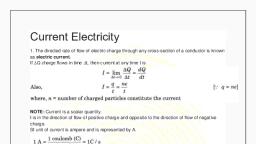
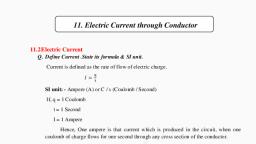
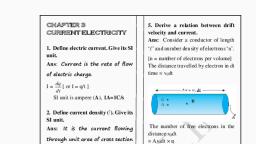
Chapter 3, Current Electricity, , Charges in motion constitute an electric current. Such currents occur, naturally in many situations. Lightning is one such phenomenon in which, charges flow from the clouds to the earth through the atmosphere. The flow, of charges in lightning is not steady, but in our everyday life we see many, devices where charges flow in a steady manner. A torch and a cell-driven, clock are examples of such devices., , Electric Current, , When current steady ,, The rate of flow of charge through any cross-section of a conductor is, called electric current flowing through it., , 1=4, t, é * _ coulomb __ _, Unit of electric current = Pears =C/s =ampere (A), When current is not steady,, , The current at time t across the cross-section of the conductor is defined as, the ratio of AQ to At in the limit of At tending to zero,, , AQ _ dQ, i” iy na, Electric Currents in Conductors, When no electric field is present:, The electrons will be moving due to thermal motion . During motion, electrons collide with the fixed ions. The direction of its velocity after the, collision is completely random. The average velocity of electrons will be, zero. So, there will be no net electric current., , When an electric field is present:, , , The electrons will be accelerated due to this field towards +Q. They will thus, move to neutralise the charges and constitute an electric current. Hence, there will be a current for a very short while and no current thereafter., , To maintain a steady electric field in the body of the conductor we use cells, or batteries.
Page 2 :
Ohm’s Law, , A basic law regarding flow of currents was discovered by G.S. Ohm in 1828., At constant temperature ,the current flowing through a conductor is directly, proportional to the potential difference between the ends of the conductor., , Val, , V=RI, Vv, , =>, , The constant of proportionality R is called the resistance of the conductor, The SI units of resistance is ohm and is denoted by the symbol 9., , Conductance, The reciprocal of resistance is called Conductance., , C=, , <l=<zI—, , Unit of conductance is ohm~!(Q7'or mho) or =siemens, , Ohm’s Law : Experimental verification, , aca Bl Te, O, , + —, , , , , , , , , , , , , , , , , , , , Voltage -Current Graph (V-I Graph), Slope = a, Slope = . =R, , c 5 Slope of V-I graph gives Resistance., 1 Its reciprocal gives conductance., , Which material has more resistance?, , A, , Slope of V-I graph gives Resistance. Slope of A is greater than that of B., So material A has more resistance than B.
Page 3 :
Factors on which the Resistance of a Conductor Depends:, 1)The material of the conductor, 2)The dimensions of the conductor, a)Length of the conductor, The resistance of a conductor is directly proportional to, length | of the conductor., Ral, b) The area of cross section of the conductor, The resistance of a conductor is inversely proportional to the crosssectional area, A., , 1, “R A, , Resistivity of a Conductor, The resistance of a conductor is directly proportional to length / of the, conductor and inversely proportional to the cross-sectional area, A., l, Re« x, _ ol, “A, , where the constant of proportionality p is called resistivity., , Resistivity depends on the material of the conductor but not on its, , dimensions., _ RA, Pr, 2, , Unit of resistivity = “= am, , , , Ohm’s Law in Vector Form, V=IR ; Current density, R= pt Current per unit area (taken normal to the current), is, i A called current density and is denoted by j., V= “ Current density i=t, Unit of current density =A/ m?, Vv =| ip 1 Current density is a vector quantity., , , , , , , , If E is the magnitude of uniform electric field in the conductor whose length is J, then the, , , , potential difference V across its ends , V=El., El =jpl, E=jp, This is the vector form of Ohm’s law. Here electric field and current density are vector quantities, »_E Conductivity, i= p Conductivity is the reclame of resistivity, j=oE aa, This is another equation for Ohm's law in vector form. } [jn it of conductivity is @-* m="