Page 1 :
CHAPTER 1, МЕСНANICS, ICONTENTS, Introduction:, 1.1 Compound Pendulum-expression of time period., 1.2 Interchangeability of centre of suspension and oscillation., 1.3 Kater's Pendulum, 1.4 Newton's law of Gravitation (Statement only), 1.5.Gravitational Field, 1.6 Gravitational Potential, 1.7 Gravitational Potential of mass, 1.8 Gravitational potential due to a solid sphere :, 1.8.a. Gravitational potential at a point outside the solid sphere, 1.8.b. Gravitational potential at a point inside the solid sphere :, 1.8.c. Gravitational potential at a point on the surface of solid sphere, 1.9 Gravitational field due to a solid sphere, 1.9.a. Gravitational ficid at a point outside the solid sphere, 1.9.b. Gravitational field àt a point inside the solid sphere, 1.9.c. Gravitational field at a point on the surface of solid sphere, 1.10 Gravitational potential due to a Spherical Shell., 1.10.a. Gravitational potential at a point outside the Spherical Shell, 1.10.b.Gravitational potential at a point inside the Spherical Shell, 1.10.c. Gravitational potential at a point on the surface of Spherical Shell, 1.11 Gravitational field due to a Spherical Shell, 1.11.a Gravitational field at a point outside the Spherical Shell, 1.11.b.Gravitational field at a point inside the Spherical Shell, 1.11.c.Gravitational field at a point on the surface of Spherical Shell, Introduction :, Mechanics is a branch of the physical sciences concerned with the state.of rest or, motion of bodies that are subjected to the action of forces. The study of mechanics, involves many morc subject arcas. However, initial study is usually split into two arcas;, statics and dynamics. Statics is concerned with bodics that are either at rest or, move with a constant speed in a Fixed direction. Dynamics deals with the, Mechanics, (9), Scanned By CamNScan
Page 2 :
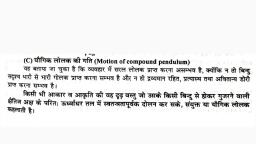
designed with the intention that they are at' rest or thcir motion remains constant, statics, of dynamics where the accelcration is zero. In cngincering, since many objccts are, accelerated motion of bodics. Statics can thcrcforc be considcred as a spccial case, descrves special treatment. Mcchanics deals with the dynamics of particles, rigid bodine, continuous media (Fluid, plasma, and solid mcchanics), and ficld theories such, clectromagnetism, gravity, ctc. This thcory plays a crucial role in quantum meçhanics, control thcory, and other areas of physics, cnginccring and even chemistry and biolomy, Clearly mechanics is a large subjcct that plays a fundamental rolc in science. Mechanice, also played a key part in the developmcnt of mathematics., 1.1, Compound pendulum- expression of time period :, "A Compound pendulum is a rigid body which is capable of oscillating freely, about a horizontal axis passing through it. Its vibrations are also simple harmonic, and its time pcriod is given by the relation", I, T= 27, mg.l, Where I-is its moment of inertia about the axis of suspension m-mass of rigid body, 1- be the length of pendulum., Expression of time period :, Let us consider S be the point of suspension of the body through which passes a, horizontal axis, perpendicular to the plane about which the body oscillates. Its centre of, gravity lies vertically below S in its normal position of rest is as shown in below Figure, [Fig : Compound Pendulum], Mechanics, Scanned By CamNScan, (10
Page 3 :
Let the body be displaced through an angle o so that its centre of gravity is now at, Moment of the restoring couple or lorque=-mg./ sin 0, If the angular acceleration produced in the body by this couple be, dr, d'0, The couple will also equal to 'I.-, Where i is moment of inertia of the body about an axis through the point of suspension, S, and perpendicular to the plane., So that I.-, di, = -mg.I sin 0, If e being very small, then Sine0, d'e, 1. =-mg.1.0, di, !!, 1.-, + nmg.l.0 = 0, di?, d'0 , mg.1.0, di?, = 0, I, (1), ----- -----, This equation is similar to the differential equation of S. H. M. Hences its time, 27, period is given by T=-, Compareing equation (1) with equation of differential equation of S. H. M., d'e, -+ w*0 = 0 we get,, di?, mgl, mg!, W =, %3D, !, I, I, T = 27,, V mg!, (2), ---- ----, We Know that the principal of parallel axis is given by,, I = 1, + ml², %3D, Scanned By CamNScan, (11), Mechanics
Page 4 :
If 1, be the M.I. of the body about an axis through (1, its C, (, and paprallel to thei, axis of suspension through S., lo : mk where k he the radius of gyrution of the body about the axis through (i, | = mk' + ml', Substituting the valuc of I in cquation (2) we get,, mk? + ml, T: 27, mgl, T = 27,, g!, T 271, i.c. the period of vibration is the same as that of a simple pendulum of length, which is length of an equivalent pendulum., 1.2 Interchangeability of centre of suspension and oscillation :, Centre of Oscillation:, k?, from G, is called the centre of, A point O, on the other side of G, at a distance, suspension, and a horizontal axis through it, parallel to the axis of suspension, is known, as the axis of oscillation of the pendulum. Thus, GO =-, from following figurc (n), 1G, to, (b), [Fig : (a) Centre of suspension, (b) Interchangeability of Centre of suspension), (a), Мcchanics, Scanned By CamNScan, (12)
Page 5 :
puting it equal to , So we have, SO = 1+1,, k?, SO = 1+, and, T = 27, = 27, V8, Thus the point of oscillation (O) lies at distance 1 from the point of suspension (S), or the distance between the two gives the length of the cquivalent simple pendulum., Interchangeability of centre of suspension and oscillation :, If the pendulum be suspended about the axis of oscillation through O, as shown in, Fig. (b), Time period of vibration will be given by, T = 27,, gl, since, :=' ::k? = 11', %3D, So that the expression for the time period t is becomes,, T = 27,, gi', 1.+7, T = 27,, k?, 1.+, T = 2n1, Which is the same as about the axis of suspension through S. Thus, the centres of, suspension and oscillation are interchangeable., Mechanics, (13), Scanned By CamNScan