Page 1 :
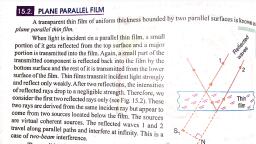
INTERFERENCE IN THIN FILMS, When a film of oil spreads over the surface of water, or a thin glass plate is illuminated, by light, interference occurs between the light waves reflected from the film, and also, between the light waves transmitted through the film., Let a monochromatic light ray SP1 be incident at an angle i on a parallel-sides, transparent thin film of thickness t and refractive index µ. At the point P1, the ray is, partly reflected along P1R1 and partly refracted along P1C1 at angle r. At point C1, It is again partly reflected along C1P2 and partly refracted along C1T1. Similarly, reflection and refractions occur at pointsP2C2.....etc as shown (Fig-a).Thus we get a set, of parallel reflected rays P1R1 P2R2 .......etc. and a set of parallel transmitted rays C1T1,, C2T2...etc. At any boundary between two different transparent media there is always, partial reflection and partial transmission., , FIG. - a, , Interference in reflected rays, The reflected rays are P1R1 and P2R2, let P2A is the perpendicular draw from P2 to P1R1., Since path difference in reflected rays from P1R1 to P2R2, Path difference = path P1C1P2 in medium – path P1A in air
Page 5 :
(d) Interference due to an infinitely thin film, When the thin of the film is small compared to the wave length of light (𝜆 >> t). The, effective path difference between the interfering waves in reflected light for a film is 2ut, cosr - 𝜆/2. When the film is excessively thin such that its thickness t is very small, compared to the wavelength of light then 2ut cos r is almost zero. Hence the effective, path difference becomes 𝜆/2. This is condition for minimum intensity. Hence every wave, length will be absent and the film will appear black in reflected light and it will appear, bright in transmitted light., , (e) Interference in a thick film, When the thickness of the film is large compared to the wave length of light (t>> 𝜆), the, path difference at any point of the film will be large. In this case the condition of, 𝟏, constructive interference (2µt cosr = (n+𝟐 ) 𝝀),at a given point is satisfied by large number of, wave length with the value of n different for different colours. At the same point the condition of, destructive interference (2µt cosr = n𝝀) is also satisfied for another set of large number of, wavelength .The, Thus in the case of a thick film illuminated by white light,the colors are not observed in the, reflected light and its appears uniformly illuminated., , (f) Colors of thin films:, When a thin film is illuminated by monochromatic light and seen in reflected light, it will appear, 𝟏, bright if 2µt cosr = (n+𝟐 ) 𝝀 and dark if 2µt cosr = n𝝀. however the film is illuminated by white, light the film shows different colors., The eye looking the film receives the waves of light reflected from the upper and lower, surfaces of the film. For a thin film these rays are very close to each other. The path, 𝟏, difference between interfering rays is (2µt cosr - 𝟐 𝝀). The path difference depends upon, t, the thickness of the film and upon r which depends upon the inclination of the incident, rays. Now white light consist of a continuous range of wave lengths. For a particular, value of t and r i.e. at a particular point of the film and for a particular position of the eye,, the waves of only certain wavelength satisfy the constructive interference. Therefore, only those color will be present in the reflected system with maximum intensity. The, other neighbouring wavelengths will be present with less intensity. There will also be, certain wavelengths which satisfy the condition of minima. Such wavelengths of colors, will be absent from the reflected light. AS result the point of the film will appear colored.
Page 6 :
(g) Fringer of equal inclination or Haidinger fringes, Let us consider that a thin film is illuminated by an extended monochrometic light, source. When the film is of uniform thickness, the path difference 2µt cosr between the, coherent beams is only due to the change in r. If the thickness of a film is large, the path, ifference will change appreciably even when r changes in a very small way. In this case, each fringe represent the locus of all point on the film, ray from which are equally, inclined to the normal. There fringes are called fringes of equal inclination. The fringes, of equal inclination are known as Haidinger fringes. In this case all the pairs of, interfering rays of equal inclination pass through the plate as a parallel beam and hence, meet at infinity. The other pairs of different inclination meet at different points at infinity., , Necessity of an Extended Light Source, An extended source is necessary to enable the eye to see whole of the film and, observed the interference pattern due to whole film., Let us consider a thin film and a narrow source of light at S (fig.a) then for each incident, ray E1,E2 we get a pair of parallel interfering rays. The incident ray produces, interference fringes because E1r,E1r′ reach the eye where as the incident ray E2 meet, the surface at some different angle and is reflected along E2r E2r'. Here E2r E2r' do not, reach the eye. Therefor,the position A of the film is visible., , Fig – a, , Fig - b, , If extended source of light is used (fig.b)the incident ray E1 after reflection from the upper and, the lower surface of the film emerges as E1r,E1r' which reach the eye. Also incident ray E2 from, some other point of the source after reflection from the upper and lower surface of the film, emerges as E2r,E2r' which also reach the eye. Therefore,in the case of such a source of light, the, rays incident at different angles on the film are well adjust by the eye and the field of view is, large. Due to this reason, to observe interference phenomenon in this film, a broad source of light, is required. With a broad source of light, rays of light are incident at different angels and the, reflected parallel beams reach the eyes or the microscope objective. Each such ray a light has its, origin at a different point on the source.
Page 7 :
Interference due to a thin wedge – shaped film, , Fig – a, Let us consider a thin wedge shaped film of refractive index µ, bounded by two plane surfaces, inclined at an angle (fig. a). Let the film be illuminated by a parallel beam of monochromatic, light the interference occurs between the incident ray reflected at the upper and lower surfaces of, the film so that equidistant alternate dark and bright fringes becomes visible. The interfering rays, in reflected light are AR1 and CR2, both originating from the same incident ray SA. To evaluate, the path difference between these two rays the perpendiculars CD and CG are drawn from C on, AR1 and AB. If 𝜃 is an angle of wedge – shaped film is very small AR1 and CR2 will be almost, parallel and after the perpendicular CD the paths will be equal., The path difference between AR1 and CR2 will be, ∆1= path ABC in medium – path AD in air, , ………..(1), , = µ( AB+BC) – AD, As ∆ACD and ∆ACG, i+∠𝐷𝐴𝐶 = ∠𝐷𝐴𝐶 +∠𝐴𝐶𝐷 = 90°, ∠𝐴𝐶𝐷 = i, r +∠𝐶𝐴𝐺 = ∠𝐶𝐴𝐺+∠𝐴𝐶𝐺 = 90°, ∠𝐴𝐶𝐺 = r, 𝑠𝑖𝑛𝑖, , 𝐴𝐷⁄, , 𝐴𝐷, , Refractive index µ of the film µ = 𝑠𝑖𝑛𝑟 =𝐴𝐺⁄𝐴𝐶 = 𝐴𝐺, 𝐴𝐶, , AD = µ AG, , ………….. (2), , To find the length of the path of light ray BC , now draw perpendicular CE from C on, OE and produces AB. These meets at F.
Page 9 :
When this condition is satisfied,the film will appear bright in the refracted light., , Destructive interference, The path difference for the destructive interference is, 1, , Δ = (𝑛 ± 2)𝜆, 𝜆, , 1, , 2𝜇t cos𝜃 − 2 = (𝑛 − 2)𝜆, , (n=1,2,……), , 2𝜇t cos𝜃 = n𝜆, Under this condition the film will appear dark in the reflected light., While r and 𝜃 are very small. So the path difference primarily depends on the, thickness of the film t., The thickness of film in wedge-shaped film increases from zero as the distance from, the edge increases. Therefore the path difference between the interfering rays, increases from zero with the increasing of the thickness of film.Thus condition (7), and (8) are satisfied .Alternately as the thickness of the film increases. Hence dark, and bright fringes are alternatively in the wedge shaped film., (i), , Fringe width, Let (n+1) and n dark fringes be formed at distance xn+1 and xn from the wedge, 0., Fringe width 𝛽 = (𝑥n+1 –xn), , If the thickness of film at these distance are tn+1 and tn, then, tn+1 = xn+1tan𝜃, tn = xntan𝜃, or, , tn+1 – tn =(xn+1 –xn) tan𝜃 = 𝛽tan𝜃, , For normal or near normal incidence i≈ 0, 𝑟 ≈ 0, For nth dark fringe, 2𝜇tn cos𝜃 = n𝜆, For (n+1)th dark fringe, 2𝜇tn+1 cos𝜃 = (n + 1)𝜆
Page 10 :
Subtracting equation (10) from equation (11), 2𝜇(tn+1−tn)cos𝜃 = 𝜆, Substituting the value in equation (9), 2𝜇𝛽tan𝜃 cos𝜃 = 𝜆, 2𝜇𝛽𝑠𝑖𝑛𝜃 = 𝜆, So that, , 𝜆, , 𝜆, , 𝛽 = 2𝜇𝑠𝑖𝑛𝜃 ≈ 2𝜇𝜃, , (if wedge angle is very small 𝑠𝑖𝑛𝜃 ≈ 𝜃), , 𝜆, , 𝛽 = 2𝜇𝜃, From this equation it is clear that the wedge film is form an angle 𝜃 is very small then, the fringe width of the reflected light is independent of n. Therefore for dark fringe and, bright fringes are equal width and if the wedge angle 𝜃 is increase then fringe width is, also decrease and if wavelength is increase then fringe width is also increase., Fringes of equal thickness or fizeau fringes, The path difference ∆ = 2𝜇t cos𝜃 between the rays reflected from the wedge shaped, film of constant wedge angle depends on the thickness of the film at that place where, light is incident normally on the film. Due to this reason the interference fringes will be, the locus of all those points at which the thickness t of film has a constant value. So, there fringes are straight fringes of equal thickness called Fizeau Fringes., The fringes width of these fringes 𝛽 =, , 𝜆, 2𝜇𝜃, , 𝑖𝑠 depend on the wedge angle while it is not, , depend on the thickness of film. These fringes are formed within film. So they are also, called localized fringes. This types of fringes are observed in Michelson's interferometer, Testing the plane of surfaces, For testing the planeness of surface of a glass plate it is placed on an optically plane, surface in such a way that a wedge shaped air film of very small wedge angle is formed between these, surfaces. Now it is illuminated with monochromatic light. The fringes so produces, are observed in the, study of microscope and if the fringes are of equal width and straight, it means that the testing surface is, plane otherwise it is not plane.