Page 1 :
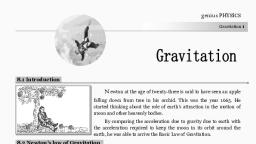
Gravitation, , , , , , , , Introduction, Kepler’s Laws, Universal Law of Gravitation, , Measurement of the Gravitational, Constant (G), , Acceleration due to Gravity, , { Contents and Concepts |, E p, , , , , , , 5.6 Variation in the Acceleration due to, gravity with Altitude, Depth, Latitude, and Shape, , 5.7 Gravitational Potential and Potential, Energy, , 5.8 Earth Satellites, , , , , , 5.1 Introduction, , All material objects have a natural tendency to, get attracted towards the Earth with constant, acceleration. This fact was demonstrated by the, Italian physicist Galileo. Indian Astronomer and, mathematician Aryabhatta (475-550 AD) concluded, that the Earth revolves about its own axis and it, moves in a circular path around the Sun. Similarly,, moon revolves in a circular orbit around the Earth., Almost thousand years after Aryabhatta, Johannes, Kepler (1571 - 1630) established three laws of, planetary motion which were afterwards supported, by the Newton’s law of gravitation., , Gravitation compels dispersed matter to, coalesce, hence it forms the basis of the existence of, the Earth, the Sun and all material macroscopic, objects in the universe., , [Note: Students can scan the adjacent [al, QR code to get detailed information = oe, a, , about work of these scientists with the, aid of a linked video.], , , , Q.1. Mention some main characteristics of, gravitational force., , Ans: Characteristics of gravitational force:, , i. Every massive object in the universe, experiences gravitational force., , ii, It is the force of mutual attraction between any, two objects by virtue of their masses., , iii. It is always an attractive force with infinite, range., , iv. It does not depend upon intervening medium., , , , , , y. It is much weaker than other fundamental, forces. Gravitational force is 10~° times, weaker than strong nuclear force., , 5.2 Kepler’s Laws, f, Enrich Your Knowledge LA ---y, , Johannes Kepler analysed the huge data |, meticulously recorded by Tycho Brahe and \, established three laws of planetary motion. 1, , Q.2. Can you recall? (Texthook page no. 78), i, What are Kepler’s laws?, ii. | What is the shape of the orbits of planets?, , i. The Kepler’s laws are:, , a. _ Kepler’s first law: The orbit of a planet, is an ellipse with the Sun at one of the, foci., , b. Kepler’s second law: The line joining, the planet and the Sun sweeps equal, areas in equal intervals of time., , c. Kepler’s third law: The square of, orbital period of revolution of a planet, around the Sun is directly proportional, to the cube of the mean distance of the, planet from the Sun., , ii. The orbits of the planet are elliptical in shape., , Q.3. State and explain Kepler’s law of orbits., Ans: Statement:, All planets move in elliptical orbits around the, , Sun with the Sun at one of the foci of the, ellipse., , , , Scanned with CamScanner
Page 2 :
Std. XI Sci.: Perfect Physics, , , , , , s, , s, , ii., , Explanation:, The figure shows the orbit of a planet around, , the Sun., , , , —2a——, , Here, S and S$’ are the foci of the ellipse and, the Sun is situated at S., , P is the closest point along the orbit from S, and is called perihelion., , A is the farthest point from S and is called, aphelion., , PA is the major axis whose length is 2a. PO, and AO are the semimajor axes with lengths, a’ each,, , MN is the minor axis whose length is 2b. MO, and ON are the semiminor axes with lengths, , “b’ each., , Enrich Your Knowledge EAN ---y, , Ellipse:, An ellipse is the locus of the points in a plane, such that the sum of their distances from two, , fixed points, called the foci, is constant., , \, ', I, 1, 1, 1, |, How to draw an ellipse? !, i, Insert two tacks or drawing pins, A and B, ;, as shown in the figure into a sheet of |, drawing paper at a distance ‘d’ apart. {, , ii. Tie the two ends of a piece of thread |, whose length is greater than distance ‘d’ |, between the two tacks and place the loop |, around AB as shown in the figure. |, , iii, Place a pencil inside the loop of thread, |, pull the thread taut and move the pencil 1, sidewise, keeping the thread taut. The |, pencil will trace an ellipse. 1, , 1, , 1, , 1, , 1, , |, , |, , !, , I, , , , . State and prove Kepler’s law of equal, areas., , : Statement:, The line that joins a planet and the Sun sweeps, equal areas in equal intervals of time., , , , , , ii., , iii., , iv., , vi., , Q, , Ans:, , t, t, I, !, I, , q Reading between the lines, , i, , Explanation:, Kepler observed that planets move faster when, , they are nearer to the Sun while they move, slower when they are farther from the Sun,, Suppose the Sun is at the origin. The Position, , ~, of planet is denoted by T and its momentum ig, , denoted by p(component 1 r)., The area swept by the planet of mass m jn, given interval Atis AA which is given by, , — if-,2, ax =i{z vat) wD), , > 4, As for small At, v is perpendicular to r and, this is the area of the triangle., , MA 1iav] wnQQ), Linear momentum (] is the product of mass, and velocity., p=mv ..R), , p=mv, , putting y = 2 in the equation (2), we get,, m, , B12 (4), at 2 m, , =, Angular momentum L is defined as,, L=rxp (5), , For central force the angular momentum is, conserved. Hence, from equations (4) and (5),, , MA constant, at 2m ©, , This proves the law of areas., , (6), , .5. What is a central force?, , A central force on an object is a for, always directed along the line joini, position of object and a fixed point usually, taken to the origin of the coordinate system., , , , , , , , , , is always along the line joining the Sun and the, , \, |, |, The force of gravity due to the Sun on a planet f, f |, planet. It is thus a central force. |, , eagle, , Scanned with CamScanner
Page 3 :
WR tan 2 Kepler»,, Ans: Statement:, The square of, , the time eri,, a planet aroung the Sun is p ore, cube of the Semimajor xj # a ‘0 the, traced by the Planet, the eltipse, Explanation;, , If ris length of Semimaj *, , = 0} x *., states that, Yor axis then, this law, Jind 1, Ter or = = constant, *Q.7, State Kepler's law, , Ans: Refer Q.4. (Only, , *Q.8. State Kepler's law of Period,, Ans: Refer QO. 6, (Statement only), , *Q.9. State Kepler's, , three laws Of planet: i, Ans: Refer 0.3, 0.4 and 0.6 (0,,P "XY motion,, , (Only Statements), Solved Examples TTS eens,, , +Q.10. bee ta be the average duration of, Year if the distance between ¢, Earth becomes neSum and the, i thrice the Present distance,, ii, twice the Present distance,, Solution:, i Consider T) be the Present distance between, the Earth and Sun, We know, T, = 365 days,, When the distance is made thrice, r, = 3r,, According to Kepler’s law of period,, Ti«r and Her, Tt? eB, , r=, Toy, , f equal, , areas,, Statement), , T,, S=V27, ia, , 1, Th=T, x 27 =365 x J7, When the distance is made, Ee, , = 1897 days, twice, r= 21,, , 2=T) V8 =365 V8 = 1032 days, , . The duration of the year would . be, 1897 days when distance is made thrice., The duration of the year would be, 1032 days when distance is made twice., , Ans: j., , , , , , , , Qi, What Woul, , id have been th i, year if the dist ¢ duration of the, , ‘ance between the Eart, Sotuises Sun were half the Present distinicer a, Given; psi, 2, n_1, % 2, To find: Time Period (T), 2, , Formula: (2) a (2), T,, , A, Calculation: We know, T, = 365 days, From formula,, , Ie, 365) (2) “3, Ae fi, , 365 Vg, , l, Tz =365 x TE, = 365 x 0.3536, = 129.1, “. T= 129.1 days, Ans: The duration of the year would be 129.1 days,, , Q.12, Calculate the Period of rey, , Jupiter around the Sun., Tadius of Jupite:, Earth’s orbit is 5,, , olution of, The ratio of the, r’s orbit to that of the, , (Period of revolution of the Earth is 1 year.), Solution:, Given: ie 2 Te=1 year, ym ol, To find: Period of Tevolution of Jupiter (T;), Formula: ca, Calculation: From formula,, , 2 3, 3) fa, Te) (ee, T= 9? =5x 5, = 11.18 years,, , Ans: Period of revolution of Ju, , piter around the Sun, is 11.18 years,, , Q.13. A Saturn year is 29.5 times the Earth’s, , year. How far is the Saturn from the Sun if, , the Earth is 1.50 x 10° km away from the, Sun?, , (NCERT), Solution:, , Given: Ts =29.5Tg,, , re= 1.50 x 10° km, , To find: Distance of Satum form the Sun (rg), Formula: or, , , , , , , , , , Scanned with CamScanner
Page 4 :
SET ar, , SH, , viii. Thus, in actual experiment measuring @ and, knowing values of t, m, M and r, the value of, G can be calculated from equation (2), , In chapter 4, you have studied in detail about, torque and its effects,, , , , , , , §5 Acceleration duc to gravity, , Q.35. Derive the expression for the acceleration, due to gravity on the surface of the Earth., , Ans:, , i, The Earth is an extended object and can be, assumed to be a uniform sphere., , iit If the mass of the Earth is M and that of any, point object is m, the distance of the point, object from the centre of the Earth is r then the, force of attraction between them is given by,, F=Gun, , ? : +1), , iii, If the point object is not acted upon by any, other force, it will be accelerated towards the, centre of the Earth under the action of this, force. Its acceleration can be calculated by, using Newton’s second law,, , F=ma wn(2), , iv. From equations (1) and (2),, , GMm, , ma=, r, , Acceleration due to the gravity of the Earth, GMm 1, = x=, rom, _ oM, r, This is denoted by g., v. If the object is close to the surface of the, Earth, r= R, then,, GM, , RB, , , , , , Earth's surface =, , 40.36. As we go from one planet to another planet,, , how will the mass and weight of a body, , change?, , Ans:, , i. As we go from one planet to another, mass of, a body remains unaffected., , ii. | However, due to change in mass and radius of, planet, acceleration due to gravity acting on, , M, the body changes as, 8 © 7 Hence, weight of the body also changes as,, , M, Wo Re, , | 237. Explain why the Earth doesn’t appear to, , —, , , , Chapter 5: Gravi, move even though the object of mass m, , (m << M) kept on the Earth exerts equal, and opposite gravitational force on it., , i, An object of mass m (much smaller than the, mass of the Earth) is attracted towards the, Earth and falls on it., , ii. At the same time, the Earth is also attracted by, the equal and opposite force towards the mass, , m., iii, | However, its acceleration towards m will be,, GmM, sea = =, M r, Beng = Ht, “2 M, , iv. Asm<<M, agann << g and is nearly zero. As,, a result, practically only the mass m moves, towards the Earth and the Earth doesn’t appear, to move., , Solved Examples J----------°, , +Q.38. Calculate mass of the Earth from given, data,, Acceleration due to gravity g = 9.81 mis’,, Radius of the Earth Re = 6.37 x 10° m,, G=6.67 x 10" N m/kg”, Solution:, Given; g=9.81 m/s’, Re= 6.37 x 10°m,, , G= 6.67 x 10 N mikg?, , To find: Mass of the Earth (Me), GM, Formula: g=—;*, RE, , Calculation:From formula,, , «2, Mew BE 9.81x(6.37%10°), EG 6.67x10", _ 981637637 sg, 6.67, = 5.967 x 10° kg, Ans: Mass of the Earth is 5.967 x 10 kg., , 2939 Calculate the value of the universal, , gravitational constant from the given data., , Mass of the Earth = 6 x 10™ kg, Radius of, , the Earth = 6400 km and the acceleration, , due to gravity on the surface = 9.8 m/s”., Solution:, , Given: M=6x 10" kg,, R= 6400 km = 64 x 10° m,, g=98 m/s?, To find: Gravitational constant (G), GM, Formula: g=yr, , , , , , Scanned with CamScanner
Page 5 :
Std. XI Sci.; Perfect Physics, , , , , , , , , , Calculation: From formula,, gk?, G=, M.2 2, G = 28% (6.4 10°) Al axid, 6 x10° 6x10, , G=6.69 x 10 N mk?, Ans: The value of gravitational constant is, 6.69 x 10" N m/kg?., , ei Calculate the acceleration due to gravity at, the surface of the Earth from the given data., , (Mass of the Earth = 6 x 10 kg, Radius of the, Earth = 6.4 x 10° m, G = 6.67 x 107" N m/kg’), , Solution:, , Given: M=6x 10" kg, R= 6.4 x 10° m, G= 6.67 x 10 N m/kg?, , To find: Acceleration due to gravity (g), , Formula: g= *, , Calculation: From formula,, , _ 6.6710" x 6x10", (6.4x10°)", , 40.0210", 40.9610", a = DM 19, 40.96, =0.977 x 10, 4 g=9.77 mis”, Ans: “The acceleration due to gravity at the surface, of the Earth is 9.77 m/s”., *Q.41. Calculate the value of acceleration due to, gravity on the surface of Mars if the radius, of Mars = 3.4 x 10° km and its mass is, , 6.4 x 10” kg., Solution:, \ Given: M=6.4 x 10 kg,, R=3.4 x 10? km=3.4 x 10°m, | To find: Acceleration due to gravity on the, i surface of the Mars (gq), | GM, , Formula: g= R, Calculation: As, G = 6.67 x 107" N m’/kg?, From formula,, , — §:67x10" x 64x10" _ 6.67x6.4, j BM (34x 10°) 34x34, | = 3.693 m/s*, , Ans: Acceleration due ~ gravity on the surface of, Mars is 3.693 m/s’., , +Q.42. Calculate the acceleration due to gravity on, the surface of moon if mass of the moon is, 1/80 times that of the Earth and diameter of, the moon is 1/4 times that of the Earth, (g=9.8 m/s’), , , , , , , , , , Solution:, . M R, Given: Mn= “gq > Rm= Gh, B= 9.8 mys?, To find: Acceleration due to gravity on th, surface of moon (gm) ©, GM, Formula: g= Re, Calculation:For moon, from formula,, - SM,, a, (Gi), _ \80) _ GM, 16 _ GM, |, &m (® 2 RE “30 R? x ;, 4, &n= c= 2 1.96 m/s?, , Ans: Acceleration due to pravity on the surface of, the moon is 1.96 m/s”., , +Q.43. Find the acceleration due to gravity on a, planet that is 10 times as massive as the, Earth and with radius 20 times of the, radius of the Earth (g = 9.8 m/s’)., Solution: :, Given: Mp = 10 x Mass of the Earth = 10 Mp,, Rp = 20x radius of the Earth = 20 Rg,, , , , , , , , g=9.8 m/s”, To find: Acceleration due to gravity on surface, of the planet (gp), GM, Formula: ar, Calculation: From formula,, _GM, | _ GM,, & R2” 8p R, = G(10M,), Gor.), —10GM,_ 1, 400R2 40, = 0.245 m/s*, Ans: Acceleration due to gravity on surface of the, planet is 0.245 m/s”., , Q.44, Acceleration due to gravity on the Earth is, g. A planet has mass and radius half that of, the Earth. How much will be percentage, change in the acceleration due to gravity on, , the planet?, Solution:, Given: &e= 8, Mp= aa »Re= ae, To find: Percentage change (Ag), Formula: = a, , , , , , Scanned with CamScanner