Notes of B.Sc. 1st Sem B, Physical Chemistry Liquid state.pdf - Study Material
Page 1 :
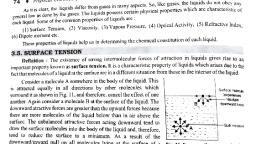
As it is clear, the, , law, , general, liquid., , each, , as, , done, , Some, , by, , like gases, the liquids do not obey anv, which are characteristic, , from gases in many aspects. So,, certain physical, the gases. The liquids possess, , liquids differ, , ofthe, , properties of liquids, , common, , of, , properties, , are:, , (5) Refractive Index, Vapour Pressure, (4) Optical Activity,, (1) Surface Tension, (2) Viscosity, (3), (6) Dipole moment etc., the chemical constitution of each liquid., These properties of liquids help us in determining, 3.5. SURFACE TENSION, , Definition: The existence of strong intermolecular forces of attraction in liquids gives rise to an, important property known as surface tension. It is a characteristic property of liquids which arises due to the, , fact that molecules ofa liquid at the surface are in a different situation from those in the interior of the liguid, Consider a molecule A somwhere in the body of the liquid. This, , is attracted equally in al directions by other molecules which, surround it as shown in Fig. 11, and therefore, cancel the effect of one, , Surface molecule, , (experienoces, resuitant, , another. Again consider a molecule B at the surface of the liquid. The, , downward atractive forces are greater than the upward forces because, there are more molecules of the liquid below than in air above the, surface. The unbalanced attractive forces acting downward tend to, draw the surface molecules into the body of the liquid and, therefore,, tend to reduce the surface to a minimum. As a result of the, downward/inward pull on all molecules lying at the surface of a, liquid, the surface behaves as if it were under tension like a stretched, membrane. Hence, this property of liquids is called surface tension., The surface tension of, , downward force), , Bulk molecule, , Fig. 11. Forces acting, , on a, , the bulk of the, , and at the, , liquid, , molecule in, , liquid., , liquid, , is defined as the force acting at, right, angles to the surface along one cm length of the surface. Thus the unit of, surface tension (y) is dyne per cm or newton, per meter in S.I., a, , system., , Further, as a result of the downward/inward pull on the molecules at the, , surface, the surface of a liquid tends to contract to the smallest, possible area for, , a, , given volume of the liquid (Fig. 12). It is for this reason that the drop of a liquid, , Inward pull of, Fig. 12.tension, surface, makes a, , aquires a spherical shape, because for a given volume, a sphere has minimum, surface area., , drop spherical., , Surface Energy: To increase the surface area, some work has, to be done, against the inward pull. For example, consider a soap solution film contained, in a rectangular frame of fine wire, (ABCD) in whcih the side CD is movable as, in, 13., In, depicted Fig., order to incease the surface area of, the film, the movable, wire has to be pulled outward from, CD, to, EF., thus some work has to B, position, be done against the force of surface, Fig. 13. Concept of surface, tension., energy, Thus, surface energy can be defined as the work in, ergs required to, be done to increase or extend the, (or, surface area by one em.The unit of surface energy is erg per, cu, Joule m in S.I. system)., , Surface energy Work per sq., =, , cm, , forcex length)dynexem dyne cm, , C(m, These units are same as those o fsurface tension, y ). Thus the su, C, r fm, ace energy is same as s u, , ension., , Surface tension values of some common, , liquids at 20°C are given in Table, , l.
Page 2 :
LiquidState, Table 1. Surface tension, values at 20"C of some liquids, (without brackets, within brackets are in Nm ), , Liquid, , Surface Tension, dynes cm (Nm, , Water, , 72 8 (0-0728), , Nitrobenzene, , 41 8 (0-0418), , Carbon disulphide, , 33-5 (0-0335), , Benzene, , 28-9 (0-0289), , Toluene, , 28-4 (0-0284), , Acetic Acid, , Effect of, , 27-6 (0-0276), , temperature, , on, , are, , in, , Liquid, , dyne cm, , 75, , while those, , Surface Tension, , dynes cm (Nm), Chloroform, , 27-1 (0-0271), , Carbon tetrachloride, , 26-8 (0-0268), , Methyl alcohol, , 226 (0-0226), , Acetone, , 23-7 (0-0237), , Ethyl alcohol, , 223 (0-0223), , Ethyl ether, , 17-0 (0-0170), , surface tension The, , temperature and becomes zero at the critical surface tension of liquids generally decreases with, and its vapour, temperature where the meniscus between the, With the increase of, disappears., liquid, the kinetic, temperature,, speed of molecules increases and therefore, the, energy of the molecules and hence, the, intermolecular forces of attraction decrease. This is, that surface tension, , increase of, , Table 2., , decreases with increase in, temperature (Table 2)., Surface tension of some, at, liquids various, =, , Liquid, , the, , reason, , temperatures (dynes cm *), =, , 20°C, , 40°C, , Water, , 60°C, , 72-75, , 69 56, , 66 18, , Ethyl alcohol, , 22-27, , 20-60, , 19-01, , Methyl aicohol, , 226, , 20-9, , Acetone, , 23-7, , 212, , 18-6, , Toluene, , 28-43, , 26-13, , 23-81, , Benzene, , 28-9, , 263, , 23-7, , 80°C, 62-61, , 16-2, , 21-53, 213, , Eotvas found that the surface tension (Y) varies linearly with temperature. He, suggested the, expression for the variation of surface tension with temperature:, , 7, , =kk(te -t), , following, (1), , where M, molecular mass of the liquid: p, density of the liquid at temperature rPC. t,, critical temperature of, the liquid i.e., the temperature at which y-0; k, a constant, and y, surtace tension ofthe liquid at temperature, fC., 2/3, , As y is surface tension of the liquid, then, , Ramsay and Shields in 1893, found that, , is molar surface energy of the, , liquid. Further,, , = 0 at r = I - 6 i.e., at 6°C less temperature than the, , critical temperature 1e. Hence they modified equation (1) as follows
Page 3 :
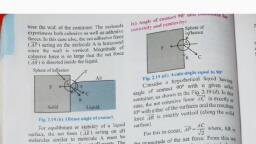
76, , Physical Chemistry2/3, , k(0e =k -1-6), , .(2), , Hence, according to equation (2). y will be zero at t = I¢ -, , 6and will be negative att = t c . Toovercome, , this difficulty/anomaly., Katayama suggested a more correct relation,, 2/3, , = k (-), , .(3), , where p' = p-d. and d is the density of vapour at temperature rC. In equation (3), 7 becomes equal to zero, , when temperature i is, , cqual to eritical temperature 1, 3.6. SOME EFFECTS OF SURFACE TENSION, Some important cffects of surface tension are explained as below, 1. Spherical shape of drops The effect of surface tension is to reduce surface area to a minimum., Hence. drops of a liquid or bubbles of a gas are spherical in shape, as stated earlier. A sphere always has, minimum surface area for a given volume. Hence a drop aquires a spherical, , shape, , 2. Rise of a liquid in a capillary tube : The rise of a liquid in a, capillary tube (.e.g.. the rise of oil in the wick of a lamp; rise of underground, , Capillary, Tube, , water on to the surface of earth; rise of water or sap in plants etc.) is a well, known phenomenon. This can be explained in terms of surface tension as, shown in Fig. 14., , Suppose, one end of glass capillary tube is put into liquid that wets, glass as shown in Fig. 14. It is found that the liquid rises into the capillary, a, , a, , ube to a certain height. This rise is obviously due to the inward/downward, pull of surface tension acting on the surface which pushes the liquid into the, capillary tube., , Fig. 14. Rise of a liquid in a, capillary tube., , It may be mentioned here that in case of liquids which do not wet, glass eg.. mercury. the level inside the capillary falls below the level, outside. Further, the upper surface of a liquid which wets glass (H,O) is, concave and that of mercury is convex Fig. 15. Such surface is called, meniscus. In Greek meaning of meniscus is a little moon. The angle, , which the curved surface (meniscus) makes with the wall of the tubeis, called contact angle and is found by drawing a tangent at that point., , 3. Interfacial tension If the immiscible or partially miseible, , (a), , (b), , liquids are taken in a vessel, then the surface tension acting along their, surface of separation (i.e., along the interface) is called the interfacial, , Fig. 15. Contact angle for a liquid, , tension. Its value is generally intermediate between the surface tension o, , (b) the does not wet glass, , (a) that wets glass, , two liquids but sometimes it is less than both. This is due to the fact that at, the interface of two liquids, the molecules of one liquid are attracted by the molecules of the other. In fact the, , surface tension of a liquid is also an interfacial tension between the two phases, one being the liquid and other, its vapour above the liquid., , 4. Surface active agents: There are certain substances like soaps, some sulphonic acids and some other, water even in small, organic compounds ike acetone, ethy and methyl alcohol etc. which when added to, surlace, amounts, decrease the, , lension of water to, , a, , considerable, , extent., , Such substances which lower, , the, , surface tension of water are called surface active agents. lt is for this reason that the soap act as detergent. For, example, if grease, , is sticking, , on the surtace of a, , cloth,, , water, , does, , not wet, , the, , not removeu, grease and hence is
Page 4 :
Liquid State, , 77, , by water alone. However, if soap is added to water, it lowers the interfacial, tension between, water and oreace, As a result, the grease mixes into the soap solution and hence, grease is removed, from the surface of, the cloth, Examples of surface tension : Floating of Iron necdie on water,, of, walking, small, clinical test for jaundice, cleaning of clothes etc. are a few, insects on water, examples where surface tension, plays its role., 3.7., , MEASUREMENT, , OF SURFACE TENSION, There are many methods which can be used for the, determination of surface, commonly used methods are brietfly described here, tension. Three most, 1. Capillary-rise method: The, principle of this method, is as follows, "One end of the capillary tube is put into a, liquid, then the force of, tension pushes the, the capillarn to a certain height as shown in, Fig. I6a, till the force of surface, liquid into, tension, the weight of the liquid column, surface, acting upwards balances, acting downward"., Y COS 6, , 2Ttr y coss0, , Upward Force, Y sin 0, , Liquid in, , Capillary, h, , Downward Force, , rr hdg, , (a), , (b), (c), a, capillary tube; (b) Surface tension (Y) acts along tangent, vertical component is y cos 0;(c) Upward force, (2Try cos ), , Fig. 16. (a) Rise of, liquid in, to, , meniscus and its, , Counterbalances the downward force, , due to, , weight of liquid column (T rhgd)., , "d capillary tube of radius is vertically put into a liquid, the, liquid rises to height h and torms a, meniscus. Then, the surface tension (Y) acting along the inner, circumference ot the tube exaetl, Supports the weight of the, liquid column., r, , By, , definition, surface tension is the force per cm acting at, , a tangent to the meniscus surface. If the, L n g e n t and tube wall is0, then component ofsurface tension acting in the vertial direction =, , Ycos, Inner, e, , a, , circumference of the capillary= 2t, , weight, , 1, , r, , s u r f a c e t e n s i o n a c t i n g u p w a r d all a l o n g the circumference =, , of the liquid acting downwards, , =, , tr", , hdg, , whee disnsity, densit ofliquid andg is acceleration due to gravity, and t, Hence at equilibrium, , 2Ttrycos 0 nr<hdg, =, , 2T r Y c o sb, , r"his the volume ofthe liquid column.
Page 5 :
78Physical Chemistryor, , rhdg, , Y, , For most, , Iiquids,, , 0 is, , SO, , 2 cos, essentially zero,, rhdg, Y, , and cos 6, , =, , 1, , 2, In order to know the value, of y. the value ofh is found with the, travelling microscope and density with a, pyknometer., 2. The, , help of a, , M, , Stalagmometer Method or Drop Formatin Method: The, a, stalagmometer as shown in Fig. 17. It resembles a, a bulb, , Bulb, , apparatus used is called, , pipette, , with, , in the middle and mark M, , the tube above the bulb., However the lower portion is made up of a, with flattened tip., Stalagmometer method is carried out in twocapillary, different, as, on, , a, , below:, , ways, , described, , (a) Drop, , Weight Method, drop falling slowly, , This method is based, upon the fact that the, of a capillary held, vertically is directly, proportional to its surface tension. Thus, for two, fall almost at the same rate, liquids, the drops of which, out of the same, capillary is, , weight, , of, , a, , out, , -Capillary, , Y2, W2, where Y and Wi are the surface, tension and weight of each, and Y2 and, drop of the liquid 1, W2 are the corresponding values, for the second, liquid. Thus, knowing the surface tension of one of the, that, of, the, liquids,, other can be, determined., , Flattened Tip, Fig. 17. Stalagmometer, , The procedure consists, of the following steps, i) The stalagmometer is first, thoroughly, with chromic acid, (solid KCr,O, + conc., HSO4) and then washed repeatedly withçleaned, water and, dried, in, finally, oven., (ii) It is kept in a vertical position in a, clamp stand and a rubber tube with a, the upper portion of the tube., pinch cock is attached to, (iii) Distilled water is sucked into the, apparatus and then the pressure is, pinch cock so that the rate of fall of droops is about, adjusted with the help of, 15-20 drops per minute, as, will, not, be formed properly., drop, otherwise the, 15, (iv), drops of water are allowed to fall into a clean, weighing bottle. Take the weight of the, weighing bottle alongwith the drops., (v) Now, rinse the apparatus with acetone and, it., , (vi) The, , experimental liquid, , adjusted, , as, , dry, , is sucked into the, , before and 15 drops of, , the, , same, , liquid are, , stalagmometer,, , taken into the, , bottle weighed., Calculations for surface tension are carried out as follows:, Suppose weight of empty bottle, Weight of bottle + 15 drops of water, Weight of bottle + 15 drops of liquid, , Weight of 15 drops of water, Weight of 15 drops of liquids, If Y, , the rate of fall of, , empty, , =018, , =, , is, , weighing-bottle and the, , = 028, =, , drops, , (02 -0 )g, (3 - )g, , and y, is the surface tension of water and liquid (experimental) respectively then
Page 6 :
Liquid State, , Y, , (030D, , Yo, , ()2, , 79, , (, (0-(0, particular temperature. Y ean, (0, , or, , Y, , Knowing Y at, be caleulated., (b) Drop Number Method : It is, however,, more convenient to count the, number of drops formed, given volume of a liquid than to find the, by a, weight, of, this, drops., Thercfore,, method, be, altemate manner as follows:, may, carried out in an, Let cqual volumes, ot' two liquids (say V ml) when allowed to fall, through the same capillary tube, form, n and n drops, and d1.d2 be their respective, densities, then, , )Weight of one drop of the liquid 1=*, ()Weight of one drop of the liquid 2 =*d2, n2, , Vxd, then, , YW, Y2, , "2 Xdj, , W2, , Vxdz, , n Xd2, , N2, Hence. knowing the number of, and, drops (n, n2 ) formed for the same volume of two, their densities (d and, liquids, knowing, d2 )and knowing the surface tension of, one of them, that of the other can be calculated., 3. The tensiometer or, the torsion balance method: It, is a commercial method, used for the, measurement of surface tension ofa, rapid, The method, liquid., was first devised, FIXED END, by Wilhelmy (in 1863) and later, developed by du Nouy (in 1919). The method is based, STRETCHED, upon the principle that the, force required to take out a, WIRE, horizontal platinum ring, dipping just below the surface, BEAM, , of, , a, , liquid, , is, , directly proportional, , the, , surface, tension of the, liquid. The platinum ring used is usually, of about 4 cm diameter and, the liquid is usually taken in, a watch, glass. The force required is measured either by, attaching the platinum ring to one end of the beam of a, sensitive balance and, placing weights on the other side, or by, using a special balance called 'torsion balance'. In, this balance, the, platinum ring is attached to one end of, the beam and the other end of the, beam is fixed to a, stretched wire which can be given a torsion, by suitable, device. The amount of the torsion just sufficient to, take, out the ring can be recorded on a, circular scale attached, to one end of the wire as shown in, Fig. 18. The, experiment is first performed with water and then with, the, liquid. Suppose the torsion, , experimental, , respectively., , to, , angles are, , Then, Y2, , 2, , LIQUID, , Pt. RINGB, CIRCULAAR, SCALE, , WATCH, GLASS, , Fig., and, , 18., , Principle of torslon, , balance., , 62 and their surface tensions, , are, , 7, , and 72
Page 7 :
Weight of one, , drop of, , 0-852, ether (w2)=-, , 50, , Y, , 72:8 dynes/cm, , 2, , xy, W1, , So,, the, Put the value in, , relation, , c m x852., 8dyne, 72, 50, 3.64, , 0-852x 72-8, 3-64, , Y2=17-04 dyne/cm., and propane are, Given that the parachors ofethane, hexane., the, parachor for, Example 4. Calculate, , 110:5, , and 150-8 respectively., Solution : Given that, , Plethane =110-5,, Then, , [P]Propane, , =, , 150-8, , [PlCH, =[P]propane-lPJethane, = 150 8 - 110:5 = 40-3, , As parachor is an additive property so we can write for hexane (C6 H14)., , [PlcH, =PlcH, +3{PlCH,, = 150-8+3x40-3 271-7, , PRACTICE PROBLEMS, The surface tension ofbenzene is292 dynes per cm. Its density is 0-88 gcm.Calculate the parachor, value., [Ans. 206], 2. The radius ofa given capillary is 0-105 mm. A liquid whose density is O-80 g/cc rises in this capillary to, a height of 6-25 cm. Calculate the surface tension of the liquid., [Ans. 25 73 dynes/cm], , 3. Calculate the parachor for octane. Given that the parachors of ethane and propane are 110-5 and 150 8, , Ans. 352.3], , respectively., , 4. The number of drops of water counted in a drop number method from a stalagmometer is 100, whereas, the number of drops for an organic liquid is 236. What is the surface tension of the organic liquid if the, surface tension of water is 72.8 dynes/cm. Densities of water and the organic liquid are 0.998 and, 0.752 g/cc respectively., [Ans. 23-24 dynes/cm, , 3.9. VISCosITY, Definition : We know that all liquids do not flow with the same speed as the flow or speed is a, characteristic property of liquids. It is well known that all liquids possess the property of flowing but some, liquids flow more easily than others. Some liquids like water, milk,, ether, alcohol etc. flow, , petrol,, , rapidly
Page 8 :
86, , Physical Chemistry-1, , while some other liquids like honey,, , glycerine, castor oil, coal tar etc. flow quite slowly. So, the tlow of liquids, depends nature of liquids i.e., intermolecular forces of attraction among the liquid molecules., speeds of flow of liquids also indicate that every liquid has some internal resistance to flow. This Different, internal, resistance to flow possessed by a, liquid is called its viscosity., The liquids which flow slowly,, obviously have, high internal resistance and, therefore, are said to be, X CmV cm/sec, more viscous (having high viscosity). On the other, hand, the liquids which flow rapidly have low, V+ v cm/sec|, internal resistance and hence have low, viscosity. To, understand, on, , the nature of, , friction, , internal resistance or, liquid, consider a liquid, , existing, flowing through a narrOw glass tube as shown in Fig., within, , a, , Fig. 19. Flow through a narrow tube, 19. All layers of a, liquid in laminar flow do not flow, with the same speed inside a tube., Imagine the lqiuid to be made up of a large number of co-axial thin, cylindrical layers. The liquid layer which is in direct, contact with the wall of the tube is almost, to greater force of friction, slationary due, applied by the stationary wall of the container., As we move from the walls, towards the centre of the tube, the, velocity of cylindrical thin layers of liquid, keeps on increasing till it is maximum at the centre., we may also, Conversely,, ntre towards walls of the, say that as we move from the, tube, the velocity of liquid layers, on, keeps, close to the wall of the container offers, decreasing. In other words, every layer, some resistance or friction to, the free flow/speed of, above it., layer immediately, the, , This force, , of friction whcih one layer ofa liquid offers to another layer, (immediately in contact with) of, liquid moving with different speed/velocity is called, viscosity., a, , It has been found that the force of, friction, , () between two co-axial cylindrical layers each, having area of, contact'4' sq cm, separated by a small distance'*, cm, and havinga velocity difference, of'V, , force of friction () is expressed as, , f«A, where, , a, , nis, , or, , f= n, , cm, , sec, then the, , Av, , constant, , of proportionality and is known as coefficient of viscosity., If we assume that, x=1 cm; A=1 cms and v= I cm sec', then f=, n, Hence, coefficient of viscosity may be defined as the force of friction, in, , velocity difference of 1 em sec, , between two consecutive, , area of one em., , During laminar flow, , of, , liquids,, , for two thin, , layers, v will, , layers,, , be taken, , dynes required to maintain, , one cm, , as, , apart and each having, , dv and, , r, , as, , dr,, , S=n.A, , an, , then fwill be:, , dx, , dv, , Hereis known as velocity gradient., dx, , dv, , ient d may be defined as small change in velocity (dv) produced between two, , Now, velocity gradient|, consecutive, , liquid layers separated by, , Units of Viscosity: We know that, , a, , small distance, , (dx) due, , to force of friction., , 3, , in
Page 9 :
LiquidState, , 87, , f=n. Av, or, , A..v, , Torce taken in dynes, distance between two consecutive layers in cm, area of contact between two, , layers, , in, , cm, , and, , velocity of flow', , in, , cm, , sec' then, , dynes x cm, , cm cm sec, n=, , dynes cm, , sec, , =, , poise, , This quantity is called, poise, after the name of pioneer worker,, being a too big quantity of, viscosity, therefore, smaller units, of poise, of poise, 100, gases., , th, , or millipoise 1000 th, , for, , Poiseuille, in the field of viscosity. Poise, are required for, liquids as centipoise, , CGS Unit of, viscosity (n) is dynes cm sec or poise. SI unit of Newton m 2, sec or Nm, nis, sec., One SI unit of, viscosity Nm sec =10 Poise, Effect of temperature on, With increase of, molecules increases. Hence, the Viscosity:, temperature, the kinetic energy of the liquid, starts moving faster. In other, liquid, words, the viscosity of a liquid decreeases, with increase of, temperature. It has been found that the decrease is about, 2% for every one, temperature. For example, honey gets frozen in winters kept in, degree increase of, bottles, glass, and not easy to take it out, summers, honey easily comes out flowing out of the, but in, same glass bottle., A number of, equations have been proposed giving relationship between, and, viscosity, temperature. The most acceptable relationship between the two, was given by Arrhenius in 1912 for, pure liquids. The equation is, |In, n=A.e5E/RT, , Slope, , where A and E are the constants of liquid, and R is a, general constant, T is taken, in absolute degrees, E is called activation, energy for viscous flow and A is, Arrhenius constant. The above equation in logarithmic form is written as, In n= In A +, , E, , Fig. 20. Plot of In n vs., , RT, , Thus, , plot of In n, , vs., , E, , is a straight line with slope equal to as shown in Fig. 20. The value of Acan be, R, , calculated from the intercept In A from the graph., , Fluidity :The reciprocal of the coefficient of viscosity (n) is called fluidity. It is represented by symbol, . Hence, , In other words, fluidity is the ease with which a liquid can flow. The units of fluidity is poise, 3.10. MEASUREMENT OF VISCOSITY, The absolute value of the coefficient of viscosity can be determined by measuring the various parameters, involved in the Poiseuille's formula viz.
Page 10 :
88, , Physical ChemistrynPr, , (1), , 8V, , However, for most of the purposes, it is sufficient to find out the relative viscosity, i.e., viscosity with, respect to water as reference. This eliminates the necessity of the measurement of a number of parameters of, , theabove formula as explained below, For a liquid flowing under its own hydrostatic pressure,, P hdg, (2), where h is the height of the liquid column, d is the density of the liquid and g is the acceleration due to gravity., Thus, the equation (1) changes to, , thdgrt, , ..(3), , 8V1, For equal volume of two, , length / and, , liquids flowing from the same height (h) through the same capillary (so that the, , the radius rare the, , d are their densities and, , same), if ni and n2 are the coetficients of, the, andt2 are their respective times of flow, thenviscosity of, , Thd hdig, 8VI, , n2, , 8V, T hd2g 12, , liquids, d and, , d1, d, , d, , or, , two, , dat2, , . (4), , d2 t2, Thus, measuring the time of flow of two, liquids, knowing their densities, and the coefficient of, viscosity of one of the liquids, that of the other can be, calculated., 2, , The apparatus used for the, measurement of relative viscosities, based, upon the above formula, is called viscometer. The, simplest is the one given by, Ostwald and is called Ostwald's, viscometer. It is shown, in, Fig. 21.It consists essentially of a bulb B, to which is, sealed a tube above and a, capillary below. There is a mark M on the tube and mark M' on, the capillary as, shown. The lower end of the, is sealed to a, capillary, bigger bulb C and a wider, tube DE. The, complete apparatus is U-shaped as shown, in, , M, , diagrammatically, , Fig. 21., The procedure consists, of the, steps, i) The apparatus is first following, washed with chromic acid, and then, thoroughly with water. It is then clamped, and, a rubber, vertically, tube is attached to the end A., (ii) A definite volume of water is, introduced into the bulb C, the end E. The, through, of, quantity water, , M, , added should be more, than that, required to fill the bulb B., (iii) Through the rubber tube attached to, the end, Fig. 21. Ostwald's, sucked up into the bulb B so that the level of A, distilled water is, water is a little, viscometer, the mark M. The water is then allowed to, above, flow back and the, time taken for the water, the mark M to M' is noted., to flow from, iv) The apparatus is then dried and the, experiment is repeated as above, the experimental liquid. The result is then calculated, taking the same volume of, the formula, using, derived above., The values of the coefficients of viscosity (in millipoise) at 20°C, for some common, in Table 5., liquids are recorded
Page 11 :
able 5. Coefficients of viscosity, , of some, , common, , Viscosity (in millipoise), , 8:0, , 2:33, , Chlorobenzene, , Acetone, , 3-29, , Carbon tetrachloride, , Carbon disulphide, , 3-68, , Ethylalcohol, , 5-63, , Acetic acid, , 5-93, , Nitrobenzene, , 6-47, , Glycerol, , Chloroform, Methyl alocohol, Benzene, , 3.11. VISCOSITY AND CHEMICAL, , at 20'C, , Liquid, , Viscosity (in millipoise), , Liquid, Ethyl ether, , liquids (in millipoise), , 9-68, 12:0, 12-2, , 20:3, , 10, , CONSTITUTION, , VIScOsity 1s largely due to intemolecular forces of attraction, which resist the flow of a liquid., , needs to be expected. Viscosity is, Theretore,, some sort of relationship between viscosity and molecular, also dependent on the shape, size and mass of the liquid molecules. Some general results have been observed, mass, , which, , are, , summerized below:, , n a particular homologous series, the viscosity increases as we go up in a series and the increase, per CH2 group is almost constant., (i) In compounds involving chain isomerism, the n-isomers have generally greater Viscosity than, the branched chain isomers., (ii) In compounds involving geometrical isomerism, trans-isomers have higher value of viscosity, than the coresponding cis-isomers., (iv) Dunstan proposed a rule, called Dunstan's rule. It predicted whether a liquid is associated or not., Dunstun found a relationship between viscosity (n) and the molar volume through the following, , equation,, a, , =40to 80, , xnx10, M, where, , d = density of the liquid, , n= co-efficient of viscosity, M, , =Molecular mass, , For associated, , liquids, the value is much higher, , than 80 and for non-associated, , associated and non-associated, between 40 to 80. Values of a few, , Table 6.xnx, M, , liquids, this value lies, , liquids are given in Table 6., , 10° valuesforsome liquids, , Liquid, Acetone, Toluene, , Value, 43, , 56, 73, , Benzene, , 559, Water, Glycol (CH,OHCH,OH), , Glycerol (CHOHCHOHCH,OH), , 2750, , Nature of liquid, Non-associated, Non-associated, , Non-associated, Associated, Associated, Associated, , 1,16,400
Page 12 :
1. The time of flow for the same volume of water and carbon, tetrachloride through an Ostwald'viscometer is 400 and 275 second, respectively. The density of water and, carbon-tetrachloride is 0- 99=, and 1-542 g cm, respectively. What is the viscosity, coefficient of CCl if the value for water i=, , 0-01002 poise?, , [Ans.0-01064poise, Ostwald VISCometer is 59-2 sec. at 25°C. If 46-2 seconds, are required for the, same volume of ethyl benzene, (density=U86/ g cm ) to flow, absolute viscosity at 25°C, that or warer Deing &'U0895 poise at through the capillary, calculate its, the, , The water flow time for, , an, , same, , 2At, , 20ec. the, , density of acetone is 98 Cm, , and the, , temperature acetone is an unassociated liquid., , 4, , temperature., , Ans. 0-00606 poise], , vISCosity, , The viscosity of water at 20°C is, that water is an associated liquid., , is 3.29, , millipoise., , 0010087 poise and its density is 0-9983 gcm, em-3., , Show that at this, , From this data show, , 3.13. VAPOUR PRESSURE, , liquid aare, in different, m, Thus, as these molecules are moving with di, directions with different speeds., peeds, they possess, the energy, of some of the, At any particular temperature,, different kinetic energy., molecules, may be so high, above the, n e lia., srface and, and come, come in the space, space above, quid. This process, the liquid surtace, leave, is known as, that they may, , According, , to kinetic, , theory, , of, , liquids,, , the molecules of, , a, , constantly moving
Page 13 :
vaporisation, , evaporation., the liquid leave, , or, , Liquid State, , As time passes, more and more, , molecules of, the liquid surface and, join the, molecules above the surface. Thus the molecules, present above the, liquid surface are called vapour. The molecules in, vapour phase, are also, constantly moving and some of them strike the surface of, , the liquid and may be, recaptured by the liquid phase. This process, of joining of vapour molecules back into, the liquid phase is called, , Pressure Gauge, reads Vapou, , Pressuree, , PZZZZ, , some, , liquid, , is, , placed, , in, , an, , connected to a nanometer as shown in, Fig. 24. As, no molecules of, vapour, so, rate of, , 0, , o, , O Vapour, , evacuated vessel, , initially there are, , condensation is zero. However,, if the, temperature is kept constant, the evaporation continues at, constant rate as shown in, Fig. 25. by the straight line plot. With the, passage of time, as the number of molecules in, the vapour phase, becomes more and more, the rate of, condensation, also increases as, shown in Fig. 25., a, Finally, stage is reached when rate of, condensation becomes equal to rate of, , evaporation, , i.e., as many, certain time, the same, number of vapour molecules re-enter, into the liquid, phase in the, same time. This state is, called the state of, equilibrium between, liquid and vapour phase. The pressure exerted, by the vapours at, equilibrium stage is known as vapour pressure as indicated, by the, manometer. This is sometimes called saturated, vapour pressure, as the, vapour phase is saturated with vapours at equilibrium, stage., Hence, vapour pressure of liquid at any, be, temperature, may, defined as the pressure exerted by the, vapour present above the, liquid in equilibrium at that temperature., , molecules leave the surface of the, , A ZUUA, o, , condensation., , Now, suppose, , 93, , Liquid, Fig., , liquid in a, , 24. Illustration of, , Vapour pressure., , Evaporation, , Condensation, , Eqm. Point, , Time, Fig., , 25., , Attainment, , of, , equilibrium, , 3.14. MEASUREMENT OF VAPOUR PRESSURE, , The various methods used for the measurement of, vapour pressure, , categories,, 1., , are, , generally classified, , into, , two, , Static Methods, , 2. Dynamic Methods, , These methods have been so named because in the static, methods, the liquid is allowed to establish its, vapour pressure without being disturbed while in the dynamic methods, the, liquid is disturbed either by, boiling it or by passing a stream of inert gas through it., Some, , commonly employed, , 1. Static Methods, (a) Barometric method, , static and, , : In, , this, , dynamic, , method,, , methods, , are, , berietly described below:, , barometric tubes are used. These are tilled with, mercury, and then inverted into the same trough of mercury. One tube is used for comparison with the other. In one of, two, , the tubes, the experimental liquid (free from dissolved air) is introduced, a few drops at a time. It evaporates, into the space above mercury. More and more of the liquid is introduced till no more liquid evaporates and, , remains as such. The difference of level of mercury in the two tubes is then the vapour pressure of the liquid at, room temperature. For finding the vapour pressure at any other temperature, the barometric tubes are, , surrounded by a heating jacket as shown in Fig. 26.
Page 14 :
94, , Physical ChemistryVacuum, , Heating, , Water, , Jacket, , Vapour, Liquid, , V.P, , Water, , Fig., , -Dropper, , 26. Barometric method for, , measuring vapour pressure, , b)Isoteniscope method: The method was, by Smith and Menzies (in 1910). It is a convenient, and accurate method which can be, used to measure the, vapour pressure over a range of temperatures. The, apparatus is shown in Fig. 26. The main, of the apparatus is the, part, and U-shaped, isoteniscope which comprises of a bulb B, portion of the tube C. The bulb B is, half-filled, nearly, with, the liquid under, same liquid is, placed in the U-shaped portion with its level, investigation and the, about, 2-3, cm, below that in the bulb. The, I8oteniscope is placed in the thermostat A whose, can be noted from the, temperature, is, IS0teniscope then connected to the rest of the, thermometer T. The, which comprises of a barometic tube D, apparatus, bottle E as shown in the, and a big, Fig. 27. The bottle E can be connected to the, desired so as to, or to the vacuum, atmosphere, the, regulate pressure inside the, pump as, apparatus., , devised, , To Atmosphere, , To vacuum, , Pump, , Fig.27. lsoteniscope method for measurement, , of vapour, , pressure, The method involves the, follow ing steps, i) The bottle E is connected to the, vacuum, and the, apparatus is evacuated till the, iaarously in the bulb B. This expels all pump, air from the, 1soteniscope BC. The level of liquid boilsin, the limb L2 stands higher than iun the limb L, the liquid, iil The temperature of the thermostat 1s now, adjusted to the desired value, and air is admitted, into the apparatus (by connecting the boOUle E. to, slowly, alinosphere), till the level of, he, the liauid in, hath the limbs L and L2 will be equal. Pressure in, limb L, is the, the, vapour, pressure, whereas, nressure in the limb L2 is equal lo the pressure, n the rest of the apparatus and is equal, eaual, to, atmospherric pressure (in em) minus the height of the mercury calpratus, Uance this difference is the vapour pressure or tne lqud at the temperature ofthe thermostat.
Page 15 :
LiquidState, , 95, , By fixing the temperature of the thermostat at any desircd valuc, the vapour pressure can be measured at, that temperature by repeating the process as described above., , 2. Dynamic method: The simplest dynamic method is based upon the principle that a liquid boils at the, temperature at which the vapour pressure becomes equal to the external pressure over the liquid. Thus, by, fixing the extermal pressure over the liquid at different values, the boiling point of the hquid is determined at, each extermal pressure. Supposethe boiling pointare/ . 12.fy etc. at the external pressures pi. P2. P3 etc., respectively. Then obviously. these pressures (p. P2. P: etc.) will be the vapour pressures at the, temperatures. I1..3 etc. respectively. By plotting the pressuresagainst the corresponding tempera, any particular liquid. a curve of the type shown in Fig. 28 is obtained. From this curve, the vapour pressure at, , any desired temperature can be found., Thus the dynamic method differs from the isoteniscope method in the respect that whereas in the, , isoteniscope method, the temperature is fixed first and then the vapour pressure is, dynamic method. the extermal pressure is fixed first and then the liquid is heated to, , the, while, measured,, find the temperature at, in, , which it boils., ., principle ofthis metod is briefly described below, known volume of the dry air at a, known weight of the experimental liquid is taken in a closed vessel. A, , 3. Gas saturation method: The basic, A, , the molecules of the liquid are carriedd, known pressure and temperature is then passed through it. As a result,, till there is no further loss in, with the air and a loss of weight of the liquid occurs. Air is continuously passed, with the vapour. In the, constant throughout. The air gets saturated, weight of the liquid keeping the pressure P, then the, the number ofmoles of the vapour and air respectively.,, air saturated with the vapour, ifni and n2 be, at the experimental, which is equal to the vapour pressure of the liquid (p), the, of, vapour, pressure, partial, , temperature will be given by, , P=, , . (1), , xp, n +n2, , If, , w, , is the loss in, , weight ofthe liquid and, , M is its moleculoar mass, then n, , =", , PV, Further, if air is, , Substituting, , supposed, , the values, , to be an ideal, , of n, , gas, n2, , Note, , RT, , and n2 in eqn. (), the vapour pressure ofthe, , desired temperature., , : Instead of dry air, any gas, , like, , nitrogen, , ....(3), , =, , liquid can be calculated at the, , which does not react with the, , liquid, , can, , be used., , RESULTS, , IMPORTANT, 3.15. SOME, below:, related with the process ofevaporation are given, Some important results, evaporation: When a liquid evaporates, the more energetic molecules leave the, 1. Cooling caused by, hence the temperature, the average kinetic energy of the remaining liquid decreases and, , liquid. As, , falls., , a, , result,, , 2. Factors affecting vapour pressure: Two important factors on which the vapour pressure of a liquid, , depends are, ), , Nature ofthe liquid : lf the intermolecular forces of attraction in the liquid are weak, the molecules, , easily leave the liquid and come into the vapour phase and hence the vapour pressure is higher. For, can, amnle. the vapour pressure of ether, acetone, benzene etc. is higher than that of water at the same, temperature (as shown in Fig. 28).
Page 16 :
vaporisatipn, , are, , nONin degrees absolute) is appror1mately, to the boilingpoint (expressed, calories), in, (expressed, , For liquids which, , 3 1 6 . OPTICAL ROTATION, , Optical rotation by organic, , compounds, , involves, , the, , need to be explained one bv, folloWing terms, which, directions at, direction, it has vibrations in all, , one as follows, , travels in any, Ifa ray of light, a Nicol, If this is passed through, , out, light:, prism, then the light which emerges, 1. Plane polarized, propagation., direction of propagation., 1.e., perpendicular to the, right angles to the path of, vibrations oniy in oniy plane, to have, is thus called a polarizer (Fig, 29), of the prism is found, light. The Nicol prism, polarised, This light is called plane, PATH OF, PROPAGATION, , HViBRATIONS IN ALL, DIRECTIONS, , NICOL, , PRISM, , PLANE, , POLARZED, LIGHT, , ROTATION OF THE, PLANE OF POLARIZED, LIGHT, , Fig. 29. Plane polarized light and its rotation, , 2.Optical activity: 1fthe plane polarized light is passed through a medium of quartz or turpentine oil or, , the solution of sugar taken in a glass tube, it is found that the plane of polarized light gets rotated. The, substances like quartz, sugar etc. which rotate the plane of poloarized light are called optically activ-
Page 17 :
98, , Physical Chemistry-, , led optical activi, activit, of polarized light is calle, , substances and the property ofa substance to rotate the plane, n Latin, are called dextro rotatory (in], to the, Substances which rotate the plane ofpolarized light theright, to the left are called laeva, o ro, rotatory, dextro means right) and those wheih rotate the plane of polarized light, (in Latin lcavous is left), , y.The, language, , C, FIRST NICOL PRISM, , (POLARIZER), , Fig., , Principle, , that, shown, to, , 1f the, , 30., , SECOND NICOL, PRISM (ANALYSER), , Principle of observing the rotation of the, , plane polarized light, , is, , plane of polarized light., , passed through, Nicol prism, the, light, passes, 30a On the other, through and, hand., , of, , the first, , in, , Fig., , another Nicol prism which has, its axis parallel, brightness is observed, , if the second Nicol prism is, through the eye piece as, with its axis at, placed, cut off and, completely, field of view in the, right angles to that of, positions the, eye piece is dark" as, Nicol prisms are set brightness is less but there, shown, in Fig. 306. At, not, at the, be, 'crossed' position so thatmay, complete, active substance, darkness., It, is, the field of, that if the wo, placed between the two, view is completely darkobserved, prism has to be rotated, the field of, prisms,, and then the, view becomes, certain angle about the, opticaly, again. This clearly showsthrough, somewhat, line, of, that after, The, bright., second, has, light, passing through the, been, propagation of light to get, The degree of, rotated., optically, active, Nicol prism to, complete darknes, rotation depends, get the darkness, upon the rotationsubstance, the plane of the, again., Thus just, second prism, polanZeu, to be, required, analyses the light and is called as the first prism, to, given, the, secon, polarizes the light and is, 3.Specific rotation: The angle in analyser, called, uc, polarizer, passing through the, degrees, solution of an, through which the, d) Nature of, acthve, optically, the optically active substance.substance dependsplane of the polarized light is, upon the, (i) Concentration, rotated o, following, of the solution (in g/ml)., factors., (1i) Length of the tube, through which the light, (iv), Wavelength of the light used., passes (in, decimeter)., the first, , all other, , prism. the, , light, , is, , is, , (v), , and, , a, , Temperature, , of the solution., If m gram of the, substance is dissolved, is the, angle of rotation (in degrees), thenin vit ml the, is, found that, , solution, Iis the, , length of the tube, ube (in decimeter, , or, , where (a), is a specific rotation constant, . (1), hich depends on the, nature, wavelength (A )of light used, and the temperature of the, of the, solution (r©). It, well as on the, substanee asas wel, is used and the temperatures of the solution is taken as, 25°C, then it is D-line of sodium pour lamp light, vapour, , equation (), we g, , wriiten as [al, , ia, , .On, On rearranging
Page 18 :
Liquid State, a, , 99, , = aXr, , . (2), Now. if wetake, m =1 g. v= Iml and, , = 1 dm, , Then, Hence. specific rotation of a substance may be defined as the angle of rotation produced when one gm, of the substance is dissolved in one ml of the soluton i.e.. concentration of the solution is I gm/ml and the, length of the solution through which light passs is one dm., , In all reported values of [a], .the concentration ofsolution is taken in gm/100 ml of the solution. Thus,, ifc g is dissolved in 100 ml, , of the solution, then we may put in equation (2),, , m=, , candv= 100, , Then we get., , 100xa, , . (3), , Ixc, , equation (3) is applicable only for solutions. In place of solution.if substance, 'd ofthe pure substance.], solid. thenin equation (2) is replaced by density, , taken is, , a, , This, , or a, , So. we get, , [a]; with the, number)., the result by 100 (to reduce the magnitude of the, , The molar rotation is obtained, , :, , weight (M) of the, , It is usually represented, , substance and, , dividing, , by multiplying, , the, , specific, , roation, , as [M];.Thus, , MEASUREMENT, , OF, , . (5), , M[a, , [M, 3.17., , liquid, , (4, , 4. Molar rotation, molecular, , pure, , 100, , OPTICAL ACTIVITY, , used, an instrument, , for the, , measurement, , of the, , angle of rotation, , in, , degrees caused by, , an, , the polarizer and the other called the, Nicol prisms, one called, It consists of two, However, the polarizer is fixed, ends of the same metal tube., optically active, on the opposite, fitted, these are, the analyser, there is, tube. In between the polarizer and, analyser. Both of, axis, the, about, the, rotated, can be, tube is 10 em long and has glass windows, but the analyser, the solution. The glass, containing, tube, the glass, in Fig., near the analyser as shown, space for keeping, on the metal tube, circular scale is fixed, A, ends., on both, Polarimeter, , is, , substance., , of, , 31., , Metal Tube, , Circular Scale, , Eye, piece, Source of, Monochromatic, , Light, , Polarizer, , Glass Tube Containing., Sol. of the Substance, Fig. 31. Structure of a polarimeter, , Analyser
Page 19 :
100, , Physical Chemistry-, , (sodium vapour lamp) is passed, viewed through, In the procedure, first of all, out of the analyser is, tube. The light emerging, the, empty, the initial, is completely dark. This gives, through the instrument, by placingrotated, field, the, till, view, of, slowly, is then, known concentration is placed, the eye-piece. The analyser, or the solution of, the, liquid, tube, containing, the, Now, found to be dark. The, of view is no longer, reading of the instrument., the eye-piece, the field, On, through, seeing, final reading. The, and the shutter is closed., dark again. This gives the, is, completely, view, of, field, till the, ' . The a is positive for, analyser is rotated slowly, the, , light, , monochromatic, , from, , a, , suitable, , reading and the initial reading gives, leavo-rotatory., substances and negative for, , difference between the final, , dextro-sotatory, , source, , angle of rotation, , o n Optical Activity, Numerical Problems Based, in gram per litre of a, 55.4°. What is the concentration, is, lactose, for, of, value, Example 1. The, sodium D-light?, l10 cm cell at 20°C with, which gives a rotation of7:24° in a, solution, , [a], , of lactose, , Solution: We are given,, , a=55.4, a, , 7-24°, =, , 10 cm = 1 dm, , formula, Substituting the values in the, , 100xa, , Ixc, , On rearranging., , 100xa, C-, , x, 100x 7.24, 55.4x1, , = 13-07 g/100 ml or 130.7 g/litre, 100 ml water, rotate, certain optically active substance containing 1-56 g in, Example 2. A solution of a, a, which has a cell 20 cm long. The D-line of sodium was used as, the polarized light to 4-91° in a polarimeter, , light source., , Calculate the, , specific, , rotation., , Solution : We are given,, , C=156 g/100 ml, O=4.91, =, , 20 cm = 2 dm, , 100xa 100x4.91, =, , 2x156, , Ixe, , al=157.37, Example 3. When o-D glucose ((al, 8-D-glucose, , is, , 120+18-7°), Calculate, , formed, , =, , until at equilibrium, , is dissolved in water, the, , the percentage, , 112.2°) is dissolved in, , [a, , optical, , water, the, , optical rotation decreases as, , +52:7°. As expected when B-D glucose, rotation increases until, , ofß form in the equilibrium mixture., , [al= 52:7°, , is obtained.
Page 20 :
LiquidState 1 0, , Solution:, , of D-glucose in the B-form., x(+18-7)+(1-x)(+112-2) =+52.7, , Suppose x is the, , The fraction, , of c-form, , =, , 1-X, , fraction, , 187x+112:2 112:2r 52:7, 112-2, 187x-112:2r 52:7-93.5x-59.7, x, , =, , 0-636, , or, , 63-6%, , (1-x)=1-000-0-636=0, , and, , Bform, , 364 or 36-4% a-form., , CHEMMCAL CONSTITUTION, of atoms within, it depends upon the arrangement, i.e.,, constitutive, property, active contain, Optical activity is a purely, which are found to be optically, compounds, the, that, observed, organic, been, called an, the molecule. It has, attached. Such a carbon atom is, atoms or groups are, different, four, which, to, atom, carbon, of, at least one, over it. A very simple example, shown by putting a sign of star (*), is, and, atom, carbon, usually, asymmetric, as represented below:, that, , 3.18. OPTICAL ACTIVITY AND, , such, , a, , compound is, , of lacticacid,, , CH, , H-C*-OH, , COOH, , of the polarized light, one of which rotates the plane, It is found that such a compound exists in two forms,, rotates the plane of the, or +' form) and the other which, to the right, is called dextro-rotatory (d-form, the same, or ' ' form). The two forms have, polarised light to the left, is called laevo-rotatory (1-form, attached to the same four atoms or groups) but differ, constitution (i.e., in each form, the asymmetric C-atom is, Thus the two forms are space-isomers, in, in their configurations i.e., arrangement of atoms or groups space., and are called optical isomers., two forms by suggesting that in case of such, Le Bel and Van't Hoff pointed out the difference in the, the centre of a regular tetrahedron and the four atoms or, molecules, the asymmetric carbon atom is present in, at the corners of the tetrahedron. This gives rise to two different spatial, groups attached to it are present, whcih were like the mirror images of each other as shown in Fig. 32., , arrangements, , yOH, , OH, , CoOH, , COOH, , MIRROR, Fig. 32. Spatial difference in d and I forms of lactic acid., , The above two configurations are different in the sense that they are not superimposable over each, other. Thus the other above two forms are related to each other as the right hand is to the left hand of the same, person. The above two forms may be represented in a simplified way as follows, , CH, H-C*-OH, COOH, (), , CH, , HO-C-H, cOOH, (11)
Page 21 :
102, , Physical Chemistry-1, , form II, the arrangement from H to OH is, to OH is clockwise and in, In form I, the arrangement from H, However, by mere, is dextero-rotatory, the other is laevo-rotatory., anti-clockwise. Hence if one of them, or laevo. The two, dextero, is, to which form, it is not possible to predict as, the, configurations,, of, inspection, enantio, opposite, morphe form)., forms are said to be enantiomorphs (Greek :, form is, the two forms are mixed together, a third, Further, if equimolar quantities of, to the fact that the rotation caused, This is obviously, obtained which is optically inactive., caused by the, nullified (or compensated) by the equal rotation, by one form to the right is, -OH, external compensation and the substances thus HC, to the left. This process is called, =, , =, , coOH, , due, , ÓH, , second form, , obtained are called racemic mixtures (or dl-form or tform). This form can be separated, into, , COOH, , d and/forms by suitable methods., , In case of compounds containing two asymmetric carbon atoms (e.g., tartaric acid), a, , fourth form is also found to exist. In this form, the rotation caused by half of the molecule is, , compensated by the other half within the molecule as shown in Fig. 33 for tartaric acid., , Fig. 33. Meso, , form of, tartaric acid, , This form which is optically inactive due to internal compensation is called meso-form., , Lastly. it may be mentioned that optical activity is found not only in the organic compounds containing, an asymmetric carbon atom but also in the compounds which contain other asymmetric atoms like nitrogen., , asymmetric, , but, , are, sulphur, silicon, cobalt, tin etc. Further, some compounds may not contain an, atom, optically active because the molecule as a whole is asymnmetric (i.e., no plane can divide themolecule into two, , identical halves). Thus it may be concluded that the optical activity is a property related with asymmetry, of the molecules. Hence optical activity can be used to test the presence of asymmetry in the molecule., , 3.19. REFRACTIVE INDEX, When a ray of light travels from one medium to another, it undergoes a change in its path or direction., , This phenomenon is known as refraction. If the ray of light travels from a less dense medium to more dense, medium (i.e., from air to liquid or air to solid or liquid to solid), the ray bends towards the normal drawn on the, surface of separation of two phases at the point of incidence as shown in Fig. 34., NORMAL, , NORMAL, , - --, , INCIDENT, , INCIDENT RAY, , RA, , AIR OR, VACUUM, , LIQUID:, , LIQUID, , AIR OR, , n), , VACUUM, --, , REFRACTEDRAY, , REFRACTED RAY, , (a), Fig., , 34., , (b), , (a) Refraction of light from air to more dense, medium,, (b) Refraction of light from a less dense medium a, to, , more, , observed by Snell's that, if ray of light travels, from air or, solid), then the ratio of the sine of, i' to, , dense, , It was, , liquid, , or, , which, , depends on the nature, , angle ofincidence, , vacuunm to a more, , the sine, of the medium. This constant is called the of angle of, refractive index, , usually represented by symbol 'n, Thus, , sin i, n=., , Sin, , (Snell's Law), , dense medium (an, , refraction'r' is constan., of the medium, , and, , B
Page 22 :
Liquid State, ne, , value, , emperaure, , of, , 103, , refractive index (n), , alongwith, , TEpecvely. Thus n, , is also found to depend upon the wavelength of light used and the, the nature of substance. These are, usually written as subscripts ana supers ripts, a, represents refractive index (n) measured at 20°C using light corresponding to, , wavelength of D-line of the sodium vapour lamp., Refractive index may also be defined in, , the ratio, of, , the velocin, , terms of speed of light. Thus, the, refractive index, in vacuum to the, velocity light in that medium., , of light, , of, , of a medium is, , Speed of light in vacuum, Speed of light in the given medium, In the, , when, , a, , Snell's law, as given above, the first, medium chosen is air or, of, ray, light travels from any less dense medium to some more vacuum. In general, it is observed that, dense medium (a liquid or a solid), then, sini, N, =, , sin r, , n, , where n is the refractive index of, the less dense medium and N that of, more dense medium., Units: Refractive index, a, , being ratio of identical quantities, so, it is a simple numerical value. Therefore., , it has no unit., , 3.20., , MEASUREMENT, , OF, , REFRACTIVE INDEX, phenomena of total, phenomena clearly., , The measurement of refractive, index is based upon the, critical angle. Let us. therefore, first, try to understand these, , INCIDENT, RAYS FROM, THE SOURCE, , reflection, , and, , NORMAL, , MEDIUM-, , R4, R2, , internal, , R3, , INTERFACE, , R, , REFRACCTT ED, , Rs, R6, , MEDIUM-IlR2, RRR, , R'4, , RREFLECTED, RAY, DARK REGION, , B A N D, , L, , DARK REGION, , BRIGHT, , TELESCOPE, Fig. 35. Critical angle and total internal reflection., , Suppose a small source of light is placed in line with the interface of the two media (Fig. 35), Ri - R6 are, the incident rays. As the angle of incidence increases, the, angle of refraction also increases. The ray R3 is, almost going along the interface. The angle of incidence for this, ray is, therefore, nearly 90° (being only, slightly less than 90°). This angle is called 'grazing angle of incidence. Thus, for the rays Ri - Rz, for which, the angle, of incidence is less than 90°, the refracted rays are Ri- R3. The rays like R4, Rs, Rg etc. having, angle of incidence greater than 90°,undergo reflection within the medium II. The, corresponding reflected rays, are R4,, R, R etc. This is called total internal reflection. Forthe ray R3, angle i- 90° The corresponding, angle of refraction is the maximum angle of refraction and is called critical, angle, usually represented by e., , Thus, when, , Putting, and, , i=90,, , r=e, , sin i = sin 90° = 1, , sin r= sin e.
Page 23 :
104, , Physical Chemistry-, , The formula, , sin, , becomes, , N, , or, , n= N sin e, , to the refracted, will be obscrved corresponding, of, band, light, will give a, be seen that a bright, to, From Fig. 35, it may, the bright band corresponding, The edge, side., either, a telescope (behind the, with darkness on, band can be observed by placing, rays R-R;,, the, of, bright, The, measure, the critical angle.about cedge, the point 0., rotated, band) which can be, refractometer. The two most, relractive index is called a, of, measurement, for, The instrument used, , Sinr, , Sn e, , R, , of, , of, , common retractometers are:, (ii) Abbe's refractometer., , (i) Pulfrich refractometer, , of the instrument is, , 36(a) whereas the design, Fig., faces, The principle ofAbbe's, A and B with their hypotenuse, prisms, two, of, angled, right, consists, essentially, The, shown in Fig. 36(b). It, at Has shown in Fig. 36(b)., a clamp C ina metal box hinged, can be clamped together with, These, together., rotated and the value ofrefractive, of wlhich the prism system can be, the, with, R, arm, an, to, help, attached, is, box, face of the lower, The, refractometer is represented in, , hypotenuse, the top of the arm R., directly on the circular scale fixed at, on the, A, is polished. drop of the liquid is placed, (B), that, whereas, prism, upper, the, of, is, prism (4) ground rough, when the two prisms are fixed together., which spreads between the two faces, A, of, the, face, prism, hypotenuse, as shown in the Fig., reflected by the mirror M on to the liquid layer,, are, The light from a suitable source is then, all directions. Thus the rays, the prism B, the light gets diffused in, of, surfce, the, On, ground, striking, 36(a)., and at angles greater, less than 90° (in the liquid-medum), incident on the polished face ofthe prism B at angles, incident at angle greater, is shown in Fig. 36(c). The rays, than 90° (in the prism B). A picture of this concept, of the prism B. The rays, within the prism B and do not come out, than 90° undergo total internal reflection, of a bright band of, and come out of the prism B in the form, refraction, 90°, than, less, undergo, incident at angles, incidence', a telescope is fixed, of the bright band corresponding to the 'grazing, the, observe, To, edges, light., of the bright band, the prism system is rotated till the edge, above the prism system, and the box containing, index, , can, , be read, , coincides with the cross-wire of the telescope., , of, refracted at the critical angle, e. However, instead, setting corresponds to the refracted ray,, for reading the refractive indices., measuring the angles, the circular scale is graduated directly, refractometer may be mentioned as follows, A few important points about the Abbe's, the refractive index of the liquid must be less than, (i) For the critical angle phenomenon to occur,, This, , that of the material of the, , glass prism B., , (ii) Ifwhite light is used, as is usually the case, a diffused coloured edge is observed in the telescope., To make the edge sharp and to remove the colour, compensating prisms are fixed behind the, , objective of the telescope,, , as, , shown in, , Fig. 36(b)., , (ii) As the refractive index depends upon temperature, therefore, to keep the temperature constant., the prism box is enclosed in a water jacket as shown in Fig. 36(6)., , (iv) An important advantage of the instrument is that it requires only a few drops of a liquid, Table 7. Refractive indices of some common liquids at 20°C, , Compound, , 20, , Compound, , n, , Water, , 13328, , Benzene, , 1:4879, , Ethy acetate, , 1:3701, , Toluene, , :4429, , Ethyl alcohol, , 13590, , Carbon tetrachloride, , 1:4573, , Acetone, , 13571, , Chloroform, , Acetic Acid, , 1-4426, , 1:3698
Page 24 :
LiquidState, -Eye, , Nomal, , Telescope, , 105, , Fixed Telescope, T, , Magnifying, Glass, Thin layer, , -Graduated, , Scale S, , B, , of liquid, , Poushed, , Compensating, , Arm R, , surface, , Prism, Prism B, , Clamp C, , Refected beam, , Ground surface, , Water Jacket, , Prism A, , Hinge H, , Incident, Beam, M, , Incident, , Mirror M, , Beam, (a) Principle of Abbe's Refractometer, , (b) Design of the instrument, , Bright band, , Polished surface, B, , Liquid, Rays Incident, in the Prism, , Normal, ays Rays incident, in the Liquid, , (c) Concept of phenomenon occurring, , at the, , polished face, , of, , prism, , B., , Fig. 36., , 3.21. REFRACTIVE INDEX AND, CHEMCAL CONSTITUTION, Attempts have been made to relate the chemical constitution of a, , Thus, , number of new terms have ben, put forward., 1. Specific, Refractivity : Lorenz and Lorenz in 1880,, relation, following, for the refractive index of a, substance,, a, , 2 +2) d, , substance with its refractive index., , purely on theoretical considerations derived the, ...()



 Learn better on this topic