Page 1 :
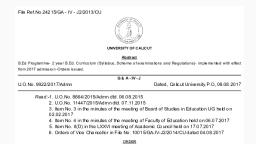
File Ref.No.4180/GA - IV - J1/2012/CU, , UNIVERSITY OF CALICUT, Abstract, , General & Academic - CBCSS UG 2019 - Scheme and Syllabus of B.Sc Computer Science Programme w.e.f 2019, Admission onwards - Anomalies resolved in General Papers - Orders Issued, G & A - IV - J, , U.O.No. 4847/2020/Admn, , Dated, Calicut University.P.O, 26.05.2020, , Read:-1. Minutes of combined meeting of Board of Studies in Computer, Science/Application/IT, Electronics, Instrumentation held on 17.05.2019, 2. U.O. No.11090/2019/Admn dated 21.08.2019, 3. Item No.V in the minutes of the meeting of Board of Studies in Computer Science and, Application (UG) held on 17.03.2020, 4. Remarks of Dean, Faculty of Science dated 14.05.2020., , ORDER, , The combined meeting of Board of Studies in Computer Science/ Application/ IT, Electronics,, Instrumentation had decided, vide paper read first above, to include the following general courses in, the subjects coming under the group of Computer Science/ Application/ IT, Electronics,, Instrumentation., Semester III, A11 Python Programming, A12 Sensors and Transducers, Semester IV, A13 Data Communication and Optical Fibers, A14 Microprocessors-Architecture and Programming, Orders were issued vide paper read second above, implementing the scheme and syllabus of, B.Sc Computer Science Programme under CBCSS UG Regulations 2019 w.e.f 2019 admn onwards in, which there occurs certain anomalies in the syllabus of General Courses of III and IV Semesters., Meeting of Board of Studies in Computer Science and Application (UG), vide paper read third above,, has resolved to rectify the anomalies occurred in the syllabus of III and IV Semester General Courses, for BSc Computer Science /IT/BCA in accordance with the General Courses prepared by the, combined, , meeting, , of, , Board, , of, , Studies, , in, , Computer, , Science/Application/IT,, , Electronics, , and Instrumentation., The Dean, Faculty of Science has approved, vide paper read fourth above, the corrections in the, syllabus of B.Sc in Computer Science Programme (LRP) and the Vice Chancellor has accorded, sanction to implement the corrected syllabus as subject to ratification of Academic Council., The corrected syllabus of B.Sc in Computer Science Programme (LRP) under CBCSS UG Regulations
Page 2 :
2019 with effect from 2019 admission onwards, is therefore implemented., U.O.No.11090/2019/Admn dated 21.08.2019 stands modified to this extent., (Corrected Syllabus appended), , Arsad M, Assistant Registrar, To, Principals of all Affiliated Colleges, Copy to: PS to VC/PA to PVC/ PA to Registrar/PA to CE/JCE I/JCE IV/SF/DF/FC, Forwarded / By Order, Section Officer
Page 3 :
UNIVERSITY OF CALICUT, THENHIPALAM, CALICUT UNIVERSITY P.O, , DEGREE OF, , BACHELOR OF SCIENCE (B.Sc.), IN, , COMPUTER SCIENCE, (CHOICE BASED CREDIT AND SEMESTER SYSTEM FOR, UNDERGRADUATE CURRICULUM), , UNDER THE, , FACULTY OF SCIENCE, , SYLLABUS, (FOR THE STUDENTS ADMITTED FROM THE ACADEMIC YEAR 2019 – 20 ONWARDS), , BOARD OF STUDIES IN COMPUTER SCIENCE (UG), THENHIPALAM, CALICUT UNIVERSITY P.O, KERALA, 673 635, INDIA, JUNE, 2019, © COPYRIGHT BY UNIVERSITY OF CALICUT, 2019, , Page 2 of 122
Page 4 :
B.Sc. Computer Science (Academic year 2019-20 onwards) 2019, , REGULATIONS, FOR THE DEGREE OF, BACHELOR OF SCIENCE IN COMPUTER SCIENCE, (Choice Based Credit and Semester System for Under Graduate Curriculum 2019), EFFECTIVE FROM THE ACADEMIC YEAR 2019-20, , B.Sc. COMPUTER SCIENCE PROGRAMME OBJECTIVE, The basic objective of the Programme is to open a channel of admission for computing courses, for students, who have done the 10+2 and are interested in taking computing/IT as a career. After, acquiring the Bachelor‟s Degree (B.Sc. Computer Science) at University of Calicut, there is, further educational opportunity to go for an MCA or other Master‟s Programme like MSc, (Computer Science), MSc (IT), MBA, etc., at this university or at any other University/Institute., Also after completing the B.Sc. Computer Science Programme, a student should be able to get, entry level job in the field of Information Technology or ITES or they can take up selfemployment in Indian & global software market. The specific objectives of the Programme, include, 1. To attract young minds to the potentially rich and employable field of computer, applications., 2. To be a foundation graduate Programme this will act as a feeder course for higher studies, in the area of Computer Science/Applications., 3. To develop skills in software development so as to enable the B.Sc Computer Science, graduates to take up self-employment in Indian and global software market., 4. To train and equip the students to meet the requirements of the Software industry in the, country and outside., , PROGRAMME STRUCTURE, Duration: The duration of the B.Sc Computer Science Programme shall be six semesters, distributed over a period of three academic years. The odd semesters (1, 3, 5) shall be from June, to October and the even Semesters (2, 4, 6) shall be from November to March. Each semester, shall have 90 working days inclusive of all examinations., Courses: The UG programme shall include five types of courses, viz; Common Courses, (Code A), Core courses (Code B), Complementary courses (Code C), Open Course (Code, D) and Audit courses (Code E)., , 2 | P a g e Board of Studies UG | Computer Science& Applications | University of Calicut, Page 3 of 122
Page 5 :
B.Sc. Computer Science (Academic year 2019-20 onwards) 2019, , Course code : Each course shall have a unique alphanumeric code number, which, includes abbreviation of the subject in three letters, the semester number (1 to 6) in which, the course is offered, the code of the course (A to E) and the serial number of the course, (01,02 ……). The course code will be centrally generated by the university. For example:, ENG2A03 represents a common course of serial number 03 offered in the second, semester and PHY2B02 representing second semester Core course 2 in Physics, programme., Credits(C): Each course shall have certain credits. A student is required to acquire a, minimum of 140 credits for the completion of the UG programme, of which 120 credits, are to be acquired from class room study and shall only be counted for SGPA and CGPA., Out of the 120 credits, 14 credits for common courses (English), 8 credits for additional, language courses and 16 credits for General courses. The maximum credits for a course, shall not exceed 5. Audit courses shall have 4 credits per course and a total of 16 credits in, the entire programme. The maximum credit acquired under extra credit shall be 4. If more, Extra credit activities are done by a student, it may be mentioned in the Grade card. The, credits of audited courses or extra credits are not counted for SGPA or CGPA., ‘Letter Grade‟ or simply „Grade‟ (G): in a course is a letter symbol (O, A+, A, B+, B, C, P,, , F,I and Ab). Grade shall mean the prescribed alphabetical grade awarded to a student, based on his/her performance in various examinations., „Credit Point‟(P) of a course is the value obtained by multiplying the grade point (G) by, the credit (C) of the course: P=G x C., ‘Extra Credit‟ is the additional credit awarded to a student over and above the minimum, credits required in a programme, for achievements in co-curricular activities and social, activities conducted outside the regular class hours, as decided by the University. For, calculating CGPA, extra credits will not be considered., Attendance: A student shall be permitted to appear for the semester examination, only if, he/she secures not less than 75% attendance in each semester. Attendance shall be, maintained by the Department concerned. Condonation of shortage of attendance to a, maximum of 10% in the case of single condonation and 20% in the case of double, condonation in a semester shall be granted by University remitting the required fee., , 3 | P a g e Board of Studies UG | Computer Science& Applications | University of Calicut, Page 4 of 122
Page 6 :
B.Sc. Computer Science (Academic year 2019-20 onwards) 2019, , Benefits of attendance may be granted to students who attend the approved activities of the, college/university with the prior concurrence of the Head of the institution. Participation in, such activities may be treated as presence in lieu of their absence on production of, participation/attendance certificate (within two weeks) in curricular/extracurricular, activities (maximum 9 days in a semester). Students can avail of condonation of shortage, of attendance in a maximum of four semesters during the entire programme (Either four, single condonations or one double condonation and two single condonations during the, entire programme) . If a student fails to get 65% attendance, he/she can move to the next, semester only if he/she acquires 50% attendance. In that case, a provisional registration, is needed. Such students can appear for supplementary examination for such semesters, after the completion of the programme. Less than 50% attendance requires Readmission., Readmission is permitted only once during the entire programme., Strike off the roll: A student who is continuously absent for 14 days without sufficient, reason and proper intimation to the Principal of the college shall be removed from the roll., Ability Enhancement courses/Audit courses: These are courses which are mandatory for, a programme but not counted for the calculation of SGPA or CGPA. There shall be one, Audit course each in the first four semesters. These courses are not meant for class room, study. The students can attain only pass (Grade P) for these courses. At the end of each, semester there shall be examination conducted by the college from a pool of questions, (Question Bank) set by the University. The students can also attain these credits through, online courses like SWAYAM, MOOC etc (optional). The list of passed students must be, sent to the University from the colleges at least before the fifth semester examination. The, list of courses in each semester with credits is given below., Course with credit, , Semester, , Environment Studies – 4, , 1, , Disaster Management – 4, , 2, , *Human Rights/Intellectual Property Rights/ Consumer Protection - 4 3, *Gender Studies/Gerontology- 4, * Colleges can opt any one of the courses., , 4, , 4 | P a g e Board of Studies UG | Computer Science& Applications | University of Calicut, Page 5 of 122
Page 7 :
B.Sc. Computer Science (Academic year 2019-20 onwards) 2019, , Admission to repeat courses should be within the sanctioned strength. However if more, candidates are there, the candidates who have suffered serious health problems, on production of, a medical certificate issued by a physician not below the rank of a Civil Surgeon in Government, service, may be permitted to repeat the course, with a written order issued by the Registrar,, Calicut University (by considering his/her SGPA/CGPA and percentage of attendance). The, number of such candidates should not exceed two., Grace Marks: Grace Marks may be awarded to a student for meritorious achievements in cocurricular activities (in Sports/Arts/ NSS/NCC/ Student Entrepreneurship) carried out besides the, regular class hours. Such a benefit is applicable and limited to a maximum of 8 courses in an, academic year spreading over two semesters. No credit shall be assigned for such activities. In, addition, maximum of 6 marks per semester can be awarded to the students of UG, Programmes, for participating in the College Fitness Education Programme (COFE)., Project: Every student of a UG degree programme shall have to work on a project of 2, credits under the supervision of a faculty member or shall write a theory course based on, Research Methodology as per the curriculum. College shall have the liberty to choose, either of the above., Extension Activities: Compulsory social service (CSS) for a period of 15 days is essential for, the successful completion of the B.Sc Computer Science Programme., , ADMISSION, The admission to all programmes will be as per Rules and Regulations of the University., The eligibility criteria for admission shall be as announced by the University from time to, time. Separate rank lists shall be drawn up for reserved seats as per the existing rules., The admitted candidates shall subsequently undergo the prescribed courses of study, in a college affiliated to the University for six semesters within a period of not less than, three years; clear all the examinations prescribed and fulfil all such conditions as, prescribed by the University from time to time., The college shall make available to all students admitted a prospectus listing all the, courses offered in various departments during a particular semester. The information so, provided shall contain title of the courses, the semester in which it is offered and credits for, the courses. Detailed syllabi shall be made available in the University/college websites., There shall be a uniform calendar prepared by the University for the registration,, conduct/schedule of the courses, examinations and publication of results. The University, , 5 | P a g e Board of Studies UG | Computer Science& Applications | University of Calicut, Page 6 of 122
Page 8 :
B.Sc. Computer Science (Academic year 2019-20 onwards) 2019, , shall ensure that the calendar is strictly followed., There shall be provision for Inter Collegiate and Inter University Transfer in third, and fifth semester within a period of two weeks from the date of commencement of the, semester. College transfer may be permitted in Second and Fourth semester also without, change in complementary course within a period of two weeks from the date of, commencement of the semester concerned., Complementary change at the time of college transfer is permitted in the third, semester if all conditions are fulfilled., CBCSS regular students can join distance education stream/Private Registration in, any semester in the same programme or different one. If core and complementary, courses are different, they have to undergo them in the new stream. The marks/grace, obtained for common courses will be retained., A student registered under distance education stream/Private Registration in the, CBCSS pattern may be permitted to join the regular college (if there is a vacancy within, the sanctioned strength) in the third and fifth semester with the same programme only. If, there is a change in complementary courses, it can be done with following conditions: i), the external and internal marks/grade obtained in the previous semesters for the earlier, complementary courses will be cancelled. ii) the students have to write the external, examinations for the previous semester for the new complementary courses along with, the subsequent batch. iii) An undertaking to the effect that “the internal evaluation for, the previous semesters of the new complementary courses will be conducted”, is to be, obtained from the Principal of the college in which the student intends to join., Provision for credit transfer is subject to common guidelines prepared by the faculty, concerned., There shall be provision for Readmission of students in CBCSS UG 2019., The Principal can grant readmission to the student, subject to the conditions detailed, below and inform the matter of readmission to the Controller of Examinations within one, month of such readmission., This readmission is not to be treated as college transfer. There should be a gap of atleast, one semester for readmission., , 6 | P a g e Board of Studies UG | Computer Science& Applications | University of Calicut, Page 7 of 122
Page 9 :
B.Sc. Computer Science (Academic year 2019-20 onwards) 2019, , The candidate seeking readmission to a particular semester should have registered for, the previous semester examination. Readmission shall be taken within two weeks from, the date of commencement of the semester concerned. For readmission, the vacancy, should be within the sanctioned strength in the parent college. If there is no vacancy in, the junior batch of the parent college, readmission can be taken in another college with, the junior batch if there is vacancy within the sanctioned strength in the concerned, college. If there is a change in complementary courses, it can be done with following, conditions: i) the external and internal marks/grade obtained in the previous semesters, for the earlier complementary courses will be cancelled. ii) the students have to write the, external examinations for the previous semester for the new complementary courses, along with the subsequent batch iii) An undertaking to the effect that “the internal, evaluation for the previous semesters of the new complementary courses will be, conducted”, is to be obtained from the Principal of the college in which the student, intends to take readmission., If change in scheme occurs while readmission, provision for credit transfer is subject, to common guidelines prepared by Board of Studies/ Faculty concerned. For readmission, to CBCSS UG 2019 involving scheme change, the Principal concerned shall report the, matter of readmission to Controller of Examinations with the details of previous, semesters and course undergone with credits within two weeks in order to fix the, deficiency/excess papers., , REGISTRATION, Each student shall make an online registration for the courses he/she proposes to take,, in consultation with the Faculty Adviser within two weeks from the commencement of, each semester. The college shall send a list of students registered for each programme in, each semester giving the details of courses registered, including repeat courses, to the, University in the prescribed form within 45 days from the commencement of the, semester., It is mandatory that the students who got admission under CBCSS UG 2019 in, SDE/Private shall register for the examinations of the concerned semesters in the same, year itself., 7 | P a g e Board of Studies UG | Computer Science& Applications | University of Calicut, Page 8 of 122
Page 10 :
B.Sc. Computer Science (Academic year 2019-20 onwards) 2019, , A student shall be normally permitted to register for the examination if he/she has, required minimum attendance. If the student has a shortage of attendance below 65% in, a semester, the student shall be permitted to move to the next semester (if the attendance, is more than 50% - Provisional registration) and can write the examination for the entire, courses of the semester in which shortage of attendance occurs as supplementary, examination only after the completion of the entire programme. In such cases, a request, from the student may be forwarded through the Principal of the college to the Controller, of Examinations within two weeks of the commencement of the semester. If the, attendance is less than 50%, the student is ineligible to continue the programme and has, to seek readmission. There will not be any Repeat semester in CBCSSUG 2019., A student who registered for the course shall successfully complete the programme, within 6 years from the year of first registration. If not, such candidate has to cancel the, existing registration and join afresh as a new candidate., For open courses there shall be a minimum of 10 and maximum of 75 students per, batch. For other courses existing pattern will be followed., Those students who have followed the UG Programmes in annual pattern or Choice, based Credit & Semester System pattern can cancel their earlier registration and register, afresh for CBCSSUG 2019 scheme in the same discipline or a differentone., The students who have attendance within the limit prescribed, but could not register, for the examination have to apply for Token registration, within two weeks of the, commencement of the next semester., , COURSE EVALUATION, Total marks for each core, elective course is 75 and lab courses shall be 100 marks and Industrial, Vist & Project Evaluation cum Programme viva- voce shall be 100 marks and open course shall, be 75 marks. The evaluation scheme for each course shall contain two parts (1) Internal, evaluation (2) external evaluation 20% weight shall be given to the internal evaluation. The, remaining 80% weight shall be for the external evaluation., , 8 | P a g e Board of Studies UG | Computer Science& Applications | University of Calicut, Page 9 of 122
Page 11 :
B.Sc. Computer Science (Academic year 2019-20 onwards) 2019, , INTERNAL EVALUATION, The internal assessment shall be based on a predetermined transparent system involving written, test, assignments, seminars and attendance in respect of theory courses and on, test/record/viva/attendance in respect of lab courses. 20% of the total marks in each course (15, marks for theory, 20 marks for lab/project) are for internal examinations. The marks secured, for internal assessment only need to be sent to University by the colleges concerned. Internal, assessment of the project will be based on its content, method of presentation, final, conclusion and orientation to research aptitude., Components with percentage of marks of Internal Evaluation of Theory Courses are, Test paper (40%), , –, , 6 Marks, , Attendance (20%), , –, , 3 Marks, , Assignment (20%), , –, , 3 Marks, , Seminar (20%), , –, , 3 Marks, , Components with percentage of marks of Internal Evaluation of Lab Courses are, Test paper (50%), , –, , 10 Marks, , Attendance (20%), , –, , 4 Marks, , Assignment/Lab involvement (30%) –, , 6 Marks, , (if a fraction appears in internal marks, nearest whole number is to be taken), , For the test paper marks, at least one test paper should be conducted. If more test papers, are conducted, the mark of the best one should be taken. To ensure transparency of the, evaluation process, the internal assessment marks awarded to the students in each course in, a semester shall be notified on the notice board at least one week before the commencement, of external examination. There shall not be any chance for improvement for internal marks., The course teacher(s) shall maintain the academic record of each student registered for the, course, which shall be forwarded to the University by the college Principal after obtaining, the signature of both course teacher and Head of the Department., , 9 | P a g e Board of Studies UG | Computer Science& Applications | University of Calicut, Page 10 of 122
Page 12 :
B.Sc. Computer Science (Academic year 2019-20 onwards) 2019, , The Split up of marks for Test paper and Class Room Participation (CRP) for internal, evaluation are as follows., Split up of marks for Test paper:, Theory Practical, 85% -100%, , 6, , 10, , 65% -85%, , 5, , 8, , 55% - 65%, , 4, , 6, , 45% - 55%, , 3, , 5, , 35%- 45%, , 2, , 4, , Less than 35%, , 1, , 2, , Theory, , Practical, , 85 % and above, , 3, , 4, , 75% ≤CRP <85%, , 2, , 2, , 50% ≤CRP <75%, , 1, , 1, , Attendance of each course will be evaluated as below, , Internal evaluation for the project shall be generally based on content, method of presentation,, final conclusion, and orientation to research aptitude. The split up shall be, Originality, , –, , 4 Marks, , Methodology, , –, , 4 Marks, , Scheme/Organization of Report, , –, , 6 Marks, , Viva-voce, , –, , 6 Marks, , EXTERNAL EVALUATION, There shall be University examinations for each course at the end of each semester . Practical, examinations shall be conducted by the University at the end of second, fourth and sixth, semesters. External evaluation of Project, Industrial Visit Report and Programme viva-voce shall, be conducted along with the project evaluation at the end of the sixth semester. External, evaluation carries 80% of marks, i.e., 60 marks, for each theory course., 10 | P a g e Board of Studies UG | Computer Science& Applications | University of Calicut, Page 11 of 122
Page 13 :
B.Sc. Computer Science (Academic year 2019-20 onwards) 2019, , The model of the question paper for external examination for theory courses of 2Hrs. duration., The students can answer all the questions in Sections A and B. But there shall be Ceiling, in each section., 1. Section A: Short answer type carries 2 marks each - 12 questions (Ceiling - 20), 2. Section B: Paragraph/ Problem type carries 5 marks each - 7 questions (Ceiling - 30), 3. Section C: Essay type carries 10 marks (1 out of 2)- (Ceiling - 10), The external examination in theory courses is to be conducted with question papers set by, external experts. The evaluation of the answer scripts shall be done by examiners based on a, well-defined scheme of valuation and answer keys shall be provided by the University. The, external examination in practical courses shall be conducted by two examiners, one internal and, an external, appointed by the University. The project evaluation with Programme viva voce will, be conducted by two examiners, one internal and an external (appointed by the University), at, the end of the sixth semester. No practical examination will be conducted in odd semester., Practical examinations for B.Sc Computer Science Programme shall be conducted in the even, semester 2, 4 and 6., The model of the question paper for external examination (lab courses) of 3 Hrs. duration shall, be:, 1. Section A: One marked question of 30 Marks from Programming Lab Part A is to be, attempted (Design Algorithm/Flowchart/Interface: 10 Marks, Code: 10 Marks, Result: 10, Marks. Total 30 Marks), 2. Section B: One marked question of 30 Marks from Programming Lab Part B is to be, attempted (Design Algorithm/Flowchart/Interface: 10 Marks, Code: 10 Marks, Result: 10, Marks. Total 30 Marks), 3. Section C:Lab viva voce (Total 10 Marks), 4. Section D:Lab Record (Total 10 Marks), , Number of students in one batch for practical examination must be limited to 14., Project guidelines – Students must be encouraged to do projects in the latest tools or tools, appropriate for their topic. Department should conduct monthly evaluation of the project and, give necessary instructions to the students as and when required. Number of students in a project, group must be limited to 4., , 11 | P a g e Board of Studies UG | Computer Science& Applications | University of Calicut, Page 12 of 122
Page 14 :
B.Sc. Computer Science (Academic year 2019-20 onwards) 2019, , The scheme of evaluation for project cum Programme viva voce shall be, 1. Relevance of the Topic, Statement of Objectives (Total 15 Marks ), 2., , Methodology (Reference/ Bibliography, Presentation, quality of Analysis/Use of, Statistical Tools) (Total 15 Marks), , 3. Findings and recommendations (Total 20 Marks), 4. Project cum Programme Viva Voce (Total 20 Marks), 5. Report of Industrial visit (Total 10 Marks), Audit course: The students can attain only pass (Grade P) for these courses. At the end of, each semester (up to fourth semester) there shall be examination conducted by the college, from a pool of questions set by the University. The students can also attain the credits, through online courses like SWAYAM, MOOC etc. The College shall send the list of, passed students to the University at least before the commencement of fifth semester, examination., , REVALUATION, In the new system of grading, revaluation is permissible. The prevailing rules for revaluation, are applicable. Students can apply for photocopies of answer scripts of external examinations., Applications for photocopies/scrutiny/revaluation should be submitted within 10 days of, publication of results. The fee for this shall be as decided by the university., , COURSE IMPROVEMENT, A maximum of two courses (Common, Core, Complementary or Open) can be improved in each, semester. Improvement of a particular semester can be done only once. The student shall avail, the improvement chance in the succeeding year after the successful completion of the semester, concerned. The internal marks already obtained will be carried forward to determine the, grades/marks in the improvement examination. If the candidate fails to appear for the, improvement examination after registration, or if there is no change in the results of the, improvement examination appeared, the marks/grades obtained in the first appearance will be, retained. Improvement and supplementary examinations cannot be done simultaneously., , 12 | P a g e Board of Studies UG | Computer Science& Applications | University of Calicut, Page 13 of 122
Page 15 :
B.Sc. Computer Science (Academic year 2019-20 onwards) 2019, , EVALUATION AND GRADING, Evaluation (both internal and external) is carried out using Mark system. The Grade, on the basis of total internal and external marks will be indicated for each course, for each, semester and for the entire programme., Indirect Grading System in 10-point scale is as below:, Ten Point Indirect Grading System, Percentage, of Marks, (Both, Internal, &External, put, together), 95 and, above, 85 to below, 95, 75 to below, 85, 65 to below, 75, 55 to below, 65, 45 to below, 55, 35 to below, 45, Below 35, Incomplete, Absent, , Grade, , Interpretation, , Grade, point, Average, ( G), , O, , Outstanding, , 10, , 9.5 -10, , A+, , Excellent, , 9, , 8.5 -9.49, , A, , Very good, , 8, , 7.5 -8.49, , B+, , Good, , 7, , 6.5 -7.49, , B, , Satisfactory, , 6, , 5.5 -6.49, , C, , Average, , 5, , 4.5 -5.49, , P, , Pass, , 4, , 3.5 -4.49, , F, I, Ab, , Failure, Incomplete, Absent, , 0, 0, 0, , 0, 0, 0, , Range of, grade, points, , Class, , First Class, with, Distinction, , First Class, , Second, Class, Third, Class, Fail, Fail, Fail, , 13 | P a g e Board of Studies UG | Computer Science& Applications | University of Calicut, Page 14 of 122
Page 16 :
B.Sc. Computer Science (Academic year 2019-20 onwards) 2019, , Example – 1, , SGPA Calculation, Course, Name, , Grade, Obtained, , Grade, point (G), , Xxxxxxx, , A, , 8, , 4, , 32, , C, , 5, , 3, , 15, , A+, , 9, , 4, , 36, , B+, , 7, , 3, , 21, , xxxxxxx, , Xxxxxxxxx, x, Xxxxxxxxx, x, Xxxxxxxxx, x, Xxxxxxxxx, , P, , 4, , 3, , 12, , xxxxxxx, , Xxxxxxxxx, , C, , 5, , 4, , 20, , Semester, I, Course, Code, xxxxxxx, xxxxxxx, xxxxxxx, xxxxxxx, , SGPA =, , Credit, (C), , Credit, point, (CXG), , Sum of the Credit points of all courses in asemester, Total Credits in that semester, , SGPA =, , (32+15+336+21+12+20)/21=1 3 6 / 2 1, , SGPA = 6.476, Percentage of marks of semester I = (SGPA/10) x 100 = 64.76 %, Note: The SGPA is corrected to three decimal points and the percentage of marks shall be, approximated to two decimal points., Example: 2, Course, Grade, Credit, Semester, Credit, Grade, Name, Obtained, (C), II, point (G), point, Course, (CXG), Code, xxxxxxx, Xxxxxxx, A, 8, 4, 32, , xxxxxx*, , Xxxxxxxxx, x, Xxxxxxxxx, x, Xxxxxxxxx, x, Xxxxxxxxx, , xxxxxxx, , Xxxxxxxxx, , xxxxxxx, xxxxxxx, xxxxxxx, , C, , 5, , 3, , 15, , A+, , 9, , 4, , 36, , B+, , 7, , 3, , 21, , F, , 0, , 3, , 0, , C, , 5, , 4, , 20, , *Failed course, 14 | P a g e Board of Studies UG | Computer Science& Applications | University of Calicut, Page 15 of 122
Page 17 :
B.Sc. Computer Science (Academic year 2019-20 onwards) 2019, , Note: In the event a candidate failing to secure 'P' grade in any Course in a semester,, consolidation of SGPA and CGPA will be made only after obtaining 'P' grade in the, failed Course in the subsequent appearance., CGPA Calculation, Example, Total Credit points obtained in six semesters, CGPA = --------------------------------------------------------------------Total Credits acquired (120), CGPA = 136 + 145 + 161 + 148 + 131 + 141 / 120 = 862/120, CGPA = 7.183, Total percentage of marks = (CGPA/10) * 100, Total % of marks = (7.183/10) * 100 = 71.83, Total Credit points obtained for Core Courses, CGPA of Core Courses = --------------------------------------------------------------------Total Credits acquired for Core Courses, Similarly CGPA of Complementary courses, Open courses, English Common courses and, Additional Language Common courses may be calculated and the respective percentage, may be calculated. All these must be recorded in the Final Grade Card., , GRADE CARD, The University shall issue to the students grade/marks card (by online) on completion of each, semester, which shall contain the following information., a), , Name of University, , b), , Name of College, , c), , Title of UG Programme, , d), , Semester concerned, , e), , Name and Register Number of student, , f), , Code number, Title and Credits of each Course opted in thesemester, , g), , Letter grade in each course in the semester, , 15 | P a g e Board of Studies UG | Computer Science& Applications | University of Calicut, Page 16 of 122
Page 18 :
B.Sc. Computer Science (Academic year 2019-20 onwards) 2019, , h), , The total credits, total credit points and SGPA in the Semester (corrected to three, , decimal places), The final Grade card issued at the end of the final semester shall contain the details of, all courses taken during the entire programme including those taken over and above the, prescribed minimum credits for obtaining the degree. The final grade card shall show, CGPA (corrected to three decimal places), percentage of marks (corrected to two decimal, places) and the overall letter grade of a student for the entire programme. The final grade, card shall also include the CGPA and percentage of marks of common courses, core, courses, complementary courses and open courses separately. This is to be done in a 10point indirect scale. The final Grade card also contains the list of Audit courses passed, and the details of Extra credits., i) Evaluation of Audit courses: The examination shall be conducted by the college, , itself from the Question Bank prepared by the University. The Question paper shall be, of 100 marks of 3 hour duration. For SDE/Private students it may be of MCQ/ fill in, the blank type questions or online question paper may be introduced., , AWARD OF DEGREE, The successful completion of all the courses (common, core, complementary and open courses), prescribed for the B.Sc. Computer Science Programme with P grade (35 %) shall be the, minimum requirement for the award of B.Sc Computer Science Programme degree., , GRIEVANCE REDRESSAL COMMITTEE, COLLEGE LEVEL, The College shall form a Grievance Redressal Committee in each department comprising of, course teacher and one senior teacher as members and the Head of the department as Chairman., This committee shall address all grievances relating to the internal assessment grades of the, students. There shall be a College Level Grievance Redressal Committee comprising of Student, Advisor, two senior teachers and two staff council members (one shall be elected member) as, members and principal as Chairman., , UNIVERSITY LEVEL, The University shall form a Grievance Redressal Committee as per the existing norms., , 16 | P a g e Board of Studies UG | Computer Science& Applications | University of Calicut, Page 17 of 122
Page 19 :
B.Sc. Computer Science (Academic year 2019-20 onwards) 2019, , BACHELOR OF COMPUTER SCIENCE PROGRAMME, STRUCTURE, , LEGEND, Item Description, C, , Credits, , E, , External Component, , I, , Internal Component, , L, , Lecture Hours, , P, , Practical Hours, , T, , Total, , Semester I, No, , Course Code, , Course Name, , C, , 01 A01, , Common English, , 02 A02, , Marks, E, , T, , L P, , T, , 3, , 15 60, , 75, , 5 0, , 5, , Common English, , 3, , 15 60, , 75, , 4 0, , 4, , 03 A07, , Languages other than English, , 4, , 20 80 100 5 0, , 5, , 04 BCS1B01, , Computer Fundamentals & HTML, , 3, , 15 60, , 75, , 1 2, , 3, , 05 XXXXC01, , Complementary Mathematics I, , 3, , 15 60, , 75, , 4 0, , 4, , 06 XXXXC01, , Optional Complementary I, , 3, , 15 60, , 75, , 4 0, , 4, , Total, , 19, , I, , Hrs/wk, , 475 23 2, , 25, , 17 | P a g e Board of Studies UG | Computer Science& Applications | University of Calicut, Page 18 of 122
Page 20 :
B.Sc. Computer Science (Academic year 2019-20 onwards) 2019, , Semester II, Marks, , Hrs/wk, , No, , Course Code, , Course Name, , C, , 07, , A03, , Common English, , 4, , 20 80 100 5, , 0, , 5, , 08, , A04, , Common English, , 4, , 20 80 100 4, , 0, , 4, , 09, , A08, , Literature in Languages other than, , 4, , 20 80 100 5, , 0, , 5, , English, , I, , E, , T, , T, , 10, , BCS2B02, , Problem Solving using C, , 3, , 15 60, , 1, , 2, , 3, , 11, , BCS2B03, , Programming Laboratory I:, HTML and Programming in C, , 4, , 20 80 100 0, , 0, , 0, , 12, , XXXXC02, , 3, , 15 60, , 75, , 4, , 0, , 4, , 3, , 15 60, , 75, , 4, , 0, , 4, , 625 23 2, , 25, , Complementary Mathematics II, 13, , XXXXC02, Optional Complementary II, Total, , 75, , L P, , 25, , Semester III, No, , Course Code, , Course Name, , 14 A11, , Python Programming, , 15, , Sensors and Transducers, , A12, , 16 BCS3B04, , Data Structures using C, , 17, , Complementary Mathematics III, , XXXX C03, , 18 XXXX C03, , Optional Complementary III, Total, , C, , Marks, , Hrs/wk, , I E T L P, 20 80 100 4 0, , T, 4, , 20 80 100 4, , 0, , 4, , 3, , 15 60, , 75, , 3, , 4, , 7, , 3, , 15 60, , 75, , 5, , 0, , 5, , 3, , 15 60, , 75, , 5, , 0, , 5, , 425 21 4, , 25, , 4, 4, , 17, , 18 | P a g e Board of Studies UG | Computer Science& Applications | University of Calicut, Page 19 of 122
Page 21 :
B.Sc. Computer Science (Academic year 2019-20 onwards) 2019, , Semester IV, Marks, No Course Code, , Course Name, , 19 A13, , Data Communication and, Optical Fibers, , Credit, , L P, , T, , 4, , 20 80 100 4 0, , 4, , Microprocessors-Architecture, and Programming, Database Management System, and RDBMS, Programming Laboratory II:, Data Structures and RDBMS, , 4, , 20 80 100 4 0, , 4, , 3, , 15 60, , 3 4, , 7, , 4, , 20 80 100 0 0, , 0, , 23 XXXXC04, , Complementary Mathematics IV, , 3, , 15 60, , 75, , 5 0, , 5, , 24 XXXXC04, , Optional Complementary IV, , 3, , 15 60, , 75, , 5 0, , 5, , 525 21 4, , 25, , 20 A14, 21 BCS4B05, 22 BCS4B06, , Total, , I, , E, , Hrs/wk, , 21, , T, , 75, , Semester V, Marks, No Course Code, , Course Name, , 25 BCS5B07, , Computer Organization and, Architecture, , 26 BCS5B08, , Java Programming, , 27 BCS5B09, , Web Programming Using, PHP, , 28 BCS5B10, 29 XXX5DXX, , Credit, , E, , T, , L P, , T, , 15 60, , 75, , 4 0, , 4, , 15 60, , 75, , 3 3, , 6, , 3, , 15 60, , 75, , 3 3, , 6, , Principles of Software, Engineering, , 3, , 15 60, , 75, , 4 0, , 4, , Open Course, , 3, , 15 60, , 75, , 3 0, , 3, , 0, , 0 2, , 2, , 15, , 375 17 8, , 25, , 3, 3, , I, , Hrs/wk, , Industrial Visit, Project Work, Total, , 19 | P a g e Board of Studies UG | Computer Science& Applications | University of Calicut, Page 20 of 122
Page 22 :
B.Sc. Computer Science (Academic year 2019-20 onwards) 2019, , List of Open Courses (XXX5DXX), No, , Course Code, , Course Name, , 29 BCS5D01, , Introduction to Computers and Office Automation, , 29 BCS5D02, , Web Designing, , 29 BCS5D03, , Introduction to Problem Solving and C Programming, , 29 BCS5D04, , Introduction to Data Analysis using spread sheet, , Semester VI, No, , Course Code, , Course Name, , 30, , BCS6B11, , Android Programming, , 31, , BCS6B12, , Operating Systems, , 32, , BCS6B13, , Computer Networks, , BCS6B14, , Programming Laboratory III:, Java and PHP Programming, , 33, , Credit, , Marks, I, E T, , Hrs/wk, L P T, , 15, , 60, , 75, , 4, , 3, , 7, , 15, , 60, , 75, , 4, , 3, , 7, , 15, , 60, , 75, , 5, , 0, , 5, , 4, , 20, , 80 100 0, , 0, , 0, , 3, 3, 3, , 34, , BCS6B15, , Programming Laboratory IV:, Android and Linux shell, Programming, , 4, , 20, , 80 100 0, , 0, , 0, , 35, , BCS6B16X, , Elective Course, , 3, , 15, , 60, , 4, , 0, , 4, , BCS6B17, , Industrial Visit & Project Work, (Industrial Visit- 1 Credit,, Project Work- 2 Credit), , 3, , 20, , 80 100 0, , 2, , 2, , 36, , Total, , 23, , 75, , 600 17 8 25, , List of Electives (BCS5B17X), No, , Course Code, , Course Name, , 35, , BCS6B16A, , System Software, , 35, , BCS6B16B, , Machine Learning, , 35, , BCS6B16C, , Discrete Structures, , 20 | P a g e Board of Studies UG | Computer Science& Applications | University of Calicut, Page 21 of 122
Page 23 :
B.Sc. Computer Science (Academic year 2019-20 onwards) 2019, , 35, , BCS6B16D, , Computer Graphics, , 35, , BCS6B16E, , Technical Writing, , 35, , BCS6B16F, , Fundamentals of Life Skill Education, , 21 | P a g e Board of Studies UG | Computer Science& Applications | University of Calicut, Page 22 of 122
Page 24 :
B.Sc. Computer Science (Academic year 2019-20 onwards) 2019, , SEMESTER I, BCS1B01 – COMPUTER FUNDAMENTALS AND HTML, Course Number: 1, Contact Hours per Week: 3 (1T + 2L), Number of Credits: 3, Number of Contact Hours: 48 Hrs., Course Evaluation: Internal – 15 Marks + External – 60 Marks, Objectives, •, •, •, •, , To equip the students with fundamentals of Computer, To learn the basics of Computer organization, To equip the students to write algorithm and draw flow chart for solving simple problems, To learn the basics of Internet and webpage design, , Prerequisites, •, , Background of the basic science at +2 level, , Course Outline, Unit I[4 T], Concepts of Hardware and Software: Computer Languages, Language Translators, Features of, good language, Basics Computer Organization: Von Neumann Model, Input Unit, Output Unit,, Storage Unit, Control Unit, Memory Hierarchy, Primary Storage, Cache Memory, Registers,, Secondary Storage Devices, Basics of Hardware Components – SMPS, Motherboard, Add-on, Cards, Ports, Memory, Adapters, Network cables, Basic Computer Configuration, Unit II [5 T], Number Systems and Boolean Algebra – Decimal, Binary, Octal and Hexadecimal Numbers,, Arithmetic involving Number Systems, Inter Conversions of Number Systems, 1‟s and 2‟s, Complements, Complement Subtractions, Digital Codes – Binary Coded Decimal (BCD),, ASCII Code ,Unicode, Gray Code, Excess-3 Code. Boolean Algebra: Boolean Operations, Logic, Expressions, Postulates, Rules and Laws of Boolean Algebra, DeMorgan's Theorem, Minterms,, Maxterms, SOP and POS form of Boolean Expressions for Gate Network, Simplification of, Boolean Expressions using Boolean Algebra and Karnaugh Map Techniques (up to 4 variables), , 22 | P a g e Board of Studies UG | Computer Science& Applications | University of Calicut, Page 23 of 122
Page 25 :
Unit III [3 T], Fundamentals of Problem Solving – The Problem Solving Aspect, Top-down Design, Definition –, Algorithm, Flowchart, Program - Properties of Flowcharts – Flowchart Symbols for Designing, Application Programs, Sample Algorithms – Sum, Average, Finding Smallest Number, Checking, Odd/Even Number, Prime Number, Quadratic Equation, Unit IV [2T + 16L], Basics of Web Design – www, W3C, Web Browser, Web Server, Web Hosting, Web Pages, DNS,, URL, Introduction to HTML, XHTML, DHTML, HTTP., Overview of HTML 5 – Basic Formatting Tags: heading, paragraph, break, underline, bold, italic,, superscript, subscript, font and image, attributes: align, color, bgcolor, font face, border, size,, navigation links using anchor tag: internal, external, mail and image, lists: ordered, unordered and, definition, HTML media tags: audio and video, Unit V [2T+16L], Creating Simple Tables: row, col, heading, cell, border, spanning – Form Controls: Input types –, text, password, text area, button, checkbox, radio button, select box, hidden controls, frames and, frame sets, CSS: Introduction - Concept of CSS, Creating Style Sheet: inline and internal, CSS Properties, CSS, Styling: Background, Text Format, Controlling Fonts - Working with Block Elements and Objects,, CSS ID and Class, Text Books, 1. Sinha. P.K, Computer Fundamentals, BPB Publications, 2. Ram. B, Computer fundamentals, New Age International Pvt. Ltd Publishers, 3. Rajaraman V and Radhakrishnan, An introduction to Digital computer Design, PHI,, 4. HTML 5 Blackbook, Dream Tech Press,2016 Edition, Reference Books, 1. Thomas L Floyd, Digital Fundamentals, Universal Book Stall, 2. Bartee T.C, Digital Computer Fundamentals, THM, , 23 | P a g e Board of Studies UG | Computer Science& Applications | University of Calicut, Page 24 of 122
Page 26 :
BSc. Computer Science (Academic Year 2019-20 Onwards), , SEMESTER II, BCS2B02 – Problem Solving Using C, Course Number:10, Contact Hours per Week: 3(1T+2L), Number of Credits: 3, Number of Contact Hours: 48Hrs., Course Evaluation: Internal – 15 Marks + External – 60 Marks, Objective, •, •, •, •, , To equip the students with fundamental principles of Problem Solving aspects., To learn the concept of programming, To study C language, To equip the students to write programs for solving simple computing problems, , Prerequisites, •, , Knowledge of basic computer operations, , Course Outline, Unit I [3T+ 3L], Introduction to C Programming - Overview and Importance of C, C Program Structure, Sample, programs., Familiarization of Integrated Development Environment - Invoking IDE, Opening a new window in, IDE, Writing, Saving and Compiling a C program, making an Executable File., Elements of C Language and Program Constructs: Character Set, C Tokens, Keywords and, Identifier, Constants, Variables, Data types, Variable Declaration and Assignment of Values,, Symbolic Constant Definition., Unit II [2T+ 6L], C Operators - Arithmetic operators, relational operators, and logical operators, assignment, operators, increment and decrement operators, conditional operators, special operators, arithmetic, expressions, evaluation of expressions, precedence of arithmetic operators, Type conversion in, expressions, operator precedence and associativity, Mathematical Functions, I/O operations Library functions., , 24 | P a g e Board of Studies UG | Computer Science& Applications | University of Calicut, Page 25 of 122
Page 27 :
BSc. Computer Science (Academic Year 2019-20 Onwards), Unit III [3T + 7L], Data input output functions - Simple C programs – Flow of Control - Decision making with IF, statement, Simple IF statement, If-else statement, Nesting of If-else and else-if Ladder, Switch, statement, Conditional operator, goto statement. Looping - While loop, Do-While, and For Loops,, Nesting of loops, jumps in loop, skipping of loops., Unit IV [4T+ 8L], Arrays and Strings - One dimensional array, two dimensional and multi-dimensional arrays, strings, and string manipulation functions., The Concept of modularization and User defined functions - Definition - Multifunction Program,, proto-types, Passing arguments, calling functions, various categories of functions, Nesting of, functions and recursion, functions and arrays, scope and lifetime of variables in functions, multi-file, programs., Structures & Union structure definition - giving values to members, structure initialization,, comparison of structure variables, arrays of structures, arrays within structures, structures within, arrays, structures and functions, Unions, bit fields., Unit V [4T+8L], Pointers - Understanding pointers, accessing the address of a variable, declaring and initializing, pointers, accessing a variable through its pointer, pointer expressions, pointer and arrays, pointer, and character string, pointers and functions, pointers and structures, pointer to pointer dynamic, memory allocation., Files: Creating, Processing, Opening and Closing a data file, command line operations, Textbook:, 1. Balaguruswami. E, Programming in ANSI C, Tata McGraw-Hill Education, 2008, References, 1. Brian W. Kernighan & Dennis M. Ritchie, The C Programming Language, Prentice Hall, 2nd, Edition 1998, 2. Yashavant P. Kenetkar, Let us C, 3. ByranGotfried, Schaums Outline series Programming with C, 4. Ashok N. Kamthane, Programming in C, Pearson, 2nd Edition, , 25 | P a g e Board of Studies UG | Computer Science& Applications | University of Calicut, Page 26 of 122
Page 28 :
BSc. Computer Science (Academic Year 2019-20 Onwards), , BCS2B03 - Programming Laboratory I: Lab Exam of 1st & 2nd, Semester - HTML and Programming in C, Course Number: 11, Number of Credits: 4, Course Evaluation: Internal – 20 Marks + External – 80 Marks, Objective, •, •, •, •, , To make the students learn web designing, To make the students learn programming environments., To practice procedural programming concepts., To make the students equipped to solve mathematical or scientific problems using C, , Prerequisites, •, •, , Knowledge in operating computer., Knowledge in Computer fundamentals., , Course Outline:, Part A: HTML lab work, List of Exercises:, 1) Design a web page to display the information of Computer Science department of your college, by using basic page tags. Display the information in the form of paragraphs/sentences. Also use, effects to highlight the information like bold, italic or underline., 2) (a) Create a webpage with HTML describing your department. Use paragraph and list tags., (b) Apply various colors to suitably distinguish key words. Also apply font styling like italics,, underline and two other fonts to words you find appropriate. Also use header tags., 3) Use the above webpage to, a) Create links on the words e.g. “Wi-Fi” and “LAN” to link them to Wikipedia pages., b) Insert an image and create a link such that clicking on image takes user to other page., c) Change the background color of the page. At the bottom create a link to take user to the top, of the page., 4) Design a page to display the information in table format. Display the list of colleges offering, B.Sc. Computer Science along with the details College Name, Address, Contact no. Address, column will consist of sub columns as House Name, Post, City and pin code., (Purpose: - Introduction of table tags along with the sub columns and other supportive tags like caption,, cell spacing, cell padding etc.), , 26 | P a g e Board of Studies UG | Computer Science& Applications | University of Calicut, Page 27 of 122
Page 29 :
BSc. Computer Science (Academic Year 2019-20 Onwards), 5) Create a webpage to create a photo Album. When the user clicks on the Image and Video Link, it should open the corresponding album., 6) Design web pages which display the product images and its information with it. The products, are computer, printers and laptop. The information displayed of product should be, configuration/ technical details, price etc., (Purpose: - Study image tag. Display image in tabular form along with the other text information.), , 7) Design a page to display the B.Sc. Computer Science syllabus by using List tag., (Purpose: - Introduce list tag to display data in ordered or unordered format as main, sub main, sub-sub, main, etc by using nos. or special types of bullets.), , 8) Create HTML pages using Hyper Links, i. File Link, ii. Single Page Link, 9) Create a hyperlink to show the information and syllabus of B.Sc. Computer Science. When, click on the links each page should display the objective of respective course, Lesson plan,, Course durationetc., (Purpose: - Introduce anchor tag to create links between pages. One can able to transfer the control to, next page, previous page or to a specific page like Home page.), , 10) Design an HTML page describing your University infrastructure. Use tables to provide layout to, your HTML page., 11) Use <span> and <div> tags to provide a layout to the above HTML page instead of a table, layout., 12) HTML pages with Tables, i. Use Tables to layout HTML pages, ii. Use <span> and <div> tags to provide a layout to the above page instead of table, layout, iii. Use Frames to divide the page contents into different parts, iv. Embed Audio and Video into your HTML webpage, 13) Design a page to display the information in table format. Display the list of colleges offering, Computer Science along with the details College Name, Address, Contact no.Address column, will consist of sub columns as Post Office, City, District and Pin code., (Purpose: - Introduction of table tags along with the sub columns and other supportive tags like caption,, cell spacing, cell padding etc.), , 14) Create an HTML page to show the use of Navigation Frame, 15) Create an HTML page to show the use of Floating Frame, , 27 | P a g e Board of Studies UG | Computer Science& Applications | University of Calicut, Page 28 of 122
Page 30 :
BSc. Computer Science (Academic Year 2019-20 Onwards), 16) Create an HTML page to show the use of Inline Frame, , 17) Design web pages to display the information about your college and UG Programmes offered in, your college. Divide the page into three frames. The top frame should display the title of the, college, left frame shout display the UG Programmes and the right frame display the details of, selected programme like fees, syllabus etc., (Purpose: - Study frame tag which allow to divide the screen into no of sections.), , 18) Design web pages to accept the student information. Student should enter the details like first, name, last name, middle name, city up to 25 characters, and address up to 50 characters. Show, the combo box to select the qualification, option button for gender selection. Display the, information accepted in a formatted form., (Purpose: - Study form tag which allow to design the formatted screen to accept the information from the, user.), , 19) Design a website to show the use of the following input controls, i. Checkbox,, ii. Radio button,, 20) Design a website to show the use of the following input controls, i. Select box,, ii. Hidden controls, 21) Design CSS style sheet to define settings for heading, body, table and links., (Purpose: - Study CSS style sheet facility. This allows setting the default settings for all the pages.), 22) Design a webpage to show the use of External Style Sheets, , Part B: C Programming, Write programs to do the following:, 1., 2., 3., 4., 5., 6., 7., 8., , Find the sum of digits and reverse of a number., Find the distance between two points., Find the factorial of a number., Find the Nth Fibonacci number using recursion., Print the reverse of a string using recursion., Solve the problem of Towers of Hanoi using recursion., Find Sin(x) and Cos(x) in the range 0o to 180o (interval 30o) using functions., Create a pyramid using „*‟., , 28 | P a g e Board of Studies UG | Computer Science& Applications | University of Calicut, Page 29 of 122
Page 31 :
BSc. Computer Science (Academic Year 2019-20 Onwards), 9. Display the multiplication tables up to the number N., 10. Find the number of words in a sentence., 11. Perform matrix addition, subtraction, multiplication, inverse, and transpose using pointers, and functions., 12. Replace a part of the string with another string., 13. Find the power of a number using structure and union., 14. Find the average of prime numbers in a group of N numbers using function., 15. Find the sum of the series S = 1 + (½)2 + (1/3)3 + ..... to 0.0001% accuracy., 16. Display the rightmost digit in a floating point number., 17. Create a pattern with the number N., e.g. N = 39174, Pattern:, 3 9174, 9 174, 1 74, 7 4, 4, 18. Display the short form of a string. E.g. Computer Science : CS, 19. Currency conversion (any four currencies), 20. Find the currency denomination of a given amount., 21. Prepare sales bill using array of structures., 22. Addition and subtraction of complex numbers using structure., 23. Find the amstrong numbers within a given range., 24. Check for palindrome string/number., 25. Check for leap year., 26. Find the number of special characters in a given string., 27. Store and read data from a text file., 28. Write odd and even numbers into separate files., 29. Swapping of two numbers using call-by-reference method., 30. Copy the contents of one file into another one using command line parameters., 31. Base conversion of numbers., 32. Calculate the percentage of marks obtained for N students appeared for examination in M, subjects using array of structures., 33. Display a table of the values of function y = exp(-x) for x varying from 0.0 to N in steps of, 0.1, 34. Design a Scientific Calculator and include as many functions as possible., 35. Merge two numeric arrays in sorted order., 36. Fill upper triangle with 1, lower triangle with -1 and diagonal elements with 0., 37. Count the occurrence of different words in a sentence., 38. Convert an input amount into words., 39. Convert a time in 24 hour clock to a time in 12 hour clock using structure., 40. Change the date/time format using structure., 41., 29 | P a g e Board of Studies UG | Computer Science& Applications | University of Calicut, Page 30 of 122
Page 32 :
BSc. Computer Science (Academic Year 2019-20 Onwards), , Include any 15 HTML programs and 20 C programs in the record book., Note: All lab works should be neatly recorded in a Laboratory Record Book in written form., However Program results can be pasted in the left hand side of the fare record. All students should, have a rough record (observation note book) too, in which they write all the works to be carried out, in the lab prior to his/her entering the lab. He/She may also note down the i/p and o/p that he gives, for program verification in the observation note book (rough record)., , 30 | P a g e Board of Studies UG | Computer Science& Applications | University of Calicut, Page 31 of 122
Page 33 :
BSc. Computer Science (Academic Year 2019-20 Onwards), , SEMESTER III, XXXXA11– Python Programming, Course Number: 14, Contact Hours per Week: 4T, Number of Credits: 4, Number of Contact Hours: 64, Course Evaluation: Internal – 20 Marks + External – 80 Marks, Outcome of the Course:, •, •, •, , Understand various statements, data types and functions in Python, Develop programs in Python programming language, Understand the basics of Object oriented programming using Python, , Objectives of the Course:, •, •, •, , To learn basics of Python programming, To learn decision making, looping and functions in Python, Understand Object Oriented Programming using Python, , Prerequisites:, •, , Knowledge of C language., , Course Outline, UNIT I [16T], Introduction to python, features, IDLE, python interpreter, Writing and executing python scripts,, comments, identifiers, keywords, variables, data type, operators, operator precedence and, associativity, statements, expressions, user inputs, type function, eval function, print function., UNIT II [16T], Boolean expressions, Simple if statement, if-elif-else statement, compound boolean expressions,, nesting, multi way decisions. Loops: The while statement, range functions, the for statement, nested, loops, break and continue statements, infinite loops., UNIT III [16T], Functions, built-in functions, mathematical functions, date time functions, random numbers, writing, user defined functions, composition of functions, parameter and arguments, default parameters,, function calls, return statement, using global variables, recursion., , 31 | P a g e Board of Studies UG | Computer Science& Applications | University of Calicut, Page 32 of 122
Page 34 :
BSc. Computer Science (Academic Year 2019-20 Onwards), UNIT IV [16T], String and string operations, List- creating list, accessing, updating and deleting elements from a, list, basic list operations. Tuple- creating and accessing tuples in python, basic tuple operations., Dictionary, built in methods to access, update and delete dictionary values. Set and basic operations, on a set., References:, 1. E. Balaguruswamy, Introduction to Computing and Problem Solving Using Python, 2. Richard L. Halterman, Learning To Program With Python, 3. Martin C. Brown, Python: The Complete Reference., , 32 | P a g e Board of Studies UG | Computer Science& Applications | University of Calicut, Page 33 of 122
Page 35 :
BSc. Computer Science (Academic Year 2019-20 Onwards), , XXXXA12 Sensors and Transducers, Course Number: 15, Contact Hours per Week: 4T, Number of Credits: 4, Number of Contact Hours: 64 Hrs., Course Evaluation: Internal – 20 Marks + External – 80 Marks, Course Outcome, The students will be able to, •, , Explain resistance, inductance and capacitance transducers., , •, , Perceive the concepts of temperature and pressure transducers., , •, , Perceive the concepts level transducers such as and flow transducers, , •, , Explain Electromagnetic transducers and radiation sensors, , •, , Explain force and torque transducers and sound transducers, , Course Outline, Unit I [16 T], Transducers: Definition, Principle of sensing & transduction, Classification, Characteristics, of transducers. Basic requirement of transducers., Resistance Transducer: Basic principle – Potentiometer –Loading effects, Resistance strain, gauge– Types., Inductance Transducer: - Basic principle – Linear variable differential transformer – RVDTtypes. Capacitance Transducer: Basic principle- transducers using change in area of plates –, distance between plates- variation of dielectric constants –Types, Unit II [16 T], Thermal sensors: Resistance change type: RTD - materials, construction, types, working, principle, Thermistor - materials, construction, types, working principle, Thermo emf sensors:, Thermocouple – Principle and types, Radiation sensors: Principle and types., Pressure Transducers: basic principle- different types of manometers-u tube manometer-well, type manometers., , 39 | P a g e Board of Studies UG | Computer Science& Applications | University of Calicut, Page 40 of 122
Page 36 :
BSc. Computer Science (Academic Year 2019-20 Onwards), Unit III [16 T], Level transducer-continuous level measurement-discrete level measurement-mass –, capacitive level gauges, Flow Transducers: Bernoulli‟s principle and continuity, Orifice plate, nozzle plate, venture, tube, Rotameter, anemometers, electromagnetic flow meter, impeller meter and turbid flow, meter, Unit IV [16 T], Hall effect transducers, Digital transducers, Piezo-electric sensors, eddy current transducers, tacho, generators and stroboscope, Magnetostrictive transducers, Radiation sensors: LDR, Photovoltaic cells, photodiodes, photo emissive cell types, Force and Torque Transducers: Proving ring, hydraulic and pneumatic load cell, dynamometer and, gyroscopes., Sound Transducers: Sound level meter, Microphone., , Text Books, 1. D Patranabis, Sensors and Transducers, PHI, 2nd Edition., 2. E. A. Doebelin, Measurement Systems: Application and Design McGraw Hill, New York, 3. A.K. Sawhney,- A course in Electrical & Electronic Measurement and, Instrumentation, DhanpatRai and Company Private Limited., 4. Murthy D.V.S., ―Transducers and Instrumentation, 2nd Edition, Prentice Hall, of India Private Limited, New Delhi, 2010., 5. S.Renganathan, ―Transducer Engineering, Allied Publishers, 2005, , 34 | P a g e Board of Studies UG | Computer Science& Applications | University of Calicut, Page 35 of 122
Page 37 :
BSc. Computer Science (Academic Year 2019-20 Onwards), , BCS3B04 – Data Structures Using C, Course Number: 16, Contact Hours per Week: 7 (3T + 4L), Number of Credits: 3, Number of Contact Hours: 112 Hrs., Course Evaluation: Internal – 15 Marks + External – 60 Marks, Objective, •, •, •, , To introduce the concept of data structures, To make the students aware of various data structures, To equip the students implement fundamental data structures, , Prerequisites, •, , Knowledge in C Programming Language, , Course Outline, UNIT I [9 T + 7L], , Introduction: Elementary data organization, Data Structure definition, Data type vs. data structure,, Categories of data structures, Data structure operations, Applications of data structures, Algorithms, complexity and time-space trade off, Big-O notation., Strings: Introduction, strings, String operations, Pattern matching algorithms, UNIT II [10 T + 14 L], Arrays: Introduction, Linear arrays, Representation of linear array in memory, Traversal, Insertions,, Deletion in an array, Multidimensional arrays, Parallel arrays, sparse matrix., Linked List: Introduction, Array vs. linked list, Representation of linked lists in memory, Traversal,, Insertion, Deletion, Searching in a linked list, Header linked list, Circular linked list, Two-way, linked list, Applications of linked lists, Algorithm of insertion/deletion in Singly Linked List (SLL)., UNIT III [10 T + 14 L], Stack: primitive operation on stack, algorithms for push and pop. Representation of Stack as Linked, List and array, Stacks applications: polish notation, recursion., Introduction to queues: Primitive Operations on the Queues, Circular queue, Priority queue,, Representation of Queues as Linked List and array, Applications of queue: Algorithm on insertion, and deletion in simple queue and circular queue., 35 | P a g e Board of Studies UG | Computer Science& Applications | University of Calicut, Page 36 of 122
Page 38 :
BSc. Computer Science (Academic Year 2019-20 Onwards), UNIT IV [10 T + 14 L], Trees - Basic Terminology, representation, Binary Trees, Tree Representations using Array &, Linked List, Basic operation on Binary tree: insertion, deletion and processing, Traversal of binary, trees: In order, Pre-order & post-order, Algorithm of tree traversal with and without recursion,, Binary Search Tree, Operation on Binary Search Tree, expression trees, implementation using, pointers, applications., UNIT V [10 T + 14 L], Introduction to graphs, Definition, Terminology, Directed, Undirected & Weighted graph,, Representation of graphs, graph traversal- depth-first and breadth-first traversal of graphs,, applications., Searching: sequential searching, binary searching, Hashing – linear hashing, hash functions, hash, table searching; Sorting: Quick Sort, Exchange sort, Selection sort and Insertion sort., , TEXT BOOKS, Seymour Lipschutz, “Data Structures”, Tata McGraw- Hill Publishing Company Limited,, Schaum‟s Outlines, New Delhi., YedidyanLangsam, Moshe J. Augenstein, and Aaron M. Tenenbaum, “Data Structures, Using C”, Pearson Education., New Delhi., Horowitz and Sahani, “Fundamentals of data Structures”, Galgotia Publication Pvt. Ltd.,, NewDelhi., REFERENCE BOOKS, 1. Trembley, J.P. And Sorenson P.G., “An Introduction to Data Structures With Applications”,, Mcgraw- Hill International Student Edition, New York., 2. Mark Allen Weiss, “Data Structures and Algorithm Analysis in C”, Addison- Wesley, (An, Imprint of Pearson Education), Mexico City., 3. A.K.Sharma, Data Structures Using C, Pearson, Second edition, 2011, 4. Nair A.S., Makhalekshmi, Data Structures in C, PHI, Third edition 2011., 5. R. Kruse etal, “Data Structures and Program Design in C”, Pearson Education Asia, Delhi2002, 6. K Loudon, “Mastering Algorithms with C”, Shroff Publisher & Distributors Pvt. Ltd., , 36 | P a g e Board of Studies UG | Computer Science& Applications | University of Calicut, Page 37 of 122
Page 39 :
BSc. Computer Science (Academic Year 2019-20 Onwards), , SEMESTER IV, XXXXA13– Data Communication and Optical Fibers, Course Number: 19, Contact Hours per Week: 4T, Number of Credits: 4, Number of Contact Hours: 64, Course Evaluation: Internal – 20 Marks + External – 80 Marks, , Course Outline, Unit I [16T]:, Introduction- Components, Networks, Protocols and standards, Basic Concepts:, , Line, , Configuration, Topology Transmission mode, analog and digital signals, Encoding and modulatinganalog-to-digital conversion, digital to analog conversion, digital data transmission, DTE-DCE, interface, modems, cable modems. Transmission media: guided media, unguided media, and, transmission impairment., Unit II [16T], Multiplexing: Many to one/ one to many, frequency division multiplexing, wave division, multiplexing, TDM, multiplexing applications: the telephone system, Cellular System, Mobile, Communication-GSM, Mobile Services, GSM system Architecture, Radio Interface in GSM, Unit III [16T], Data link Control: Line Discipline, flow control, error control, Data link Protocols: Asynchronous, Protocols, synchronous protocols, character oriented protocols, bit – oriented protocols, link access, procedures. Local Area Networks: Ethernet, token bus, token ring, FDDI, Comparison, Switchingcircuit switching, packet switching, message switching, integrated services digital networks, (ISDN): services, history, subscriber access to ISDN., Unit IV [16T], Overview of Optical Fiber Communication - Introduction, historical development, general system,, advantages, disadvantages, and applications of optical fiber communication, optical fiber, waveguides, fiber materials, Optical Sources And Detectors- Introduction, LED‟s, LASER diodes,, Photo detectors. Ray theory, cylindrical fiber, single mode fiber, cutoff wave length, mode field, diameter., , 33 | P a g e Board of Studies UG | Computer Science& Applications | University of Calicut, Page 34 of 122
Page 40 :
BSc. Computer Science (Academic Year 2019-20 Onwards), Text Book:, 1. Behrouz A. Forouzan, Data Communication and Networking, TMH, 2. Mobile Communications – Jochen H. Schiller , Second Edition ,Pearson, 3. Optical Fiber Communication – Gerd Keiser, 4th Ed., MGH, 2008., , Reference Books:, 2. William Stallings: Data & Computer Communications, 6/e, Pearson Education., 3. William L. Schweber : Data Communication, McGraw Hill., 4. Electronic Communication Systems - Kennedy and Davis, TMH, 5. Optical Fiber Communications– – John M. Senior, Pearson Education. 3rd Impression,2007., 6. Fiber optic communication – Joseph C Palais: 4th Edition, Pearson Education., , 38 | P a g e Board of Studies UG | Computer Science& Applications | University of Calicut, Page 39 of 122
Page 41 :
BSc. Computer Science (Academic Year 2019-20 Onwards), , XXXXA14 Microprocessors-Architecture and Programming, Course Number: 20, Contact Hours per Week: 4T, Number of Credits: 4, Number of Contact Hours: 64 Hrs., Course Evaluation: Internal – 20 Marks + External – 80 Marks, Objective, •, •, •, •, , To understand internals of Microprocessor., To learn architecture of 8085 Microprocessor, To learn instruction set of 8085 Microprocessor, To learn how to program a Microprocessor, , Prerequisites, •, , Basic knowledge of Computer., , Course Outline, Unit I [16 T], General architecture of computer, Introduction to Microprocessor, Memory classification,, Introduction to 8085,Microprocessor bus organizations ,data bus, address bus, control bus. Memory, addressing, memory mapping. 8085 architecture in detail. General purpose registers and special, purpose registers, flag register -8085 pins and signals., Unit II [16 T], Assembly language programming basics. Opcode, Mnemonics etc. 8085 instruction set ,Data, transfer ,Arithmetic and Logic, Shifting and rotating, Branching/Jump, Program control., Addressing modes. Memory read and write cycle. Timing diagram. Instruction cycle , machine, cycle and T-states. Types of I/O addressing .Simple programs., Unit III [16 T], Types of programming techniques looping, indexing (pointers),delay generation. Stack in 8085, call, and return Instructions. Data transfer between stack and microprocessor. Subroutine and delay, programs. Interrupts in 8085. Interrupt driven programs. Interfacing - Programmable peripheral, devices - 8255A, 8254, 8237., , 37 | P a g e Board of Studies UG | Computer Science& Applications | University of Calicut, Page 38 of 122
Page 42 :
BSc. Computer Science (Academic Year 2019-20 Onwards), Unit IV [16 T], Introduction to 8086/88 microprocessors – overview, 8086 internal architecture. The execution, unit, BIU, Registers, Flags, Segmentation, physical address calculation, addressing modes., , Text Book:, 1. Ramesh S. Gaonkar, Microprocessor Architecture Programming and Application with, 8085, Prentice Hall, 2. Doughles V Hall, Microprocessors and Interfacing: Programming and Hardware, Tata, McGraw Hill, Reference Book:, 1. Microprocessor and Microcomputer - Based system Design - M. Rafiquzzman - CRC press, 2.A.P Mathur, Introduction to Microprocessors, Tata McGraw-Hill Education, 3. The Intel Microprocessors: 8086/8088, 80186/80188, 80286, 80386, 80486, Pentium, Pentium, Pro, Pentium II, III, IV and Core 2 with 64 bit Extensions, Barry B. Brey, Prentice Hall Pearson, 5. Microprocessors PC Hardware and Interfacing –N.Mathivanan – PHI, , 40 | P a g e Board of Studies UG | Computer Science& Applications | University of Calicut, Page 41 of 122
Page 43 :
BSc. Computer Science (Academic Year 2019-20 Onwards), , BCS4B05 – Database Management System and RDBMS, Course Number: 21, Contact Hours per Week: 7 (3T + 4L), Number of Credits: 3, Number of Contact Hours: 112 Hrs., Course Evaluation: Internal – 15 Marks + External – 60 Marks, Objective, •, •, •, •, , To learn the basic principles of database and database design, To learn the basics of RDBMS, To learn the concepts of database manipulation SQL, To study PL/SQL language, , Prerequisites, •, , Basic knowledge of computers, data structures and programming, , Course Outline, Unit I [8 T+ 2L], Database System concepts and applications Introduction to databases, File Systems vs. DBMS,, Advantages and Disadvantages of using DBMS Approach, Database administrators and user, Data, Models, Schemas, and Instances, Types of Data Models, Three Schema Architecture and Data, Independence, Database Languages and Interfaces., Unit II [10 T+ 6L], Entity-Relationship Model - Conceptual Data Models for Database Design Entity Relationship, Models, Concept of Entity, Entity Sets, Relationship Sets, Attributes, Domains, Constraints, Keys,, Strong and Weak Entities, Concepts of EER., Relational Data Model Relations, Domains and Attributes, Tuples, Keys. Integrity Rules, Relational, Algebra and Operations, Relational Calculus and Domain Calculus, Relational Database Design, using ER to Relational Mapping., Unit III [10 T+12L], Relational Database Design - Relational database design Anomalies in a Database, Normalization, Theory, Functional Dependencies, First, Second and Third Normal Forms, Relations with more, , 41 | P a g e Board of Studies UG | Computer Science& Applications | University of Calicut, Page 42 of 122
Page 44 :
BSc. Computer Science (Academic Year 2019-20 Onwards), than one Candidate Key, Good and Bad Decompositions, Boyce Codd Normal Form, Multivalued, Dependencies and Fourth Normal Form, Join Dependencies and Fifth Normal Form., Unit IV [10 T +20L], SQL Concepts: Basics of SQL, DDL, DML, DCL, Tables – Create, Modify and Delete table, structures, Rename and Drop tables, Defining constraints – Primary key, foreign key, unique, not, null, check, IN operator, Select Command, Logical Operators, Functions - aggregate functions, Built-in functions –numeric,, date, string functions, set operations, sub-queries, correlated sub-queries, Use of group by, having,, order by, join and its types, Exist, Any, All. View - Creation, Renaming the column of a view,, destroys view., Unit V [10 T+24L], Transaction Management and Concurrency Control - Transaction Properties (ACID), states,, Commit, Rollback; Concurrency Control Lost update problems, Locks, two phase locking., Programming with SQL: Data types: Base and Composite, Attributes. Variables – Constants Using set and select commands, Control Structures: IF, IF THEN ELSE, IF THEN ELSEIF, CASE., Loops: LOOP, EXIT, CONTINUE, WHILE, FOR, and FOREACH - Looping Through Arrays Looping Through Query Results. Security: Locks: Table-level Lock, Row-level Lock, Deadlock,, Advisory Lock. Cursors: Boud and Unbound Cursors, Declaration, Opening, Working with cursors:, FETCH, MOVE, UPDATE/DELETE, CLOSE, Looping through a Cursor. Concept of Stored, Procedures – Advantages and Disadvantages – Creation – Parameters Setting for Function- Alter –, Drop – Grant and Revoke - Passing and Returning data to/from Stored Procedures - Using stored, procedures within queries – Triggers: Creation, Modification, Deletion, Error Handling: Control, Structures, Cursors, Functions, Triggers., Textbooks:, 1. Abraham Silberschatz, Henry F Korth, S.Sudharshan, Database System Concepts,, 6thEdition, 2. W. Gilmore, Beginning PHP and PostgreSQL 8: From Novice to Professional, Goels, Computer Hut (2007), ISBN: 9788181286000, 3. PosgreSQL Official Documentation Online, References:, 1., 2., 3., 4., , Alex Krigel and Boris M.Trukhnov, SQL Bible, Wiley pubs, Paul Nielsen, Microsoft SQL Server 2000 Bible, Wiley Dreamtech India Pubs., CJ Date, Introduction to Database Systems, Addison Wesley., Ramkrishnan, Database Management Systems, McGraw Hill, , 42 | P a g e Board of Studies UG | Computer Science& Applications | University of Calicut, Page 43 of 122
Page 45 :
BSc. Computer Science (Academic Year 2019-20 Onwards), , BCS4B06- Programming Laboratory II: Lab Exam of 3rd and 4th, Semester - Data Structures and RDBMS, Course Number: 22, Number of Credits: 4, Course Evaluation: Internal – 20 Marks + External – 80 Marks, Objective, •, •, •, , To make the students equipped to solve mathematical or scientific problems using C, To learn how to implement various data structures., To provide opportunity to students to use data structures to solve real life problems., , Prerequisites, •, •, •, , Knowledge in operating computer., Theoretical knowledge in Data structures., Knowledge in Database, , Course Outline, Part A: Data structure – Lab Questions, 1. Sort a given list of strings, 2. Reverse a string using pointers., 3. Implement Pattern matching algorithm., 4. Search an element in the 2-dimensional array, 5. Append 2 arrays, 6. Merge two sorted array into one sorted array., 7. Search an element in the array using iterative binary search., 8. Search an element in the array using recursive binary search., 9. Implement sparse matrix, 10. Implement polynomial using arrays, 11. Implement singly linked list of integers., 12. Delete a given element from a singly linked list, 13. Sort a singly linked list., 14. Delete an element from a singly linked list, 15. Implement a doubly linked list of integers, 16. Implement a circular linked list., 17. Implement polynomial using linked list, , 43 | P a g e Board of Studies UG | Computer Science& Applications | University of Calicut, Page 44 of 122
Page 46 :
BSc. Computer Science (Academic Year 2019-20 Onwards), 18. Addition of 2 polynomials, 19. Implement Stack using array, 20. Implement Stack using linked list, 21. Infix expression into its postfix expression, 22. Implement Queue using array, 23. Implement Queue using linked list, 24. Implement a binary search tree of characters., 25. Traverse a binary search tree non recursively in preorder, 26. Traverse a binary search tree non recursively in inorder, 27. Traverse a binary search tree non recursively in postorder, 28. Traverse a binary search tree recursively in preorder, 29. Traverse a binary search tree recursively inorder, 30. Traverse a binary search tree recursively postorder., 31. Delete an element from a binary search tree., 32. Search an element in a binary search tree, 33. Implement linear sort, 34. Implement bubble sort, 35. Implement exchange sort, 36. Implement selection sort., 37. Implement insertion sort., 38. Implement quick sort., 39. Implement merge sort., 40. Implement heap sort, , Part B: DBMS– Lab Questions, 1. Create a table employee with fields (EmpID,EName, Salary, Department, Age). Insert some, records. Write SQL queries using aggregate functions for, A. Display the total number of employees., B. Display the age of the oldest employee of each department., C. Display departments and the average salaries, D. Display the lowest salary in employee table, E. Display the highest salary in sales department;, 2. A trading company wants to keep the data of their Order Processing Application using the, following relations., Customer_Master, Customer_Number, Customer_Name, Address, Pincode, , -, , Primary Key, Not NULL, , 44 | P a g e Board of Studies UG | Computer Science& Applications | University of Calicut, Page 45 of 122
Page 47 :
BSc. Computer Science (Academic Year 2019-20 Onwards), Order_Master, Order_Number, Order_date, Customer_Number, Order_amount, , -, , Primary Key, Not NULL, Refers Customer_master table, Not NULL, , Line_Number, Order_Number, Item_No, Quantity, ITEM, , -, , Primary Key, Primary Key, Not NULL, Refers ITEM table, Not NULL, , Item_No, UnitPrice, , -, , Primary Key, Not NULL, , -, , Primary Key, Primary Key, Refers Warehouse table, Not NULL with Integrity Check, , -, , Primary Key, Not NULL, , Order_Detail, , SHIPMENT, Order_Number, Warehouse_No, Ship_Date, WAREHOUSE, Warehouse_No, City, , A. Create the above tables by properly specifying the primary keys and foreign keys., B. Enter at least five tuples for each relation., C. Produce a listing: Cust_Name, No_of_orders, Avg_order_amount, where the middle, column is the total number of orders by the customer and the last column is the average, order amount for that customer., D. List the Order_Number for orders that were shipped from all the warehouses that the, company has in a specific city., E. Demonstrate the deletion of an item from the ITEM table and demonstrate a method of, handling the rows in the ORDER_ITEM table that contains this particular item., 3. In this session you need to create database for an Employee management system of an ABC, organization. The details about different tables are given below. According to that you can, proceed further and create tables using PostgreSQL/MySQL, Create the following tables with the specified constraints:, 45 | P a g e Board of Studies UG | Computer Science& Applications | University of Calicut, Page 46 of 122
Page 48 :
BSc. Computer Science (Academic Year 2019-20 Onwards), Department:, Department Number, Department Name, Manager ID, Manager, Date of Joining, , -, , Primary Key, Not NULL unique, Refers to EmployeeID of employee table., , -, , Not NULL., , -, , Not NULL, , -, , Not NULL, Primary Key, Not NULL, , -, , M or F, Range of 5000 to 25000, , -, , Refers to Department Number of Department table., , Employee:, First Name, Middle Initials, Last Name, Employee ID, Date of Birth, Address, Gender, Salary, Date of Joining, Department Number, , Department location:, Department Number Refers to Department number of department table., Department Location Not NULL., Department number & Department location are combined Primary Key, Project:, Project Name, Project Number, Project Location, Department number, , -, , Not NULL., Primary Key., Not NULL., Refers to department number of Department table., , Works-on:, Employee ID, Not NULL refers to Employee ID of Employee table., Project Number, Not NULL refers to Project number of Project table., Hours, Not NULL., Employee ID & Project Number are combined primary key., Dependent:, Employee ID, Dependent Name, , -, , Refer to employee table Employee ID field, Gender - M or F, , 46 | P a g e Board of Studies UG | Computer Science& Applications | University of Calicut, Page 47 of 122
Page 49 :
BSc. Computer Science (Academic Year 2019-20 Onwards), Date of Birth, Not NULL, Relationship, Not NULL, Now enter a few sets of meaningful data and answer the following queries., A. List the department wise details of all the employees., B. Find out all those departments that are located in more than one location., C. Find the list of projects., D. Find out the list of employees working on a project., E. List the dependents of the employee whose employee id is 001, 4. These sessions is similar to the previous one, but in this session, assume that you are, developing a prototype database of the College library management system, for that you, need to create the following tables:, • Book Records, • Book details, • Member details and, • Book issue details, Book Records:, Accession Number, ISBN Number, Books:, ISBN Number, Author, Publisher, Price, Members:, Member ID, Member Name, Maximum Number of books that can be issued, Maximum Number of days for which book can be issued, Book Issue:, Member ID, Accession Number, Issue Date, Return Date, You must create constraints, including referential integrity constraints, as appropriate., Please note accession number is unique for each book. A book, which has no return date,, , 47 | P a g e Board of Studies UG | Computer Science& Applications | University of Calicut, Page 48 of 122
Page 50 :
BSc. Computer Science (Academic Year 2019-20 Onwards), can be considered as issued book. Enter suitable data into the tables. Now answer the, following:, A. Insert data in all the three tables (use insert)., B. Insert appropriate description associated with each table and the column (use, comment)., C. Display the structure of the tables., D. Display the comments that you have inserted., E. Using SELECT statement, write the queries for performing the following function:, a. Get the list of all books (No need to find number of copies)., b. Get the list of all members., c. Get the Accession number of the books which are available in the library., d. On return of a book by a member calculate the fine on that book., e. List of books issued on 01-Jan-2005., f. Get the list of all books having price greater than Rs. 500/g. Get the list of members who did not have any book issued at any time., h. Get the list of members who have not returned the book., i. Display member ID and the list of books that have been issued to him/her, from time to time., j. Find the number of copies of each book (A book accession number would be, different but ISBN number would be the same)., k. Find the number of copies available of a book of given ISBN number., l. Get the member ID and name of the members to whom no more books can, be issued, because they have already got as many books issued as the number, for which they are entitled., 5. This session is based on Lab 2 where you have created a library management system. In this, session you have different query specification., You must create appropriate forms, reports, graphs, views and data filtering, use of, multilevel report, etc. to answer these queries., A. Get the list of ISBN-Number, Book name, available copies of the books of which, available copies are greater than zero., B. Get the list of ISBN-Number, Book name, Total copies, available copies of the book, of which available copies are greater than zero. List should be displayed in, alphabetical order of book name., C. Get the list of ISBN number, Book name, Author, total copies, cost (cost is price, total copies). List should be displayed in descending order of cost., D. Get the list of books issued to each member., E. Write query to know the maximum and average price of the books., F. Get the list of all existing members and the number of days for which a member is, allowed to keep the book. Also find out the members who have got the maximum, number of books issued., , 48 | P a g e Board of Studies UG | Computer Science& Applications | University of Calicut, Page 49 of 122
Page 51 :
BSc. Computer Science (Academic Year 2019-20 Onwards), G. Get the list of member codes of those members who have more than two books, issued., H. Find the details of the books presently issued to a member., I. Create the history of issue of a book having a typical accession number., J. To set the width of the book name to 35., 6. Create the following table and perform the necessary tasks defined below one by one. You, must use the query tools/ SQL/ Reports/ Forms/ Graphs/Views/ using client/server wherever, needed., 1. Create the following table named customer, Column name, , Type, , size, , Customer ID, , Character, , 10, , Name, , Character, , 25, , Area, , Character, , 3, , Phone, , Numeric, , 7, , Insert the appropriate data into table and do the following., • Update Phone numbers of all customers to have a prefix as your city STD Code, • Print the entire customer table, • List the names of those customers who have e as second letter in their names., • Find out the Customer belonging to area „abc‟, • Delete record where area is NULL., • Display all records in increasing order of name., • Create a table temp from customer having customer-id, name, and area fields only, • Display area and number of records within each area (use GROUP by clause), • Display all those records from customer table where name starts with a or area is „abc‟., • Display all records of those where name starts with „a‟ and phone exchange is 55., 7. Answer the following queries using Library system as created earlier. You must create a, view to know member name and name of the book issued to them, use any inbuilt function, and operators like IN, ANY, ALL,EXISTS., a. List the records of members who have not been issued any book using EXISTS operator., b. List the members who have got issued at least one book (use IN / ANY operator)., c. List the books which have maximum Price using ALL operator., d. Display Book Name, Member Name, and Issue date of Book. Create a view of this, query of the currently issued books., , 49 | P a g e Board of Studies UG | Computer Science& Applications | University of Calicut, Page 50 of 122
Page 52 :
BSc. Computer Science (Academic Year 2019-20 Onwards), 8. Create a table of Employee (emp_number, name, dept_number, salary) and Department, (dept_ number, dept_name). Insert some records in the tables through appropriate forms, having integrity checks. Add some records in employee table where department value is not, present in department table. Now answer the following query:, a. Display all records from employee table where department is not found in department, table., b. Display records from employee table in a report format with proper headings. This, report must also contain those records where department number does not match with, any value of department table., c. Display those employee records who have salary less than the salary of person whose, emp_number= A100., d. Create another table: SalesData (RegionCode, City, SalespersonCode, SalesQty)., e. Display records where salesperson has achieved sales more than average sales of all, sales persons of all the regions., 9. Create the following tables:, , 10., , 11., 12., 13., , 14., , Order party: (Order number, Order date, customer code), Order: Order number, Item code, Quantity, The key to the second table is order-number + item-code, Create a form for data entry to both the tables., Create a table shop with fields Item_ID, Item_Name, Price, and Quantity. Write a, procedure 'sales' to update the quantity by accepting Item_ID and Quantity as argument., Write PostgreSQL block to invoke the procedure, Implement student information system, SQL scripts to display various reports like Result of an Examination, Salary Report, Sales, Report, Sales reports grouped on Sales person or item, etc, Write simple PostgreSQL anonymous blocks for displaying whole numbers from 1 to 100,, odd numbers from 1 to 100, even numbers from 1 to 100, positive whole numbers up to a, given number, odd numbers from 1 to a given number, even numbers from 2 to a given, number, Fibonacci numbers up to 100, Strange numbers up to 1000, factorials of the, numbers from 1 to 10, etc., Create a table product with the fields(Product_code primary key, Product_Name, Category,, Quantity, Price). Insert some records Write the queries to perform the following., a. Display the records in the descending order of Product_Name, b. Display Product_Code, Product_Name with price between 20 and 50, c. Display the Product_Name and price of categories bath soap, paste, washing powder, d. Display the product details whose Quantity less than 100 and greater than 500, e. Display product names starts with 's', f. Display the products which not belongs to the category 'paste', , 50 | P a g e Board of Studies UG | Computer Science& Applications | University of Calicut, Page 51 of 122
Page 53 :
BSc. Computer Science (Academic Year 2019-20 Onwards), g. Display the product names whose second letter is 'a' and belongs to the Category, 'washing powder', 15. Create a STUDENT table with following fields:, Field Name, , Type, , Width, , RegNo, , Character, , 10, , Name, , Character, , 20, , Paper1, , Numeric, , 3, , Paper2, , Numeric, , 3, , Paper3, , Numeric, , 3, , Paper4, , Numeric, , 3, , Paper5, , Numeric, , 3, , Total, , Numeric, , 3, , Result, , Character, , 6, , Grade, , Character, , 1, , Enter the RegNo, Name and Marks in 5 Papers of at least 10 students. Write a SQL program, to process the records to update the table with values for the fields Total, (Paper1+Paper2+Paper3+Paper4+Paper5), Result („Passed‟ if total is greater than or equal, to 50% of the total; „Failed‟ otherwise), and Grade („A‟ if mark obtained is greater than or, equal to 90% of the total mark, „B‟ if mark obtained is greater than or equal to 75% of the, total mark, „C‟ if mark obtained is greater than or equal to 60% of the total mark, „D‟ if, mark obtained is greater than or equal to 50% of the total mark, and „F‟ if mark obtained is, less than 50% of the total mark). Display a report in descending order of the total mark,, showing the data entered into the table along with the total marks, result and grade., 16. An examination has been conducted to a class of 10 students and 4 scores of each student, have been provided in the data along with their reg_no, name, total and avg_score. Assign, null values to the fields total and average. Write Postgresql block to do the following, Find the total and average of each student. Update the table with the calculated values, Assign a letter grade to each student based on the average Score as, avg_score between 90 and 100, avg_score 75 -89, , -, , A, B, , 51 | P a g e Board of Studies UG | Computer Science& Applications | University of Calicut, Page 52 of 122
Page 54 :
BSc. Computer Science (Academic Year 2019-20 Onwards), avg_score 60- 74, avg_score 50 -59, avg_score below 50, , -, , C, D, Failed, , 17. Prepare a salary report of the employees showing the details such as:, EmpNo, Name, Basic Pay, DA, Gross Salary, PF, Net Salary, Annual Salary and Tax, For this purpose, create a table named SALARIES having the following structure., Field Name, , Type, , Width, , EmpNo, , Character, , 10, , Name, Basic, , Character, Numeric, , 20, 6, , Enter the records of at least 10 employees. Use the following information for calculating the, details for the report:, DA is fixed as the 40% of the basic pay., PF is fixed as 10% of the basic pay., Gross Salary is (Basic Pay + DA)., Net Salary is (Gross Salary – PF), Annual Salary is (12 * Net Salary), Tax is calculated using the following rules:, If annual salary is less than 100000, No Tax, If annual salary is greater than 100000 but less than or equal to 150000, then the tax is 10%, of the excess over 100000., If annual salary is greater than 150000 but less than or equal to 250000, then the tax is 20%, of the excess over 150000., If annual salary is greater than 250000, then the tax is 30% of the excess over 250000., 18. Generate a Hospital information system that can generate the following reports:, • Patients who belongs to in-patient category, • Patients who belongs to out-patient category, For this purpose, create a table named HOSPITAL having the following structure., Field Name, Type, Width, PatientID, Name, Age, , character, character, numeric, , 10, 20, 3, , 52 | P a g e Board of Studies UG | Computer Science& Applications | University of Calicut, Page 53 of 122
Page 55 :
BSc. Computer Science (Academic Year 2019-20 Onwards), Doctor, PatientType, ConsultCharge, BloodTestCharge, XrayCharge, OtherCharges, TotalAmount, , character, character, numeric, numeric, numeric, numeric, numeric, , 20, 15, 6, 6, 6, 6, 6, , Enter the records of at least 10 patients. Write a SQL program to display the report in the, ascending order of patient name., 19. Using the Hospital table created in Lab 16, generate a Hospital information system that can, generate the following reports:, • Patients undergone blood test., • Patients who have taken X-Rays, 20. Design a Hotel Bill calculating system that generates hotel bills for the customers., 21. Design an Electricity Bill Report generating system that generates electricity bills details of, customers for a month., 22. Generate a Library Information System that generates report of the books available in the, library., 23. Programs involving multiple tables., 24. Create a table named Elec_Bill (Cust_No, Cust_Name, Units_Consumed, Bill_Amt). Set, bill_amt as null. Write a PostgreSQL function to calculate the Bill_Amt by accepting, Cust_No and Units_Consumed. Write a PostgreSQL block to update the calculated amount, by invoking the function., 25. Create two tables Book (BookID, BookName, Author, Publisher) and Book_Del, (Date_of_Del, BookID, BookName), Create and application to generate a trigger before deleting a record from book table. The, trigger procedure should insert the deleted BookID and BookName along with current date, to the table Book_Del., , Include any 20 Data structure Lab questions and 15 DBMS Lab questions in the, record book., Note: All lab works should be neatly recorded in a Laboratory Record Book in written form., However Program results can be pasted in the left hand side of the fare record. All students should, have a rough record (observation note book) too, in which they write all the works to be carried out, in the lab prior to his/her entering the lab. He/She may also note down the i/p and o/p that he gives, for program verification in the observation note book (rough record)., 53 | P a g e Board of Studies UG | Computer Science& Applications | University of Calicut, Page 54 of 122
Page 56 :
BSc. Computer Science (Academic Year 2019-20 Onwards), , SEMESTER V, BCS5B07 Computer Organization and Architecture, Course Number: 35, Contact Hours per Week: 4 T, Number of Credits: 3, Number of Contact Hours: 64 Hrs., Course Evaluation: Internal – 15 Marks + External – 60 Marks, Objectives of the Course, •, •, , To learn logic gates, combinational circuits and sequential circuits, To learn basics of computer organization and architecture, , Prerequisites, •, , Boolean algebra, , Course Outline, Unit I [12 T], Digital Logic - Positive and negative logic, logic gates ,NOT gate, OR gate, AND gate, XOR and, X-NOR gates, Universal gates- NAND gate, NOR gate,. Combinational circuits- Half adder, half, subtractor, full adder, full subtractor, ripple carry adders, look-ahead carry adders, decoders, BCD, to 7-segment decoder, encoders, multiplexers and demultiplexers., Unit II [13 T], Sequential Logic Circuits: Edge triggering, Pulse triggering ,SR latch, SR flip flop, JK flip flop,, Master Slave JK flip flop, D flip flop, T flip flop. Shift register: serial in - serial out, serial in parallel out, parallel in - serial out, parallel in-parallel out configurations. counters (asynchronous &, synchronous), up/down counter, decade counter, mod N counter, Ring counter, Johnson‟s counter, Unit III [13 T], Basic Computer Organization and Design: Instruction Codes , Computer Registers, Computer, Instructions, Instruction types, Timing and Control, Instruction Cycle, Memory reference, Instructions, Register reference instructions, Input, Output and Interrupt Design of Basic Computer,, Design of Accumulator logic, , 54 | P a g e Board of Studies UG | Computer Science& Applications | University of Calicut, Page 55 of 122
Page 57 :
BSc. Computer Science (Academic Year 2019-20 Onwards), Unit IV [13 T], Micro programmed Control: Control Memory, Address sequencing, Micro program Example,, Design of control unit. Processor Organization: general register organization, stack organization,, instruction formats, addressing modes, data transfer and manipulation, program control, Unit V [13 T], Memory Organization: Memory mapping, Associative memory, Cache memory, Virtual Memory,, Memory Management Hardware, hit/miss ratio, Input-Output Organization: Peripheral devices, I/O, interface, Modes of Transfer-asynchronous and synchronous, Priority Interrupt, Strobe Control,, Handshaking. Direct Memory Access, Input-Output Processor, Serial Communication. I/O, Controllers, Textbooks:, Thomas L Floyd, Digital Fundamentals, Universal Book Stall (Unit I and II), M. Morris Mano, Computer System ArchitecturePHI (Unit III – V), References:, 1., 2., 3., 4., 5., 6., , Rajaraman V & Radhakrishnan, An Introduction to Digital Computer Design, PHI., William Stallings, Computer Organization and Architecture, PHI., Malvino & Leach, Digital Principles & Applications, TMH, Jain R.P. , Modern Digital Electronics, TMH, Malvino, Digital Computer Electronics, TMH, Bartee T.C., Digital Computer Fundamentals, THM, 7. William H. Gothmann, Digital Electronics: An Introduction to Theory and Practice, PHI, , 55 | P a g e Board of Studies UG | Computer Science& Applications | University of Calicut, Page 56 of 122
Page 58 :
BSc. Computer Science (Academic Year 2019-20 Onwards), , BCS5B08 Java Programming, Course Number: 26, Contact Hours per Week: 6 (3T + 3L), Number of Credits: 3, Number of Contact Hours: 96 Hrs., Course Evaluation: Internal: 15 Marks + External: 60 Marks, Objectives, •, •, •, •, , To review on concept of OOP., To learn Java Programming Environments., To practice programming in Java., To learn GUI Application development in JAVA., , Prerequisites, •, , Knowledge in OOP & Programming, , Course Outline, Unit I [9 T + 5L], Introduction to OOPS, Characteristics of OOPS, Object oriented languages, comparison between, procedural and object oriented programming, basic principles of Object Orientation-class, object,, abstraction, encapsulation, inheritance, polymorphism, modularity, and message passing. Features, of object orientation - attributes, state, identity, operation, behaviour., Unit II [9 T + 8L], Introduction to Java: History, Versioning, The Java Virtual Machine, Byte code, Writing simple, java program, Language Components: Primitive Data Types, Comments, Keywords, literals, The, break Statement, The continue Statement, Operators – Casts and Conversions, Arrays. Introduction, to classes and methods, constructors, Passing Objects to Methods, Method Overloading, Static and, final, The this Reference, finalize, inner and nested classes. Inheriting class, extends, member, access and inheritance, super keyword, Object class. Dynamic method dispatch, method overriding,, abstract class, interface, packages, import statement., Unit III [10 T + 12 L], Exceptions, I/O and Threads Input and Output in Java: The File Class, Standard Streams, Keyboard, Input, File I/O Using Byte Streams, Character Streams, File I/O Using Character Streams Buffered Streams, File I/O Using a Buffered Stream, Keyboard Input Using a Buffered Stream,, 56 | P a g e Board of Studies UG | Computer Science& Applications | University of Calicut, Page 57 of 122
Page 59 :
BSc. Computer Science (Academic Year 2019-20 Onwards), Writing Text Files. Threads: Threads vs. Processes, Creating Threads by Extending Thread,, Creating Threads by Implementing Runnable, Advantages of Using Threads, Daemon Threads,, Thread States, Thread Problems, Synchronization. Exceptions: Exception Handling, The Exception, Hierarchy, throws statement, throw statement, Developing user defined Exception Classes- The, finally Block., Unit IV [10 T + 12 L], Database Connectivity & Applets: Introduction to JDBC : The JDBC Connectivity Model,, Database Programming, Connecting to the Database, Creating a SQL Query, Executing SQL, Queries, Getting the Results, Updating Database Data, Executing SQL Update/Delete, The, Statement Interface, The ResultSet Interface, ResultSetMetaData. Introduction to GUI Applications, - Applets - Types of Applet, Applet Skeleton, Update method, repaint Methods, Html Applet tag, and passing parameter to applet., Unit V [10 T + 11 L], Events and GUI Applications: Event Handling: The Delegation Event Model, Event Classes, Event, Listener Interfaces, Adapter Classes. Java Desktop Applications, Introduction to the AWT,, Overview of the AWT, Structure of the AWT, The AWT hierarchy, Containers, Components,, Canvas, Frame Working with: Color, Font, FontMetrics, Simple Graphics- Point, line, Rectangle,, Polygon, Controls - Button, , Checkbox, Choice, , Label, List, Scroll bar, TextArea, TextField,, Layout Manager, MenuBar, Menu, MenuItem , Checkbox MenuItem., Text Books, 1. Herbert Scheldt, Java The Complete Reference, 8th Edition, Tata McGraw-Hill Edition,, ISBN: 9781259002465, References, 1. E Balaguruswamy, Programming in Java: A Primer, 4th Edition, Tata McGraw Hill, Education Private Limited, ISBN: 007014169X., 2. Kathy Sierra, Head First Java, 2nd Edition, Shroff Publishers and Distributors Pvt Ltd,, ISBN: 8173666024., 3. David Flanagan, Jim Farley, William Crawford and Kris Magnusson, Java Enterprise in a, Nutshell: A Desktop Quick Reference, 3rd Edition, O'Reilly Media, ISBN: 0596101422., , 57 | P a g e Board of Studies UG | Computer Science& Applications | University of Calicut, Page 58 of 122
Page 60 :
BSc. Computer Science (Academic Year 2019-20 Onwards), , BCS5B09 Web Programming using PHP, Course Number: 27, Contact Hours per Week: 6 (3T + 3L), Number of Credits: 3, Number of Contact Hours: 96 Hrs., Course Evaluation: Internal: 15 Marks + External: 60 Marks, Remarks:- HTML portion covered in Computer Fundamentals and HTML paper is, trimmed. Emphasis is given for HTML 5., , Objectives, •, •, •, •, , To review on concept of OOP., To learn Java Programming Environments., To practice programming in Java., To learn GUI Application development in JAVA., , Prerequisites, •, , Knowledge in OOP & Programming, , Course Outline, Unit I [9 T + 9L], Introduction web-documents: Static, Dynamic, Active - Web programming: client side and server, side scripting. HTML 5: Document Structure, Elements, Attributes, Types of Elements and, Attributes, Basic HTML Data types. Using HTML5 form elements: datalist, keygen, output,, progress, meter. File uploading using forms - Frameset and frames. CSS: External CSS, CSS3, Syntax, Selector: Universal, Class, ID. Working with Lists and Tables, CSS ID and Class –, Navigation Bar - Image Gallery – Image Opacity., Unit II [9 T + 9L], Javascript: Introduction, Client side programming, script tag, comments, variables. Including, JavaScript in HTML: head, body, external. Data types. Operators: Arithmetic, Assignment,, Relational, Logical. Conditional Statements, Loops, break and continue. Output functions: write,, writeln, popup boxes: prompt, alert, confirm. Functions: Built-in Global Functions: alert(),, prompt(), confirm(), isNan(), Number(), parseInt(). User Defined Functions, Calling Functions with, Timer, Events Familiarization: onLoad, onClick, onBlur, onSubmit, onChange, Document Object, Model (Concept). Objects: String, Array, Date., , 58 | P a g e Board of Studies UG | Computer Science& Applications | University of Calicut, Page 59 of 122
Page 61 :
BSc. Computer Science (Academic Year 2019-20 Onwards), Unit III [10 T + 10 L], PHP: Introduction, Server side programming, Role of Web Server software, Including PHP Script, in HTML: head, body, external. Comments, Data types, variables and scope, echo and print., Operators: Arithmetic, Assignment, Relational, Logical. Conditional Statements, Loops, break and, continue. User Defined Functions., Unit IV [10 T + 10 L], Working with PHP: Passing information between pages, HTTP GET and POST method, Cookie,, Session. String functions: strlen, strops, strstr, strcmp, substr, str_replace, string case, Array, constructs: array(),list() and foreach(). Header()., Unit V [10 T + 10 L], PHP & PostgreSQL: Features of PostgreSQL, data types, PostgreSQL commands – CREATE, DATABASE, CREATE TABLE, DESCRIBE TABLE (\d table_name or using, usinginformation_schema), SELECT, SELECT INTO, CREATE AS, DELETE, UPDATE,, INSERT. PHP - PostgreSQL Integration: Establishing Database Connection (pg_connect(),, pg_connection_status(), pg_dbname()), Getting Error String (pg_last_error()), Closing database, Connection (pg_close()), Executing SQL statements (pg_query(), pg_execute()), Retrieving Data, (pg_fetch_row(),, pg_fetch_array(),, pg_fetch_all(),, pg_fetch_assoc(),, pg_fetch_object(),, pg_num_rows(), pg_num_fields() pg_affected_rows(), pg_num_rows(), pg_free_result()), Insertion, and Deletion of data using PHP, Displaying data from PostrgreSQL database in webpage., Introduction to AJAX - Implementation of AJAX in PHP - Simple example for partial page update., Textbook, 1. HTML 5 Blackbook, Dreamtech Press, ISBN 9879351199076, 2016 Edition., 2. W. Gilmore, Beginning PHP and PostgreSQL 8: From Novice to Professional , Goels, Computer Hut (2007), ISBN: 9788181286000, Reference, 1., 2., 3., 4., , HTML 5 Blackbook, Dreamtech Press, ISBN 987-93-5119-907-6, 2016 Edition., Jon Duckett, Beginning Web Programming with HTML,XHTML, CSS, Wrox., Jim Converse & Joyce Park, PHP & MySQL Bible, Wiley., PosgreSQL Official Documentation Online, , 59 | P a g e Board of Studies UG | Computer Science& Applications | University of Calicut, Page 60 of 122
Page 62 :
BSc. Computer Science (Academic Year 2019-20 Onwards), , BCS5B10 Principles of Software Engineering, Course Number: 28, Contact Hours per Week: 4T, Number of Credits: 3, Number of Contact Hours: 64 Hrs., Course Evaluation: Internal: 15 Marks + External: 60 Marks, Objectives, •, •, •, , To learn engineering practices in Software development., To learn various software development methodologies and practices., To learn and study various Evaluation methods in Software Development., , Prerequisites, •, , Knowledge in Programming, , Course Outline, UNIT I [13T], Software and Software Engineering: Overview of Software Engineering, Practice & Myths;, Software Process; Generic process model- Framework Activity, Task Set, Process Patterns, Process, Improvement; SDLC , Prescriptive process model- Waterfall Model, Spiral Model, Incremental, Process Model, Evolutionary Process Model; Specialized Process Models: Component Based, Development, the Formal Methods Models;, Agile development-Agile Process; Extreme Programming; Other Agile Process Models – ASD,, Scrum, DSDM, FDD, LSD, Agile Modeling, Agile Unified Process.., UNIT II [13T], Requirements Engineering- Establishing the Groundwork- Eliciting Requirements - Developing use, cases - Building the requirements model - Negotiating, validating Requirements - Requirements, Analysis-Requirements Modeling Strategies., UNIT III [14T], MODELING WITH UML: Concepts and Diagrams - Use Case Diagrams - Class Diagrams Interaction Diagrams - State chart Diagrams – Activity Diagrams - Package Diagrams - Component, Diagrams - Deployment Diagrams -Diagram Organization- Diagram Extensions. Design ProcessDesign concepts: Abstraction, Architecture, patterns, Separation of Concerns, Modularity,, , 60 | P a g e Board of Studies UG | Computer Science& Applications | University of Calicut, Page 61 of 122
Page 63 :
BSc. Computer Science (Academic Year 2019-20 Onwards), Information Hiding, Functional Independence, Refinement, Aspects, Refactoring, Object Oriented, Design Concepts, Design Classes- Design Model: Data, Architectural, Interface, Component,, Deployment Level Design Elements., UNIT IV [11T], Structured coding Techniques-Coding Styles - Standards and Guidelines-Documentation, Guidelines-Modern Programming Language Features: Type checking-User defined data types-Data, Abstraction Exception Handling - Concurrency Mechanism., UNIT V [13T], TESTING: Software Quality- Software Quality Dilemma- Achieving Software Quality- Testing: Strategic, Approach to software Testing- Strategic Issues - Testing: Strategies for Conventional Software, Object, oriented software, Web Apps-Validating Testing- System Testing- Art of Debugging., , MAINTENANCE: Software Maintenance-Software Supportability- Reengineering - Business, Process Reengineering- Software Reengineering- Reverse Engineering - Restructuring- Forward, Engineering- Economics of Reengineering, TEXT BOOKS, 1. Roger S, “Software Engineering – A Practitioner’s Approach”, seventh edition, Pressman,, 2010., 2. Pearson Education, “Software Engineering by Ian Sommerville”, 9th edition, 2010., 3. Roff: UML: A Beginner‟s Guide TMH, REFERENCES, 1. Hans Van Vliet, “Software Engineering: Principles and Practices”, 2008., 2. Richard Fairley, “Software Engineering Concepts”, 2008., 3. RohitKhurana, Software Engineering: Principles and Practices, 2nd Edition, Vikas, Publishing House Pvt Ltd., 4. PankajJalote, An Integrated Approach to Software Engineering, 3rd Edition, Narosa, Publishing House., 5. Alhir, learning UML, SPD/O‟Reily, , 61 | P a g e Board of Studies UG | Computer Science& Applications | University of Calicut, Page 62 of 122
Page 64 :
BSc. Computer Science (Academic Year 2019-20 Onwards), , Open Courses (XXX5DXX), BCS5D01 Introduction to Computers and Office Automation, Course Number: 29, Contact Hours per Week: 3 T, Number of Credits: 3, Number of Contact Hours: 48 Hrs., Course Evaluation: Internal – 15 Marks + External – 60 Marks, Objective, •, , To learn Office Automation., , Prerequisites, •, , Basic knowledge in Computer & Internet., , Course Outline, Unit I [12T], , Introduction to Computers: Types of Computers - DeskTop, Laptop, Notebook and Netbook., Hardware: CPU, Input / Output Devices, Storage Devices – System - Software - Operating, Systems, Programming Languages, Application Software - Networks - LAN, WAN - Client Server., Unit II [12T], Documentation Using a Word Processor (OpenOffice Writer / M.S. Word) - Introduction to Office, Automation, Creating & Editing Document, Formatting Document, Auto-text, Autocorrect,, Spelling and Grammar Tool, Document Dictionary, Page Formatting, Bookmark, Advance Features, - Mail Merge, Macros, Tables, File Management, Printing, Styles, linking and embedding object,, Template., Unit III [12T], Electronic Spread Sheet (Open Office Calc/MS-Excel) - Introduction to Spread Sheet, Creating &, Editing Worksheet, Formatting and Essential Operations, Formulas and Functions, Charts,, Advanced features – Pivot table & Pivot Chart, Linking and Consolidation., , 62 | P a g e Board of Studies UG | Computer Science& Applications | University of Calicut, Page 63 of 122
Page 65 :
BSc. Computer Science (Academic Year 2019-20 Onwards), Unit IV [12T], Presentation using (OpenOffice Impress/MS-Power Point): Presentations, Creating, Manipulating &, Enhancing Slides, Organizational Charts, Charts, Word Art, Layering art Objects, Animations and, Sounds, Inserting Animated Pictures or Accessing through Object, Inserting Recorded Sound Effect, or In-Built Sound Effect., References:, 1. Michael Miller, Absolute Beginner’s Guide to Computer Basics, Prentice Hall., 2. Russell A. Stultz, Learn Microsoft Office, BPB Publication., 3. H.M.Deitel, P. J. Deitel, et al., Internet & World Wide Web - How to program, Prentice, Hall., , 63 | P a g e Board of Studies UG | Computer Science& Applications | University of Calicut, Page 64 of 122
Page 66 :
BSc. Computer Science (Academic Year 2019-20 Onwards), , BCS5D02 Web Designing, Course Number: 29, Contact Hours per Week: 3 T, Number of Credits: 3, Number of Contact Hours: 48 Hrs., Course Evaluation: Internal – 15 Marks + External – 60 Marks, Objective, •, , To learn Web designing., , Prerequisites, •, , Basic knowledge in Computer & Internet., , Course Outline, Unit I [12T], HTML: Introduction - history of html, sgml - structure of html document, web page layout, html, tags and types - font type, paragraph formatting, meta data, blockquote, hyperlinks, linking,, comments, white space, horizontal ruler, images, ordered and unordered lists, frames, tables, forms, Unit II [12T], DHTML: Introduction, DHTML technologies, elements of DHTML, document object model,, events - window events, form events, keyboard events, mouse events, style sheets, properties used, in style sheets - background properties, positioning properties., Unit III [12T], Javascript: Introduction and advantages of javascript, java script syntax, writing javascript in html,, javascript operators, arrays and expressions, programming constructs - for .. in loop, while loop dialog boxes and prompts - alert, prompt, confirm methods - functions - built-in functions and user, defined functions, scope of variables, handling events, using event handlers and event methods,, form object, properties, methods, form element‟s properties and methods., Unit IV [12T], HTML Editor: Introduction, advantages, creating, opening, saving a web page, building forms,, formatting and aligning text and paragraph, adding lists, styles and themes, linking pages, working, with images, frames., Reference:, , 64 | P a g e Board of Studies UG | Computer Science& Applications | University of Calicut, Page 65 of 122
Page 67 :
BSc. Computer Science (Academic Year 2019-20 Onwards), 1. H. M. Dietel, Internet and World Wide Web, Pearson., , 65 | P a g e Board of Studies UG | Computer Science& Applications | University of Calicut, Page 66 of 122
Page 68 :
BSc. Computer Science (Academic Year 2019-20 Onwards), , BCS5D03 Introduction to Problem Solving and C Programming, Course Number: 29, Contact Hours per Week: 3 T, Number of Credits: 3, Number of Contact Hours: 48 Hrs., Course Evaluation: Internal – 15 Marks + External – 60 Marks, Objective, •, •, •, , To introduce fundamental principles of Problem Solving aspects., To learn the concept of programming., To learn C language., , Prerequisites, •, , Background of the basic science at +2 level, , Course Outline, Unit I [12T], , Introduction: The problem solving aspect, Top-down design, Implementation of algorithms,, Program verification, efficiency of algorithms. Introduction to C Programming, overview and, importance of C, C Program Structure and Simple programs, Creation and Compilation of C, Programs under Linux and Windows Platforms., Unit II [12T], Elements of C Language and Program constructs, Character Set, C Tokens, Keywords and, Identifier, Constants, Variables, Data types, Variable declaration and assignment of values,, Symbolic constant definition. C-Operators, Arithmetic operators, relational operators, and logical, operators, assignment operators, increment and decrement operators, conditional operators, special, operators, arithmetic expressions, evaluation of expressions, precedence of arithmetic operators,, Type conversion in expressions, operator precedence and associativity, Mathematical Functions,, I/O operations., Unit III [12T], Decision making, Branching and Looping, Decision making with IF statement, Simple IF, statement, If.. .else statement, Nesting of If..else and else...if Ladder, Switch statement, Conditional, operator, Go-to statement. Looping: While loop, Do-While, and For Loops, Nesting of loops, jumps, in loop, skipping of loops., , 66 | P a g e Board of Studies UG | Computer Science& Applications | University of Calicut, Page 67 of 122
Page 69 :
BSc. Computer Science (Academic Year 2019-20 Onwards), Unit IV [12T], Array & Strings - One dimensional array, two dimensional array and multidimensional array,, strings and string manipulation functions. Structures & Union structure definition , giving values to, members, structure initialization, comparison of structure variables, arrays of structures, arrays, within structures, structures within arrays, structures and functions, Unions, CSC-fields., References:, 1., 2., 3., 4., , Balaguruswami, Programming in ANSI C, Brian W. Kernighan & Dennis M. Ritchie, The C Programming Language, Yashvant P. Kanetkar, Let Us C, ByranGotfried, Programming with C, Schaums Outline Series, , 67 | P a g e Board of Studies UG | Computer Science& Applications | University of Calicut, Page 68 of 122
Page 70 :
BSc. Computer Science (Academic Year 2019-20 Onwards), , BCS5D04 Introduction to Data Analysis using Spread sheet, Course Number: 29, Contact Hours per Week: 3T, Number of Credits: 3, Number of Contact Hours: 48 Hrs., Course Evaluation: Internal – 15 Marks + External – 60 Marks, Objective, •, •, , To introduce the importance of software tools., To learn the Analysis using Spread sheets., , Prerequisites, •, , Background of the Basic Scince and statistics at +2 level, , Course Outline, Unit I [12T], Introduction to MS Excel and Understanding Basic Working with it: Quick review on MS Excel, Options, Ribbon, Sheets , Difference between Excel 2003, 2007, 2010 and 2013- Saving Excel File, as PDF, CSV and Older versions - Using Excel Shortcuts - Copy, Cut, Paste, Hide, Unhide, and, Link the Data in Rows, Columns and Sheet Using Paste Special Options - Formatting Cells, Rows,, Columns and Sheets - Protecting & Unprotecting Cells, Rows, Columns and Sheets with or without, Password - Page Layout and Printer Properties - Inserting Pictures and other objects in Worksheets, Unit II [12T], Introduction to Pivot table: Use multiple pivot tables and pivot charts to create dashboard, Connect, multiple slicers to the pivot tables., Unit III [12T], Pivot table applications in analytics: filter the data shown in the pivot in different ways to achieve, subsets of the data, Use calculated fields on top of the pivot table to calculate profitability and find, anomalies., Unit IV [12T], Formulae and Function: Use formulas to aggregate the data as an alternative to pivot tables for, more flexible reporting layouts. Usage of multiple tables in a single pivot, introduction to data table., Text Books:, , 68 | P a g e Board of Studies UG | Computer Science& Applications | University of Calicut, Page 69 of 122
Page 71 :
BSc. Computer Science (Academic Year 2019-20 Onwards), 1. Winston, Microsoft Excel 2013: Data Analysis and Business Modeling, Prentice Hall India, Learning Private Limited (2013), ISBN: 9788120349605, References:, 1. John Walkenbach, Microsoft Excel 2013 Bible, Wiley (23 April 2013), ISBN:, 9788126541720., 2. Paul McFedries, Excel 2013 Formulas and Function 1st Edition, Pearson India (2014),, ISBN: ISBN: 9789332524026., , 69 | P a g e Board of Studies UG | Computer Science& Applications | University of Calicut, Page 70 of 122
Page 72 :
BSc. Computer Science (Academic Year 2019-20 Onwards), , SEMESTER VI, BCS6B11 Android Programming, Course Number: 30, Contact Hours per Week: 5 (4T + 1L), Number of Credits: 3, Number of Contact Hours: 80 Hrs., Course Evaluation: Internal – 15 Marks + External – 60 Marks, Objective, •, •, •, •, , To have a review on concept of Android programming., To learn Android Programming Environments., To practice programming in Android., To learn GUI Application development in Android platform with XML, , Prerequisites, •, , Knowledge in OO & Java Programming., , Course Outline, Unit I [13T+3L], Introducing the android computing platform, History of android, an- droid softwarestack,, Developing end user application using Android SDK, Android java packages,Setting up the, development environment, Installing android development tools(ADT), Fundamental components,, Android virtual devices, Running on realdevice, Structure of android application, Application life, cycle., Unit II [13T+3L], Understanding android resources - String resources, Layout resources, Resourcereference syntax,, Defining own resource IDs - Enumerating key android resources,string arrays, plurals, Colour, resources, dimension resources, image resources,Understanding content providers - Android built in, providers, exploring databaseson emulator, architecture of content providers, structure of android, content URIs,reading data using URIs, using android cursor, working with where clause,inserting, updates and deletes, implementing content, Understanding intents basicsof intents, available intents,, exploring intent composition, Rules for ResolvingIntents to Their Components, ACTION PICK,, GET CONTENT, pending intents, , 70 | P a g e Board of Studies UG | Computer Science& Applications | University of Calicut, Page 71 of 122
Page 73 :
BSc. Computer Science (Academic Year 2019-20 Onwards), Unit III [13T+3L], User interfaces development in android - building UI completely in code, UI usingXML, UI in, XML with code, Android's common controls - Text controls, buttoncontrols, checkbox control,, radio button controls, image view, date and timecontrols, map view control, understanding adapters,, adapter views, list view, gridview, spinner control, gallery control, styles and themes,, Understanding layoutmanagers - linear layout manager, table layout manager, relative layout, manager,frame layout manager, grid layout manager., Unit IV [13T+3L], Android menus - creating menus, working with menu groups, responding tomenu items, icon menu,, sub menu, context menu, dynamic menus, loading menuthrough XML, popup menus, Fragments in, Android structure of fragment,fragment life cycle, fragment transaction and back stack, fragment, manager, saving fragment state, persistence of fragments, communications with, fragments,startActivity() and setTargetFragment(), using dialogs in android, dialogfragments,, workingwith toast, Implementing action bar - tabbed navigation action bar activity, implementing, base activity classes, tabbed action bar and tabbedlistener, debug text view layout, action bar and, menu interaction, list navigationaction bar activity, spinner adapter, list listener, list action bar,, standard navigationaction bar activity, action bar and search view, action bar and fragments., Unit V [12T+4L], Persisting data - Files, saving state and preferences - saving application data,creating, saving and, retrieving shared preferences, preference framework andpreference activity, preference layout in, XML, native preference controls,preference fragments, preference activity, persisting the, application state, includingstatic files as resources, Working with file system, SQLLite - SQLLite, types,database manipulation using SQLLite, SQL and database centric data model for Android,, Android database classes., References:, 1. Satya Komatineni & Dave MacLean,Pro Android 4, Apress., 2. Retomeier, Professional Android 4 Application Development, Wrox., 3. Zigurd Mednieks, Laird Dornin, G. Blake Meike, and Masumi Nakamura, Programming, Android, O'Reilly, , 71 | P a g e Board of Studies UG | Computer Science& Applications | University of Calicut, Page 72 of 122
Page 74 :
BSc. Computer Science (Academic Year 2019-20 Onwards), , BCS6B12 Operating Systems, Course Number: 31, Contact Hours per Week: 5 (4T + 1L), Number of Credits: 3, Number of Contact Hours: 80 Hrs., Course Evaluation: Internal – 15 Marks + External – 60 Marks, Objectives, •, •, •, •, , To learn objectives & functions of Operating Systems., To understand processes and its life cycle., To learn and understand various Memory and Scheduling Algorithms., To have an overall idea about the latest developments in Operating Systems, , Prerequisites, •, , Knowledge in Data structures., , Course Outline, Unit I [12T + 4P], Operating System - Objectives and functions - The Evolution of Operating Systems: Serial, Processing, Simple batch Systems, Multi Programmed batch Systems, Time Sharing Systems,, Parallel Systems, Distributed Systems, Real time systems. Definition of Process, Process States,, Process Control Block, Operations on Process, Process Communication, Communication in Client, server System, Basic concepts of threads, Concurrency, Principles of Concurrency, Mutual, exclusion, Semaphores, Messages, Dead lock: Prevention, Detection, Avoidance., Unit II [13 T + 3P], Linux Shell Programming: Introduction – Shells available in Unix: Bourne shell (sh), C shell (csh),, TC shell (tcsh), Korn shell (ksh), Bourne Again SHell (bash). Bash: special characters – getting, help – man pages – Linux Directory Layout – Command for Navigating the Linux Filesystems:, pwd, cd, ls, file, cat, cp, mv, mkdir, rmdir, whereis – Piping and Redirection - Informational, Commands: ps, w, id, free – clear, echo, more. File permissions – Setting Permissions – Making a, file executable. Creating shell programs: comments, variables, operators (arithmetic, relational,, logical) – single and double quotes - read – echo – test - conditional commands, iterative, commands – break – continue - evaluating expressions using expr, bc – strings – grep – arrays., , Unit III [13T + 3P], 72 | P a g e Board of Studies UG | Computer Science& Applications | University of Calicut, Page 73 of 122
Page 75 :
BSc. Computer Science (Academic Year 2019-20 Onwards), CPU Scheduling: Scheduling Criteria, Scheduling algorithms: FCFS, SJF, Priority, RR, Multilevel,, Feedback Queue - Process synchronization, The Critical Section Problem, Synchronization, Hardware, Classical Problems of Synchronization: Reader Writer, Dining Philosopher. File and, Database System, File System, Functions of organization, Allocation and Free Space Management., Unit IV [13T + 3P], Memory Management, Address Binding, Logical Vs Physical Address Space, Dynamic Loading,, Dynamic Linking and Shared Libraries, Overlays, Swapping, Contiguous Memory allocation,, Paging, Segmentation, Virtual memory, Demand Paging, Page Replacement, Thrashing., Unit V [13 T + 3 P], Protection and security: policy and mechanism, authentication, authorization. Mobile OS: Concepts,, history, features, architecture, future scope. Case studies: Android, UNIX kernel and Microsoft, Windows NT (concepts only)., Text Books, 1. Silberschatz, Galvin and Gagne, Operating System Concepts, John Willey & Sons, 2. William Stallings, Operating Systems, Internals and Design Principles, PHI, 3. Mendel, Cooper,, Advanced, Bash-Scripting, Guide,, Available, http://www.tldp.org/LDP/abs/abs-guide.pdf, , at, , References:, 4. Nutt G.J, Operating Systems: A Modern Perspective, Addison Wesley, , 73 | P a g e Board of Studies UG | Computer Science& Applications | University of Calicut, Page 74 of 122
Page 76 :
BSc. Computer Science (Academic Year 2019-20 Onwards), , BCS6B13 Computer Networks, Course Number: 32, Contact Hours per Week: 5T, Number of Credits: 3, Number of Contact Hours: 80 Hrs., Course Evaluation: Internal – 15 Marks + External – 60 Marks, Objectives, •, •, •, , To learn about transmissions in Computer Networks., To learn various Protocols used in Communication., To have a general idea on Network Administration., , Prerequisites, •, •, , Knowledge in data structure., Knowledge in Operating System., , Course Outline:, Unit I [16 T], Introduction to Computer networks, Topology, categories of networks, Internetwork, Internet,, Network Models, Layered model, OSI and TCP/IP models, Physical layer, Switching - Circuit, switching, Packet Switching and Message Switching, DTE - DCE Interface, EIA - 232 interface,, X.21 modems., Unit II [16T], Data link layer, Error detection and correction, Types of errors, Single CSC error and Burst error,, Vertical redundancy check (VRC), longitudinal redundancy Check (LRC), Cyclic Redundancy, Check(CRC), Error correction - Single CSC error correction, Hamming code Data compression Huffman code, data link control, Line discipline, Flow control, Error control, Multiple Access,, Random Access, ALOHA, pure ALOHA and slotted ALOHA, CSMA/CD and SCMA/CA, Polling,, Wired LANs, Ethernet - IEEE standards, Wireless LANs., Unit III [16T], Network layer, Networking and Internetworking devices - Repeaters, Bridges, Routers, Gateways,, Logical addressing - IPv4 & IPv6 addresses, Network Address Translation(NAT), Internet, protocols, internetworking, Datagram, Transition from IPv4 to IPv6, Address Mapping-Error, reporting and multicasting - Delivery, Forwarding and Routing algorithms, Distance Vector, Routing, Link State Routing., , 74 | P a g e Board of Studies UG | Computer Science& Applications | University of Calicut, Page 75 of 122
Page 77 :
BSc. Computer Science (Academic Year 2019-20 Onwards), Unit IV [16 T], Transport layer, Process-to-process Delivery: UDP, TCP and SCTP, Congestion control and, Quality of Service, Application Layer, Domain Name Systems-Remote Login-Email FTP, WWW,, HTTP, Introductory concepts on Network management: SNMP., Unit V [16T], Cryptography and Network Security: Introduction – Goals of Security – Attacks - Services and, Techniques. Basics of Cryptography: Plain Text - Cipher Text – Encryption – Decryption., Confidentiality: Basics of Symmetric Key Ciphers - Traditional Symmetric Key Ciphers:, Substitution, Transposition, Stream & Lock, Modern – Components of Modern Block Cipher –, DES - Modern Stream Cipher. Basics of Asymmetric Key Ciphers – RSA Cryptosystem. Integrity:, Message – Message Digest – Hash Function. Authentication: MAC. Digital Signature : Analogy, with Manual Signature – Process – Signing the Digest – Services – RSA Digital Signature Scheme., Textbook:, 1. Behurouz A Forozan, Introduction to Data Communications & Networking, TMH, References:, Andrew S. Tanenbaum, Computer Networks, PHI, William Stallings, Data and Computer Communications, VIIth Edition, Pearson Education, William Stallings, Cryptography and Network Security, Principles and Practices, Prentice, Hall of India., Steven Graham and Steve Shah, Linux Administration: A Beginners Guide, Third Edition,, Dreamtech,2003., , 75 | P a g e Board of Studies UG | Computer Science& Applications | University of Calicut, Page 76 of 122
Page 78 :
BSc. Computer Science (Academic Year 2019-20 Onwards), , BCS6B14 Programming Laboratory III: Lab Exam of Vth Semester, Java and PHP Programming, Course Number: 33, Contact Hours per Week: 0, Number of Credits: 4, Number of Contact Hours: 0 Hrs., Course Evaluation: Internal – 20 Marks + External – 80 Marks, Objective, •, •, •, •, •, , To practice Java programming., To practice client side and server side scripting., To practice PHP Programming., To practice developing dynamic websites., To practice how to interact with databases through PHP., , Prerequisites, •, •, , Theoretical knowledge in Java programming., Theoretical knowledge of PHP Programming., , Course Outline, Part A: Java Programming, 1., 2., 3., 4., 5., 6., , 7., , 8., 9., 10., , Write a program to find the distance between two points., Write a program to find the sum, difference, product, quotient and remainder of two, numbers passed as command line argument., Write java program to display Fibonacci series up to a limit., Write java program to display armstrong numbers within a range., Given the sides of a triangle, write a program to check whether the triangle is equilateral,, isosceles or scalene and find its area., Read an array of 10 or more numbers and write a program to find the, a) Smallest element in the array, b) Largest element in the array, c) Second largest element in the array, Write a program to perform base conversion, a) Integer to binary, b) Integer to Octal, c) Integer to Hexadecimal, Write a program to verify De Morgan‟s Law, Write a program to merge two arrays., Write a program to find the trace and transpose of a matrix., , 76 | P a g e Board of Studies UG | Computer Science& Applications | University of Calicut, Page 77 of 122
Page 79 :
BSc. Computer Science (Academic Year 2019-20 Onwards), 11., 12., 13., 14., 15., 16., 17., 18., , 19., , 20., , 21., 22., 23., 24., 25., 26., 27., 28., 29., 30., , Write java program to find the sum of the digits and reverse of a given number using class, and objects., Write a program to sort a set of n numbers using a class., Create a class „Account‟ to represent a bank account. Write a program to deposit and, withdraw amounts from the account., Using class and objects, Write a java program to find the sum of two complex numbers, (Hint: Use object as parameter to function)., Create a class Time with hh, mm, ss as data members. Write a java program to find the sum, of two time intervals (Hint: Use object as parameter to function)., Write a program to count and display total number of objects created to a class (Hint: static, members)., Write a java program to find the volume of cube, rectangular box, cylinder using function, overloading., Create a class student with methods to read and display the student details. Create a derived, class result with methods to read marks of 5 subjects. Write a java program to display the, total and grade of students, creating objects of class result., Create a class Employee with ID, Name Designation and Dept. Create a child class salary, with Basic, HRA, DA and Allowance. Write a program to compute the net salary assuming, that HRA is 1250, DA, Allowance are 110% and 35% of the Basic salary., Write a program to demonstrate inheritance hierarchy by using class a base class shape and, 'TwoDim' and 'ThreeDim' as sub classes. Create classes „square‟ and 'triangle' derived from, TwoDim and 'sphere and 'cube' derived from ThreeDim. A reference variable of shape is, used to determine area of various shapes., Write a program to demonstrate the order in which constructors are invoked in multilevel, inheritance., Create an abstract class shape with two data members and an abstract method area. Create, two child classes rectangle and triangle. Write a program to display the area of the shapes., Create an interface calculator having methods to perform basic arithmetic operation. Write, a program to implement the interface to perform operation on integer and float values., Create a class factorial with a method that accept a number and return its factorial in a, package P1. Using the factorial class, write a program to find the factorial of a number., Write a multi thread java program for displaying odd numbers and even numbers up to a, limit (Hint : Implement thread using Runnable interface)., Write a multi thread java program for displaying numbers ascending and descending order, (Hint: create thread by inheriting Thread class)., Write a program to handle arithmetic exception., Create a user defined exception „MinBalExp‟ to be invoked when the read number is less, than a pre-set value., Create a user defined exception „OddValExp‟ to be invoked when the read number is an, odd number., Write a program to copy a file to another. Pass the file names as command line arguments., , 77 | P a g e Board of Studies UG | Computer Science& Applications | University of Calicut, Page 78 of 122
Page 80 :
BSc. Computer Science (Academic Year 2019-20 Onwards), 31., 32., 33., 34., 35., 36., 37., 38., 39., 40., , Write a program to track keyboard events on an applet., Write an applet to display a rectangle with specified coordinate and colour passed as, parameter from the HTML file., Create an AWT application to add, remove items in a list box., Create an AWT application to select gender using radio buttons., Design a window to accept the qualifications of a user using checkboxes., Create an applet for a displaying smiling face., Write a program to display ip address of the system., Write a program to implement echo server (A server that echo the messages the client, sends)., Create a database table employee (id, name, design, dept). Write a program to list the, employees using JDBC., Write a program to insert a new employee record to the above table., , Part B: PHP Programming, HTML and CSS, 1. Design a website of an educational institution using framesets and links. A sample design is, as shown below., Top Frame, Menu frame, , Details frame, , 2. Design a webpage that illustrates the use of the following form controls: (i) input controls:, single-line text, password, multi-line text. (ii) buttons: submit and reset., 3. Design a webpage that illustrates the use of the following form controls: (i) input controls:, check box, radio button, select box (ii) buttons: submit and reset., 4. Design a webpage that illustrates the use of the following form controls: (i) input controls:, datalist, multi-select box, grouped select box (ii) buttons: submit and reset., 5. Design a webpage that illustrates the use of field sets and legends., 6. Design a web page to demonstrate Border colors using internal CSS., 7. Design a web page to demonstrate Text alignment using CSS., 8. Design a web page to demonstrate inline CSS., 9. Design a webpage to invert the behavior of the <h1> to <h6> tags using external CSS., 10. Design a webpage for a simple image gallery., , JavaScript, 11. Write a javascript program to perform find the area and circumference of a circle., , 78 | P a g e Board of Studies UG | Computer Science& Applications | University of Calicut, Page 79 of 122
Page 81 :
BSc. Computer Science (Academic Year 2019-20 Onwards), 12. Write a javascript program to check whether a given number is perfect, abundant or, deficient. Use alert box to display the output., 13. Write a javascript program to check whether the given sides can form a triangle. If yes, find, the type (isosceles, equilateral and scalene) and area of the triangle. Use prompt dialogue, box to accept the sides., 14. Write a javascript program to display the nth prime number. Value of n should be accepted, from the user. Validate the value entered by the user: Only positive numbers except 0 are to, be accepted., 15. Write a JavaScript program to find all years in which 1st January is a Sunday between a, given range (eg:- between 2010 and 2017). Use, 16. Design a webpage to illustrate image rollover., 17. Design a JavaScript program to illustrate the following events: onLoad, onClick,, onBlur,onSubmit, onChange., 18. Design a JavaScript program to display the multiplication table of a no accepted from the, user., 19. Design a form that accepts two integers. Provide 4 buttons for Add, Subtract, Multiply,, Divide. Add JavaScript program to add, subtract, multiply and divide the given numbers, when these buttons are clicked. Use output element to display the results., 20. Write a JavaScript program to create a table after accepting row and column numbers from, the user. Contents of each cell should be corresponding row-column number (e.g. Row-0, Column-0)., 21. Write a JavaScript program to store different colors in an array and change the background, color of the page using this array elements, 22. Write a JavaScript program to create clock with a timing event., 23. Write a JavaScript program for form validation for question numbers 2, 3 and 4., 24. Design a webpage to demonstrate the use of progress HTML element., , PHP, 25. Write a PHP program to check whether the given number is Armstrong or not., 26. Write a PHP program to check whether a given number is perfect, abundant or deficient., 27. Display the Fibonacci series up to a given number., 28. Create a php program to display the bio data of a person by reading the personal details, using an HTML page., 29. Create a login page using database., 30. Create a mysql table student with fields roll no, name, mark, grade. Insert records in the, table. Write a PHP program to display the mark list of a student by accepting the register no, of the student., 31. Write a php application to generate the pay slip of an employee by accepting name, basic, salary and designation. The net salary will be calculated based on the following conditions., , 79 | P a g e Board of Studies UG | Computer Science& Applications | University of Calicut, Page 80 of 122
Page 82 :
BSc. Computer Science (Academic Year 2019-20 Onwards), , Designation, , conveyance allowance, , extra allowance, , Manager, , 1000, , 500, , Supervisor, , 750, , 200, , Clerk, , 500, , 100, , Peon, , 250, , HRA – 25 %, Income tax, Gross <=200, , 0, , 2500 < gross <=4000, , 3%, , 4000< gross <=5000, , 5%, , Gross >5000, , 8%, , Gross= basic + HRA + conveyance + extra, Net = gross – income tax, 32. Create a table “product” with fields itemcode, itemname, unitprice. Write php program to, insert 5 records into the table and display it in a table format., 33. Write a php program for delete and update operation on account table. The account table, contain fields such as accountno, name and amount., 34. Write an HTML page to display a list of fruits in a list box. Write php program to display, the names of the fruits which are selected by the user., 35. Write php program to store current date/time in a cookie and display the „last visited on„, date time on the web page upon reopening of the same page., 36. Design a PHP page to implement a login screen using sessions. Login details are to be, verified from the server side with values stored in a database., 37. Write a php program to create an array and store 10 names in the array. Do the following, operations., a. Display the contents using for each statement., b. Display the array in a sorted order., c. Display the array without the duplicate elements, d. Remove the last element and display, e. Display the array in reverse order, f. Search an element in the given array., 38. Design a PHP page to illustrate the use of keygen HTML element., , 80 | P a g e Board of Studies UG | Computer Science& Applications | University of Calicut, Page 81 of 122
Page 83 :
BSc. Computer Science (Academic Year 2019-20 Onwards), 39. Design a PHP page to illustrate the use of meter HTML element – accept five cities and the, temperature of those cities and display the result graphically., 40. Design a PHP page to illustrate the use of file upload – uploading files of a type with a, specified size to the webserver., , Include any 20 Java Programming Lab questions and 20 PHP Programming, Lab questions in the record book., Android versions eclipse, studio etc. may be used for doing the lab works., Note: All lab works should be neatly recorded in a Laboratory Record Book in written form., However Program results can be pasted in the left hand side of the fare record. All students should, have a rough record (observation note book) too, in which they write all the works to be carried out, in the lab prior to his/her entering the lab. He/She may also note down the i/p and o/p that he gives, for program verification in the observation note book (rough record)., , 81 | P a g e Board of Studies UG | Computer Science& Applications | University of Calicut, Page 82 of 122
Page 84 :
BSc. Computer Science (Academic Year 2019-20 Onwards), , BCS6B15 Programming Laboratory IV: Lab Exam of Android and, Linux Shell Programming, Course Number: 34, Contact Hours per Week: 0, Number of Credits: 4, Number of Contact Hours: 0 Hrs., Course Evaluation: Internal – 20 Marks + External – 80 Marks, Objective, •, •, •, •, , To practice Android programming., To practice user interface applications., To develop mobile application., To practice shell programming, , Prerequisites:, •, •, , Theoretical knowledge in Android programming., Theoretical knowledge of Shell Programming., , Course Outline:, Part A: Android Programming, 1. Programs to understand basic arithmetic operations, 2. Programs to understand basic logic operations, 3. Programs to understand loops and control statements, 4. Programs to understand GUI in android, 5. Android application for adding two numbers, 6. Develop simple user interface to display message, 7. Create two menu items-opening a file-saving a file, 8. Inserting values into Spinner control using Text view and Button., 9. Implementation of background image, 10. Starting another activity from your own activity using intent, 11. Create a new activity that services ACTION-PICK for contact data which display each of, the contact in the contact database and lets the user to select one before closing and, returning the selected contacts URL to the calling activities, 12. Create Android application to linkify a text view to display web and E-mail address as, hyperlinks. When clicked they will open the browser and E-mail address respectively, 13. Implementation of array adapter, 14. Create an alert dialogs used to display a message and offer two button options to continue., Clicking either button will close the dialog after executing the attached click listener, 82 | P a g e Board of Studies UG | Computer Science& Applications | University of Calicut, Page 83 of 122
Page 85 :
BSc. Computer Science (Academic Year 2019-20 Onwards), 15. Get data from Text view control and insert into database using SQLite. Another activity, shows inserted data in a List View control, 16. Load menu item by parsing XML data., 17. Program to implement simple calculator, 18. Program to Get IP Address, 19. Program to Home and Lock Screen Widget (Temperature Widget), 20. Create a new contact using intent, 21. A Button control shows Date picker and Text view control displays selected date., 22. Insert data into Spinner and delete selected item using SQLite., 23. Program to create simple login screen., 24. Create an Android application to display the map of your locality. Use ACTION_VIEW, intent by passing latitude and longitude as parameters., 25. Create an Android application to convert a voice into text (using Google Speech to Text, service), 26. Create an Android application to populate a list view by getting names & numbers from a, SQLite database table., 27. Display the saved contacts available in the android phone in a listview using content, providers, 28. Create an image grid. Images should be placed under the resources section., 29. Create an android app with three tabs. First tab should contain two Edit text and that should, accept age and name. In the second tab you need another 3 edit texts that accept education, address and phone number. After these information is proved, when the third tab is open it, should display all the provided information neatly., 30. Create a custom toast with an Image and a TextView., 31. Apply a Custom List style to a ListView. ListView should have at least 10 Items., 32. Determine the acceleration of your android device along all three axes using accelerometer?, (i.e. x,y,z)., 33. Capture an Image from the primary camera of an android device and save that picture into, the internal storage., 34. Create an app to list files under a given folder name in an EditText, 35. Fetch data from an arbitrary URL given in an EditText and display it in a TextView, 36. Create an SQLite database named student. Accept student details from the MainActivity and, save it in the table called student. Display the calculated result in the second activity when a, button on the MainActivity is clicked., 37. Create an android app to switch the wifi on and off also illustrate the use of permission in, android?, 38. Create a spinner that takes data from the String.xml file., 39. Create a simple android application that opens the default messaging application available in, the android device?, 40. Create an app to display message in the notification bar?, , 83 | P a g e Board of Studies UG | Computer Science& Applications | University of Calicut, Page 84 of 122
Page 86 :
BSc. Computer Science (Academic Year 2019-20 Onwards), , Part B: Shell Programming, 1. Write a script to find area of a circle, 2. Write a shell script to find given number is even or odd, 3. Write a shell script to make a menu driven calculator using case, 4. Write a shell script to find the greatest of three numbers, 5. Write a shell script to compute mean and standard deviation of three numbers, 6. Write a shell script to find sum of all digits from a given number, 7. Write a shell script to find reverse of a number, 8. Write a shell script to find prime numbers upto a given number, 9. Write a shell script to find n fibonacci numbers, 10. Write a shell script to check whether a given number is Amstrong or not, 11. Write a shell script to reverse a string and check whether a given string is palindrom or not, 12. Write a shell script to count no of line,words and characters of a input file, 13. Code for Write a shell program to convert all the contents into the uppercase in a particular, file in Unix, 14. Write a script to find the value of one number raised to the power of another. Two numbers, are entered through the keyboard., 15. Write a shell script find the factorial of a given number, 16. An employee Basic salary is input through keyboard where da is 40% of basic salary and, hra is 20% of basic salary. Write a program to calculate gross salary, 17. Write a shell script to find the average of the number entered as command line arguments, 18. Code for Shell script which whenever gets executed displays the message “Good, Morning/Good afternoon /Good Evening “depending on the time it get executed", 19. Write a shell script to Display Banner, calander of given year, 20. Code for a program to display current date and time, number of users , terminal name, login, date and time, 21. Write a shell script which uses all the file test operators, 22. Write a shell script to copy the contents of file to another. Input file names through, command line. The copy should not be allowed if second file exists., 23. Write a shell script to find number of vowels, consonants, numbers in a given string., 24. Code for Shell script to perform operations like display, list, make directory and copy,, rename, delete, 25. Write a shell script to compare two files and remove one of them if they are same, , Include any 15 Android Programming Lab questions and 15 Shell Programming, Lab questions in the record book., Note: All lab works should be neatly recorded in a Laboratory Record Book in written form., However Program results can be pasted in the left hand side of the fare record. All students should, 84 | P a g e Board of Studies UG | Computer Science& Applications | University of Calicut, Page 85 of 122
Page 87 :
BSc. Computer Science (Academic Year 2019-20 Onwards), have a rough record (observation note book) too, in which they write all the works to be carried out, in the lab prior to his/her entering the lab. He/She may also note down the i/p and o/p that he gives, for program verification in the observation note book (rough record)., , 85 | P a g e Board of Studies UG | Computer Science& Applications | University of Calicut, Page 86 of 122
Page 88 :
BSc. Computer Science (Academic Year 2019-20 Onwards), , BCS6B17 Industrial Visit and Project Work, Course Number: 36, Contact Hours per Week: 4 (0T + 2L in V Sem + 2L in VI Sem), Number of Credits: 2, Number of Contact Hours: 64 Hrs., Course Evaluation: Internal – 20 Marks + External – 80 Marks, Objective, To provide practical knowledge on software development process, , Prerequisites, Basic programming and system development knowledge, , Course Outline, The objective of the B.Sc. Computer Science final project work is to develop a quality software, solution by following the software engineering principles and practices. During the development of, the project the students should involve in all the stages of the software development life cycle, (SDLC). The main objective of this project course is to provide learners a platform to demonstrate, their practical and theoretical skills gained during five semesters of study in B.Sc. Computer, Science Programme., During project development students are expected to define a project problem, do requirements, analysis, systems design, software development, apply testing strategies and do documentation with, an overall emphasis on the development of a robust, efficient and reliable software systems. The, project development process has to be consistent and should follow standard. For example database, tables designed in the system should match with the E-R Diagram. SRS documents to be created as, per IEEE standards., Students are encouraged to work on a project preferably on a live software project sponsored by, industry or any research organization. Topics selected should be complex and large enough to, justify as a B.Sc. Computer Science final semester project. The courses studied by the students, during the B.Sc. Computer Science, Programme provide them the comprehensive background knowledge on diverse subject areas in, computer science such as computer programming, data structure, DBMS, Computer Organization,, Software Engineering, Computer Networks, etc., which will be helping students in doing project, work. Students can also undertake group project to learn how to work in groups. However, the, maximum number of students in a group must be limited to 4., , 86 | P a g e Board of Studies UG | Computer Science& Applications | University of Calicut, Page 87 of 122
Page 89 :
BSc. Computer Science (Academic Year 2019-20 Onwards), For internal evaluation, the progress of the student shall be systematically assessed through two or, three stages of evaluation at periodic intervals., A bonafied project report shall be submitted in hard bound complete in all aspects., , Industrial Visit:, Contact Hours per Week: NIL, Number of Credits: 1, Number of Contact Hours: NIL, Course Evaluation: External – 10 Marks, Guide Lines:, • Minimum one day visit to National research Institutes, Laboratories, places of scientific, Importance or Software Companies., OR, • One week Industrial Training / internship at any software firms/ Research Labs, • The Industrial visit should be done in fifth or sixth semester., • A 10 – 20 page Industrial visit / Training report have to be submitted with certificate from, industry / institute, sufficient photos and analysis along with Project for evaluation in the sixth, semester., , 87 | P a g e Board of Studies UG | Computer Science& Applications | University of Calicut, Page 88 of 122
Page 90 :
BSc. Computer Science (Academic Year 2019-20 Onwards), , Electives, BCS6B16a System Software, Course Number: 35, Contact Hours per Week: 4T, Number of Credits: 3, Number of Contact Hours: 64 Hrs., Course Evaluation: Internal – 15 Marks + External – 60 Marks, Objective, •, •, •, , To build fundamental knowledge in system software., To learn functions of various system software., To learn specifically learn compilation process of a program., , Prerequisites, •, , Basic knowledge in Programming., , Course Outline:, Unit I [12T], System software: General concept, Assemblers, loaders, linkers, macros, compilers, interpreters,, operating system, Design of assemblers., Unit II [13T], Macros and macro processors, Macro definitions and instructions, Macro calls, Features of Macros,, Design of Macro processors., Unit III [13T], Loading, linking and relocating Loader schemes- Binders, linking loaders, overlays, dynamic bindersDynamic loading and dynamic linking – Relocatability of programs., , Unit IV [13T], Compilers - Phases of a compiler - Lexical, Syntax, Intermediate code generation, Optimization,, Code generation, Symbol table and error correcting routines – Passes of a compiler., Unit V [13T], Case studies of lexical and syntax analyzers: LEX and YAAC., , 88 | P a g e Board of Studies UG | Computer Science& Applications | University of Calicut, Page 89 of 122
Page 91 :
BSc. Computer Science (Academic Year 2019-20 Onwards), References:, 1., 2., 3., 4., , D.M. Dhamdhere, Systems Programming and Operating Systems, John J Donovan, Systems programming, Jim Welsh and R M Mckeag, Structured System Programming, Prentice Hall., Principal of Compiler Design, Alfred Aho V and Jeffrey D Ullman,Addison- Wesley, Publications., 5. L Lbech, System Software, , BCS6B16b | Machine Learning, Course Number: 35, Contact Hours per Week: 4T, Number of Credits: 3, Number of Contact Hours: 64 Hrs., Course Evaluation: Internal – 15 Marks + External – 60 Marks, Objectives, •, •, , To familiarize with the basic concepts of Linear Algebra, Probability Theory for Machine, Learning., Introduce Machine Learning to the graduates and enable them think more scientifically, , Outcome, •, •, , The students will be able to understand machine learning concepts, They also get the essential mathematical and statistical foundations of machine learning, , Course Outline, Unit I [12 T], Basics of Linear Algebra for ML : Classes of spaces (vector , metric , normed , inner product),, Pythagorean Theorem, Type of matrices, Matrix operations, Eigenvector, Fundamental Theorem of, Linear Algebra., , 89 | P a g e Board of Studies UG | Computer Science& Applications | University of Calicut, Page 90 of 122
Page 92 :
BSc. Computer Science (Academic Year 2019-20 Onwards), Unit II [13 T], Foundations of Probability for ML : Probability Theory (Random Variables, Distributions, Mean, and Variance, Bayes Rule), Basic Techniques (Naive Bayes, Nearest Neighbor Estimators, KMeans), Density Estimation (Limit Theorems, Parzen Windows, Exponential Families, Estimation,, Sampling)., Unit III [13 T], Introduction to Machine Learning : Applications, Issues in Machine Learning, Designing a, Learning system - Supervised Learning - Unsupervised Learning, Vapnik-Chervonenkis Dimension, – Probably Approximately Correct (PAC) Learning- Learning Multiple Classes, Bayesian Decision, theory- Classification, Discriminant Functions, Association rules., Unit IV [13 T], Dimensionality Reduction : Subset Selection-Principal Component Analysis-Linear Discriminant, Analysis, Clustering- K-means Clustering- Expectation maximization Algorithm- Hierarchical, Clustering,, Unit V [13 T], Parametric and Non-Parametric methods for classification and regression : Parametric, methods-Maximum Likelihood Estimation- Baye‟s Estimator-Parametric Classification, Regression, ,Non-Parametric methods- Kernel Estimator- K-nearest neighbour estimator, Decision TreesUnivariate Trees-Classification trees, Regression trees, Rules extraction from Trees, References, 1. Ethem Alpaydın, Introduction to Machine Learning, Second edition, MIT Press, 2010., 2. Alex Smola and S.V.N. Vishwanathan ,Introduction to Machine Learning, Second Edition,, Cambridge University Press, 3. Jason Brownlee, Basics of Linear Algebra for Machine Learning, First Edition, Machine, Learning Mastery, 2018, 4. Bishop. C M, Pattern Recognition and Machine Learning. Springer, 2006., 5. Duda, R O, Hart P E and Stork D G. Pattern Classification. Wiley-Interscience, 2nd Edition,, 2000., 6. Hastie T, Tibshirani R and Friedman J, The Elements of Statistical Learning: Data Mining,, Inference and Prediction. Springer, 2nd Edition, 2009., 7. Mitchell T, Machine Learning. McGraw Hill, 1997., 8. Mohssen Mohammed, Muhammad Badruddin Khan ,Eihab Bashier Mohammed Bashier,, Machine Learning Algorithms and applications, CRC Press, First Edition,2017, Online References, , 90 | P a g e Board of Studies UG | Computer Science& Applications | University of Calicut, Page 91 of 122
Page 93 :
BSc. Computer Science (Academic Year 2019-20 Onwards), MIT Open Courseware, Stanford Machine Learning Courses, IISc Machine Learning, IIT, Kharaghpur, Bombay and Delhi ML Courses,, , 91 | P a g e Board of Studies UG | Computer Science& Applications | University of Calicut, Page 92 of 122
Page 94 :
BSc. Computer Science (Academic Year 2019-20 Onwards), , BCS6B16c Discrete Structures, Course Number: 35, Contact Hours per Week: 4T, Number of Credits: 3, Number of Contact Hours: 64 Hrs., Course Evaluation: Internal – 15 Marks + External – 60 Marks, Course Outline, Unit I [13 T], Prepositional Calculus - Propositions, Logical Connectives, Disjunction, Conjunction, Negation,, Conditional Connectives, Precedence Rule, Logical Equivalence, Logical Quantifiers. Methods of, Proof - What is a Proof? Different Methods of Proof, Direct Proof, Indirect Proofs, Counter, Examples, Principle of Induction. Boolean Algebra and Circuits – Boolean Algebras, Logic, Circuits, Boolean Functions., Unit II [12 T], Sets, Relations and Functions: Introducing Sets, Operations on Sets, Basic Operations, Properties, Common to Logic and Sets Relations, Cartesian Product, Relations and their types, Properties of, Relations, Functions, Functions, Operations on Functions., Unit III [13 T], Combinatorics - An Introduction, Multiplication and Addition Principles, Permutations,, Permutations of Objects not Necessarily Distinct, Circular Permutations, Combinations, Binomial, Coefficients, Combinatorial Probability, Unit IV [13 T], Pigeonhole Principle, Inclusion-Exclusion Principle, Applications of Inclusion - Exclusion,, Application to Surjective Functions, Application to Probability, Application to Derangements., Unit V [13 T], Partitions and Distributions Integer Partitions, Distributions, Distinguishable Objects into, Distinguishable Containers, Distinguishable Objects into Indistinguishable Containers,, Indistinguishable Objects into Distinguishable Containers, Indistinguishable Objects into, Indistinguishable Containers., , 92 | P a g e Board of Studies UG | Computer Science& Applications | University of Calicut, Page 93 of 122
Page 95 :
BSc. Computer Science (Academic Year 2019-20 Onwards), Text Book:, 1. Elements of Discrete Mathematics By C.L.Liu - Mograw-Hills., References:, 1. Applied Discrete Structure for Computer Science By Alan Doerr And Kenneth LevassurGalgotia Publication., 2. Discrete Mathematics by J.K. Sharma, Macmillan India Ltd., , 93 | P a g e Board of Studies UG | Computer Science& Applications | University of Calicut, Page 94 of 122
Page 96 :
BSc. Computer Science (Academic Year 2019-20 Onwards), , BCS6B16d Computer Graphics, Course Number: 35, Contact Hours per Week: 4T, Number of Credits: 3, Number of Contact Hours: 64 Hrs., Course Evaluation: Internal – 15 Marks + External – 60 Marks, Objective, •, , To learn basics of Computer Graphics., , Course Outline, Unit I [13 T], Introduction to Computer Graphics Definition, Application, Pixel, Frame Buer, Raster and Random, Scan display, Display devices CRT, Color CRT Monitors, basics of LCD & LED Monitors., Unit II [12 T], , Scan Conversion of line DDA algorithm of line drawing, Scan conversion of circles Bresenham's, circle generating algorithm, Polygon FillingScan line polygon filling algorithm., Unit III [13 T], Two Dimensional transformation, Translation, Rotation, Scaling, Homogeneous Coordinates,, Reflection, Shear., Unit IV [13 T], Window to view port transformation, clipping, line clipping, Cohen Sutherland line clipping,, Polygon clipping, Sutherland and Gary Hodgman polygon clipping algorithm., Module V [13 T], Color Models &Color Applications Light and Color, Different color models, RGB, CMY, YIQ., Introduction to GIMP Image Manipulation using GIMP., Textbook:, 1. Donald Hearn and M. Pauline Baker, Computer Graphics, PHI, New Delhi., References:, , 94 | P a g e Board of Studies UG | Computer Science& Applications | University of Calicut, Page 95 of 122
Page 97 :
BSc. Computer Science (Academic Year 2019-20 Onwards), 1. Zhigang Xiang and Roy Plasock , Computer Graphics, Schaum's Outlines., 2. Deborah Morley, Understanding Computers Today and Tomorrow, Introductory Edition., , 95 | P a g e Board of Studies UG | Computer Science& Applications | University of Calicut, Page 96 of 122
Page 98 :
BSc. Computer Science (Academic Year 2019-20 Onwards), , BCS6B16e Technical Writing, Course Number: 35, Contact Hours per Week: 4T, Number of Credits: 3, Number of Contact Hours: 64 Hrs., Course Evaluation: Internal – 15 Marks + External – 60 Marks, Objectives, •, , Acquire the skills and knowledge for professional technical communication, web content, writing, soft skill development and search engine optimization., , Prerequisites, •, , Basic communication skills in English., , Course Outline, Unit I [13 T], , Basics of Technical Communication: Technical Communication - features; Distinction between, General and Technical communication; Language as a tool of communication; Levels of, communication: Interpersonal, Organizational, Mass communication; the flow of Communication:, Downward, Upward, Lateral or Horizontal (Peer group); Barriers to Communication., Unit II [13 T], Constituents of Technical Written Communication: Word formation, Prefix and Suffix; Synonyms, and Antonyms; Homophones; One Word Substitution; Technical Terms; Paragraph Development:, Techniques and Methods -Inductive, Deductive, Spatial, Linear, Chronological etc; The Art of, Condensation- various steps., Unit III [12 T], Forms of Technical Communication - Business Letters: Sales and Credit letters; Letter of Enquiry;, Letter of Quotation, Order, Claim and Adjustment Letters; Memos, Notices, Circulars; Job, application and Resumes., Unit IV [13 T], Reports: Types; Significance; Structure, Style & Writing of Reports. Technical Proposal; Parts;, Types; Writing of Proposal; Significance, Technical Paper, Project, Dissertation and Thesis, , 96 | P a g e Board of Studies UG | Computer Science& Applications | University of Calicut, Page 97 of 122
Page 99 :
BSc. Computer Science (Academic Year 2019-20 Onwards), Writing. E-Media: E-mail – E-Newsletter – Blogging – E-Magzines – Social Networks., Unit V [13 T], Soft Skills: Presentation Strategies - Preparing a Presentation – Body Language – Voice Dynamics, – Handling Questions., Text Books, 1. Professional Communication: For GautamBuddh Technical University & Mahamaya, Technical University, Pearson Education India., 2. Phillip A. Laplante, Technical Writing: A Practical Guide for Engineers and Scientists, (What Every Engineer Should Know), CRC Press., References, 1. Gerald J. Alred ,Charles T. Brusaw, Walter E. Oliu, Handbook of Technical Writing, Tenth, Edition., 2. Gary Blake and Robert W. Bly, The Elements of Technical Writing, New York: Macmillan, Publishers., 3. Hackos, JoAnn T., Managing Your Documentation Projects. Wiley, 1994., , 97 | P a g e Board of Studies UG | Computer Science& Applications | University of Calicut, Page 98 of 122
Page 100 :
BSc. Computer Science (Academic Year 2019-20 Onwards), , BCS6B16f Fundamentals of Life Skill Education, Course Number: 35, Contact Hours per Week: 4T, Number of Credits: 3, Number of Contact Hours: 64 Hrs., Course Evaluation: Internal – 15 Marks + External – 60 Marks, Objectives, •, •, •, , Develop intra-personal, inter-personal, critical thinking, decision, communication skills., Establish self management and help to maintain work life balance., Get an insight to career planning and development, , making, , and, , Course Outline, Unit I [13 T], Introduction to life skill education, definition, components, pillars of learning, need for life skill, training, approaches - critical thinking skills/decision making skills, interpersonal/communication, skills, criteria for using life skills., Unit II [13 T], Communication skills, communication, definition , components- sender, message, channel ,, receiver, feedback, types of communication, effective interpersonal communication, barriers,, communication noise, listening, ways to improve interpersonal communication, effective public, speaking interview, group discussion, Unit III [13 T], Career planning, career planning steps, choosing a career, career development, career guidance and, career guidance centre, need and importance of career guidance, career guidance centre and, sources, making a career decision, preparing a resume and tips, Unit IV [12 T], Self management, self esteem, definitions, practice self acceptance, practice self acceptance, characteristics of people with high self-esteem, low self esteem, characteristics and causes, selfesteem building, self awareness importance, develop self awareness, self control, developing self, control, emotional intelligence or emotional quotient, emotional quotient , two aspects of emotional, intelligence, five domains of emotional eq or ei, social intelligence, coping with emotions,, 98 | P a g e Board of Studies UG | Computer Science& Applications | University of Calicut, Page 99 of 122
Page 101 :
BSc. Computer Science (Academic Year 2019-20 Onwards), emotional intelligence,, Unit V [13 T], Stress and strain: concept of stress, meaning and definition of stress, types of stress, major, symptoms of stress, manage everyday stress. strain-mental strain, causes of strain, conflict, conflict, resolution, understanding conflict in relationships, emotional awareness, managing and resolving, conflict, stages of healthy conflict resolution, styles of conflict resolution, styles of dealing with, conflict, developing positive thinking, positive and negative self-talk, better self-talk, impacts ,, assertiveness, behaviour , importance of assertive behaviour., , Text Books, 1. ShaliniVerma, Development of Life Skills and Professional Practice , Vikas Publishing, House; First edition (2014), References:, 1. Dr. K. RavikanthRao and Dr. P. Dinakar, Life Skills Education, Neelkamal; First edition, (2016), 2. http://www.universityofcalicut.info/SDE/opencourses/Life_skill_education.pdf, , 99 | P a g e Board of Studies UG | Computer Science& Applications | University of Calicut, Page 100 of 122
Page 102 :
BSc. Computer Science (Academic Year 2019-20 Onwards), , (Model Question Paper), Name……………………………., Reg. No…………………………., SECOND SEMESTER B.Sc. DEGREE EXAMINATION APRIL2020, (CBCSS-UG), Core Course – COMPUTER SCIENCE: BCS2B02 – PROBLEM SOLVING USING C, Time: 2 Hours, , Maximum: 60 Marks, , Section A – Short Answer type questions, (Answer all questions, each correct answer carries a maximum of 2Marks. Ceiling 20 marks), 1.How will you define a symbolic constant?, 2.Differentiate between the constants „A‟ and “A”, 3.What is an identifier? Give examples, 4. What is a register variable?, 5. What is the purpose of return () statement?, 6. How will you read a string using scanf() function?, 7. What is a pointer? How will you access a variable through its pointer?, 8. What is a conditional operator? Explain with example., , 9.What is a structure?, 10. Differentiate between actual and formal parameters with example, 11. What is meant by type casting?, 12. What is meant by dynamic memory allocation?, Section B – Short Essay type questions, (Answer all questions, each correct answer carries a maximum of 5 marks. Ceiling 30 marks), 13. Write a program to find the length of a string using pointer, 14. What are arrays? How are arrays defined? Illustrate with example., 15. Describe the switch statement with example, 16. What is a function? What are its advantages?, 17. Explain the jumping statements in C with examples, 18. Which are the file handling functions?, 19. Differentiate between call by value and call by reference with suitable examples, , 100 | P a g e Board of Studies UG | Computer Science& Applications | University of Calicut, Page 101 of 122
Page 103 :
BSc. Computer Science (Academic Year 2019-20 Onwards), , SECTION C – Essay type questions, (Answer any one question, correct answer carries l0 marks), 20. Explain the different looping statements in C with examples, 21. Write a program to print prime numbers in a group of n numbers using function., , 101 | P a g e Board of Studies UG | Computer Science& Applications | University of Calicut, Page 102 of 122
Page 104 :
BSc. Computer Science (Academic Year 2019-20 Onwards), , UNIVERSITY OF CALICUT, THENHIPALAM, CALICUT UNIVERSITY P.O, , SYLLABUS, FOR, , COMPUTER SCIENCE, (COMPLEMENTARY), (CHOICE BASED CREDIT AND SEMESTER SYSTEM FOR UNDER GRADUATE, CURRICULUM), UNDER THE, , FACULTY OF SCIENCE, FOR THE STUDENTS ADMITTED FROM THE ACADEMIC, YEAR 2019 – 20 ONWARDS, , BOARD OF STUDIES IN COMPUTER SCIENCE (UG), THENHIPALAM, CALICUT UNIVERSITY P.O, KERALA, 673 635, INDIA, JUNE, 2019, © COPYRIGHT BY UNIVERSITY OF CALICUT, 2019, , 102 | P a g e Board of Studies UG | Computer Science& Applications | University of Calicut, Page 103 of 122
Page 105 :
BSc. Computer Science (Academic Year 2019-20 Onwards), , REGULATIONS, FOR, , COMPUTER SCIENCE - COMPLEMENTARY, (Choice Based Credit and Semester System for Under Graduate Curriculum), EFFECTIVE FROM THE ACADEMIC YEAR 2019-20, , COURSE EVALUATION:, Total marks for each complementary theory course is 75 marks and lab course shall be 100 marks., The evaluation scheme for each course shall contain two parts (1) Internal evaluation (2) external, evaluation. 15 marks shall be given to the internal evaluation of theory course. The remaining 60, marks shall be for the external evaluation., , INTERNAL EVALUATION, The internal assessment shall be based on a predetermined transparent system involving written, test, assignments, seminars and attendance in respect of theory courses and on test/record/viva/, attendance in respect of lab courses. 15 marks in each theory course, 20 for lab, are for internal, examinations., Components with percentage of marks of Internal Evaluation of Theory Courses are:, Test paper, Attendance, Assignment, Seminar, , –, –, –, –, , 6 Marks, 3 Marks, 3 Marks, 3 Marks, , Components with percentage of marks of Internal Evaluation of Lab Courses are:, Test paper (50%), , –, , 10 Marks, , Attendance (20%), , –, , 4 Marks, , Assignment/Lab involvement (30%) –, , 6 Marks, , 103 | P a g e Board of Studies UG | Computer Science& Applications | University of Calicut, Page 104 of 122
Page 106 :
BSc. Computer Science (Academic Year 2019-20 Onwards), Split up of marks for Test paper:, Theory Practical, 85% -100%, , 6, , 10, , 65% -85%, , 5, , 8, , 55% - 65%, , 4, , 6, , 45% - 55%, , 3, , 5, , 35%- 45%, , 2, , 4, , Less than 35%, , 1, , 2, , Theory, , Practical, , 85 % and above, , 3, , 4, , 75% ≤CRP <85%, , 2, , 2, , 50% ≤CRP <75%, , 1, , 1, , Attendance of each course will be evaluated as below, , (If a fraction appears in the final internal marks awarded, nearest whole number is to be taken), To ensure transparency of the evaluation process, the internal assessment marks awarded to the, students in each course in a semester shall be notified on the notice board at least one week before, the commencement of external examination. There shall not be any chance for improvement for, internal marks. The course teacher(s) shall maintain the academic record of each student registered, for the course, which shall be forwarded to the University by the college Principal after obtaining, the signature of both course teacher and HOD. The marks secured for internal examination only, need be sent to university, by the colleges concerned., , EXTERNAL EVALUATION:, There shall be University examinations for each theory course at the end of each semester. Practical, examinations shall be conducted by the University at the end of fourth semester. External, evaluation carries 60 Marks for each theory course, 80 Marks for lab course. External evaluation of, even (2 and 4) semesters will be conducted in centralized valuation camps immediately after the, examination. Answer scripts of odd semester (1 and 3) examination will be evaluated by home, 104 | P a g e Board of Studies UG | Computer Science& Applications | University of Calicut, Page 105 of 122
Page 107 :
BSc. Computer Science (Academic Year 2019-20 Onwards), valuation. All question papers shall be set by the university. The model of the question paper for, external examination (theory courses) of 2 Hrs. duration. The students can answer, , all, , the, , questions in Sections A and B. But there shall be Ceiling in each section., Section A: Short answer type carries 2 marks each - 12 questions (Ceiling - 20), Section B: Paragraph/ Problem type carries 5 marks each - 7 questions (Ceiling - 30), Section C: Essay type carries 10 marks (1 out of 2) - (Ceiling - 10), The external examination in theory courses is to be conducted with question papers set by external, experts. The evaluation of the answer scripts shall be done by examiners based on a well-defined, scheme of valuation and answer keys shall be provided by the University. The external examination, in practical courses shall be conducted by two examiners, one internal and an external, appointed by, the University., The model of the question paper for external examination (lab courses) of 3 Hrs. duration shall be:, 1. Section A: One marked question of 30 Marks from Programming Lab Part A (C, Programming) is to be attempted (Design - Algorithm/Flowchart/Interface: 10 Marks, Code:, 10 Marks, Result: 10 Marks. Total 30 Marks), 2. Section B: One marked question of 30 Marks from Programming Lab Part B is to be, attempted (Design - Algorithm/Flowchart/Interface: 10 Marks, Code: 10 Marks, Result: 10, Marks. Total 30 Marks), 3. Section C: Lab viva voce (Total 10 Marks), 4. Section D: Lab Record (Total 10 Marks), Number of students in one batch for practical Examination must be limited to 14., , REVALUATION:, In the new system of grading, revaluation is permissible. The prevailing rules for revaluation are, applicable. Students can apply for photocopies of answer scripts of external examinations., Applications for photocopies/scrutiny/revaluation should be submitted within 10 days of, publication of results. The fee for this shall be as decided by the university., , IMPROVEMENT COURSE, A maximum of two courses (Common, Core, Complementary or Open) can be improved in each, semester. Improvement of a particular semester can be done only once. The student shall avail the, improvement chance in the succeeding year after the successful completion of the semester, concerned. The internal marks already obtained will be carried forward to determine the, , 105 | P a g e Board of Studies UG | Computer Science& Applications | University of Calicut, Page 106 of 122
Page 108 :
BSc. Computer Science (Academic Year 2019-20 Onwards), grades/marks in the improvement examination. If the candidate fails to appear for the improvement, examination after registration, or if there is no change in the results of the improvement, examination appeared, the marks/grades obtained in the first appearance will be retained., Improvement and supplementary examinations cannot be done simultaneously., , 106 | P a g e Board of Studies UG | Computer Science& Applications | University of Calicut, Page 107 of 122
Page 109 :
BSc. Computer Science (Academic Year 2019-20 Onwards), , CURRICULUM FOR B.Sc. COMPUTER SCIENCE, (COMPLEMENTARY), (2019-20 ACADEMIC YEAR ONWARDS – As per the CBCSSUG 2019 Regulations), , Credits, , Contact, Hours, , CSC1C01, , Computer Fundamentals, , 15 60 75, , 2, , 2, , 4, , 2, , 15 60 75, , 2, , 2, , 4, , 2, , Total, , Total, , Externa, , Marks, , Internal, , Course Title, , Lab, , 1, , Course, Code, , Total Credits: 12, , Theory, , 1, , Course No, , Semester, , Total Courses: 5, , II, , 2, , CSC2C02, , Fundamentals of System, Software, Networks and, DBMS, , III, , 3, , CSC3C03, , Problem solving using C, , 15 60 75, , 3, , 2, , 5, , 2, , IV, , 4, , CSC4C04, , Data Structures Using C, , 15 60 75, , 3, , 2, , 5, , 2, , IV, , 5, , CSC4C05, , Programming Lab: C and, Data Structures, , 20 80 100, , 0, , 0, , 0, , 4, , Total ( 5 Courses), , 400, , 12, , 107 | P a g e Board of Studies UG | Computer Science& Applications | University of Calicut, Page 108 of 122
Page 110 :
BSc. Computer Science (Academic Year 2019-20 Onwards), , CSC1C01 – Computer Fundamentals, Semester: 1, Course Number: 1, Contact Hours: 2T+2L, Number of Credits: 2, Number of Contact Hours: 64, Course Evaluation: Internal – 15 Marks + External – 60 Marks, Aim of the Course:, To impart the students with fundamental principles and operations of various units of computer and, to impart them with the basic skill in application packages., , Objectives of the Course:, •, •, , To learn the basics of computer hardware units and how they work together, To acquire basic skill with office packages, , Prerequisites:, Background of the basic science at +2 level, Course Outline, UNIT I [7T+6L], Number systems- Non-positional number systems and positional number systems (Binary, Octal, and Hexadecimal), Converting from one number system to another- decimal to a new base,, converting to decimal from another bases, converting from base other than ten to base other than, ten, short cut method for converting from binary to octal, octal to binary, binary to hexadecimal and, hexadecimal to binary, Computer Codes (BCD, EBCDIC, ASCII) error detecting and correcting, codes, parity bit, Hamming Code, computer arithmetic ,importance of binary, binary addition and, subtraction., UNIT II [6T+7L], Boolean Algebra and Logic circuits- fundamental concepts of Boolean Algebra, postulates,, Principle of duality, theorems of Boolean Algebra, Boolean functions, minimization, complement,, canonicals forms, conversion between canonical forms. Logic Gates- AND, OR, NOT, NAND,, NOR, XOR and XNOR, logic circuits, converting expression to logic circuit, universal NAND and, NOR gates, Exclusive OR and equivalence functions, Design of Combinational circuits (Half, Adder, Subtractor and Full Adder), , 108 | P a g e Board of Studies UG | Computer Science& Applications | University of Calicut, Page 109 of 122
Page 111 :
BSc. Computer Science (Academic Year 2019-20 Onwards), UNIT III [6T+7L], Basic Computer Organization-Input Unit, Output Unit, Storage Unit (Direct, Sequential and, Random Access), CPU organization, Control Unit (micro programmed and hardwired control),, primary storage, memory hierarchy, storage locations and addresses, storage capacity, bit, byte,, nibble, RAM, ROM, PROM and EPROM, cache memory, registers. Secondary storage devices, (Magnetic tape, Hard disk and CD drive), UNIT IV [7T+6L], I/O devices - Input Devices-identification and its use, keyboard, pointing devices (mouse, touch pad, and track ball), Video digitizer, remote control, joystick, magnetic stripes, scanner, digital camera,, microphone, sensor, and MIDI instruments, Output Devices identification and its use, monitor,, printer (laser, inkjet, dot-matrix), plotter, speaker, control devices (lights, buzzers, robotic arms, and, motors), UNIT V [6T+6L], Planning a Computer program, purpose of program planning, algorithm, flowchart - symbols,, sample flowcharts, advantages and limitations., Text Books:, , 1. Pradeep K. Sinha and Priti Sinha, Computer Fundamentals, BPB, References:, Peter Nortorn, Introduction to Computer, TMH, Rajaraman, V, Fundamental of Computers, Prentice Hall India, B. Ram, Computer Fundamentals, , Lab List, Word Processing, •, •, •, •, •, , Paragraph formatting, Newspaper style Document, Table creation, Mail merge, Page formatting and printing, , Spreadsheet, •, , Worksheet entries, including formulas, , 109 | P a g e Board of Studies UG | Computer Science& Applications | University of Calicut, Page 110 of 122
Page 112 :
BSc. Computer Science (Academic Year 2019-20 Onwards), •, •, •, , Formatting cells, Chart creation, Functions, , Presentation Software, •, •, •, •, , Creating presentation, Animations, Sound, Inserting picture, , 110 | P a g e Board of Studies UG | Computer Science& Applications | University of Calicut, Page 111 of 122
Page 113 :
BSc. Computer Science (Academic Year 2019-20 Onwards), , CSC2C02 – Fundamentals of System Software,, Networks and DBMS, Semester: 2, Course Number: 2, Contact Hours: 2T+2L, Number of Credits: 2, Number of Contact Hours: 64, Course Evaluation: Internal – 15 Marks + External – 60 Marks, Aim of the Course:, To impart the students with the basic concepts of system software, Computer Networks and, Database., , Objectives of the Course:, •, •, •, , To learn the basic concepts of various system software, To learn the basics of Computer Networks, To learn the basics of Databases, , Prerequisites:, Background of the basic science at +2 level, , Course Outline, UNIT I [6 T+6L], System software - classification of programming languages (Machine, assembly & High level),, Characteristics and Comparison, language processors (Assembler, Interpreter and Compiler),, Operating Systems- Functions, types of OS (batch, multiprogramming, time sharing, real time and, distributed), UNIT II [7 T+6L], Computer networks- goals of networking, network topologies, types of networks (LAN, MAN and, WAN), network model, OSI model- 7 layers, Internet Layer- 5 layers, Communication MediaGuided (Twisted Pair, Coaxial Cable and Fiber Optic) and Unguided (microwave, satellite)., , 111 | P a g e Board of Studies UG | Computer Science& Applications | University of Calicut, Page 112 of 122
Page 114 :
BSc. Computer Science (Academic Year 2019-20 Onwards), UNIT III [6 T+7L], Database Management Systems-definition, structure of Database, data models (Record based Data, model, Network model: - Basic Components, Record types, data types, links,, relationships,Hierarchical model and Relational model), UNIT IV [6 T+7L], Structured query language - Create, insert, select, update, delete, alter, drop commands, UNIT V [7 T+6L], HTML-hypertext, hyper media, understanding basic HTML tools- HTML editor, web browser,, General structure of HTML document, different types of elements-doc type, comment element,, structural element, HTML tags and attributes: <html>, <body>, <head>,, <title>, <h1>,... ,<h6>, <br>, <table>, <img>, <hr>, adding links, background image to the body,, creating lists., References:, P. K Sinha, Fundamentals of Computers, D. M Dhamdhere,Operating System: A concept based Approach, , Behrouz A Forouzan, Data Communication & Networking, MC Graw Hill, Joel Sklar,Principles of Web Page Design, Vikas Publications, , Lab List, HTML, 1., 2., 3., 4., 5., , Simple HTML document creation, HTML document with tables, HTML document with various lists, HTML document with links to different parts of the same, documents and to separate documents, , MySQL, 1., 2., 3., 4., , Table creation, Data insertion and deletion, Data retrieval, Alteration of tables, , 112 | P a g e Board of Studies UG | Computer Science& Applications | University of Calicut, Page 113 of 122
Page 115 :
BSc. Computer Science (Academic Year 2019-20 Onwards), , CSC3C03 – Problem Solving Using C, Semester: 3, Course Number: 3, Contact Hours: 3T+2L, Number of Credits: 2, Number of Contact Hours: 80 Hrs., Course Evaluation: Internal – Internal – 15 Marks + External – 60 Marks, Aim of the Course:, To equip the students with the basic concepts of problem solving using computers., Objectives of the Course:, • To learn the concepts of programming., • To learn the C language, Prerequisites:, • Background of the basic science at +2 level, Course Outline, UNIT I [9 T+7L], Introduction to C- Structure of C program, Character Set, Keywords, Identifiers, Data Types,, Qualifiers, Variables, Declarations, Symbolic Constants, Expressions, Statements, Different Types, of Operators (Arithmetic, Logical, Relational & Equality, Unary and Conditional), Operator, Precedence and Associativity, Library Functions, Comments, I/O functions-( Formatted scanf(), &printf(), getchar (), putchar (), getche(), gets(), puts()), UNIT II [9 T+7L], Control Statements- Selection Statements (if, if-else, else if ladder, switch), iteration (while, do, while, for), jumping (goto, break, continue), Nested Control Statements, UNIT III [10 T+6L], Structured Data types - Arrays (One dimensional and Two Dimensional), Character and String, Functions, Structure (Definition,Processing-period Operator), Union, UNIT IV [10 T+6L], User defined Functions - Advantages, Definition, Accessing functions, formal and Actual, 113 | P a g e Board of Studies UG | Computer Science& Applications | University of Calicut, Page 114 of 122
Page 117 :
BSc. Computer Science (Academic Year 2019-20 Onwards), , CSC4C04 – Data Structure Using C, CourseNumber: 4, ContactHoursperWeek: 5(3T+2L), NumberofCredits:2, NumberofContactHours: 80 Hrs, CourseEvaluation: Internal – 15 Marks+External – 60 Marks, Objectives of the Course:, •, •, •, , To introduce the concept of datastructures, To make the students aware of various datastructures, To equip the students implement fundamental datastructures, , Prerequisites:, •, , Knowledge in C Programming Language, , Objectives of the Course:, Unit I [11 T+6L], Primitive Data types and Abstract Data Types(ADT) - Introduction to data structures – definition characteristics of data structures - categories of data structures – algorithm - space complexity and, time complexity of an algorithm (concept only)., Unit II [7 T+6L], Arrays and Singly Linked Lists - 1D, 2D and Multi-dimensional arrays – operations on arrays Sparse matrix Representation, Unit III [9 T+7L], Lists- Linked List- Definition –Creation- Operations, Basics of Doubly Linked List, Circular, Linked List., Unit IV [11 T+7L], Stack and Queues – Definition and Operations on stack - Implementation of Stack using arrays and, linked lists - Applications of Stacks - Polynomial Addition, Queues – Definition, Implementations of queue using arrays and linked lists – basics of Circular, queue, Dequeue - Applications of queues., Unit V [10 T+7L], 115 | P a g e Board of Studies UG | Computer Science& Applications | University of Calicut, Page 116 of 122
Page 119 :
BSc. Computer Science (Academic Year 2019-20 Onwards), , CSC4C05 – Programming Lab: C and Data structure, Semester: 4, Course Number: 5, Number of Credits: 4, Course Evaluation: Internal – 20 Marks + External – 80 Marks, Aim of the Course:, •, , To provide practical skill in Programming, , Objectives of the Course:, •, •, •, , To develop C Programming skills, To make the students equipped to solve mathematical or scientific problems using C, To learn how to implement various data structures., , Prerequisites:, •, , Background of the basic computing knowledge, , Course Outline, LAB LIST, C programming, Write programs and draw flowchart/write algorithms to do the following, , C PROGRAMMING, 1. Find roots of a quadratic equation, 2. Find the area and nature of a triangle, 3. Find the sum of digits and reverse of a number, 4. Find the factorial of a number, 5. Find Sin(x), 6. Find Cos(x), 7. Display pyramid using „*‟, 8. Check for leap year, 9. To display count of +ves, -ves and zeros in a set of N numbers, 10. Find first n prime numbers, 11. Find LCM and HCF of 2 numbers, 12. To print Armstrong numbers within range, 117 | P a g e Board of Studies UG | Computer Science& Applications | University of Calicut, Page 118 of 122
Page 120 :
BSc. Computer Science (Academic Year 2019-20 Onwards), Evaluate the series 1 + x + x2/2! + x3/3! + …. + xn/n!, Convert a decimal number to a new base, Find the decimal equivalent of a number(base other than 10), Calculate percentage of marks obtained for N students appeared for examination in M, subjects., 17. To calculate standard deviation of N numbers., 18. To merge two arrays, 19. To find Nth Fibonacci number, 20. To find row and column totals of a matrix, 21. Matrix addition, multiplication and transpose, 22. To find the trace of a square matrix, 23. To sort n numbers, 24. Find the strings end with a particular character, 25. Find the number of words in a given sentence, 26. To check whether given string is palindrome or not, 27. Swapping of two numbers using function, 28. Reverse a string using recursion, 29. Find the number of vowels in a string, 30. To find length of a string using pointer, 31. To count the occurrence of a word in a sentence., 32. To generate mark list of N students in a class using array of structures., 33. To insert an element at the correct position in a sorted array, 34. To store and read from a text file, 35. Write odd and even numbers into two files, 13., 14., 15., 16., , DATASTRUCTURE USING C, 1. Sort a given list of strings, 2. Search an element in a 1-dimensional array, 3. Search an element in a 2-dimensional array, 4. Merge two sorted array into one sorted array., 5. Search an element in the array using recursive binary search., 6. Implement sparse matrix, 7. Implement polynomial using arrays, 8. Implement singly linked list of integers., 9. Delete an element from a singly linked list, 10. Implement a doubly linked list of integers, 11. Implement a circular linked list., 12. Implement polynomial using linked list, 13. Addition of 2 polynomials, 14. Implement Stack using array, , 118 | P a g e Board of Studies UG | Computer Science& Applications | University of Calicut, Page 119 of 122
Page 121 :
BSc. Computer Science (Academic Year 2019-20 Onwards), 15. Implement Stack using linked list, 16. Implement Queue using array, 17. Implement Queue using linked list, 18. Implement bubble sort, 19. Implement selection sort., 20. Implement insertion sort., 21. Implement quick sort., 22. Implement merge sort., , All lab works should be neatly recorded in a Laboratory Record Book in written form. However, Program results can be pasted in the left hand side of the fare record. The laboratory record should, have a minimum of:, •, , 20 lab exercises from C Programming, , •, , 15 lab exercises from Data structure Programming, , All students should maintain a rough record (observation note book) too, in which they write all the, works to be carried out in the lab prior to his/her entry into the lab. He/She may also note down the, input and output for program verification in the rough record., , 119 | P a g e Board of Studies UG | Computer Science& Applications | University of Calicut, Page 120 of 122
Page 122 :
BSc. Computer Science (Academic Year 2019-20 Onwards), (Model Question Paper), Name……………………………., Reg. No…………………………., FIRST SEMESTER B.Sc. DEGREE EXAMINATION NOVEMBER 2019, (CBCSS-UG), Complementary Course – COMPUTER SCIENCE: CS1C01 – COMPUTER FUNDAMENTALS, , Time: 2 hours, , Marks: 60, Section A – Short Answer type questions, , (Answer all questions, each correct answer carries a maximum of 2Marks. Ceiling 20 marks), 1., , What are the different types of number systems?, , 2., , Perform of the following conversions:, (a) 1208 to decimal, , 3., , (b) 11011.1012 to decimal, , Perform of the following binary operations:, (a) 10111 + 1101, , (b) 10101 – 1111, , 4., , What is universal gate? Why it is known as universal gate?, , 5., , Apply DeMorgan‟s theorem in the expression AB C + D, , 6., , What is cache memory?, , 7., , What is microprogram?, , 8., , What is MIDI instrument?, , 9., , Write an algorithm to check for leap year., , 10., , What is the function of video digitizer?, , 11., , What is the use of magnetic strip?, , 12., , What is the purpose of programme planning?, , (, , ), , 120 | P a g e Board of Studies UG | Computer Science& Applications | University of Calicut, Page 121 of 122
Page 123 :
BSc. Computer Science (Academic Year 2019-20 Onwards), , Section B – Short Essay type questions, (Answer all questions, each correct answer carries a maximum of 5 marks. Ceiling 30 marks), 13., , What are the different digital codes?, , 14., , Write about different error detection and correction codes., , 15., , Draw the logic diagram and truth table of full adder., , 16., , What are the different types of memory?, , 17., , What are the different types of printers?, , 18., , Write a note on gaming devices., , 19., , What are the advantages and limitations of flowchart?, , SECTION C – Essay type questions, (Answer any one question, correct answer carries l0 marks), 20., , What are rules, laws and theorems of Boolean Algebra?, , 21., , Explain the functions of any two secondary storage devices., , 121 | P a g e Board of Studies UG | Computer Science& Applications | University of Calicut, Page 122 of 122