Page 2 :
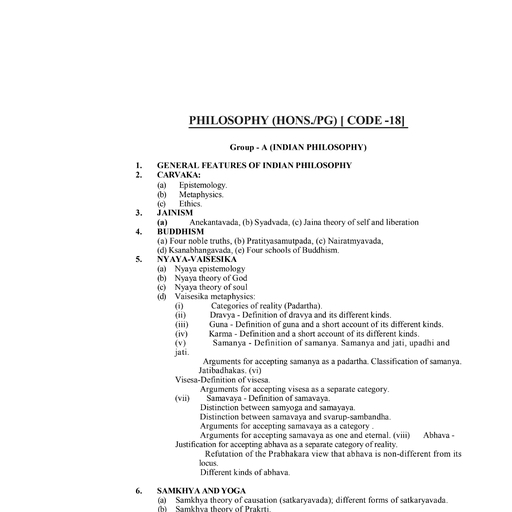
6. SAMKHYA AND YOGA, (a) Samkhya theory of causation (satkaryavada); different, forms of satkaryavada., (b) Samkhya theory of Prakrti, (c) Samkhya conception of Guna, (d) Relation between Prakrti and Gunas, (e) Proofs for the existence of prakrti, (f) Samkhya theory of Purusa; proofs for the existence; of purusa, Doctrine of plurality of selves., (g) Theory of evolution (after Vacaspati’s commentary), (h) Samkhya theory of liberation – jivanmukti and videhamukti., (i) Yoga conception of God., (j) Cittabhumi and Cittavrtti, (k) Eight – fold means of Yoga., (l) Samadhi – its different types., 7. MIMAMSA (PRABHAKARA AND BHATTA), (a) Arthapatti and Anupalabdhi as sources of valid knowledge., (b) Pramanyavada in respect of origin of knowledge and, knowledge of knowledge., 8. VEDANTA (SAMKARA AND RAMANUJA), (a) Nature of Brahman, according to Samkara., (b) Saguna Brahman and nirguna Brahman, according to Samkara., (c) Relation between Brahman and the world (Jagat) according to, Samkara., (d) Samkara’s doctrine of Maya, (e) Ramanuja’s criticism of Samkara’s doctrine of Maya, (f) The Advaita theory of liberation – Jivanmukti and videhamukti, (g) Ramajuja’s theory of Brahman, (h) Relation between Jiva and Brahman, according to Ramanuja, Group –B (ETHICS), 1), 2), 3), 4), 5), 6), 7), , The Nature of Ethics, Moral and Non-moral Action, The Nature of Moral Judgement, Object of Moral Judgement, Postulates of Morality, Theories of Punishment, Standard’s of Morality, , Hedonism:, (a) Psychological and Ethical, (b) Egoistic Hedonism, (c) Gross, Egoistic Hedonism, (d) Refined Egoistic Hedonism (e) Altruistic, Hedonism – Bent ham’s Theory, (f) Mill’s Utilitarianism, (g) Act –, Utilitarianism and Rule – Utilitarianism, 9. Deontological Theories, Act - Deontological Theories, Rule – Deontological, Theories Kant’s Theory
Page 3 :
10. Practical Ethics, (i) The concept of Practical Ethics, (ii) Euthanasia, (iii)Killing Animals, (iv)Environmental Ethics, Group – C, (HISTORY OF WESTERN PHILOSOPHY), Plato :, , (a), (b), , Theory of Knowledge, Theory of Forms, , Aristotle:, , (a), (b), (c), (d), , Doctrine of Causality, Theory of Substance, Matter and Form, Criticism of Plato’s Theory of Forms, , Descartes:, , (a), (b), (c), (d), (e), (f), (g), (h), (i), , Cartesian Method, Cartesian Method of Doubt, Cogito ergo sum, Criterion of Truth, Theory of Ideas, Proofs for the Existence of God, Doctrine of Substance, Mind-Body Relation, Proof of the External World, , Spinoza:, , (a), (b), (c), (d), (e), (f), , Doctrine of Substance, Relation between Substance and Attributes, Doctrine of Modes, Theory of Knowledge, Mind – Body Relation, Conception of Freedom; Intellectual Love of God., , Leibnitz:, , Doctrine of Monads: Truths of Reason of Truths of Fact; The Principles of, Non-Contradiction, Sufficient Reason and the Identity of Indiscernibles;, The Doctrine of Pre-established Harmony; Theory of Knowledge. Problem, of Evil., Refutation of Innate Ideas and Principles; Theory of Ideas:, Distinction, between Primary and Secondary Qualities. Theory of Knowledge., of, Rejection of Materialism; Criticism of Abstract Ideas; Rejection the, Distinction between Primary and Secondary Qualities; Esseest Percipi;, Role of God in Berkeley’s Philosophy., , Locke:, Berkeley:, , Hume:, , Distinction between Impressions and Ideas; Relation of Ideas and Matters, of Facts; Causality; Self, Scepticism., , Kant:, , Apriori and Empirical Knowledge; Analytic and Synthetic Judgement;, Synthetic Apriori Judgement-Kant’s Problem; Copernican Revolution, in
Page 4 :
Philosophy; Space and Time; Categories of the Understanding.
Page 5 :
Group – D, (PSYCHOLOGY), Methods of, Psychology: Introspection: Extrospection; Experimental Method., Sensation: Definition; Attributes of Sensation; Weber-Fechner Law, Perception: Definition; Distinction between Sensation and Perception; Gestalt Theory, of Perception., Memory:, Factors of Memory: Marks of Good Memory: Laws of Association. Causes, of Forgetfulness., Attention: Nature, Condition and Span of Attention: Division of Attention., Learning: Theories of Learning- Trial and Error Theory; Pavlov’s Conditioned, Response Theory: Gestalt Theory., Instinct:, Biological Theory; Psychological Theory., Consciousness: Levels of Consciouness; Proofs for the Existence of the Unconscious;, Freud’s Theory of Dream., Intelligence: Definition; Measurement of Intelligence; I.Q. Binet – Simon Test of, Intelligence; Terman Merril and Wecshler Test of Intelligence., Theories of Intelligence: Unifactor; Two-Factor (Spearman’s Theory);, Multifactor Theory., Group – E, (LOGIC), Basic Concepts : Social Group; Community; Association ; Institution; Customs;, Folkways and Mores., Social Class and Caste : Principles of Class and Caste; Class Attitudes and Class, Consciousness., Social Change : The Marxist Theory of Social Change., Political Philosophy : Nature and Scope; Scientific Theory and Philosophical, theory. Political Ideals : Democracy – Its diferent forms., Socialism – Utopian and Scientific., Sarvodaya; Gandhiji’s Conception of Nonviolence. Gandhiji’s Theory of Trusteeship., , Group – F, (SOCIAL AND POLITICAL PHILOSOPHY), 1) Categorical Propositions and Classes: Quality, Quality and Distribution of, Terms; Translating Categorical Propositions into Standard form., 2) Immediate Inference: Conversion, Obversion, Contraposition: Square of, Opposition; Determination of the truth-value of a proposition, given the, truth-value of another proposition., 3) Categorical Syllogism: General Rules and Fallacies; Solving Problems and, Proving Theorems concerning Syllogism., 4) Boolean Interpretation of Categorical Propositions, Venn Diagrammatic, Representation of Categorical Propositions. Use of Venn Diagram to Test, Arguments for validity; Review of the Traditional Laws of Logic concerning, Immediate Inference and Syllogism: hypothetical and Disjunctive Syllogism:, Dilemma.
Page 6 :
(5) Truth Functions: Negation, Conjunction, Disjunction, Conditional, Biconditional., Testing Argument-forms and Arguments for validity by applying (a) Truthtable Method, (b) Method of Resolution, (c) Shorter Truth-table TechniqueReductio Ad Absurdum. Testing Statement/Statement-form for Validity of, Truth-table Method and method of Resolution. Proving invalidity, to, Construct Formal Proof of Validity., (6) Quantification: Translating Sentences into Quantificational Language:, Quantification Rules – Ul, EI, UG EG. To Construct Formal Proof of Validity, of Arguments involving Monadic Quantification, To Prove invalidity of, Arguments involving Monadic Quantification., (7) Analogy and Probable Inference: Induction by Simple Enumeration; Analogical, Argument; Appraising Analogical Arguments., , (8) Causul Connection and Mill’s Methods of Experimental Enquiry. The Meaning of, Cause; Doctrine of Plurality of Causes: Method of Agreement; Method of, Difference; Joint Method of Agreement and Difference; Method of, Concomitant Variation; Method of Residues. Criticisms of Mil’s Methods;, Vindication of Mill’s Methods., 9) Hypothesis: Distinction between Scientific and Unscientific Explanation;, Criteria for appraising Scientific Explanation.




 Learn better on this topic