Page 3 :
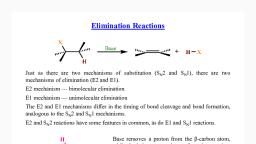
Dr. Suchita Wankhede, , Introduction of elimination reaction, As is evident from the term “Elimination reactions”, these are organic, chemical reactions in which a pair of atoms or groups of atoms (leaving group), are removed (eliminated) from a molecule, usually through the action of acids,, bases, or metals and, in some cases, by heating to a high temperature. In most, organic elimination reactions, at least one hydrogen is lost to form the, unsaturated bond and it is one of the main methods used for the formation of, unsaturated compounds (alkene or alkyne) from substrates containing single, carbon-carbon bonds (saturated compounds). Elimination may be considered, the reverse of an addition reaction., , Substitution Reaction, , Elimination reaction, , Types of elimination reactions, Based on the position of the leaving group, these may be αeliminations, β-eliminations or 1,3 or Ƴ-eliminations., α-eliminations generate carbenes, which are unstable divalent, carbon species useful for many other reactions., , Amolakchand Mahavidyalaya, Yavatmal, , Page 3
Page 5 :
Dr. Suchita Wankhede, , E1 – Unimolecular elimination reaction, E – elimination, 1 – Unimolecular of first order, Reaction –, The reaction of tert. butyl bromide with aq. methyl alcohol gives isobutylene., , Tert. butyl bromide, , isobutylene, , Rate of reaction, As rate of reaction is depends on only one reactant i.e. tert. butyl bromide, it is, first order elimination reaction., Rate = K [tert. butyl bromide], Mechanism, It involves following two steps,, Step 1, In this step, the reactant first undergoes unimolecular ionization and forms a, carbocation intermediate without the involvement of any base. This step is slow, and rate-determining and is analogous to the rate-determining step in the SN1, mechanism. The leaving group leaves in this step., , Amolakchand Mahavidyalaya, Yavatmal, , Page 5
Page 6 :
Dr. Suchita Wankhede, , Step 2, In this step base forms an elimination product by removing a proton from, carbon adjacent to the positively charged carbon, gives alkene. This is the fast, step., , Energy Profile diagram, , Amolakchand Mahavidyalaya, Yavatmal, , Page 6
Page 7 :
Dr. Suchita Wankhede, , E2 – Bimolecular elimination reaction, E – elimination, 2 – Bimolecular or second order, Reaction –, The reaction of Ethyl bromide with ethoxide base gives ethylene., , Ethyl bromide, , Ethylene, , Rate of reaction, As rate of reaction is depends on both reactant i.e. ethyl bromide and ethoxide, ion, it is second order elimination reaction. It is similar to SN2 reaction., Rate = K [ethyl bromide][C2H5O-], Mechanism, It involves only one step,, The reaction occurs in a single step i.e. it is a concerted type of reaction, in which both the groups (proton and leaving group) are eliminated, simultaneously in the rate determining step., The base ethoxide ion abstracts a proton from the β-carbon, and the, leaving group (Br-) departs at the same time from the α-carbon., The α C-Br and β C-H bonds are coplanar in the transition state and the, two leaving groups must be in trans relationship for undergoing E2, , Amolakchand Mahavidyalaya, Yavatmal, , Page 7
Page 9 :
Dr. Suchita Wankhede, , Factors affecting rate of E1 and E2 reaction (E1 Vs E2), Structure of substrate, Strength of base, Nature of leaving group, Nature of solvents, , Structure of substrate, 1. E1 reaction –, In the mechanism of E1 reaction the first step is the formation of, intermediate carbocation, which is a rate determining step. Thus stability, of carbocation plays important role. Any structure which forms more, stable of carbocation, will be reactive. Factors like +I effect,, hyperconjugation and conjugative effect stabilize carbocation as in SN1, reaction. The reactivity with increasing order for E1 reaction is given as, follows,, , Thus, alkyl and aryl substitutions on α and β- carbon with respect to the, leaving group increases the rate of E1 reaction. Steric strain increases the, yield of E1 product., 2. E2 reaction –, It is found that, branching at α and β- carbons increases the rate of the E2, reaction. This is because as the number of substituent increases on the, Amolakchand Mahavidyalaya, Yavatmal, , Page 9
Page 10 :
Dr. Suchita Wankhede, , carbon atoms of the developing double bond, the stability of transition, state increases. Thus tert. alkyl halides are more reactive than sec. alkyl, halides which are more than the primary alkyl halides., , On contrary, steric strain in the transition state of SN2 reaction, slow, down the rate of reaction., , It is also found that, the electron withdrawing groups on the β-carbon, increases the rate of E2 reaction. This is because the – I group increases, the acidity of the β-hydrogens and stabilizes the carbanion character of, the transition state., , Strength of base, 1. E1 reaction –, In rate determining step of E1 reaction, base does not play any important, role. Thus the strength and concentration of base have no effect on the, rate of E1 reaction. But still weak base is requires in the reaction (the, solvent molecule serve the purpose which themselves behave as base)., 2. E2 reaction –, As base is involved in rate determining step of E 2 reaction mechanism,, the strength of base plays important role. A stronger base increases the, Amolakchand Mahavidyalaya, Yavatmal, , Page 10
Page 11 :
Dr. Suchita Wankhede, , rate of E2 reaction. With increasing order of basicity order of rate is also, increases as shown below., NH2- > -OC2H5 > -OH, There are bulky (sterically hindered) and small (sterically unhindered), bases. All of them are suitable for E2 reactions but they are used, selectively mainly to control the regiochemistry of the E 2 reaction. Small, bases can also serve as nucleophiles and perform an SN2 reaction., , Nature of leaving group, 1. E1 reaction –, Reactivity of substrate depends mainly on the nature of leaving group., The best leaving groups are those which are least basic and more, polarisable. Thus the decreasing order of the leaving group reactivity is,, , 2. E2 reaction –, In general better the leaving group, higher is the rate of E2 reaction. Thus,, when β-phenyl halides are treated with sodium ethoxide in ethyl alcohol,, , Amolakchand Mahavidyalaya, Yavatmal, , Page 11