Page 1 :
Systematic Procedure for Inorganic Qualitative Analysis, Systematic Analysis of Anion, S.No, 1, , 2, , 3, , 4, , Experiment, Preliminary Reactions, , Observation, Colourless, , Inference, Absence of Fe2+, Fe3+, Ni2+,, Co2+., Appearance, Green, May be Fe2+, Ni2+, Cu2+, Blue, Cu2+, Brown, May be Fe2+, Pink, May be Co2+, Mn2+, A colourless gas with a May be NH4+ salt, characteristic, pungent, odour turning moist red, Action of heat, litmus paper blue., Take a small amount of, the given salt taken in a, Reddish brown vapours May be, dry test tube, heat it, turning acidified ferrous, gently; then strongly., sulphate paper brown, are, obtained., Substance is white when May be (Zn)2+, cold and yellow when hot., Flame Test, (i) Bluish green flame, May be Cu2+, To a small amount of the (ii) Apple green, May be Ba2+, given salt taken in a (iii) Brick red, May be Ca2+, watch glass, add a drop (iv) Crimson red, May be Sr2+, of Con. HCl and make it, into a paste. Introduce, the paste with the help, of a glass rod to the base, of, the, non-luminous, bunsen burner., Identification of Anions from Volatile Products:, Brisk, effervescence, of Anion is CO32colourless, odourless gas, turning lime water, milky is, obtained., Colourless gas with a smell Anion is sulphide., of rotten eggs, turning lead, acetate paper black is, obtained., Colourless gas with smell of Anion is SO32burning sulphur turning, Action of dilute H2SO4:, acidified dichromatic green, To a small portion of the, is obtained., given salt taken in a test, Reddish brown gas with Anion is, tube add 1 or 2ccs of, fishy, odour, turning, H2SO4 and gently warm, acidified ferrous sulphate, it., brown is obtained., Colourless gas with smell of Anion may be acetate., vinegar is obtained., No, characteristic Absence of CO32-,, , S2-,, 2observation., SO3 , CH3COO
Page 2 :
5, , 6, , 7, , 8, , Reddish brown vapours, turning moist fluorescent, paper red., Colourless, gas, with, pungent smell giving dense, white fumes with a glass, Action of Con.H2SO4, rod dipped in NH4OH, To a small amount of, given salt taken in a test solution., tube, add 2-3 ccs of, Violet coloured vapours, Con.H2SO4 and gently, turning starch paper blue, heat it., or violet., Reddish brown vapours, turning acidified ferrous, sulphate paper brown., No, characteristic, observation., Action of Con.H2SO4 with Copius evolution of reddish, Cu turnings:, brown gas turning acidified, Mix a small amount of ferrous, sulphate, paper, the given salt taken in a brown is observed., test tube with a few Cu, bits, add 2 – 3 ccs of No reddish brown vapours., H2SO4 and heat it., A greenish yellow gas, Action of Con.H2SO4 with turning starch iodide paper, violet (or) blue is obtained., MnO2, To a small amount of the Reddish brown vapours, given salt taken in a test turning moist fluorescent, paper red is obtained., tube, add an equal, amount of MnO2 and, Violet, vapours, turning, add a few ccs of, starch paper blue (or) violet, Con.H2SO4 and gently, is obtained., heat., No characteristic coloured, vapours are obtained., Action of NaOH, A colourless gas with a, To a pinch of the given pungent smell giving dense, salt taken in a test tube, white fumes with glass rod, add few ccs of 10% dipped in HCl is obtained., NaOH, solution, and, gently warm it., No characteristic gas is, Ammonium liberated., , Anion may be bromide., Anion may be chloride., , Anion may be Iodide., Anion may be nitrate., Absence of, , ,, , ,, , &, , Anion is nitrate., , Absence of, Anion may be chloride., Anion may be bromide., Anion may be iodide, Absence of, , ,, , ,, , Cation is ammonium., , Ammonium is absent., , Sodium Carbonate Extract, Identification of Anions in solution, Preparation of Extract:, Take about, , or, , of the given salt in a 50cc beaker., , Mix it well with about, , thrice its amount of solid sodium carbonate. Add about 15 – 20ml of distilled, water. Mix well with neat glass rod. Boil contents of the beaker over Bunsen, flame. Cool and filter through filter assembly. Collect the clean filtrate in, another beaker. The Filtrate is called soda extract.
Page 3 :
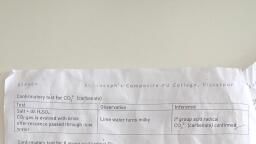
S.No, 9, , 10, , 11, , 12, , 13, , Experiment, Silver Nitrate Test:, To a portion of extract, add dilute HNO3 until, effervescence, ceases., Add few drops in excess,, 2 – 3nos of AgNO3, solution., , Observation, Inference, Curdy white precipitate Anion is Cl–, soluble in NH4OH., –, Pale, yellow, precipitate Anion is Br, sparingly soluble in NH4OH., , Yellow precipitate insoluble Anion is, in NH4OH., , Absence of Br–, Cl–, I–, No precipitate is obtained., Barium Chloride Test:, A, white, precipitate Anion is, To about one or two ccs insoluble in HCl., of the extract, (after, neutralizing with acetic A white precipitate soluble Anion is, acid and boiling of CO2) in HCl., add BaCl2 solution., To a portion of the above No precipitate is obtained., Absence of, ppt add dil. HCl., Lead Acetate Test:, To about one or two ccs, of the extract (after, acidifying with acetic, acid, boiling off CO2 and, cooling) add lead acetate, solution., Ferrous Sulphate Test:, (Brown Ring Test), To about 1 or 2cc of, extract, add, dilute, H2SO4 in drops until the, effervescence, ceases., And few drops in excess, add 2- 3 drops of freshly, prepared FeSO4 solution., Keeping the test tube in, a slanting position, add, Con., H2SO4, without, disturbing the solution., Ferric Chloride Test:, Take about 1 or 2ccs of, the extract in a test tube, and add neutral FeCl3, solution., Filter,, if, required, and divide the, solution or the filtrate in, two parts:, (i) To, dil.HCl, , one, , part, , White ppt, soluble in excess, of, ammonium, acetate, solution., , A brown ring is obtained at Anion is, the junction of the liquid., , No brown ring is observed., , Deep, red, produced, , colouration, , add Red colouration disappears, , (ii) To the second part, add water and boil, , confirmed., , Reddish brown ppt., , Anion, , is absent., , confirmed., , confirmed., confirmed.
Page 4 :
14, , 15, , Calcium Chloride Test:, To a portion of the A white precipitate of Confirms Oxalate., sodium, carbonate calcium oxalate is obtained, extract, taken in a test, tube add dil. Acetic acid, and boil off CO2. Then, add a few drops of, calcium, chloride, solution., Add dil. HNO3 to the The precipitate dissolves., white ppt and warm., Ethyl Acetate Test:, To a pinch of given salt A pleasant fruity odour is The presence of anion acetate is, taken in a test tube, add obtained., confirmed., a few drops of ethanol, followed by 1 or 2ccs of, H2SO4. Gently heat and, cool it., Pour into, Na2CO3.
Page 5 :
Systematic Analysis of Cations, Preparation of Original solution:, Check solubility of the given salt in:, - Cold water (or) hot water (or) Dil HCl (or) Conc. HCl., original solution., , Label this solution as, , Procedure for Separation of Basic Radicals into Groups, , To the original solution, add Dil. HCl., White, ppt., Group, I, 2+, present (Pb, and, If no ppt. pass H2S through the given solution. If a coloured ppt. is formed,, group 2 cations are present (Cu2+), Pb2+., If no ppt is obtained from the above, boil off H2s gas and add a, few drops of conc. HNO3 to the remaining solution. Cool, add, 2-3g of solid NH4Cl. Boil again and add NH4OH solution till it, becomes alkaline., If a ppt is formed, Group III cations are present. Reddish, brown ppt. Fe3+ Gelatinous white ppt. Al3+, If no ppt., pass H2S to the given solution., If a ppt is formed Group IV cations are, present. Black ppt. (Co2+, Ni2+), Flesh coloured ppt. Mn2+ white ppt. Zn2+., If no ppt is formed, boil off, H 2S, gas, add, (NH4)2CO3, solution., If a white ppt is formed Group, V cations are present (Ba2+,, Sr2+, Ca2+), If, no, ppt., Group, VI, cation, is, present (Mg2+, , If none of the cations are present, check for Group 0 (, , ), , Cation Analysis, Group O (NH4+):, To a pinch of given salt add Yellowish brown precipitate Cation is ammonium., some water and warm., is obtained., Then allow it to cool. Add, Nessler’s reagent and, No precipitate is obtained., Cation is not ammonium., excess of NaOH solution.
Page 6 :
Group I (lead):, Group I precipitate is dissolved by heating the precipitate with dil.HNO3 or distilled, water. Divide the solution into 3 portions and carry out the following reactions., , Experiment, , Observation, , Inference, , To one portion of the above A white precipitate, solution add dilute H2SO4. PbSO4 is obtained., , of, , To another portion, add A, potassium, chromate, solution., , of Presence, confirmed., , yellow precipitate, is obtained., , Golden Spangles Test:, A yellow, To the 3rd portion, add KI obtained., solution, , precipitate, , Pb2+, , is present., , of, , is The presence of, confirmed., , is, , is, , To above yellow precipitate, Precipitate dissolves and, add some H2O, boil and reappears in the form of, then cool., golden spangles., , Group II (, , :, , The group 2 precipitate is dissolved by heating with dilute HCl. Precipitate dissolves., , Experiment, Test for, :, To one portion of the above, solution add drops of, NH4OH, until it is in, excess., , Observation, , Inference, , A pale blue precipitate The presence of Cu2+ is, which dissolves in excess confirmed., NH4OH to give any inky, blue solution is obtained., , To another portion, add, dilute acetic acid and A chocolate brown ppt., potassium, ferrocyanide, [K4(Fe(CN6))], , Confirms copper., , Group III:, Group III precipitate is heated with Con. HCl and water, cooled and filtered., , Reddish brown precipitate indicates Fe2+ (or) Fe3+, Gelatinous white indicates Al3+, Experiment, , 1., , Observation, Inference, To 1 cm3 OS, add a Formation of a deep Fe2+ confirmed., few drops of dilute blue colour or ppt., HCl and then add
Page 7 :
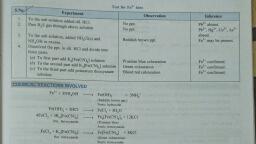
2., , 0.5 cm3 of potassium, ferricyanide solution., White, gelatinous, precipitate dissolves, in minimum quantity, of dil. HCl. To this,, add a few drops of, blue litmus solution., , Formation of a blue Al3+ confirmed., floating, ppt., in, colourless, solution., (This is known as Lake, test), , Add NH4OH solution A blue ppt., suspended, in excess., in a colourless medium, (called a lake), 2B To one part of the White Precipitate soluble Al3+ confirmed, above solution add in excess of NaOH, NaOH solution, solution, 3., , (i), , (ii), , Reddish brown ppt., (Shows the presence, of Fe3+) Treat it with, minimum quantity of, dil. HCl solution to, dissolve the ppt. and, then heat. Divide the, solution, into, two, parts., To one part, add few, drops of potassium, ferrocyanide solution., , A yellow, produced., , solution, , is, , may be present., , A deep blue colour or, ppt. is obtained., , confirmed., , To another portion A deep red colour is, add few drops of obtained., potassium, sulphocyanide, solution., , confirmed., , Group IV :, Group IV precipitate is warmed with dilute HCl centrifugate, , Black precipitate Ni2+, Ni is not soluble in dilute HCl. To residue A Red rosy precipitate, add Con.HCl, boil, cool. Divide the presence of Ni2+, solution into two parts and boil of H2S. To, one part add dimethyl glyoxime reagent., Con.NH4OH, till the solution becomes, alikaline., , confirms, , the
Page 8 :
Sodium Hydroxide and Br2 – water test., A black precipitate confirms the, To the second part of the above solution, of Ni2+., add NaOH and Br2 water and then boil, Confirmation of Zn2+:, Dissolve a part of white ppt in dil. HCl., Boil off H2S and divide the solution in two, parts., Bluish White ppt confirms Zinc., (i) To one part of solution add Pot., ferrocyanide solution, White ppt soluble in excess of, (ii) To second part of solution add NaOH., obtained., Flesh (buff) colour precipitate indicates A white precipitate is formed., Mn2+., water to the white ppt it turns, Dissolve the precipitate in Dil. HCl and brown. Mn2+ confirmed., boil off H2S then add NaOH solution., Lead peroxide test, A pink colouration is produced., To the second part of the flesh coloured confirmed., ppt, add a little of PbO2 powder and, conc. HNO3., Boil, cool and allow to, stand., , presence, , NaOH is, Add Br, black or, Mn2+ is, , Group V :, Take a small portion of Group V precipitate, carry out flame test. Take group V, precipitate, add dilute CH3COOH, warm. Boil of CO2 and divide the solution into, three parts., Barium, Ba2+, 1. Potassium chromate, test., To one part of the above, solution, add a few drops of, K2CrO4 solution – Yellow, ppt. Ba2+ confirmed., , Stronium Sr2+, 1. Ammonium sulphate, test., To the second part of the, above solution add a few, drops, of, ammonium, sulphate solution – white, ppt. Sr2+ confirmed., , 2. Dil. H2SO4 Test, Flame test, To another portion of the, above solution, add a few, drops of dil. H2SO4 – white, ppt. insoluble in HCl., Ba2+ confirmed., , Calcium Ca2+, 1. Ammonium oxalate test., To the third portion of the, above, solution,, add, ammonium, oxalate, solution and then NH4OH, solution to make it alkaline, and scratch the sides of, the test tube – white ppt., Ca2+ confirmed., Flame test
Page 9 :
Test for Mg2+:, 1. Ammonium phosphate test., White crystalline ppt., To the original salt solution, add solid, NH4Cl, warm to dissolve, cool and add, NH4OH solution in slight excess. Then, add ammonium phosphate solution,, shake well and allow to stand, 2. To the original sat solution, add White crystalline ppt confirms Mg2+, disodium hydrogen phosphate., , Additional Test:, Ash test for Al3+, Zn2+, Mg2+, To a pinch of given salt, taken in a test tube, add a, few drops of Con.H2SO4,, Co(No3)2. Mix it well. Dip, one filter paper bit in a, Bunsen flame., After it, burns remove it from, flame., After cooking, observe the odour of the, ash formed., , Blue tinted ash is obtained. The presence of Al3+ is, confirmed., Green, tinted, ash, is, obtained., The presence of Zn2+ is, confirmed., Pink tinted ash is obtained., The presence of Mg2+ is, confirmed.
Page 10 :
READY REFERENCE CHART FOR QUALITATIVE ANALYSIS OF BASIC RAIDCALS, Make the solution of the given salt in distilled water, in dil. HCl or conc. HCl, cold or hot. Label it original solutions (O.S.). To the O.S., add dil. HCl, White ppt., , If Group I is absent, pass H2S gas through O.S. for sufficient time after acidification with dil. HCl filter., , 2+, , (Pb ), Confirmation, , PPt. - Group II, Black ppt. - (Pb, , 2+, , (i), , of Pb, Boil white ppt., with distilled, water, and, divide, the, solution into, two parts., Add KI solution, to one part of, above, solution., Yellow, ppt., confirms Pb, , (ii), , 2+, , ., , Add K2CrO4, (i), solution to the, second part of, (ii), the, above, solution., Yellow, ppt., confirms Pb, (i), , 2+, , ., , 2+, , 2+, , , Cu, , ), , 3+, , Yellow ppt. - (As ), Dissolve the black ppt. in minimum, quantity of 50% HNO3. To one part of, the above solution add. dil. H2SO4, and alcohol. If a white ppt. is formed, Pb, , 2+, , (i) is, is indicated. If no white ppt., , formed, add excess NH4OH to the, second part of the solution - Blue, , 2+, coloured solution indicates Cu (ii), ., Confirmation of Cu, , 2+, , Add excess of NH4OH solution to, original solution. Deep blue solution., Acidify the above deep blue solution, (i), with dil. acetic acid. Add Pot., ferrocyanide solution. Chocolate, 2+, (ii), brown ppt. confirms Cu ., , If Group II is absent, add solid NH4Cl, 0.5 ml conc. HNO3 to the O.S. Boil and cool. Add NH4OH till it smells of ammonia. If a ppt. is formed, group III is present., Reddish brown ppt. If group III is absent, through a part of the solution obtained in group III pass H 2S gas. If a ppt. is obtained group IV is present., 3+, (Fe ), 2+, White ppt. - (Zn ), If Group IV is absent, to the O.S. add solid NH4Cl, NH4OH and, 3+, White ppt. - (Al ), 2+, 2+, Black ppt. - (Ni and Co ), (NH4)2CO3 solution., Confirmation of (Fe3+), 2+, Dissolve the brown ppt. Flesh coloured ppt. - (Mn ), in dil. HCl and divide the, 2+ 2+ 2+, 2+, If Group V is absent, White ppt. (Ba , Sr , Ca ), Confirmation of Zn, solution into two parts., 2+, To one part of solution Dissolve a part of white ppt. in dil. HCl and divide the solution in two Dissolve a part of white ppt. in dil. acetic test for Mg ., (i), To the O.S. add a, add pot. ferrocyanide parts., acid. Boil off CO2., To one part of solution add. pot. ferrocynaide solution solution. A prussion (i), (i), To one part of the above solution, add pinch of NH4Cl, a few, Bluish white ppt., blue colour or ppt., To second part of solution add NaOH solution. White ppt. K2CrO4 solution. Yellow ppt. Confirms groups of NH4OH, To second part of (ii), 2+, soluble in excess., solution, add., pot., and excess of amm., Ba ., sulphocyanide solution. Confirmation of Ni2+ and Co2+, phosphate solution 2+, 2+, 2+, 2+, A blood red colouration., (ii), If, Ba, is, absent,, then, to, the, second, part, If the ppt. obtained is black Ni or Co is indicated. Note the colour, White ppt. - Mg ., 3+, of above solution add amm. sulphate, Confirmation of Al, 2+, (ii), Perform, charcoal, 2+, of, the, salt., If, the, salt, is, greenish, Ni, is, indicated, and, if, the, salt, is, Perform charcoal cavity cavity cobalt nitrate, solution. A white ppt. confirms Sr ., cobalt nitrate test with purple Co2+ is indicated., test with white ppt. 2+, 2+, (iii), If both Ba and Sr are absent, then to A pink mass., white ppt. Blue mass., 2+, the third part of the above solution add, +, Lake test. White ppt. + Confirmation of Co, ammonium oxalate solution. A white Test for NH4, dil. HCl + a few drops of, To the salt and, Take O.S. and neutralise the acid by adding NH4OH. Add a, 2+, blue litmus solution + (i), ppt. confirms Ca ., sodium, hydroxide, pinch of potassium nitrite and acidify with dil. acetic acid NH4OH, solution, in, Perform, the, flame, test, with, a, part, of, the, solution, and, heat. If, Yellow ppt., salt., excess. A blue ppt., (ii), ammonia, gas, evolves, Perform boraxbead test with the salt. - Blue bead, 2+, +, suspended, in, a, 2+, (i), Light green flame-Ba confirmed., NH4 is present., colourless, medium Confirmation of Ni, 2+, Pass the gas through, (ii), Crimson red flame-Sr confirmed., (called a lake), (i), Take O.S. and make alkaline by adding NH4OH and then add a, Nessler’s reagent. A, 2+, (iii), Brick red flame-Ca confirmed., few drops of dimethyl glyoxime - Bright red ppt., brownish ppt. or, (ii), Perform borax bead test with the salt - Brown bead in, colouration, is, oxidising flame and grey bead in reducing flame., obtained., Confirmation of Mn, , 2+, , (i), , Dissolve flesh coloured ppt. in dil. HCl, boil off H 2S, add NaOH, , (ii), , and Br2 water. - White ppt. turning grey., Perform borax bead test with group ppt. - Pink bead in, oxidising flame and colourless in reducing flame., , +, , Note: NH4 may be, tested, in, the, beginning of analysis, of basic radicals as, zero group.