Page 1 :
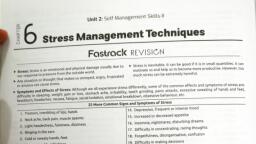
E X P E C T A T I O N, 1. Apply a challenging work that is perceived to be neither too difficult or too easy., 2. Understand the value of self – esteem to ourselves., 3. Analyze that our goals may start out to be easy overtime may tend to distress., P R E – T E S T, Directions: Choose the letter of the best answer. Write your answer on your notebook., 1. What do you call the dimension of health that deals with a person’s thoughts and feelings?, A. Physical dimension C. Emotional dimension B. Mental dimension D. Social dimension, 2. What do you call the physical and emotional response to a sad and unexpected situation due to some experiences?, A. Anxiety C. Grief B. Stress D. Love, 3. Any situation that may cause stress to a person is called?, A. Love C. Distress B. Stressor D. Eustress, 4. Which of the following is considered stressful?, A. Losing your money C. Attending a party B. Going to a new place D. Witnessing a tribal dance, 5. If you feel happy when you got an outstanding grade in the exam after long hours of review, what kind of response is that?, A. Eustress C. Distress B. Anxiety D. Stress, R E C A P, Direction: Read each question carefully., Write TRUE if the statement is correct and FALSE if it is not., 1. Decision making is an important skill to teach children of all ages, because parents want children to grow up to be independent, responsible, and happy adults., 2. Critical thinking is not an important process during adolescence., 3. Skipping breakfast helps you perform well in school., 4. The symptoms of hypoglycemia are dizziness, headaches, and fainting., 5. Eating in fast food restaurant is a healthy habit., LESSON, INTRODUCTION, Mental and Emotional health, Health is most often being related to solely the physical well-being of an individual. Little do people know that health is more than looking healthy. As we learned in the previous modules, health has various dimensions: physical, emotional, mental, social, moral- spiritual, and environmental. Aside from looking healthy, an individual must also be feeling, thinking, and interacting healthy to achieve wellness. This module will focus on your mental and emotional health. It will help you be aware of how your health is affected with the way you think and feel., STRESS, Do you think stress is always something negative? Actually, stress can either be negative or positive!, Stress -is defined as the physiological (or physical) and emotional responses to a significant or unexpected change or disruption in one’s life (Payne, et al., 2005). It may also refer to “what you feel when you react to pressure, either from the outside world (school, family, friends) or from yourself i.e. wanting to fit in, wanting to do well in school., Stressor -refers to the things that make a person stressed., There are two different kinds of stress, 1. Eustress -refers to a positive and healthy response of the body from a stressor. It produces good effects to one’s well-being. For example, a person, who studied for long hours then tool and got an outstanding grade in the exam, may feel happiness and enjoyment., 2. Distress -refers to a negative reaction of the body towards a given stressor. It may cause problems in health, alter the mood and emotions, and even affect the way a person woke up late for work, he or she may feel anger and disappointment., Is stress Normal and Inevitable? Yes! Stress is normal and inevitable, Everyday we experience different kinds of stress. Some are good and some are not, that no one is spared from experiencing stress because it is part of our lives., COMMON AREAS OF STRESSOR THAT AFFECT STRESS, Common stressors that affect adolescents:, • Schools, • Parents, • Peer groups, • Lack of life skills, • Personal thoughts, SCHOOL, People have different learning styles, interests and strenghts. Unfortunately, school is a standard structure that doesn’t take this differences into consideration., PARENTS, a. High expectations are a big stress and challenge for young people., b. After school activities are important but become a stressor if parents expect their teens to be involved in too many., c. Stressed parents can transfer their stress on to their children., LACK OF LIFE SKILLS, Skills such as organization and time management are important stress preventers. Likewise, an absence of these valuable skills can make life more hectic and chaotic. The effects of stress in your body, Stress is any change in the environment that requires your body to react and adjust in response. The body reacts to these changes with physical, mental and emotional responses., Some sources of stress for teens include:, • Schools demands and frustrations., • Negative thoughts or feelings about the themselves., • Changes in their bodies. • Problems with friends and/or peers at school., • Unsafe living environment/ neighborhood., • Separation or divorce of parents., • Chronic illness or severe problems in the family., • Death of loved one. • Moving or changing schools., • Taking on too many activities or having too high expectations., • Family financial problems., Mental health -includes our emotional, psychological, and social well-being. It affects how we think, feel, and act. It also determine how we handle stress, relate to others, and make choices., Factors that contributes to mental health problems:, • Biological factor, such as genes or brain chemistry., • Life experiences, such as trauma or abuse;, • Family history of mental health problems., Emotional health -it means you’re aware of your emotions. You can deal with them, whether they’re positive or negative. Emotionally healthy people still feel stress, anger, and sadness. But they know how to manage their negative feelings., Ways to improve or maintain good emotional health, • Be aware of your emotions and reactions., • Express your feelings in appropriate ways., • Think before you act., • Manage stress, • Strive for balance., • Take care of your physical health., • Connect with others., • Find purpose and meaning., • Stay positive., Activity 1: LET’S BRAINSTORM, Directions:, 1. Ask four of your friends to give words that are related to mental and emotional health. Write their responses on the semantic web below., 2. Complete the web below., 3. Come up with your own definition of mental and emotional health., WRAP – UP, Directions: Read the following situations., Draw a smiling face ( 😊 )if you consider it as a source of eustress and a sad face ( ☹) if it causes distress., _____1. Choosing a gift for a friend _____ 6. Losing your money, _____2. Arguing with a classmate _____ 7. Getting a birthday surprise, _____3. Going to a new place _____ 8. Attending a party, _____4. Having a new born sibling _____ 9. Witnessing a tribal dance, _____5. Getting a failing mark _____ 10. Watching a traditional play., Directions: Choose the letter of the best answer. Write your answer on your notebook., 1. It affects how we think, feel, and act. It also determine how we handle stress, relate to others, and make choices A. Mental health C. Emotional health B. Eustress D. Distress, 2. Which of the following best describes eustress? A. Arguing with siblings C. Getting high grades B. Losing loved ones D. Having separated parents, 3. It refers to the things that make a person stressed. A. Stress C. Distress B. Eustress D. Stressor, 4. It is defined as the physiological and emotional responses to a significant or unexpected change or disruption in one’s life. A. Stress C. Distress B. Eustress D. Stressor, 5. If you woke late for work, feeling angry and disappointment you are having a kind of stress called. A. Stress C. Distress B. Eustress D. Stressor, DOODLE IT, Directions:, 1. Answer the question, “what are you thinking and feeling right now?”, 2. Draw pictures or write words and phrases that best describe your answer., Books:, • Physical Education & Health 7, Teachers Guide, First Edition, 2017 • Physical Education & Health 7, Learner’s Material First Edition, 2017, Online References https://www.aacap.org https://www.uhhospitals.org https://www.undestood.org www.mycollegesuccessstory.com https://www.mentalhealth.gov https://www.healthline.com https://familydoctor.org