Page 1 :
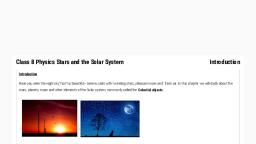
UNIVERSE, , THE UNIVERSE, , INTRODUCTION, , The universe is a huge space which contains everything that exists. The vast expanse of space that contains everything in it is known as the universe. It, includes the sun, the planets, the Milky Way galaxy and all the other galaxies. The universe is continually expanding. Nobody knows how big the universe is. It, is impossible to even have shown that the universe is getting bigger and bigger. like a balloon being blown up. The branch of science that deals with the study, of heavenly bodies is called astronomy. People whostudy the universe are called astronomers. The most important instrument used by the astronomers is the, telescope., , , , During the daytime you can see only the sun, which appears to move from East to West. After sunset, the night sky is dotted with bright stars. At night the, moon and thousands of stars are seen twinkling in the sky. If you watch the sky through a telescope you may see millions of stars, some of which are brightly, coloured. You see certain groups of stars which appear to be forming figures in clusters. They are called constellations. The moon is a natural satellite of earth, whose size changes every day. Moon completes one revolution around the earth in 27 days, 7 hours and 43 minutes. Furthermore, you see an occasional, comet, which appears as a ball of fire, having a tail. Then, there are shooting stars or meteors. They appear to fall from the sky. In addition to all these there, are some bright heavenly bodies which do not twinkle. They are called planets. The natural bodies in the sky are called celestial bodies or heavenly bodies, Example- The sun, the earth, the moon, planets, stars, meteors, comets are called heavenly bodies or celestial bodies.
Page 2 :
Horizon: the line at which the earth’s surface and the sky appears to meet., , MEASUREMENT OF DISTANCES IN THE UNIVERSE, The distances between heavenly bodies in space are very large. Itis very difficult to measure these distances in kilometre. That is why, they are expressed in, terms of light year and parsec., , (a) LIGHT YEAR‘A light year is the distance travelled by the light at a speed of 300,000 kmis. If a spaceship could travel at the speed of light (3 x 10⁵ km/s), it, Would reach the moon in just over 1 second., 1 light year = Speed of light x 365 days = 3,00,000 km/s x 365 x 24 x 60 x 60 sec., , = 9,460,000, 000, 000 km, 1 light year = 9.46 x 40° km (approx.) The sun, the closest star to earth, is about 8 light minutes away from it. It means that light from sun takes about 8, minutes to reach the Earth. The star closest to the Earth after the Sun is Alpha Centauri It is 4.3 light years away from Earth, ie., itis at a distance of 4.3 x, 9.46 x 10¹² km from Earth. It also implies that light from this star, visible on Earth, at a particular night would have left its surface approximately 4.3 years ago., , (b) PARSEC: One Parsec (pe) is equal to 3.26 light years. The distance of Proxima Centauri which is a companion of, Alpha Centauri is 1.3 parsec, , STARS AND PLANETS, , Astar is a heavenly body which has light of its own. We are able to count 3000 stars in the sky with the naked eye. With the help of a small telescope, we can, see 100,000 stars, Nearly 20 thousand million stars can be seen through a powerful telescope. The stars are very large in size and are several times bigger, than the sun but some are smaller. They appear small because they are very far away.
Page 3 :
STARS AND PLANETS, , Astar is a heavenly body which has light of its own. We are able to count 3000 stars in the sky with the naked eye. With the help of a small telescope, we can, see 100,000 stars, Nearly 20 thousand million stars can be seen through a powerful telescope. The stars are very large in size and are several times bigger, than the sun but some are smaller. They appear small because they are very far away, , , , Stars consist of large amount of hydrogen gas at very high temperature. They are so hot that they give out light. It is because of this light that stars glow at, night. They move in the sky but their positions remain fixed in the sky with respect to other stars. They seem to twinkle due to air disturbances in the, atmosphere of earth. The Sun is a star which gives light all the time., , "Planets are heavenly bodies which revolve around the Sun." They do not have their own light but reflect the light of the Sun that falls on them. Planets do not, winkle. They move with respect to the Earth as well as with respect to the sun. The Earth is also a planet. Till recently there were nine planets in the solar, system but now the last, i.e., the ninth planet- Pluto has been removed from being called a planet.
Page 4 :
Geocentric system: A theory of the structure of the solar system in which earth is assumed, to be the center and all the stars and planets rotate around the earth., , Heliocentric system it is theory in which the Earth and planets revolve around the Sun at, the center of the Solar system., , The stars forming a group that has a recognizable shape is called a constellation., , , , (a) Great Bear (b) Orion (c) Cassiopeia (d) Leo Major, Fig. 17.11 : Some constallations in the night sky, , Ursa Major [Fig.17.11 (a)] is also known as the Big Dipper,the Great Bear, or the Saptarshi. There are seven prominent stars in, , this constellation. It appears like a big ladle or a question mark. There are, three stars in the handle of the ladle and four in its bowl. In this
Page 5 :
constellation, all the stars appear to revolve around the Pole Star., , Orion is another well-known, constellation that can be seen during, winter in the late evenings. It is one of, the most magnificent constellations in, the sky. It also has seven or eight bright, stars [Fig. 17.11(b)] Orion is also called, the Hunter. The three middle stars, represent the belt of the hunter. The, four bright stars appear to be arranged, in the form of a quadrilateral.