Page 1 :
Page |1, , 10 CIRCLES, EXERCISE 10.1, , Q.1. Fill in the blanks :, (i) The centre of a circle lies in ___________ of the circle. (exterior/, interior), (ii) A point, whose distance from the centre of a circle is greater than its, radius lies in __________ of the circle. (exterior/interior), (iii) The longest chord of a circle is a __________ of the circle., (iv) An arc is a __________ when its ends are the ends of a diameter., (v) Segment of a circle is the region between an arc and __________ of, the circle., (vi) A circle divides the plane, on which it lies in __________ parts., Sol. (i) interior (ii) exterior (iii) diameter (iv) semicircle (v) the chord (vi), three, Q.2. Write True or False: Give reasons for your answers., (i) Line segment joining the centre to any point on the circle is a radius, of the circle., (ii) A circle has only finite number of equal chords., (iii) If a circle is divided into three equal arcs, each is a major arc., (iv) A chord of a circle, which is twice as long as its radius, is a diameter, of the circle., (v) Sector is the region between the chord and its corresponding arc., (vi) A circle is a plane figure., Sol. (i) True (ii) False (iii) False (iv) True (v) False (vi) True
Page 2 :
Page |1, , 10 CIRCLES, EXERCISE 10.2, Q.1. Recall that two circles are congruent if they have the same radii. Prove that, equal chords of congruent circles subtend equal angles at their centres., Sol. Given : Two congruent circles with centres, O and O′. AB and CD are equal chords, of the circles with centres O and O′, respectively., To Prove : ∠AOB = ∠COD, Proof : In triangles AOB and COD,, AB = CD [Given], AO = CO′ ⎫, ⎬ [Radii of congruent circle], BO = DO′⎭, ⇒ ∆AOB ≅ ∆CO′D, , [SSS axiom], , ⇒ ∠AOB ≅ ∠CO′D, , Proved. [CPCT], , Q.2. Prove that if chords of congruent circles subtend equal angles at their, centres, then the chords are equal., Ans. Given : Two congruent circles with, centres O and O′. AB and CD are, chords of circles with centre O, and O′ respectively such that ∠AOB, = ∠CO′D, To Prove : AB = CD, Proof : In triangles AOB and CO′D,, AO = CO′ ⎫, ⎬ [Radii of congruent circle], BO = DO′⎭, ∠AOB = ∠CO′D, [Given], ⇒ ∆AOB ≅ ∆CO′D, [SAS axiom], ⇒, AB = CD, Proved. [CPCT]
Page 3 :
Page |1, , 10 CIRCLES, EXERCISE 10.3, Q.1. Draw different pairs of circles. How many points does each pair have in, common? What is the maximum number of common points?, Ans., , Q.2., Ans., , Q.3., Ans., , Maximum number of common points = 2 Ans., Suppose you are given a circle. Give a construction to find its centre., Steps of Construction :, 1. Take arc PQ of the given circle., 2. Take a point R on the arc PQ and draw chords PR, and RQ., 3. Draw perpendicular bisectors of PR and RQ. These, perpendicular bisectors intersect at point O., Hence, point O is the centre of the given circle., If two circles intersect at two points, prove that their centres lie on the, perpendicular bisector of the common chord., Given : AB is the common chord of two intersecting circles (O, r) and (O′, r′)., To Prove : Centres of both circles lie on the perpendicular bisector of, chord AB, i.e., AB is bisected at right angle by OO′., Construction : Join AO, BO, AO′ and BO′., Proof : In ∆AOO′ and ∆BOO′, AO = OB (Radii of the circle (O, r), AO′ = BO′ (Radii of the circle (O′, r′)), OO′ = OO′, (Common), ∴ ∆AOO′ ≅ ∆BOO′ (SSS congruency), ⇒ ∠AOO′ = ∠BOO′ (CPCT), Now in ∆AOC and ∆BOC, ∠AOC = ∠BOC (∠AOO′ = ∠BOO′), AO = BO, (Radii of the circle (O, r)), OC = OC, (Common)
Page 5 :
Page |1, , 10 CIRCLES, EXERCISE 10.4, Q.1. Two circles of radii 5 cm and 3 cm intersect at two points and the distance, between their centres is 4 cm. Find the length of the common chord., Sol. In ∆AOO′,, AO2 = 52 = 25, AO′2 = 32 = 9, OO′2 = 42 = 16, AO′2 + OO′2 = 9 + 16 = 25 = AO2, ⇒ ∠AO′O, = 90°, [By converse of pythagoras theorem], Similarly, ∠BO′O = 90°., ⇒ ∠AO′B = 90° + 90° = 180°, ⇒, AO′B is a straight line. whose mid-point is O., ⇒ AB = (3 + 3) cm = 6 cm Ans., Q.2. If two equal chords of a circle intersect within the circle, prove that the, segments of one chord are equal to corresponding segments of the other, chord., Sol. Given : AB and CD are two equal chords of a circle which meet at E., To prove : AE = CE and BE = DE, Construction : Draw OM ⊥ AB and ON ⊥ CD and join OE. Proof :, In ∆OME and ∆ONE, OM = ON [Equal chords are equidistant], OE = OE, [Common], ∠OME = ∠ONE [Each equal to 90°], ∴ ∆OME ≅ ∆ONE, [RHS axiom], ⇒, EM = EN, ...(i), [CPCT], Now, AB = CD, [Given], , 1, 1, AB =, CD, 2, 2, ⇒, AM = CN, ..(ii) [Perpendicular from, centre bisects the chord], Adding (i) and (ii), we get, EM + AM = EN + CN, ⇒, AE = CE, ..(iii), Now, AB = CD, ..(iv), ⇒ AB – AE = CD – AE, [From (iii)], ⇒, BE = CD – CE Proved., Q.3. If two equal chords of a circle intersect within the circle, prove that the line, joining the point of intersection to the centre makes equal angles with the, chords., Sol. Given : AB and CD are two equal chords of a circle which meet at E, within the circle and a line PQ joining the point of intersection to the, centre., To Prove : ∠AEQ = ∠DEQ, ⇒
Page 6 :
Page |2, , Construction : Draw OL ⊥ AB and OM ⊥ CD., Proof : In ∆OLE and ∆OME, we have, OL = OM [Equal chords are equidistant], OE = OE, [Common], ∠OLE = ∠OME, [Each = 90°], ∴ ∆OLE ≅ ∆OME, [RHS congruence], ⇒ ∠LEO = ∠MEO, [CPCT], Q.4. If a line intersects two concentric circles (circles with the same centre) with, centre O at A, B, C and D, prove that AB = CD (see Fig.), Sol. Given : A line AD intersects two concentric circles at A, B, C and D,, where O is the centre of these circles., To prove : AB = CD, Construction : Draw OM ⊥ AD., Proof : AD is the chord of larger circle., ∴, AM = DM, ..(i) [OM bisects the chord], BC is the chord of smaller circle, ∴, BM = CM, ..(ii) [OM bisects the chord], Subtracting (ii) from (i), we get, AM – BM = DM – CM, ⇒ AB = CD Proved., Q.5. Three girls Reshma, Salma and Mandip are playing a game by standing, on a circle of radius 5 m drawn in a park. Reshma throws a ball to Salma,, Salma to Mandip, Mandip to Reshma. If the distance between Reshma, and Salma and between Salma and Mandip is 6 m each, what is the, distance between Reshma and Mandip?, Sol. Let Reshma, Salma and Mandip be represented, by R, S and M respectively., Draw OL ⊥ RS,, OL2 = OR2 – RL2, OL2 = 52 – 32 [RL = 3 m, because OL ⊥ RS], = 25 – 9 = 16, OL =, , 16 = 4, , Now, area of triangle ORS =, =, Also, area of ∆ORS =, , 1, × KR × 05, 2, , 1, × KR × 05, 2, , 1, 1, × RS × OL =, × 6 × 4 = 12 m2, 2, 2, , 1, × KR × 5 = 12, 2, 12 × 2 = 24, ⇒ KR =, = 4.8 m, 5, 5, ⇒ RM = 2KR, ⇒ RM = 2 × 4.8 = 9.6 m, Hence, distance between Reshma and Mandip is 9.6 m Ans., , ⇒
Page 7 :
Page |3, , Q.6. A circular park of radius 20 m is situated in a colony. Three boys Ankur,, Syed and David are siting at equal distance on its boundary each having, a toy telephone in his hands to talk each other. Find the length of the string, of each phone., Sol. Let Ankur, Syed and David be represented by A, S, and D respectively., Let PD = SP = SQ = QA = AR = RD = x, In ∆OPD,, OP2 = 400 – x2, 400 − x2, , ⇒, , OP =, , ⇒, , AP = 2 400 − x2 + 400 − x2, [ ∵ centroid divides the median in the ratio 2 : 1], , = 3 400 − x2, Now, in ∆APD,, PD2 = AD2 – DP2, ⇒, , 2, , x2 = (2x)2 – (3 400 − x2 ), , ⇒, x2 = 4x2 – 9(400 – x2), ⇒, x2 = 4x2 – 3600 + 9x2, ⇒ 12x2 = 3600, ⇒, ⇒, , x2 =, , 3600, = 300, 12, , x = 10 3, , Now, SD = 2x = 2 × 10 3 = 20 3, ∴ ASD is an equilateral triangle., ⇒ SD = AS = AD = 20 3, Hence, length of the string of each phone is 20, , 3 m Ans.
Page 8 :
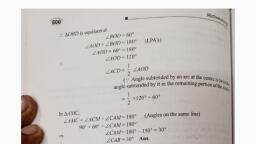
Page |1, , 10 CIRCLES, EXERCISE 10.5, Q.1. In the figure, A, B and C are three points on a circle with, centre O such that ∠ BOC = 30° and ∠ AOB = 60°. If D is, a point on the circle other than the arc ABC, find ∠ ADC., Sol. We have, ∠BOC = 30° and ∠AOB = 60°, ∠AOC = ∠AOB + ∠BOC = 60° + 30° = 90°, We know that angle subtended by an arc at the centre, of a circle is double the angle subtended by the same arc on the remaining, part of the circle., ∴ 2∠ADC = ∠AOC, 1, 1, ⇒ ∠ADC =, ∠AOC =, × 90°, ⇒ ∠ADC = 45° Ans., 2, 2, Q.2. A chord of a circle is equal to the radius of the circle. Find the angle, subtended by the chord at a point on the minor arc and also at a point on, the major arc., Sol. We have, OA = OB = AB, Therefore, ∆OAB is a equilateral triangle., ⇒, ∠AOB = 60°, We know that angle subtended by an arc at the centre of a circle is double, the angle subtended by the same arc on the remaining part of the circle., ∴, ∠AOB = 2∠ACB, 1, 1, ⇒, ∠ACB =, ∠AOB =, × 60°, 2, 2, ⇒, ∠ACB = 30°, 1, Also, ∠ADB =, reflex ∠AOB, 2, 1, 1, =, (360° – 60°) =, × 300° = 150°, 2, 2, Hence, angle subtended by the chord at a point on the minor arc is 150°, and at a point on the major arc is 30° Ans., Q.3. In the figure, ∠PQR = 100°, where P, Q and R are points on a circle with, centre O. Find ∠OPR., Sol. Reflex angle POR = 2∠PQR, = 2 × 100° = 200°, Now, angle POR = 360° – 200 = 160°, Also,
Page 10 :
Page |3, , Q.6. ABCD is a cyclic quadrilateral whose diagonals intersect at a point E. If, ∠ DBC = 70°, ∠ BAC = 30°, find ∠ BCD. Further, if AB = BC, find ∠ ECD., Sol. ∠CAD = ∠DBC= 70°, [Angles in the same segment], Therefore,, ∠DAB = ∠CAD + ∠BAC, = 70° + 30° = 100°, But, ∠DAB + ∠BCD = 180°, [Opposite angles of a cyclic quadrilateral], So,, ∠BCD = 180° – 100° = 80°, Now, we have AB = BC, Therefore, ∠BCA = 30° [Opposite angles of an isosceles triangle], Again, ∠DAB + ∠BCD = 180°, [Opposite angles of a cyclic quadrilateral], ⇒ 100° + ∠BCA + ∠ECD = 180° [∵ ∠BCD = ∠BCA + ∠ECD], ⇒ 100° + 30° + ∠ECD = 180°, ⇒ 130° + ∠ECD = 180°, ⇒ ∠ECD = 180° – 130° = 50°, Hence, ∠BCD = 80° and ∠ECD = 50°, Ans., Q.7. If diagonals of a cyclic quadrilateral are diameters of the circle through, the vertices of the quadrilateral, prove that it is a rectangle., Sol. Given : ABCD is a cyclic quadrilateral, whose, diagonals AC and BD are diameter of the circle passing, through A, B, C and D., To Prove : ABCD is a rectangle., Proof : In ∆AOD and ∆COB, AO = CO, [Radii of a circle], OD = OB, [Radii of a circle], ∠AOD = ∠COB, [Vertically opposite angles], ∴, ∆AOD ≅ ∆COB, [SAS axiom], ∴, ∠OAD = ∠OCB, [CPCT], But these are alternate interior angles made by the transversal AC,, intersecting AD and BC., ∴ AD || BC, Similarly, AB || CD., Hence, quadrilateral ABCD is a parallelogram., Also, ∠ABC = ∠ADC, ..(i), [Opposite angles of a ||gm are equal], And, ∠ABC + ∠ADC = 180° ...(ii), [Sum of opposite angles of a cyclic quadrilateral is 180°], ⇒ ∠ABC = ∠ADC = 90°, [From (i) and (ii)], ∴ ABCD is a rectangle. [A ||gm one of whose angles is, 90° is a rectangle] Proved., Q.8. If the non-parallel sides of a trapezium are equal, prove that it is cyclic., Sol. Given : A trapezium ABCD in which AB || CD, and AD = BC., To Prove : ABCD is a cyclic trapezium., Construction : Draw DE ⊥ AB and CF ⊥ AB., Proof : In ∆DEA and ∆CFB, we have, AD = BC, [Given], ∠DEA = ∠CFB = 90° [DE ⊥ AB and CF ⊥ AB]
Page 11 :
Page |4, , DE = CF, [Distance between parallel lines remains constant], ∴, ∆DEA ≅ ∆CFB, [RHS axiom], ⇒, ∠A = ∠B, ...(i) [CPCT], and,, ∠ADE = ∠BCF, ..(ii) [CPCT], Since,, ∠ADE = ∠BCF, [From (ii)], ⇒, ∠ADE + 90° = ∠BCF + 90°, ⇒ ∠ADE + ∠CDE = ∠BCF + ∠DCF, ⇒, ∠D = ∠C, ..(iii), [∠ADE + ∠CDE = ∠D, ∠BCF + ∠DCF = ∠C], ∴ ∠A = ∠B and ∠C = ∠D, [From (i) and (iii)] (iv), ∠A + ∠B + ∠C + ∠D = 360° [Sum of the angles of a quadrilateral is 360°], , Q.9., Sol., , Q.10., Sol., , Q.11., Sol., , ⇒ 2(∠B + ∠D) = 360°, [Using (iv)], ⇒ ∠B + ∠D = 180°, ⇒ Sum of a pair of opposite angles of quadrilateral ABCD is 180°., ⇒ ABCD is a cyclic trapezium Proved., Two circles intersect at two points B and C. Through B, two line segments, ABD and PBQ are drawn to intersect the circles at A, D and P, Q, respectively (see Fig.). Prove that ∠ ACP = ∠QCD., Given : Two circles intersect at two points, B and C. Through B, two line segments ABD, and PBQ are drawn to intersect the circles, at A, D and P, Q respectively., To Prove : ∠ACP = ∠QCD., Proof : ∠ACP = ∠ABP ...(i), [Angles in the same segment], ∠QCD = ∠QBD ..(ii), [Angles in the same segment], But,, ∠ABP = ∠QBD ..(iii) [Vertically opposite angles], By (i), (ii) and (ii) we get, ∠ACP = ∠QCD Proved., If circles are drawn taking two sides of a triangle as diameters, prove that, the point of intersection of these circles lie on the third side., Given : Sides AB and AC of a triangle ABC are, diameters of two circles which intersect at D., To Prove : D lies on BC., Proof : Join AD, ∠ADB = 90° ...(i) [Angle in a semicircle], Also, ∠ADC = 90° ..(ii), Adding (i) and (ii), we get, ∠ADB + ∠ADC = 90° + 90°, ⇒, ∠ADB + ∠ADC = 180°, ⇒ BDC is a straight line., ∴ D lies on BC, Hence, point of intersection of circles lie on the third side BC. Proved., ABC and ADC are two right triangles with common hypotenuse AC. Prove, that ∠CAD = ∠CBD., Given : ABC and ADC are two right triangles with common hypotenuse AC., To Prove : ∠CAD = ∠CBD
Page 12 :
Page |5, , Proof : Let O be the mid-point of AC., Then OA = OB = OC = OD, Mid point of the hypotenuse of a right triangle is, equidistant from its vertices with O as centre and, radius equal to OA, draw a circle to pass through A, B,, C and D., We know that angles in the same segment of a circle, are equal., Since, ∠CAD and ∠CBD are angles of the same segment., Therefore, ∠CAD = ∠CBD. Proved., Q.12. Prove that a cyclic parallelogram is a rectangle., Sol. Given : ABCD is a cyclic parallelogram., To prove : ABCD is a rectangle., Proof : ∠ABC = ∠ADC ...(i), [Opposite angles of a ||gm are equal], But, ∠ABC + ∠ADC = 180° ... (ii), [Sum of opposite angles of a cyclic quadrilateral is, 180°], ⇒ ∠ABC = ∠ADC = 90° [From (i) and (ii)], ∴ ABCD is a rectangle, [A ||gm one of whose angles is 90° is a rectangle], Hence, a cyclic parallelogram is a rectangle. Proved.
Page 13 :
Page |1, , 10 CIRCLES, EXERCISE 10.6 (Optional), Q.1. Prove that the line of centres of two intersecting circles subtends equal, angles at the two points of intersection., Sol. Given : Two intersecting circles, in which OO′ is the, line of centres and A and B are two points of, intersection., To prove : ∠OAO′ = ∠OBO′, Construction : Join AO, BO, AO′ and BO′., Proof : In ∆AOO′ and ∆BOO′, we have, AO = BO, [Radii of the same circle], AO′ = BO′, [Radii of the same circle], OO′ = OO′, [Common], ∴, ∆AOO′ ≅ ∆BOO′ [SSS axiom], ⇒, ∠OAO′ = ∠OBO′ [CPCT], Hence, the line of centres of two intersecting circles subtends equal angles, at the two points of intersection. Proved., Q.2. Two chords AB and CD of lengths 5 cm and 11 cm respectively of a circle, are parallel to each other and are on opposite sides of its centre. If the, distance between AB and CD is 6 cm, find the radius of the circle., Sol. Let O be the centre of the circle and let its radius be r cm., Draw OM ⊥ AB and OL ⊥ CD., 1, 5, Then, AM = AB =, cm, 2, 2, , 1, 11, CD =, cm, 2, 2, Since, AB || CD, it follows that the points O, L, M are, , and,, , CL =, , collinear and therefore, LM = 6 cm., Let OL = x cm. Then OM = (6 – x) cm, Join OA and OC. Then OA = OC = r cm., Now, from right-angled ∆OMA and ∆OLC, we have, OA2 = OM2 + AM2 and OC2 = OL2 + CL2 [By Pythagoras Theorem], ⇒, , r2, , = (6 –, , x)2, , ⎛5, + ⎜ ⎞⎟, ⎝ 2⎠, , 2, , ..(i) and, , r2, , =, , x2, , ⎛ 11 ⎞, + ⎜ ⎟, ⎝ 2 ⎠, , 2, , ... (ii)
Page 14 :
Page |2, , ⎛5⎞, ⇒ (6 – x)2 + ⎜ ⎟, ⎝ 2⎠, , 2, , 2, , ⎛ 11 ⎞, = x2 + ⎜ ⎟ [From (i) and (ii)], ⎝ 2⎠, 25, 121, ⇒ 36 + x2 – 12x +, = x2 +, 4, 4, 121, 25, ⇒ – 12x =, –, – 36, 4, 4, 96, ⇒ – 12x =, – 36, 4, ⇒ – 12x = 24 – 36, ⇒ – 12x = – 12, ⇒, x = 1, Substituting x =1 in (i), we get, ⎛5⎞, r2 = (6 – x)2 + ⎜ ⎟, ⎝ 2⎠, , 2, , ⎛5, ⇒ r2 = (6 – 1)2 + ⎜ ⎞⎟, ⎝ 2⎠, , 2, , 2, , =, , (5)2, , ⇒ r2 =, , 125, 4, , ⇒, , r2, , ⇒ r =, , 25, ⎛5, + ⎜ ⎞⎟ = 25 +, 4, ⎝ 2⎠, , 5 5, 2, , 5 5, cm. Ans., 2, Q.3. The lengths of two parallel chords of a circle are 6 cm and 8 cm. If the, smaller chord is at distance 4 cm from the centre, what is the distance of, the other chord from the centre?, Sol. Let PQ and RS be two parallel chords of a circle with centre O., We have, PQ = 8 cm and RS = 6 cm., Draw perpendicular bisector OL of RS which meets PQ in M. Since,, PQ || RS, therefore, OM is also perpendicular bisector of PQ., 1, Also, OL = 4 cm and RL =, RS ⇒ RL = 3 cm, 2, 1, and PM =, PQ ⇒ PM = 4 cm, 2, In ∆ORL, we have, OR2 = RL2 + OL2 [Pythagoras theorem], Hence, radius r =
Page 15 :
Page |3, , ⇒ OR2 = 32 + 42 = 9 + 16, ⇒ OR2 = 25 ⇒ OR = 25, ⇒ OR = 5 cm, ∴ OR = OP, [Radii of the circle], ⇒ OP = 5 cm, Now, in ∆OPM, OM2 = OP2 – PM2 [Pythagoras theorem], ⇒ OM2 = 52 – 42 = 25 – 16 = 9, OM = 9 = 3 cm, Hence, the distance of the other chord from the centre is 3 cm. Ans., Q.4. Let the vertex of an angle ABC be located outside a circle and let the sides, of the angle intersect equal chords AD and CE with the circle. Prove that, ∠ ABC is equal to half the difference of the angles subtended by the chords, AC and DE at the centre., Sol. Given : Two equal chords AD and, CE of a circle with centre O. When, meet at B when produced., , 1, (∠AOC – ∠DOE), 2, Proof : Let ∠AOC = x, ∠DOE = y, ∠AOD = z, ∠EOC = z, [Equal chords subtends equal angles at the centre], ∴ x + y + 2z = 36°, [Angle at a point], .. (i), OA = OD ⇒ ∠OAD = ∠ODA, ∴ In DOAD, we have, ∠OAD + ∠ODA + z = 180°, ⇒ 2∠OAD = 180° – z, [ ∠OAD = ∠OBA], To Prove : ∠ABC =, , ⇒ ∠OAD = 90° –, , z, 2, , ... (ii), , z, 2, ⇒ ∠ODB = ∠OAD + ∠ODA, , Similarly ∠OCE = 90° –, , ⇒ ∠OEB = 90° –, , ... (iii), [Exterior angle property], , z, + z, 2, , [From (ii)], , z, ... (iv), 2, Also, ∠OEB = ∠OCE + ∠COE, [Exterior angle property], , ⇒ ∠ODB = 90° +, , ⇒ ∠OEB = 90° –, , z, 2, , ⇒ ∠OEB = 90° +, , z, 2, , + z, , [From (iii)], ... (v)
Page 16 :
Page |4, , y, 2, O from (iv), (v) and (vi), we have, , Also, ∠OED = ∠ODE = 90° –, , ∠BDE = ∠BED = 90° +, , ... (vi), , y⎞, z, ⎛, – ⎜ 90° − ⎟, 2, 2⎠, ⎝, , y+z, 2, ⇒ ∠BDE = ∠BED = y + z, ∴ ∠BDE = 180° – (y + z), ⇒ ∠ABC = 180° – (y + z), , ⇒ ∠BDE = ∠BED =, , ... (vii), ... (viii), , y − z 360° − y − 2 z − y, =, = 180° – (y + z), 2, 2, From (viii) and (ix), we have, , Now,, , ... (ix), , x− y, Proved., 2, Q.5. Prove that the circle drawn with any side of a rhombus as diameter, passes, through the point of intersection of its diagonals., Sol. Given : A rhombus ABCD whose diagonals intersect each other at O., To prove : A circle with AB as diameter passes through O., Proof : ∠AOB = 90°, [Diagonals of a rhombus bisect each other at 90°], ⇒ ∆AOB is a right triangle right angled at O., ⇒ AB is the hypotenuse of A B right ∆AOB., ⇒ If we draw a circle with AB as diameter, then it, will pass through O. because angle is a semicircle, is 90° and ∠AOB = 90° Proved., , ∠ABC =, , Q.6. ABCD is a parallelogram. The circle through A, B and C intersect CD, (produced if necessary) at E. Prove that AE = AD., Sol. Given : ABCD is a parallelogram., To Prove : AE = AD., Construction : Draw a circle which, passes through ABC and intersect, CD (or CD produced) at E., Proof : For fig (i), ∠AED + ∠ABC = 180°, [Linear pair] ... (ii), But ∠ACD = ∠ADC = ∠ABC + ∠ADE, ⇒, ∠ABC + ∠ADE = 180° [From (ii)], , ... (iii), , From (i) and (iii), ∠AED + ∠ABC = ∠ABC + ∠ADE, ⇒, ∠AED = ∠ADE, ⇒, ∠AD = ∠AE [Sides opposite to equal angles are equal], Similarly we can prove for Fig (ii) Proved.
Page 17 :
Page |5, , Q.7. AC and BD are chords of a circle which bisect each other. Prove that (i), AC and BD are diameters, (ii) ABCD is rectangle., Sol. Given : A circle with chords AB and CD, which bisect each other at O., To Prove :, , (i) AC and BD are diameters, (ii) ABCD is a rectangle., , Proof : In ∆OAB and ∆OCD, we have, OA = OC, , ⇒, ⇒, , [Given], , OB = OD, ∠AOB = ∠COD, , [Given], [Vertically opposite angles], , ∆AOB ≅ ∠COD, ∠ABO = ∠CDO and ∠BAO = ∠BCO, , [SAS congruence], [CPCT], , ⇒ AB || DC, Similarly, we can prove BC || AD, , ... (i), ... (ii), , Hence, ABCD is a parallelogram., But ABCD is a cyclic parallelogram., ∴ ABCD is a rectangle., [Proved in Q. 12 of Ex. 10.5], ⇒, ∠ABC = 90° and ∠BCD = 90°, ⇒, AC is a diameter and BD is a diameter, [Angle in a semicircle is 90°] Proved., Q.8. Bisectors of angles A, B and C of a triangle ABC intersect its circumcircle, at D, E and F respectively. Prove that the angles of the triangle DEF are, 90° –, , 1, 1, 1, A, 90° –, B and 90° –, C., 2, 2, 2, , Sol. Given : ∆ABC and its circumcircle. AD, BE,, CF are bisectors of ∠A, ∠B, ∠C respectively., Construction : Join DE, EF and FD., Proof : We know that angles in the same, segment are equal., ∠C, 2, ∠A, ∠1 =, 2, ∠A, ∠4 =, 2, From (i), we have, ∠C, ∠5 + ∠6 =, 2, ∠C, ⇒, ∠D =, 2, , ∴, , ∠5 =, , ∠B, ..(i), 2, ∠C, and ∠2 =, ..(ii), 2, ∠B, and ∠3 =, ..(iii), 2, , and ∠6 =, , ∠B, 2, ∠B, +, 2, +, , ...(iv), , But ∠A + ∠B + ∠C = 180°, ⇒, ∠B + ∠C = 180° – ∠A, , [∵ ∠5 + ∠6 = ∠D]
Page 18 :
Page |6, , ∠B, ∠C, ∠A, +, = 90° –, 2, 2, 2, ∴ (iv) becomes,, ∠A, ∠D = 90° –, ., 2, Similarly, from (ii) and (iii), we can prove that, ∠B, ∠C, ∠E = 90° –, and ∠F = 90° –, Proved., 2, 2, Q.9. Two congruent circles intersect each other at points A and B. Through A, any line segment PAQ is drawn so that P, Q lie on the two circles. Prove, that BP = BQ., Sol. Given : Two congruent circles which intersect at A and B. PAB is a line, through A., To Prove : BP = BQ., Construction : Join AB., Proof : AB is a common chord of both the circles., But the circles are congruent —, ⇒ arc ADB = arc AEB, , ⇒, , ⇒, ⇒, , ∠APB = ∠AQB Angles subtended, BP = BQ, [Sides opposite to equal angles are equal] Proved., , Q.10. In any triangle ABC, if the angle bisector of ∠A and perpendicular bisector, of BC intersect, prove that they intersect on the circumcircle of the triangle, ABC., Sol. Let angle bisector of ∠A intersect circumcircle of ∆ABC at D., Join DC and DB., ∠BCD = ∠BAD, [Angles in the same segment], ⇒ ∠BCD = ∠BAD, , 1, ∠A, 2, , [AD is bisector of ∠A] ...(i), Similarly ∠DBC = ∠DAC, , 1, ∠A, 2, , ... (ii), , From (i) and (ii) ∠DBC = ∠BCD, ⇒ BD = DC, [sides opposite to equal angles are equal], ⇒ D lies on the perpendicular bisector of BC., Hence, angle bisector of ∠A and perpendicular bisector of BC intersect on, the circumcircle of ∆ABC Proved.