Page 1 :
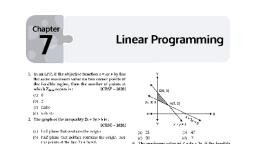
Chapter, , Linear Programming, , . Inan LPP, if the objective function z = ax + by has, the same maximum value on two corner points of, the feasible region, then the number of points at, which Zax occurs is : [CBSE - 2020], , (a) 0, (b) 2, (c) finite, (d) infinite, . The graph of the inequality 2x + 3y > 6 is:, [CBSE — 2020], (a) half plane that contains the origin, , (b) half plane that neither contains the origin nor, the points of the line 2x + 3y = 6, , (c) whole XOY-plane excluding the points on the, line 2x + 3y =6, (d)_ entire XOY plane., , . Which of the following types of problems cannot, be solved by linear programming methods?, , (a) Transportation problem, (b) Manufacturing problems, (c) Traffic signal control, , (d)_ Diet problems, , . The optimal value of the objective function is, allained al the points:, , (a) Corner points of the feasible region, (b) Any point of the feasible region., (c) on x-axis, (a) on y-axis, . An optimisation problem may involve finding :, (a) maximum profit, (b) minimum cost, (c) minimum use of resources, (d) All of the above, . The condition x 2 0, y 2 0 are called:, (a) restrictions only, (b) negative restrictions, (c) non-negative restrictions, (a) None of the above, , . The feasible region for the an LPP is shown in this, following figure. Then, the minimum value of Z =, 1x + 7y is, , , , Y' xty=5 9, (a) 21 (b) 47, (©) 20 (d) 31, , . The maximum value of Z = 4x + 3y, if the feasible, , region for the an LPP is shown below:, , ¥, , (0, 40), , , , B (16, 16), , , , (a) 112 (b) 100, (c) 72 (d) 110, , . In which of the following problems (s), linear, , programming can be used :, (a) manufacturing problems, (b) diet problems, , (c) transportation problems, (d) All of these, , . Corner points of the feasible region for an LPP are, , (0, 2), (3, 0), (6, 0), (6, 8) and (0, 5)., , Let F = 4x + 6y be the objective function. The, , minimum value of F occurs at :, , (a) (0,2) only, , (b) (3, 0) only, , (c) the mid-point on the line segment joining the, points (0, 2) and (3, 0) only, , (A) any point on the line segment joining the points, (0, 2) and (3, 0)
Page 2 :
11., , 12., , 13., , 14., , 15., , 16., , 17., , 18., , 19., , , , The corner points of the feasible region determined, by the following system of linear inequalities, 2x + y < 10, x + 3y <15, x, y > 0 are (0, 0), (5, 0), (3, 4), and (0, 5). Let Z = px + qy, where p,q > 0. Condition, onp and q, so that the maximum of Z occurs at both, (3, 4) and (0, 5) is =, , @) p=9 (b) p=24, , (©) p=39 (d) q=3p, , The variable x and y in a linear programming, problem are called :, , (a) decision variables (b) linear variables, , (c) optimal variables (d) None of these, , The linear inequalities or equations or restrictions, on the variables of a linear programming problem, are called :, , (a) linear relations (b) constraints, , (c) functions (d) objective functions, The objective function of an LPP is:, , (a) aconstraint, , (b) a function to be optimised, , (c) arelation between the variables, , (d) None of the above, , Which of the term is not used in a linear, programming problem ?, (a) Optimal solution, , (c) Concave region, , (b) Feasible solution, , (d) Objective function, Which of the following sets are not convex ?, , &) @yirtyps4, , (a) (x,y) :3x7+ 2 <6, The optimal value of the objective function is, attained at the point is :, , (a) given by intersection of inequations with axes, only, , given by intersection of inequations with X-axis, only, , (©) given by corner points of the feasible region, , (a) None of the above., , The feasible solution for a LPP shown in Fig. Let Z, = 3x - dy be the objective function. Minimum of Z, occurs at :, , (b), , , , (0,0) 6,0), , (a) (0,0) (b) 0,8), , (©) (5,0) (d) (4,10), , Refer to Question 18. Maximum of Z occurs at :, (a) 6,0) (b) 5), , (©) (6,8) (d) @, 10), , 20., , 21., , 23., , 24., , 26., , 27., , 28., , Refer to Question 18. (Maximum value of Z +, Minimum value of Z) is :, , (a) 13 (b) 1, () -13 (d) -17, , Feasible region in the set of points which satisfy :, (a) The objective functions, , (b) Some the given functions, , (c) Allof the given constriants, , (d) None of these, , . The region of feasible solution in LPP graphic, , method is called., (a) Infeasible region — (b)_ unbounded region., (c) Infinite region (d) feasible region., In equation 3x — y 23 and 4x—4y>4:, (a) Have solution for positive x and y, (b) Have no solution for positive x and y, (c) Have solution for all x, (d) Have soluton for all y, The corner point of the feasible region determined, by the system of linear constraints are (0, 0), (0, 30),, (20, 40), (60, 20), (50, 0). The objective function is Z, = 4x + 3y. Compare the quantity in Column A and, Column B:, Col. A, Max Z, (a) Quantity in column A is greater, (b) Quantity in column A is greater, (c) Two quantities are equal, (d) Relationship cannot be determined and the, basis of information supplied, , , , Col. B, 340, , , , , , , , , , , , . Ina LPP, the objective function is always :, , (a) cubic (b) quadratic, (c) linear (d) constant, Maximise, 7 = - x + 2y, subject to the constraints, , x23, xty25,x+2y 26, y20:, , (a) Max, Z= 12 at (2, 6), , (b) Zhas no max. value, , (c) Max., Z=10 at (2, 6), , (d) Max., Z=14 at (2, 6), , A linear programming problem is one that is, , concerned with :, , (a) finding the upper limits of a linear function of, several variables, , (b) finding the lower limit of a linear function of, several variables, , () finding the limiting values of a linear function, of several variables, , (d) finding the optimal value (max or min) of a, linear function of several variables, , Objective function is expressed in terms of the, , , , Numbers, , (a), , (c) Decision variables _, , (b) Symbols
Page 3 :
29., , 30., , 31., , 32., , 33., , @, , In a transportation problem, with 4 supply point, and 5 demand points how many number of, contraints required in its formulation :, , (a) 20 (b) 1 ( 0 (d) 9, , The feasible region (shaded) for a LPP is shown in, the figure. The max. Z = 5x + 7y is:, , A(7, 0), x, , , , (a) 43, , (b) 47 () 45, The position of points O(0, 0) and P(2, — 2) in the, region of graph of inequation 2x - 3y <5, will be:, (a) O inside and P outside, , (b) Oand P both inside, , (c) Oand P both outside, , (d) 49, , (d) O outside and P inside, , Let Z = ax + by is a linear objective function, variables x and y are called ... .. variables., (a) Independent (b), (0) Decision (d) Dependent, Infeasibility means that the number of solutions, , to the linear programming models that satisfies all, constraints is :, , (a) Atleast (b) An infinite number, (©) Zero (d) Atleast?, , , , Continuous, , , , , , Choose the correct option :, , (a) Both (A) and (B) are true and R is the correct, explanation A., , (b) Both (A) and (R) are true but R is not correct, explanation of A., , (Q) Ais true but R is false., , (d)_ Ais false but R is true., , , , , , 34., , 35., , 36., , Assertion (A) : The region represented by the set, {(@ 9) :4.<2x? +17 <9} is a convex set., , Reason (R) : The set {(x, y):4 <x? +17 < 9} represents, the region between two concentric circles of radii 2, and 3., , Assertion (A) : If a L.P.P. admits two optimal, solutions then it has infinitely many optimal, solutions., , Reason (R) : If the value of the objective function of, a LPP is same at two corners then it is same at every, point on the line joining two corner points., , A furniture dealer deals in only two items—tables, and chairs. He took a loan of & 50,000 from the, bank to invest in this business. He took a room, on rent for the storage of furniture which has a, storage space of at most 60 pieces. A table costs, % 2500 while a chair costs ¢ 500. He estimates that, from the sale of one table, he can make a profit of, % 250 and that from the sale of one chair a profit of, , , , % 75. Find the number of tables and chairs he, should buy from the available money so as to, maximize his total profit, assuming that he can sell, all the items which he buys., , , , Y, , (0, 60), , B (10, 50), , al 2:9), , 20-= 30 ==40 =; 50-- 6070., , 5x +y= 100 oi, Fig., Graphical representation of optimization problem, Based on the above information answer the, following :, , (i) Which constraint shows the linear objective, function using decision variables v and y ?, , (a) Z=250x+75y — (b), Z=250x—75y, (c) Z=275x-50y = (d)._ Z=75x-250y, , (ii) Which equation shows that “he can store only, 60 pieces of chairs and tables” ?, , (a) x+y 260 (b) x-y 260, (c) x-y=60 (d) xt+ys60, (iii) Choose correct investment constraint by, , furniture dealer :, (a) 2500x + 500y < 50000, (b) 2500x — 500y < 50000, (c) 500x —2500y s 50000, (d) 500x + 2500y < 50000, (iv) In which case total profit would be = 6250 ?, (a) 10 tables and 50 chairs, (b) 50 tables and 10 chairs, (c) 5 tables and 55 chairs, (d) 20 tables and 40 chairs, , (v) Due to this storage space maximum of 60 pieces,, his investment is limited to a maximum of :, , (a) %55000 (b) 250000, (c) 58000 (dy 45000
Page 4 :
37. A cooperative socicty of farmers has 50 hectare of, land to grow two crops X and Y. The estimation of, income from crops per hectare is 10,500 and 9,000, respectively. To control weeds, a runny herbicide, has used for both crops at rates of 20 litres and, 10 litres per hectare. Additionally, no more than 800, litres of herbicide should be used for protecting, fish and natural world using a fishpond which, collect drainage from this ground., , , , Fig. : Graph of OABC is the feasible region (shaded), , , , , , , , , , , , Corner Point Z=10500x +9000y, O(0, 0) 0, ‘A(40, 0) 420000, B(30, 20) 495000, C(0, 50) 450000, , , , , , , , , , Based on the above information answer the, following questions :, (i) What is the objective function of given problem ?, (a) Z=9000x + 10500y (b) Z=10500x + 9000y, (c) Z-=8000x + 10500y (d) 7 =10500x -9000y, (ii) Which equation shows the constraint related to, , land?, (a) x+y 250 (b) x-y250, (c) x+y S50 (d) x-ys50, (iii) What is the characteristics of the feasible region, , OABC ?, (a) Unbounded (b) Bounded, (c) Both(a)and(b) (d) None of these, (iv) The maximum income would be got by people, is:, (a) = 4,95,000 (b) % 4,90,000, (c) % 4,85,000 (d) %4,80,000, (v) How much ground should be billed to each, crops so as to maximize the total income of the, people ?, (a) 30 hectare for crop x and 20 hectare from, ctopy, (b) 20 hectare for crop x and 30 hectare from, crop y, , (Q) 20hectare for crop x and 40 hectare from crop y, (d) 40 hectare for crop x and 20 hectare from, ORY:, , 38. There are three machines installed in a factory,, , machines |, LU and LI. Out of these three machines,, machines I and IT are capable of being operated for, at most 12 hours in a day whereas machine II] must, be operated for at least 5 hours a day. In factory they, produce only two types of toys namely, M and N each, of them requires the use of all the three machines., The number of hours taken by M and N on each of, the three machines are given in the table below:, , , , , , , , , , Number of hours required on machines, Items, I I at, M 1 2 a, N 2 1.25, , , , , , , , , , , , The amount of profit she makes on per price of toy, Mis % 600 and on toy N is = 400., , , , , , , , , , , , , , , , , , Corner point | Z = 600x + 400y, 6, 9) 3000, (6, 0) 3600, G&4) 4000 < | Maximum, (0, 6) 2400, (0, 4) 1600, , , , , , Y, , 2xty=12 We, 14, , 10, 8, , 8 Inco, 6), , 5, +2y=5N4, xtgy, , C(4, 4),, 1 |, E@, 4) a, , B @, 0), gag ith, AG, 0), Fig., Graph of ABCDE is the feasible region (shaded), Based on the above information answer the, following :, (i) How many of each type of toys should she, produce so as to maximize her profit assuming, , that she can sell all the toys that she produed ?, What will be the maximum profit ?, , (a) 4units,%4000 — (b)_ 4 units, 7 6000, (c) 5units, %3600___(d)_5 units, 7 5600
Page 5 :
(ii) Select the equation of the total profit on, production :, , (a) Z=600x-400y (b) 7 =600x + 400y, (c) Z=600x x 400y (d) None of these, (iii) Choose the correct constraint of Machine I:, (a) x+2y212 (b) x42y<12, (c) x+2y=12 (d) x+2y $12, (iv) According to above figure 1, constraint on, Machine IL is :, (a) 2x+2y<12 (b) 2x+y<12, (c) x+2ys12 (d) x+2y$21, (v) Tick on correct constraint on Machine II is :, , 5 5, (a) reyuee (b) vigyse, , () xtSyss (d) rth y25, , 39. Corner points of the feasible region for an LPP, are (0, 3), (5, 0), (6, 8), (6, 8). Let z = 4x — 6y be the, objective function., , Based on the above information, answer the, following questions :, (i) The minimum value of z occurs at:, , (a) ©, 8) (b) 6,0), , (c) @,3) (d) ©,8), (i) Maximum value of 2 occurs at :, , (a), 0) b) @,8), , (©) (©, 3) (d) ©,8), (iii) Max 2— min z=, , (a) 58 (b) 68, , () 78 (d) 88, , (iv) The comer points of the feasible region, determined by the system of linear in equalities, as:, , 7+, , ly, oY B(3, 2), 1, pat, 123° 45 t, (3. 0) Ne, , (a) (0,0), (3, 0), (3, 2), (2, 3), (>) G,0), 6,2), (2,9), 0,-3), (c) (0,0), (3, 0), (2, 3), (3, 2), @, 3), (d) None of these, (v) The feasible solution of LPP belongs to :, (a) First and second quadrant, (b) First and third quadrant, (c) Only second quadrant, (d) Only first quadrant, , , , , , , , , , 40., , Linear programming is a method for finding the, optimal values (maximum or minimum) of quanties, subject to the constraints when relationshp is, expressed as linear equation or inequalities. Based, on the above information, answer the following, questions :, , (i) The optimal value of the objective function is, , attainted at the points :, , (a), , (b) on y-axis, , (c) which are corner points of the feasible, region, , a-axis, , (d) none of these, (ii) The graph of the inequality 3x + 4y < 12 is, (a) Half plane that contains the origin, (b) Half plane that neither contains the origin, nor the points one the line 3x + 4y = 12, (c). Whole XOY plane excluding the points on, the line 3x + 4y = 12, , None of these, , (d), , (iii) The feasible region for an LPP is shown in the, figure. Let z = 2x + 5y be the objective function, maximum of z occurs at, , 4, , 0, 8, 6, 4 B&@6, 3), 2, 0, , , , (@) (7,0) (b), © @6) (d) (43), , (iv) The corner points of the feasible region, determined by the system of linear constraints, are (0, 10), (5, 5), (15, 15), (0, 20). Let z = px + qy,, where p, q > 0 condition on p and q so that the, maximum of z occurs at botht he points (15, 15), and (0, 20) is:, , (a) p=q (b) p=2q, (©) q=2p (d) q=3p, , (v) The comer points of feasible region determined, by the system of linear constraints are (0, 0),, (0, 40), (20, 40), (60, 20), (60, 0). The objective, function is z = 4x + 3y. Compare the quantity in, Column A and Column B :, , , , Column A, Max Z, , Column B, 325, , , , , , , , , , , , (a) The quantity in column in A is greater, (b) The quantity in column in B is greater, (c)_ The two quantities are equal, , (d) None of these