Page 1 :
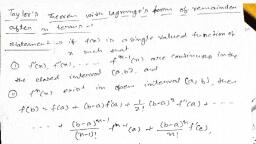
108 Real Analysis, This is called Maclaurin’s Expansion and the last or (+ 1)th term in this expansion,, , a, May : ‘i r z os, viz. —; f° (8.x) is called Lagrange’s form of remainder after n tafs in Maclaurin’s exapnsion., nH;, , Note 5. Putting a= 0 in (vii), we have, , A, , h, , ee eh oh, f(h)=fO) thf’ O)+55F O)+..+ 5 py, , + ate (0h) «-Axi), , where 0<0<1., -This result is called Maclaurin’s Theorem., 2:17. Taylor's Theorem with Cauchy’s form of remainder after n terms, Statement. /f f(x) is a single valued function of x such that, , CfOL OO af ~! (x) are continuous in the closed interval [a, a+ h] and, , (ii) f" (x) exists in the open interval (a,a+h),, Then these exists atleast one real number @ € (0, 1) such that, 2 n-l, “ FO gn, fla+h)=f(a)+hf (a+, if (Oye ee D!, , , , f"-* (a), , n'a ey"!, + ee (a+@h)., Proof. Let ¢ (x) be the auxilliary function given by, , 2, 6) =f) +(ath—n7' @) + RED pray, , n-1 ;, rt etieeh® a fi), where A is a constant to be chosen such that (a + h) = (a) |, Putting x=a+h in (i), we get (ii) |, and putting x =a in (i) we get o(a+h)=f(at+h) ‘ }, , 2 wt, , COSOMS O*T I A+ AGS eH — GD |, , From 6 (a+ h) =6 (a), we get |, 2 yen! |, , , , flat =fla+hf' (+3, f" @+...+, Which gives the value of A., , Now, it is given that f (x), f’ (0), f” («), ..f"7 ! (@ are continuous in the closed intemal, , ay he V@y+hnr— ...liv), , 2, Ja.a+h}. Also (a+h—x), esha etc. are polynomials in x and so are contiuous for, , every value of x and so in particular are continuous in the closed interval [a, a + h] also., , .. From (i) we find that the function (x) is continuous in the closed interval, [a,a+h].
Page 3 :
2:18. Taylor’s and Maclaurin’s Series, , Real Analysis, , (Kumaon 91), , (a) If the differential coefficient of f(x) of all orders exists in the neighbourhood, , (a-8, a+) of a and h<§&, then for all values of # we have, S(at+h)=S,+R,, , 2 a=l, ser I -1, where Sn =f (@) + hf’ @+ar (a) +... ee 1) ug (@), Hy, and R, = aif (a+6,A),, , where 0< 8, < 1,, , As 1 0, R, > 0, hence we get, , wi), , --(ii), , A 2 n, 5 > Rr h 9,, flathy= pe wo Sn =f (a) + hf’ (a) toa SP" @) +t TP @t.. ii), , This is known as Taylor’s series and R,, is Lagrange’s form of the remainder which tends, , lo z¢ro as uo,, (b) Putting a=0 and A=x in (iii), we get, , 2 a, FO)=fO) +f’ +35 f" (0) + +f" O+ =, , This is known as Maclaurin’s Series and the Maclaurin’s, n, , Ss (@,x) 3 0ash—0,, 2-19. Failure of Taylor’s Series., The expression of a funct, which, (i) f(x) or any of its differential coefficient becomes infinite., (ii) f@) or any of its differential Coefficient is discontin, lim, a, , Oat, be, Bh ap (x+0h) #0, , (iii), , Re, “4e., the seriesS, , CPs, ‘ ae Ff (x) is not convergent., 1=Nn ‘, , 2-20. Failure of Maclaurin’s Series, , The expansion of a functi, of x for which, , (i) f(O) or any one of f’ (0), f” (0), suf" (0) is not finite,, , Gi) f (2) or any of its derivatives is discontinuous as x passes through zero. ., , eo. AIDA - lim Kia, , (iii) Hy coRn®O.ben gh. <p (6x) #0,, ; po. erg, , 4¢, the series Y —, , onl 7 (0) in not convergent., n= =, , a, , , , ion f (x) by Taylor's Theorem will fail for those values of x for, , uous, and, , on f(x) by Maclaurin’s Theorem is not valid for those values, , «(iv), , form of remainder, viz,