Notes of OSSSC, Mathematics & English Grammar & General Knowledge & Reasoning & ODIA GRAMMAR LCM and HFC Question with Solution Free
[email protected] - Study Material
Page 1 :
LCM AND HCF, , 2, , LCM AND HCF, Rule 2 : L.C.M of fractions, , Importance : Questions based on L.C.M and H.C.F, concepts (in addition involved in other questions) are, , L.C.M.of numerators, = H.C.F. of denominators, , independently asked in certain competitive exams. A little, practice with full ‘concentration’ will enable you to learn, , Rule 3 : H.C.F. of fractions, , how to solve these questions., Scope of questions : Most asked questions are related, , H.C. F of numerators, = L.C.M.of denominators, , to finding out L.C.M. or H.C.F. for numbers special, questions are based on remainder on dividing. difference, , IMPORTANT POINTS, , ratio of L.C.M./H.C.F. to make complete square/cube of, , l If there is no common factor between two numbers,, , different number etc., Way to success : TRICKS in addition to formulae help, , then L.C.M. will be the product of both numbers., , l If there are ‘n’ numbers in a set and H.C.F. of any two, , in most of L.C.M. & H.C.F. questions., , numbers is H and L.C.M. of all ‘n’ numbers is L, then, , IMPORTANT DEFINITIONS :, Highest Common Factor (H.C.F) : It is also called, , n -1, ´L, product of all ‘n’ numbers is (H), , Greatest common Diviser (G.C.D). When a greatest number, divides perfectly the two or more given numbers then that, number is called the H.C.F. of two or more given numbers., e.g., The H.C.F of 10, 20, 30 is 10 as they are perfectly, divided by 10,5 and 2 and 10 is highest or greatest of, them., Least common Multiple (L.C.M.) : The least number, which is divisible by two or more given numbers, that least, number is called L.C.M. of the numbers., L.C.M. of 3,5,6 is 30, because all 3 numbers divide, 30, 60, 90, ...... and so on perfectly and 30 is minimum of, , Rule 4 : When a number is divided by a, b or c leaving, same remainder ‘r’ in each case then that number must be, k + r where k is LCM of a, b and c., Rule 5 : When a number is divided by a, b or c leaving, remainders p, q or r respectively such that the difference, between divisor and remainder in each case is same i.e.,, (a – P) = (b – q) = (c – r) = t (say) then that (least) number, must be in the form of (k – t), where k is LCM of a, b and c, Rule 6 : The largest number which when divide the, numbers a, b and c the remainders are same then that, largest number is given by H.C.F. of (a – b), (b – c) and, (c – a)., , them., , Rule 7 : The largest number which when divide the, , Factor and Multiple : If a number m, divides perfectly, second number n, then m is called the factor of n and n is, , numbers a, b and c give remainders as p, q, r respectively, is given by H.C.F. of (a – p), (b – q) and (c – r)., , called the multiple of m., , Rule 8 : Greatest n digit number which when divided, , Rule 1 : 1st number × 2nd number = L.C. M. × H.C.F., , by three numbers p,q,r leaves no remainder will be, , l There are two methods for calculating the H.C.F, , Required Number = (n – digit greatest number) – R, , and L.C.M., , R is the remainder obtained on dividing greatest n digit, , (i) Factor Method, , number by L.C.M of p.q,r., Rule 9 : The n digit largest number which when divided, , (ii) Division Method, , l If the ratio of two numbers is a:b, (lowest form i.e., , by p, q, r leaves remainder ‘a’ will be, , indivisible to each other) then, , Required number = [n – digit largest number – R] + a, , Numbers are ak and bk, where k is a constant and, , where, R is the remainder obtained when, , hence,, , n – digit largest number is divided by the L.C.M of p, q, r., qq q, , H.C.F. is K and L.C.M. is abk., , SME–73
Page 2 :
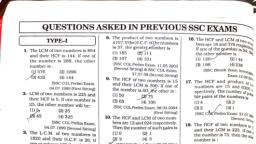
LCM AND HCF, , QUESTIONS ASKED IN PREVIOUS SSC EXAMS, TYPE–I, 1. The LCM of two numbers is 864, and their HCF is 144. If one of, the number is 288, the other, number is :, (1) 576, (2) 1296, (3) 432, (4) 144, (SSC CGL Prelim Exam., 04.07.1999 (First Sitting), , 2. LCM of two numbers is 225 and, their HCF is 5. If one number is, 25, the other number will be:, (1) 5, (2) 25, (3) 45, (4) 225, (SSC CGL Prelim Exam., 04.07.1999 (Second Sitting), , 3. The L.C.M. of two numbers is, 1820 and their H.C.F. is 26. If, one number is 130 then the other, number is :, (1) 70, (2) 1690, (3) 364, (4) 1264, (SSC CGL Prelim Exam., 24.02.2002 (First Sitting), , 4. The LCM of two numbers is, 1920 and their HCF is 16. If one, of the number is 128, find the, other number., (1) 204, (2) 240, (3) 260, (4) 320, , 8. The product of two numbers is, 4107. If the H.C.F. of the numbers, is 37, the greater number is, (1) 185, (2) 111, (3) 107, (4) 101, (SSC CGL Prelim Exam. 11.05.2003, (Second Sitting) & SSC CGL Exam., 27.07.08 (Second Sitting), , (SSC (South Zone) Investigator, Exam 12.09.2010), , 9. The HCF of two numbers is 15, and their LCM is 300. If one of, the number is 60, the other is :, (1) 50, (2) 75, (3) 65, (4) 100, , 17. The HCF and product of two, numbers are 15 and 6300 respectively. The number of possible pairs of the numbers is, (1) 4, (2) 3, (3) 2, (4) 1, , (SSC CGL Prelim Exam. 08.02.2004, (First Sitting), , 10. The HCF and LCM of two numbers are 12 and 924 respectively., Then the number of such pairs is, (1) 0, (2) 1, (3) 2, (4) 3, (SSC CGLTier-1 Exam 26.06.2011, (Second Sitting), , 11. The LCM of two numbers is 30, and their HCF is 5. One of the, number is 10. The other is, (1) 20, (2) 25, (3) 15, (4) 5, (SSC CGL Prelim Exam. 04.07.1999, (First Sitting), , (SSC CGL Prelim Exam., , 12. The product of two numbers is, 1280 and their H.C.F. is 8. The, L.C.M. of the number will be :, (1) 160, (2) 150, (3) 120, (4) 140, , 24.02.2002 (Second Sitting), , (SSC CPO SI Exam. 16.12.2007), , 5. The HCF of two numbers 12906, and 14818 is 478. Their LCM is, (1) 400086 (2) 200043, (3) 600129 (4) 800172, , 13. The H.C.F. and L.C.M. of two, numbers are 8 and 48 respectively. If one of the number is 24,, then the other number is, (1) 48, (2) 36, (3) 24, (4) 16, , (SSC CGL Prelim Exam., 24.02.2002 (Middle Zone), , 6. The H.C.F. and L.C.M. of two 2digit numbers are 16 and 480 respectively. The numbers are :, (1) 40, 48, (2) 60, 72, (3) 64, 80, (4) 80, 96, (SSC CPO S.I., Exam. 26.05.2005), , 7. The HCF of two numbers is 16, and their LCM is 160. If one of, the number is 32, then the other, number is, (1) 48, (2) 80, (3) 96, (4) 112, (SSC CPO Sub Inspector, Exam. 12.01.2003, , 16. The HCF and LCM of two numbers are 18 and 378 respectively., If one of the number is 54, then, the other number is, (1) 126, (2) 144, (3) 198, (4) 238, , (SSC CGLTier-I Exam. 16.05.2010, (First Sitting), , 14. The H.C.F and L.C.M of two numbers are 12 and 336 respectively., If one of the number is 84, the, other is, (1) 36, (2) 48, (3) 72, (4) 96, (SSC CGLTier-I Exam. 16.05.2010, (Second Sitting), , (SSC CGL Prelim Exam. 27.07.2008, (Second Sitting), , 18. The HCF of two numbers is 15, and their LCM is 225. If one of, the number is 75, then the other, number is :, (1) 105, , (2) 90, , (3) 60, , (4) 45, (SSC CHSL DEO & LDC, Exam. 27.11.2010), , 19. The LCM of two numbers is 520, and their HCF is 4. If one of the, number is 52, then the other, number is, (1) 40, (2) 42, (3) 50, (4) 52, (SSC CISF Constable (GD), Exam. 05.06.2011), , 20. The H.C.F. of two numbers is 96, and their L.C.M. is 1296. If one, of the number i s 864,, the other is, (1) 132, (2) 135, (3) 140, (4) 144, (SSC CHSL DEO & LDC, Exam. 04.12.2011, (IInd Sitting (East Zone), , 21. The LCM of two numbers is 4, times their HCF. The sum of LCM, and HCF is 125. If one of the, number is 100, then the other, number is, (1) 5, (2) 25, (3) 100, (4) 125, (SSC Multi-Tasking (Non-Technical), Staff Exam. 20.02.2011), , 15. The product of two numbers is, 216. If the HCF is 6, then their, LCM is, (1) 72, (2) 60, (3) 48, (4) 36, , 22. Product of two co-prime numbers, is 117. Then their L.C.M. is, (1) 117, (2) 9, (3) 13, (4) 39, , (SSC CISF ASI Exam 29.08.2010, (Paper-1), , Exam. 19.05.2013 Ist Sitting), , SME–74, , (SSC CGL Tier-I
Page 3 :
LCM AND HCF, 23. The product of two numbers is, 2160 and their HCF is 12. Number of such possible pairs is, (1) 1, (2) 2, (3) 3, (4) 4, (SSC CHSL DEO & LDC Exam., 27.10.2013 IInd Sitting), , 24. LCM of two numbers is 2079 and, their HCF is 27. If one of the, number is 189, the other number is, (1) 297, (2) 584, (3) 189, (4) 216, (SSC (10+2) Level Data Entry, , Operator & LDC Exam., 10.11.2013, IInd Sitting), , 25. The product of two numbers is, 2028 and their HCF is 13. The, number of such pairs is, (1) 1, (2) 2, (3) 3, (4) 4, (SSC CPO S.I., Exam. 12.01.2003 & SSC CGL Tier-I, Exam. 19.06.11 (First Sitting), , 26. The HCF and LCM of two numbers are 13 and 455 respectively., If one of the number lies between, 75 and 125, then, that number is :, (1) 78, (2) 91, (3) 104, (4) 117, (SSC CGL Prelim Exam., 04.07.1999 (First Sitting), , 27. The H.C.F. of two numbers is 8., Which one of the following can, never be their L.C.M.?, (1) 24, (2) 48, (3) 56, (4) 60, (SSC CGL Prelim Exam., 27.02.2000 (First Sitting), , 28. The HCF of two numbers is 23, and the other two factors of their, LCM are 13 and 14. The larger, of the two numbers is :, (1) 276, (2) 299, (3) 345, (4) 322, (SSC CGL Prelim Exam., 08.02.2004 (First Sitting), , 29. The L.C.M. of three different numbers is 120. Which of the following cannot be their H.C.F.?, (1) 8, (3) 24, , (2) 12, (4) 35, , TYPE–II, 1. The least number which when, divided by 4, 6, 8, 12 and 16, leaves a remainder of 2 in each, case is :, (1) 46, (2) 48, (3) 50, (4) 56, (SSC CGL Prelim Exam., 04.07.1999 (First Sitting), , 2. The least number, which when, divided by 12, 15, 20 or 54, leaves a remainder of 4 in each, case, is :, (1) 450, (2) 454, (3) 540, (4) 544, (SSC CGL Prelim Exam., 04.07.1999 (Second Sitting), , 3. Find the greatest number of five, digits which when divided by 3,, 5, 8, 12 have 2 as remainder :, (1) 99999, (2) 99958, (3) 99960, (4) 99962, (SSC CGL Prelim Exam., 24.02.2002 (First Sitting), , 4. The least multiple of 13, which, on dividing by 4, 5, 6, 7 and 8, leaves remainder 2 in each case is:, (1) 2520, (2) 842, (3) 2522, (4) 840, (SSC CGL Prelim Exam. 24.02.2002, (Middle Zone, SSC CGL Prelim Exam., 24.02.2002 (Second Sitting) & SSC CGL, Prelim Exam. 13.11.2005), , 5. A, B, C start running at the same, time and at the same point in the, same direction in a circular stadium. A completes a round in 252, seconds, B in 308 seconds and, C in 198 seconds. After what time, will they meet again at the starting point ?, (1) 26 minutes 18 seconds, (2) 42 minutes 36 seconds, (3) 45 minutes, (4) 46 minutes 12 seconds, (SSC Constable (GD) & Rifleman, , (SSC CGL Tier-1 Exam, 26.06.2011 (First Sitting), , (GD) Exam. 22.04.2012 (Ist Sitting), , 30. The H.C.F. and L.C.M. of two, numbers are 44 and 264 respectively. If the first number is divided by 2, the quotient is 44., The other number is, (1) 147, (2) 528, (3) 132, (4) 264, , 6. Find the largest number of four, digits such that on dividing by 15,, 18, 21 and 24 the remainders are, 11, 14, 17 and 20 respectively., (1) 6557, (2) 7556, (3) 5675, (4) 7664, , (SSC CHSL DEO & LDC, , (SSC CGL Prelim Exam., 24.02.2002 (Middle Zone), , Exam. 9.11.2014, , SME–75, , 7. The least perfect square, which, is divisible by each of 21, 36 and, 66 is, (1) 214344, (2) 214434, (3) 213444, (4) 231444, (SSC CPO S.I. Exam. 12.01.2003), , 8. The least number, which when, divided by 4, 5 and 6 leaves remainder 1, 2 and 3 respectively, is, (1) 57, (2) 59, (3) 61, (4) 63, (SSC CPO S.I. Exam. 12.01.2003), , 9. Let the least number of six digits which when divided by 4, 6,, 10, 15 leaves in each case same, remainder 2 be N. The sum of, digits in N is :, (1) 3, (2) 5, (3) 4, (4) 6, (SSC CGL Prelim Exam., 11.05.2003 (First Sitting), , 10. Which is the least number which, when doubled will be exactly, divisible by 12, 18, 21 and 30 ?, (1) 2520, , (2) 1260, , (3) 630, , (4) 196, (SSC CGL Prelim Exam., 11.05.2003 (Second Sitting), , 11. The smallest square number divisible by 10, 16 and 24 is, (1) 900, (2) 1600, (3) 2500, (4) 3600, (SSC CPO S.I. Exam. 07.09.2003), , 12. If the students of a class can be, grouped exactly into 6 or 8 or, 10, then the minimum number, of students in the class must be, (1) 60, (2) 120, (3) 180, (4) 240, (SSC CGL Prelim Exam., 08.02.2004 (First Sitting), , 13. The least number which when, divided by 4, 6, 8 and 9 leave, zero remainder in each case and, when divided by 13 leaves a remainder of 7 is :, (1) 144, (2) 72, (3) 36, (4) 85, (SSC CGL Prelim Exam., 08.02.2004 (Second Sitting), , 14. The smallest number, which, when divided by 12 and 16, leaves remainder 5 and 9 respectively, is :, (1) 55, (2) 41, (3) 39, (4) 29, (SSC CPO S.I. Exam. 26.05.2005)
Page 4 :
LCM AND HCF, 15. A number which when divided by, 10 leaves a remainder of 9, when, divided by 9 leaves a remainder, of 8, and when divided by 8, leaves a remainder of 7, is :, (1) 1539, (2) 539, (3) 359, (4) 1359, , 22. What least number must be subtracted from 1936 so that the, resulting number when divided, by 9, 10 and 15 will leave in each, case the same remainder 7 ?, (1) 37, (2) 36, (3) 39, (4) 30, (SSC CGL Prelim Exam., 27.07.2008 (Second Sitting), , (SSC CPO S.I. Exam. 26.05.2005), , 16. What is the smallest number, which leaves remainder 3 when, divided by any of the numbers, 5, 6 or 8 but leaves no remainder when it is divided by 9 ?, (1) 123, (2) 603, (3) 723, (4) 243, (SSC Section Officer (Commercial, Audit) Exam. 25.09.2005), , 17. The least number which when divided by 16, 18, 20 and 25 leaves, 4 as remainder in each case but, when divided by 7 leaves no remainder is, (1) 17004, (2) 18000, (3) 18002, (4) 18004, (SSC CGL DEO & LDC, Exam. 04.12.2011 (Ist Sitting, (East Zone), , 18. What is the least number which, when divided by the numbers 3,, 5, 6, 8, 10 and 12 leaves in each, case a remainder 2 but when divided by 13 leaves no remainder ?, (1) 312, (2) 962, (3) 1562, (4) 1586, (SSC CGL Prelim Exam., 13.11.2005 (Second Sitting), , 19. The least multiple of 7, which, leaves the remainder 4, when, divided by any of 6, 9, 15 and, 18, is, (1) 76, (2) 94, (3) 184, (4) 364, (SSC Section Officer (Commercial, Audit) Exam. 30.09.2007, (Second Sitting), , 20. The largest number of five digits, which, when divided by 16, 24,, 30, or 36 leaves the same remainder 10 in each case, is :, (1) 99279, (2) 99370, (3) 99269, (4) 99350, (SSC CPO S.I. Exam. 16.12.2007), , 21. The smallest number, which, when divided by 5, 10, 12 and, 15, leaves remainder 2 in each, case; but when divided by 7, leaves no remainder, is, (1) 189, (2) 182, (3) 175, (3) 91, (SSC CGL Prelim Exam. 27.07.2008, (First Sitting), , 23. The least number, which when, divided by 18, 27 and 36 separately leaves remainders 5,14,, and 23 respectively, is, (1) 95, (2) 113, (3) 149, (4) 77, (SSC CPO S.I. Exam. 09.11.2008), , 24. The least number which when, divided by 5, 6, 7 and 8 leaves a, remainder 3, but when divided, by 9 leaves no remainder is, (1) 1677, (2) 1683, (3) 2523, (4) 3363, (SSC CPO S.I. Exam. 06.09.2009), & SSC CGL Tier-1 Exam., 26.06.2011 (Second Sitting), , 25. The greatest number of four digits which when divided by 12, 16, and 24 leave remainders 2, 6 and, 14 respectively is, (1) 9974, (2) 9970, (3) 9807, (4) 9998, (SSC CPO S.I. Exam. 06.09.2009), , 26. When a number is divided by 15,, 20 or 35, each time the remainder is 8. Then the smallest number is, (1) 428, (2) 427, (3) 328, (4) 338, (SSC CPO S.I. Exam. 06.09.2009), , 27. The smallest number, which,, when divided by 12 or 10 or 8,, leaves remainder 6 in each, case, is, (1) 246, (2) 186, (3) 126, (4) 66, (SSC (South Zone) Investigator, Exam. 12.09.2010), , 28. The traffic lights at three different road crossings change after, 24 seconds, 36 seconds and 54, seconds respectively. If they all, change simul taneo usly at, 10 : 15 : 00 AM, then at what, time will they again change simultaneously?, (1), (2), (3), (4), , 10, 10, 10, 10, , :, :, :, :, , 16, 18, 17, 22, , :, :, :, :, , 54, 36, 02, 12, , AM, AM, AM, AM, , (SSC CGLTier-1 Exam., 26.06.2011 (First Sitting), , SME–76, , 29. From a point on a circular track 5, km long A, B and C started, running in the same direction at, the same time with speed of 2, , 1, 2, , km per hour, 3 km per hour and, 2 km per hour respectively. Then, on the starting point all three will, meet again after, (1) 30 hours (2) 6 hours, (3) 10 hours (4) 15 hours, (SSC CGL Prelim Exam., 11.05.2003 (Second Sitting), , 30. Four runners started running, simultaneously from a point on a, circular track. They took 200, seconds, 300 seconds, 360, seconds and 450 seconds to, complete one round. After how, much time do they meet at the, starting point for the first time ?, (1) 1800 seconds, (2) 3600 seconds, (3) 2400 seconds, (4) 4800 seconds, (SSC CGL Tier-1 Exam., 19.06.2011 (Second Sitting), , 31. Four bells ring at intervals of 4,, 6, 8 and 14 seconds. They start, ringing simultaneously at 12.00, O’clock. At what time will they, again ring simultaneously ?, (1) 12 hrs. 2 min. 48 sec., (2) 12 hrs. 3 min., (3) 12 hrs. 3 min. 20 sec., (4) 12 hrs. 3 min. 44 sec., (SSC CGL Prelim Exam., 04.07.1999 (Second Sitting), , 32. 4 bells ring at intervals of 30, minutes, 1 hour, 1, , 1, hour and 1, 2, , hour 45 minutes respectively. All, the bells ring simultaneously at, 12 noon. They will again ring simultaneously at :, (1) 12 mid night (2) 3 a.m., (3) 6 a.m., (4) 9 a.m., (SSC CGL Prelim Exam., 24.02.2002 (First Sitting), , 33. Four bells ring at the intervals of, 5, 6, 8 and 9 seconds. All the, bells ring simulataneously at, some time. They will again ring, simultaneously after, (1) 6 minutes, (2) 12 minutes, (3) 18 minutes (4) 24 minutes, (SSC CGL Prelim Exam., 24.02.2002 (Middle Zone)
Page 5 :
LCM AND HCF, 34. Three bells ring simultaneously at, 11a.m. They ri ng at regular, intervals of 20 mi nutes, 30, minutes, 40 minutes respectively. The time when all the three, ring together next is, (1) 2 p.m., (2) 1 p.m., (3) 1.15 p.m., (4) 1.30 p.m., (SSC CGL Tier-1 Exam. 19.06.2011, (First Sitting), , 35. The greatest number of four digits which when divided by 3, 5,, 7, 9 leave remainders 1, 3, 5, 7, respectively is :, (1) 9763, (2) 9764, (3) 9766, (4) 9765, (SSC CGL DEO & LDC Exam. 21.10.2012, (IInd Sitting), , 36. Five bells begin to toll together, and toll respectively at intervals, of 6, 7, 8, 9 and 12 seconds., After how many seconds will they, toll together again ?, (1) 72 Sec., (2) 612 Sec., (3) 504 Sec., (4) 318 Sec., (SSC Constable (GD), Exam. 12.05.2013), , 37. L.C.M. of, (1), , 8, 27, , 10, (3), 3, , 2 4 5, , ,, is, 3 9 6, (2), , 20, 3, , 20, (4), 27, (SSCCGL DEO & LDC, Exam. 20.10.2013), , 38. The number nearest to 10000,, which is exactly divisible by each, of 3, 4, 5, 6, 7 and 8, is :, (1) 9240, (2) 10080, (3) 9996, (4) 10000, (SSC CGL Prelim Exam., 08.02.2004 (First Sitting), , 39. The largest 4-digit number exactly divisible by each of 12, 15, 18, and 27 is, (1) 9690, (2) 9720, (3) 9930, (4) 9960, (SSC Section Officer (Commercial Audit), , Exam. 26.11.2006 (Second, Sitting ), , 40. The least number, which is a perfect square and is divisible by, each of the numbers 16, 20 and, 24, is, (1) 1600, (2) 3600, (3) 6400, (4) 14400, , (SSC Section Officer (Commercial Audit), , Exam. 30.09.2007 (Second, Sitting ), , 41. The number nearest to 43582 divisible by each of 25, 50 and 75, is :, (1) 43500, (2) 43650, (3) 43600, (4) 43550, (SSC CPO S.I. Exam. 16.12.2007), , 42. The smallest number, which, when increased by 5 is divisible, by each of 24,32, 36 and 564, is, (1) 869, (2) 859, (3) 4320, (4) 427, (SSC CPO S.I. Exam. 09.11.2008), , 43. The greatest number, which, when subtracted from 5834,, gives a number exactly divisible, by each of 20, 28, 32 and 35, is, (1) 1120, (2) 4714, (3) 5200, (4) 5600, (SSC CGL Tier-I Exam., 16.05.2010 (First Sitting), , 44. The smallest perfect square divisible by each of 6, 12 and 18 is, (1) 196, (2) 144, (3) 108, (4) 36, , (1) 17, (3) 21, , (SSC CPO SI, ASI Online, Exam.05.06.2016) (IInd Sitting), , 50. The LCM fo two prime numbers, x and y, (x > y) is 161. The value, of (3y – x) :, (1) –2, (2) –1, (3) 1, (4) 2, (SSC CGL Tier-I (CBE), Exam. 27.10.2016 (Ist Sitting), , 51. Three electronic devices make a, beep after every 48 seconds, 72, seconds and 108 seconds respectively. They beeped together at 10 a.m. The time when they, will next make a beep together at, the earliest is, (1) 10 : 07 : 12 hours, (2) 10 : 07 : 24 hours, (3) 10 : 07 : 36 hours, (4) 10 : 07 : 48 hours, (SSC CGL Tier-II (CBE), Exam. 12.01.2017), , (SSC (South Zone) Investigator, Exam. 12.09.2010), , 45. The greatest 4-digit number exactly divisible by 10, 15, 20 is, (1) 9990, (2) 9960, (3) 9980, (4) 9995, (SSC Graduate Level Tier-II, Exam. 29.09.2013), , 46. Find the least number which, when divided separately by 15,, 20, 36 and 48 leaves 3 as remainder in each case., (1) 183, (2) 243, (3) 483, (4) 723, (SSC CGL Tier-II Exam. 21.09.2014), , 47. Three men step off together from, the same spot. Their steps measure 63 cm, 70 cm and 77 cm, respectively. The minimum distance each should cover so that, all can cover the distance in complete steps is, (1) 9630 cm (2) 9360 cm, (3) 6930 cm, (4) 6950 cm, (SSC CGL Tier-II Exam. 21.09.2014), , 48. Three bells ring at intervals of 36, seconds, 40 seconds and 48 seconds respectively. They start ringing together at a particular time., They will ring together after every, (1) 6 minutes, (2) 12 minutes, (3) 18 minutes (4) 24 minutes, (SSC CGL Tier-II Online, Exam.01.12.2016), , 49. The LCM of four consecutive, numbers is 60. The sum of the, first two numbers is equal to the, fourth number. What is the sum, of four numbers?, , SME–77, , (2) 14, (4) 24, , TYPE–III, 1. The maximum number of students among whom 1001 pens, and 910 pencils can be, distributed in such a way that, each student gets same number, of pens and same number of, pencils, is :, (1) 91, (2) 910, (3) 1001, (4) 1911, (SSC CGL Prelim Exam. 04.07.1999, (First Sitting), , 2. The greatest number, which, when divide 989 and 1327 leave, remainders 5 and 7 respectively,, is :, (1) 8, (2) 16, (3) 24, (4) 32, (SSC CGL Prelim Exam. 24.02.2002, (Second Sitting), , 3. H.C.F of, , 2 4, 6, , and, is, 3 5, 7, , (1), , 48, 105, , (2), , (3), , 1, 105, , (4), , 2, 105, 24, 105, , (SSC Graduate Level Tier-II, Exam. 16.09.2012), , 4. Let N be the greatest number, that will divide 1305, 4665 and, 6905 leaving the same remainder in each case. Then, sum of, the digits in N is :, (1) 4, (2) 5, (3) 6, (4) 8, (SSC CGL Prelim Exam. 08.02.2004, (Second Sitting)
Page 6 :
LCM AND HCF, 5. What is the greatest number that, will divide 307 and 330 leaving, remainders 3 and 7 respectively ?, (1) 19, (2) 16, (3) 17, (4) 23, , subject-wise and the height of, each stack is the same. Total, number of stacks will be, (1) 14, (2) 21, (3) 22, (4) 48, , (SSC CGL Prelim Exam. 13.11.2005, (Second Sitting), , (SSC CGL Prelim Exam. 04.02.2007, (First Sitting), , 6. Which greatest number will divide 3026 and 5053 leaving remainders 11 and 13 respectively?, (1) 18, (2) 30, (3) 45, (4) 60, , 13. A farmer has 945 cows and 2475, sheep. He farms them into flocks,, keeping cows and sheep separate and having the same number of animals in each flock. If, these flocks are as large as possible, then the maximum number, of animals in each flock and total, number of flocks required for the, purpose are respectively, (1) 15 and 228 (2) 9 and 380, , (SSC CPO S.I. Exam. 03.09.2006), , 7. The greatest number, by which, 1657 and 2037 are divided to give, remainders 6 and 5 respectively, is, (1) 127, (2) 133, (3) 235, (4) 305, (SSC Section Officer (Commercial, Audit) Exam. 26.11.2006, (Second Sitting), , 8. The largest number, which divides 25, 73 and 97 to leave the, same remainder in each case, is, (1) 24, (2) 23, (3) 21, (4) 6, (SSC CGL Prelim Exam. 04.02.2007, (Second Sitting), , 9. What is the greatest number, which will divide 110 and 128, leaving a remainder 2 in each, case ?, (1) 8, (2) 18, (3) 28, (4) 38, FCI Assistant Grade-III, Exam. 05.02.2012 (Paper-I), East Zone (IInd Sitting), , 10. A milkman has 75 litres milk in, one can and 45 litres in another., The maximum capacity of container which can measure milk, of either container exact number, of times is :, (1) 1 litre, (2) 5 litres, (3) 15 litres (4) 25 litres, (SSC CGL Prelim Exam. 24.02.2002, (Second Sitting), , 11. What is the least number of, square tiles required to pave the, floor of a room 15 m 17 cm long, and 9 m 2 cm broad?, (1) 840, (2) 841, (3) 820, (4) 814, (SSC CGL Prelim Exam. 11.05.2003, (First Sitting), , 12. Three sets of English, Mathematics and Science books containing 336, 240, 96 books respectively have to be stacked in such, a way that all the books are stored, , (3) 45 and 76, , (4) 46 and 75, , (SSC (10+2) Level Data Entry, Operator & LDC Exam. 11.12.2011, (Ist Sitting (Delhi Zone), , 14. A milk vendor has 21 litres of cow, milk, 42 litres of toned milk and, 63 litres of double toned milk. If, he wants to pack them in cans, so that each can contains same, litres of milk and does not want, to mix any two kinds of milk in a, can, then the least number of, cans required is, (1) 3, (2) 6, (3) 9, , (4) 12, , 18. The greatest number that will divide 729 and 901 leaving remainders 9 and 5 respectively, is, (1) 15, , (2) 16, , (3) 19, , (4) 20, , (SSC CHSL DEO Exam. 02.11.2014, (Ist Sitting), , 19. Three tankers contain 403 litres,, 434 litres, 465 litres of diesel, respectively. Then the maximum, capacity of a container that can, measure the diesel of the three containers exact number of times is, (1) 31 litres, , (2) 62 litres, , (3) 41 litres, , (4) 84 litres, , (SSC CAPFs SI, CISF ASI & Delhi, Police SI Exam. 22.06.2014, TF No. 999 KP0), , 20. There are 24 peaches, 36 apricots and 60 bananas and they, have to be arranged in several, rows in such a way that every, row contains the same number, of fruits of only one type. What, is the minimum number of rows, required for this to happen ?, (1) 12, (2) 9, (3) 10, (4) 6, (SSC CHSL (10+2) DEO & LDC, Exam. 16.11.2014, IInd Sitting, , (SSC Constable (GD) & Rifleman, , TF No. 545 QP 6), , (GD) Exam. 22.04.2012 (IInd Sitting), , 21. The greatest number by which, 2300 and 3500 are divided leaving the remainders of 32 and 56, respectively, is, (1) 136, (2) 168, (3) 42, (4) 84, , 15. The greatest number that divides, 411, 684, 821 and leaves 3, 4, and 5 as remainders, respectively, is, (1) 254, (2) 146, (3) 136, (4) 204, (SSC FCI Assistant Grade-III Main, Exam. 07.04.2013), , 16. Find the greatest number which, will exactly divide 200 and 320., (1) 10, (2) 20, (3) 16, (4) 40, (SSC CGL Tier-II Exam. 21.09.2014, , 17. 84 Maths books, 90 Physics, books and 120 Chemistry books, have to be stacked topicwise., How many books will be there in, each stack so that each stack will, have the same height too ?, (1) 12, (2) 18, (3) 6, (4) 21, (SSC CAPFs SI, CISF ASI & Delhi, Police SI Exam. 22.06.2014, , SME–78, , (SSC CAPFs SI, CISF ASI & Delhi, Police SI Exam, 21.06.2015, IInd Sitting), , 22. The product of two 2–digit numbers is 2160 and their H.C.F. is, 12. The numbers are, (1) (12, 60), (2) (72, 30), (3) (36, 60), (4) (60, 72), (SSC CGL Tier-I (CBE), Exam. 09.09.2016) (Ist Sitting), , 23. Find the greatest number that will, divide 390, 495 and 300 without, leaving a remainder., (1) 5, , (2) 15, , (3) 25, , (4) 35, , (SSC CGL Tier-I (CBE), Exam. 02.09.2016) (IInd Sitting)
Page 7 :
LCM AND HCF, 24. In a school, 391 boys and 323, girls have been divided into the, largest possible equal classes, so, that each class of boys numbers, the same as each class of girls., What is the number of classes ?, (1) 23, (2) 19, (3) 44, (4) 17, (SSC CGL Tier-I (CBE), Exam. 11.09.2016 (IInd Sitting), , 25. Two pipes of length 1.5 m and, 1.2 m are to be cut into equal, pieces without leaving any extra, length of pipes. The greatest, length of the pipe pieces of same, size which can be cut from these, two lengths will be, (1) 0.13 metre (2) 0.4 metre, (3) 0.3 metre (4) 0.41 metre, (SSC CGL Tier-II (CBE), Exam. 12.01.2017), , TYPE–IV, 1. The LCM and the HCF of the, numbers 28 and 42 are in the, ratio :, (1) 6 : 1, (2) 2 : 3, (3) 3 : 2, (4) 7 : 2, (SSC CGL Prelim Exam. 27.02.2000, (Second Sitting), , 2. If the ratio of two numbers is, 2 : 3 and their L.C.M. is 54,, then the sum of the two numbers is, (1) 5, (2) 15, (3) 45, (4) 270, (SSC CPO S.I. Exam. 07.09.2003), , 3. The ratio of two numbers is 4 : 5, and their L.C.M. is 120. The, numbers are, (1) 30, 40, (2) 40, 32, (3) 24, 30, (4) 36, 20, (SSC CPO S.I. Exam. 07.09.2003), , 4. Three numbers are in the ratio, 2 : 3 : 4 and their H.C.F. is 12., The L.C.M. of the numbers is, (1) 144, (2) 192, (3) 96, (4) 72, (SSC CGL Prelim Exam. 04.02.2007, (Second Sitting), , 5. Two numbers are in the ratio, 3 : 4. If their LCM is 240, the, smaller of the two number is, (1) 100, (2) 80, (3) 60, (4) 50, (SSC CGL Prelim Exam. 27.07.2008, (First Sitting), , 6. Two numbers are in the ratio, 3 : 4. Their L.C.M. is 84. The, greater number is, (1) 21, (2) 24, (3) 28, (4) 84, (SSC CGLTier-I Exam. 16.05.2010, (First Sitting), , 7. Two numbers are in the ratio 3 :, 4. If their HCF is 4, then their, LCM is, (1) 48, (2) 42, (3) 36, (4) 24, (SSC CGL Prelim Exam. 24.02.2002, (First Sitting) & SSC (South Zone), Investigator Exam. 12.09.2010 &, SSC MTS Exam. 10.03.2013), , 8. The ratio of the sum to the LCM, of two natural numbers is 7 :, 12. If their HCF is 4, then the, smaller number is :, (1) 20, (2) 16, (3) 12, (4) 8, (SSC CGL DEO & LDC, Exam. 11.12.2011 (IInd Sitting, (Delhi Zone), , 9. Two numbers are in the ratio, 3 : 4. The product of their H.C.F., and L.C.M. is 2028. The sum of, the numbers is, (1) 68, (2) 72, (3) 86, (4) 91, (SSC DEO Exam. 02.08.2009), , 10. The LCM of two numbers is 48., The numbers are in the ratio 2 : 3., The sum of the numbers is, (1) 28, (2) 32, (3) 40, , (4) 64, , (SSC Multi-Tasking (Non-Technical), Staff Exam. 27.02.2011), , 11. The ratio of two numbers is, 4 : 5 and their H.C.F. is 8. Then, their L.C.M. is, (1) 130, (2) 140, (3) 150, (4) 160, (SSC CGL DEO & LDC, Exam. 04.12.2011, (IInd Sitting (North Zone), , 12. The ratio of two numbers is, 3 : 4 and their HCF is 5. Their, LCM is :, (1) 10, (2) 60, (3) 15, (4) 12, (SSC CAPFs SI & CISF ASI, Exam. 23.06.2013), , 13. Three numbers are in the ratio, 1 : 2 : 3 and their HCF is 12., The numbers are, (1) 12, 24, 36 (2) 5, 10, 15, (3) 4, 8, 12, (4) 10, 20, 30, (SSC CGL Tier-I Exam., , 19.10.2014 (Ist Sitting), , 14. If x : y be the ratio of two whole, numbers and z be their HCF,, then the LCM of those two numbers is, (1) yz, (3), , (2), , xy, z, , xz, y, , (4) xyz, , 15. The H.C.F. and L.C.M. of two, numbers are 21 and 84 respectively. If the ratio the two numbers is 1 : 4, then the larger of, the two numbers is, (1) 12, (2) 108, (3) 48, , (4) 84, (SSC CGL Tier-II Exam,, 25.10.2015, TF No. 1099685), , TYPE–V, 1. The product of the LCM and HCF, of two numbers is 24. The, difference of the two numbers is, 2. Find the numbers ?, (1) 8 and 6, (2) 8 and 10, (3) 2 and 4, (4) 6 and 4, (SSC CGL Prelim Exam., 04.07.1999 (First Sitting), , 2. The LCM of two numbers is 495, and their HCF is 5. If the sum, of the numbers is 100, then, their difference is :, (1) 10, (2) 46, (3) 70, (4) 90, (SSC CGL Prelim Exam., 04.07.1999 (Second Sitting), , 3. Two numbers, both greater than, 29, have HCF 29 and LCM 4147., The sum of the numbers is :, (1) 966, (2) 696, (3) 669, (4) 666, (SSC CGL Prelim Exam. 04.07.1999, (First Sitting), & SSC CGL Prelim, Exam. 24.02.2002 (Second Sitting), , 4. The sum of the H.C.F. and L.C.M, of two numbers is 680 and the, L.C.M. is 84 times the H.C.F. If one, of the number is 56, the other is :, (1) 84, (2) 12, (3) 8, (4) 96, (SSC CGL Prelim Exam. 13.11.2005, (First Sitting), , 5. The sum of two numbers is 84, and their HCF is 12. Total number of such pairs of number is, (1) 2, (2) 3, (3) 4, (4) 5, (SSC HSL DEO & LDC Exam., 28.11.2010 (IInd Sitting), , 6. The sum of a pair of positive integer is 336 and their H.C.F. is, 21. The number of such possible pairs is, (1) 2, (2) 3, (3) 4, (4) 5, , (SSC CHSL DEO & LDC, , (SSC CGL DEO & LDC Exam., , Exam. 16.11.2014, , 04.12.2011 (Ist Sitting (North Zone), , SME–79
Page 8 :
LCM AND HCF, 7. The sum of two numbers is 45., , 1, of their, 9, sum. Their L.C.M. is, (1) 200, (2) 250, (3) 100, (4) 150, Their difference is, , (SSC CGL Prelim Exam. 04.02.2007, (First Sitting), , 8. The H.C.F. of two numbers, each, having three digits , is 17 and, their L.C.M. is 714. The sum of, the numbers will be :, (1) 289, (2) 391, (3) 221, (4) 731, (SSC CPO S.I. Exam. 16.12.2007), , 9. The product of the LCM and the, HCF of two numbers is 24. If the, difference of the numbers is 2,, then the greater of the number is, (1) 3, (2) 4, (3) 6, (4) 8, (SSC CGL Prelim Exam. 27.07.2008, (First Sitting), , 10. The sum of two numbers is 216, and their HCF is 27. How many, pairs of such numbers are there?, (1) 1, (2) 2, (3) 3, (4) 0, (SSC CGL Prelim Exam. 27.07.2008, (First Sitting), , 11. The LCM of two numbers is 12, times their HCF. The sum of the, HCF and the LCM is 403. If one, of the number is 93, then the, other number is, (1) 124, (2) 128, (3) 134, (4) 138, (SSC CGL Prelim Exam. 27.07.2008, (Second Sitting), , 12. Sum of two numbers is 384., H.C.F. of the numbers is 48. The, difference of the numbers is, (1) 100, (2) 192, (3) 288, (4) 336, (SSC CPO S.I. Exam. 06.09.2009), , 13. The sum of two numbers is 36, and their H.C.F and L.C.M. are, 3 and 105 respectively. The sum, of the reciprocals of two, numbers is, , 2, (1), 35, (3), , 4, 35, , 3, (2), 25, (4), , 2, 25, , (SSC CGL Tier-I Exam. 16.05.2010, (Second Sitting) & SSC HSL DEO, & LDC Exam. 28.11.2010), , 14. L.C.M. of two numbers is 120 and, their H.C.F. is 10. Which of the, following can be the sum of those, two numbers ?, (1) 140, (2) 80, (3) 60, (4) 70, (SSC CGL Tier-1 Exam 19.06.2011, (Second Sitting), , 15. Three numbers which are coprime to one another are such, that the product of the first two, is 551 and that of the last two, is 1073. The sum of the three, numbers is :, (1) 75, (2) 81, (3) 85, (4) 89, (SSC CGL Prelim Exam. 11.05.2003, (First Sitting), , 16. The sum of two numbers is 36, and their H.C.F. is 4. How many, pairs of such numbers are possible ?, (1) 1, (2) 2, (3) 3, (4) 4, (SSC CGL Prelim Exam. 08.02.2004, (Second Sitting), , 17. If the HCF and LCM of two consecutive (positive) even numbers, be 2 and 84 respectively, then, the sum of the numbers is, (1) 30, (2) 26, (3) 14, (4) 34, (SSC CGL DEO & LDC Exam. 11.12.2011, (Ist Sitting (East Zone), , 18. The LCM of two positive integers, is twice the larger number. The, difference of the smaller number, and the GCD of the two numbers, is 4. The smaller number is :, (1) 12, (2) 6, (3) 8, (4) 10, (SSC CGL DEO & LDC Exam. 21.10.2012,, IInd Sitting), , 19. The L.C.M. of two numbers is 20, times their H.C.F. The sum of, H.C.F. and L.C.M. is 2520. If one, of the number is 480, the other, number is :, (1) 400, (2) 480, (3) 520, (4) 600, (SSC CPO S.I. Exam. 26.05.2005), , 20. The LCM of two numbers is 44, times of their HCF. The sum of, the LCM and HCF is 1125. If, one number is 25, then the other number is, (1) 1100, (2) 975, (3) 900, (4) 800, (SSC CPO S.I., Exam 12.12.2010 (Paper-I), , SME–80, , 21. If A and B are the H.C.F. and, L.C.M. respectively of two, algebraic expressions x and y, and, A + B = x + y, then the value of A3, + B3 is, (1) x3 – y3, (2) x3, 3, (3) y, (4) x3 + y3, (SSC FCI Assistant Grade-III Main, Exam. 07.04.2013), , 22. HCF and LCM of two numbers, are 7 and 140 respectively. If the, numbers are between 20 and, 45, the sum of the numbers is :, (1) 70, (2) 77, (3) 63, (4) 56, (SSC CGL Prelim Exam. 11.05.2003, (First Sitting), , 23. The number between 3000 and, 4000 which is exactly divisible, by 30, 36 and 80 is, (1) 3625, (2) 3250, (3) 3500, (4) 3600, (SSC CHSL (10+2) DEO & LDC, , Exam. 16.11.2014 , Ist Sitting, TF No. 333 LO 2), , 24. Let x be the least number, which, when divided by 5, 6, 7 and 8, leaves a remainder 3 in each case, but when divided by 9 leaves no, remainder. The sum of digits of, x is, (1) 21, (2) 22, (3) 18, (4) 24, (SSC CGL Tier-II Exam,, 25.10.2015, TF No. 1099685), , 25. The greatest four digit number, which is exactly divisible by each, one of the numbers 12, 18, 21, and 28 is, (1) 9828, (2) 9288, (3) 9882, (4) 9928, (SSC CHSL (10+2) LDC, DEO & PA/SA, Exam, 01.11.2015, IInd Sitting), , 26. A number x is divisible by 7., When this number is divided by, 8, 12 and 16. It leaves a remainder 3 in each case. The least, value of x is:, (1) 148, (2) 149, (3) 150, (4) 147, (SSC CHSL (10+2) LDC, DEO, , & PA/SA Exam, 15.11.2015, (IInd Sitting) TF No. 7203752), , 27. Let x be the smallest number,, which when added to 2000, makes the resulting number divisible by 12, 16, 18 and 21., The sum of the digits of x is, (1) 7, (2) 5, (3) 6, , (4) 4, (SSC CGL Tier-II Exam,, 25.10.2015, TF No. 1099685)
Page 9 :
LCM AND HCF, 28. The smallest five digit number, which is divisible by 12,18 and, 21 is :, (1) 10224, (2) 30256, (3) 10080, (4) 50321, , 5. If P = 23.310.5 ; Q = 25.3.7, then, HCF of P and Q is :, (1) 2.3.5.7, (2) 3.23, , (SSC CHSL (10+2) LDC, DEO, , (SSC CGL DEO & LDC, Exam. 11.12.2011 (IInd Sitting, (East Zone), , (3) 22.37, , (SSC CHSL (10+2) LDC, DEO, & PA/SA Exam, 20.12.2015, (Ist Sitting) TF No. 9692918), , 30. The number between 4000 and, 5000 that is divisible by each of, 12, 18, 21 and 32 is, (1) 4023, (2) 4032, (3) 4302, (4) 4203, , 7. (3), , 8. (1), , 11. (4), , 12. (2), , 13. (2), , 14. (2), , 15. (3), , 16. (4), , 1, when 4 is, 6, , 17. (4), , 18. (2), , 19. (4), , 20. (2), , 21. (2), , 22. (3), , 23. (1), , 24. (2), , subtracted from its numerator, and 1 is added to its denominator. If 2 and 1 are respectively, added to its numerator and the, , 25. (1), , 26. (1), , 27. (3), , 28. (2), , 29. (3), , 30. (1), , 31. (1), , 32. (4), , 33. (1), , 34. (2), , 35. (1), , 36. (3), , 37. (2), , 38. (2), , 39. (2), , 40. (2), , 41. (2), , 42. (2), , 43. (2), , 44. (4), , 45. (2), , 46. (4), , 47. (3), , 48. (2), , 49. (2), , 50. (1), , 51. (1), , 6. A fraction becomes, , denominator, it becomes, , 1, ., 3, , (SSC CGL DEO & LDC, Exam. 04.12.2011 (IInd Sitting, (North Zone), , (SSC CPO SI & ASI, Online, Exam. 06.06.2016) (IInd Sitting), , TYPE–VI, 1. The LCM of two multiples of 12, is 1056. If one of the number is, 132, the other number is, (1) 12, (2) 72, (3) 96, (4) 132, (SSC CPO S.I. Exam. 06.09.2009), , 2. The least number to be subtracted from 36798 to get a number which is exactly divisible by, 78 is, (1) 18, (2) 60, (3) 38, (4) 68, (SSC CPO S.I. Exam. 06.09.2009), , 3. Find the least multiple of 23,, which when divided by 18, 21, and 24 leaves the remainder 7,, 10 and 13 respectively., (1) 3013, (2) 3024, (3) 3002, (4) 3036, , 4. (3), , 6. (2), , 31. If the product of three consecutive numbers is 210 then sum of, the smaller number is :, (2) 4, (4) 11, , 3. (4), , 10. (3), , & PA/SA Exam, 20.12.2015, (Ist Sitting) TF No. 9692918), , (1) 3, (3) 5, , 2. (4), , 9. (2), , Then, the LCM of the numerator and denominator of the said, fraction, must be, (1) 14, (2) 350, (3) 5, (4) 70, , (SSC CHSL (10+2) LDC, DEO, , 1. (3), 5. (4), , & PA/SA Exam, 06.12.2015, (IInd Sitting) TF No. 3441135), , 29. A number between 1000 and, 2000 which when divided by 30,, 36 and 80 gives a remainder 11, in each case is, (1) 1451, (2) 1641, (3) 1712, (4) 1523, , (4) 25.3 10.5.7, , TYPE-II, , 7. The HCF (GCD) of a, b is 12, a,, b are positive integers and a >, b > 12. The smallest values of, (a, b) are respectively, (1) 12, 24, (2) 24, 12, (3) 24, 36, (4) 36, 24, , TYPE-III, 1. (1), , 2. (3), , 3. (2), , 4. (1), , 5. (1), , 6. (3), , 7. (1), , 8. (1), , 9. (2), , 10. (3), , 11. (4), , 12. (1), , 13. (3), , 14. (2), , 15. (3), , 16. (4), , 17. (3), , 18. (2), , 19. (1), , 20. (3), , 21. (4), , 22. (3), , 23. (2, , 24. (4), , 25. (3), , TYPE-IV, , (SSC CGL Tier-I, Exam. 11.11.2012, Ist Sitting), , 8. The number of pair of positive, integers whose sum is 99 and, HCF is 9 is, (1) 2, (2) 3, (3) 4, (4) 5, , 1. (1), , 2. (3), , 3. (3), , 4. (1), , 5. (3), , 6. (3), , 7. (1), , 8. (3), , 9. (4), , 10. (3), , 11. (4), , 12. (2), , 13. (1), , 14. (4), , 15. (4), , (SSC CHSL (10+2) LDC, DEO & PA/SA, , TYPE-V, , Exam, 01.11.2015, IInd Sitting), , SHORT ANSWERS, , 1. (4), , 2. (1), , 3. (2), , 4. (4), , 5. (2), , 6. (3), , 7. (3), , 8. (3), , TYPE-I, , 9. (3), , 10. (2), , 11. (1), , 12. (3), , 13. (3), , 14. (4), , 15. (3), , 16. (3), , 17. (2), , 18. (3), , 19. (4), , 20. (1), , 1. (3), , 2. (3), , 3. (3), , 4. (2), , 5. (1), , 6. (4), , 7. (2), , 8. (2), , (SSC CGL Prelim Exam. 24.02.2002, (First Sitting), , 21. (4), , 22. (3), , 23. (4), , 24. (3), , 9. (2), , 10. (3), , 11. (3), , 12. (1), , 25. (1), , 26. (4), , 27. (1), , 28. (3), , 4. The greatest number, that divides 122 and 243 leaving respectively 2 and 3 as remainders, is, (1) 12, (2) 24, (3) 30, (4) 120, , 13. (4), , 14. (2), , 15. (4), , 16. (1), , 29. (1), , 30. (2), , 31. (4), , 17. (3), , 18. (4), , 19. (1), , 20. (4), , 21. (2), , 22. (1), , 23. (2), , 24. (1), , 25. (2), , 26. (2), , 27. (4), , 28. (4), , 29. (4), , 30. (3), , (SSC CGL Prelim Exam. 08.02.2004, (First Sitting), , SME–81, , TYPE-VI, 1. (3), , 2. (2), , 3. (1), , 4. (4), , 5. (2), , 6. (4), , 7. (4), , 8. (4)
Page 10 :
LCM AND HCF, , EXPLANATIONS, TYPE-I, 1. (3) Using Rule 1,, Required number, , =, , LCM ´ HCF, First number, , =, , 864 ´ 144, = 432, 288, , 2. (3) Using Rule 1,, LCM × HCF = 1st Number× 2nd, Number, Þ 225 × 5 = 25 × x, , \x =, , 225 ´ 5, = 45, 25, , 3. (3) Using Rule 1,, Given that, L.C.M. of two numbers = 1820, H.C.F. of those numbers = 26, One of the number is 130, \ Another number, , =, , 1820 ´ 26, = 364, 130, , 4. (2) Using Rule 1,, We have,, First number × second number, = LCM × HCF, \ Second number, , =, , 1920 ´ 16, = 240, 128, , 5. (1) Using Rule 1,, Product of two numbers, = HCF × LCM, Þ 12906 × 14818, = LCM × 478, , Þ LCM =, , 12906 ´ 14818, 478, , = 400086, 6. (4) Using Rule 1,, H.C.F. of the two 2-digit numbers, = 16, Hence, the numbers can be expressed as 16x and 16y, where, x and y are prime to each other., Now,, First number × second number, = H.C.F. × L.C.M., Þ 16x × 16y = 16 × 480, , 16 ´ 480, = 30, 16 ´ 16, The possible pairs of x and y, satisfying the condition xy = 30 are :, (3, 10), (5, 6), (1, 30), (2, 15), , Þ xy =, , Since the numbers are of 2-digits each., Hence, admissible pair is (5, 6), \ Numbers are : 16 × 5 = 80, and 16 × 6 = 96, 7. (2) Using Rule 1,, We know that,, First number × Second number, = LCM × HCF, Þ Second number, , =, , 16 ´ 160, = 80, 32, , 8. (2) Using Rule 1,, , Product of two numbers, LCM =, HCF, , =, , 4107, = 111, 37, , Obviously, numbers are 111 and, 37 whi ch satisfy the given, condition., Hence, the greater number = 111, 9. (2) Using Rule 1,, First number × Second number, = HCF × LCM, \ Second number, , 15 ´ 300, = 75, =, 60, 10. (3) Let the numbers be 12x and, 12y where x and y are prime to, each other., \ LCM = 12xy, \ 12xy = 924, Þ xy = 77, \ Possible pairs = (1,77) and (7,11), 11. (3) Using Rule 1,, First number × second number, = LCM × HCF, Let the second number be x., \ 10x = 30 × 5, , Þx=, , 30 ´ 5, = 15, 10, , 12. (1) Using Rule 1,, HCF × LCM = Product of two, numbers, Þ 8 × LCM = 1280, Þ LCM =, , 1280, = 160, 8, , 13. (4) Using Rule 1,, First number × second number, = HCF × LCM, Þ 24 × second number = 8 × 48, , 8 ´ 48, \ Second number =, = 16, 24, , SME–82, , 14. (2) Using Rule 1,, First number × second number, = HCF × LCM, Þ 84 × second number, = 12 × 336, \ Second number, , 12 ´ 336, = 48, 84, 15. (4) Let the numbers be 6x and, 6y where x and y are prime to, each other., \ 6x × 6y = 216, =, , 216, =6, 6´6, \ LCM = 6xy = 6 × 6 = 36, 16. (1) Using Rule 1,, Second number, Þ xy =, , HCF ´ LCM, = First number, , 18 ´ 378, = 126, 54, 17. (3) Let the number be 15x and, 15y, where x and y are co –prime., \ 15x × 15y = 6300, =, , 6300, = 28, 15 ´ 15, So, two pairs are, , Þ xy =, , (7, 4) and (14, 2), 18. (4) Using Rule 1,, First number × Second number, = HCF × LCM, Þ 75 × Second number, = 15 × 225, \ Second number, , 15 ´ 225, = 45, 75, 19. (1) Using Rule 1,, First number × second number, = HCF × LCM, =, , Þ 52 × second number, = 4 × 520, Þ Second number, , 4 ´ 520, = 40, 52, 20. (4) Using Rule 1,, First number × Second number, = HCF × LCM, =, , Þ 864 × Second number, = 96 × 1296 Þ Second number, =, , 96 ´ 1296, = 144, 864
Page 11 :
LCM AND HCF, 21. (2) Using Rule 1,, Let LCM be L and HCF be H, then, L = 4H, \ H + 4H = 125, Þ 5H = 125, , 125, = 25, 5, \ L = 4 × 25 = 100, \ Second number, ÞH=, , =, , L´H, First number, , 100 ´ 25, = 25, 100, 22. (1) HCF of two-prime numbers = 1, \ Product of numbers = their, LCM = 117, 117 = 13 × 9 where 13 & 9 are, co-prime. L.C.M (13,9) = 117., 23. (2) HCF = 12, Numbers = 12x and 12y, where x and y are prime to each, other., \ 12x × 12y = 2160, =, , 2160, 12 ´ 12, = 15 = 3 × 5, 1 × 15, Possible pairs = (36, 60) and, (12, 180), 24. (1) Using Rule 1,, Second number, , Þ xy =, , =, , H.C.F. ´ L.C.M., First Number, , =, , 27 ´ 2079, = 297, 189, , 25. (2) Here, HCF = 13, Let the numbers be 13x and 13y, where x and y are Prime to each, other., Now, 13x × 13y = 2028, Þ xy =, , 2028, = 12, 13 ´ 13, , The possible pairs are : (1, 12),, (3, 4), (2, 6), But the 2 and 6 are not co-prime., \ The required no. of pairs = 2, 26. (2) HCF = 13, Let the numbers be 13x and 13y., Where x and y are co-prime., \ LCM, = 13 xy, \ 13 xy, = 455, , 455, = 35 = 5 ´ 7, 13, \ Numbers are 13 × 5 = 65 and, 13 × 7 = 91, , \ xy, , =, , 27. (4) HCF of two numbers is 8., This means 8 is a factor common to both the numbers. LCM, is common multiple for the two, numbers, it is divisible by the, two numbers. So, the required, answer = 60, 28. (4) Let the numbers be 23x and, 23y where x and y are co-prime., \ LCM = 23 xy, As given,, 23xy = 23 × 13 × 14, \ x = 13, y = 14, \ The larger number = 23y, = 23 × 14 = 322, 29. (4) LCM = 2 × 2 × 2 × 3 × 5, Hence, HCF = 4, 8, 12 or 24, According to question, 35 cannot be H.C.F. of 120., 30. (3) Using Rule 1,, First number = 2 × 44 = 88, \ First number × Second, number, = H.C.F. × L.C.M., Þ 88 × Second numebr, = 44 × 264, Þ Second number, =, , 44 ´ 264, = 132, 88, , TYPE-II, 1. (3) Using Rule 4,, L.C.M. of 4, 6, 8, 12 and 16 = 48, \ Required number, = 48 + 2 = 50, 2. (4) Using Rule 4,, LCM of 15, 12, 20, 54 = 540, Then number = 540 + 4 = 544, [4 being remainder], 3. (4) Using Rule 4,, The greatest number of five digits is 99999., LCM of 3, 5, 8 and 12, , 2 3,, 2 3,, 3 3,, 1,, , 5,, 5,, 5,, 5,, , 8, 12, 4, 6, 2, 3, 2, 1, , \ LCM = 2 × 2 × 3 × 5 × 2 = 120, After dividing 99999 by 120, we, get 39 as remainder, 99999 – 39 = 99960, = (833 × 120), 99960 is the greatest five digit, number divisible by the given divisors., In order to get 2 as remainder in, each case we will simply add 2, to 99960., \ Greatest number, = 99960 + 2 = 99962, , SME–83, , 4. (3) Using Rule 4,, LCM of 4, 5, 6, 7 and 8, = 2 4, 5, 6, 7, 8, , 2 2, 5, 3, 7, 4, 1, 5, 3, 7, 2, = 2 × 2 × 2 × 3 × 5 × 7 = 840., let required number be 840 K +, 2 which is multiple of 13., Least value of K for which (840, K + 2) is divisible by 13 is K = 3, \ Required number, = 840 × 3 + 2, = 2520 + 2 = 2522, 5. (4) Required time = LCM of 252,, 308 and 198 seconds, , 2, , 252, 308 198, , 2, 7, 9, , 126, 154,, 63, 77,, 9,, 11,, , 11, , 1,, 1,, , 11,, 1,, , 99, 99, 99, 11, 1, , \ LCM = 2 × 2 × 7 × 9 × 11, = 2772 seconds, = 46 minutes 12 seconds, 6. (2) 15 = 3 × 5, 18 = 32 × 2, 21 = 3 × 7, 24 = 23 × 3, LCM = 8 × 9 × 5 × 7 = 2520, The largest number of four digits, = 9999, , Required number, = 9999 – 2439 – 4 = 7556, (Because, 15 – 11 = 4, 18 – 14 = 4, 21 – 17 = 4, 24 – 20 = 4), 7. (3) LCM of 21, 36 and 66, \ LCM = 3 × 2 × 7 × 6 × 11, = 3 × 3 × 2 × 2 × 7 × 11, \ Required number, = 32 × 22 × 72 × 112, = 213444, 8. (1) Using Rule 5,, Here 4 – 1 = 3, 5 – 2, = 3, 6 – 3 = 3, \ The required number, = LCM of (4, 5, 6) – 3, = 60 – 3 = 57
Page 12 :
LCM AND HCF, 9. (2) LCM of 4, 6, 10, 15 = 60, Least number of 6 digits, = 100000, The least number of 6 digits which, is exactly divisible by 60 =, 100000 + (60 – 40), = 100020, \ Required number (N), = 100020 + 2 = 100022, Hence, the sum of digits = 1 + 0, +0+0+2+2=5, 10. (3) The LCM of 12, 18, 21, 30, , 2 12, 18, 21, 30, 3, , 6,, 2,, , 9,, 3,, , 21, 15, 7, 5, , \ LCM = 2 × 3 × 2 × 3 × 7 × 5, = 1260, \ The required number, , =, , 1260, = 630, 2, , 11. (4) We find LCM of = 10, 16, 24, , 2, 2, 2, 2, 3, 5, , 10, 16, 24, 5, 8, 12, 5, 4, 6, 5, 2, 3,, 5, 1, 3, 5, 1, 1, 1, 1, 1, , \ LCM = 22 × 22 × 3 × 5, \ Required number, =2×2×2×2×3×3×5×5, = 3600, 12. (2) Required number of students, = LCM of 6, 8, 10 = 120, 13. (2) LCM of 4, 6, 8, 9, , 15. (3) Using Rule 5,, Here, Divisor – remainder = 1, e.g., 10 – 9 = 1, 9 – 8 = 1,, 8–7=1, \ Required number, = (L.C.M. of 10, 9, 8) –1, = 360 – 1 = 359, 16. (4) We find LCM of 5, 6 and 8, 5=5, 6=3×2, 8 = 23, = 23 ×3 × 5 = 8 × 15 = 120, Required number = 120K + 3, \ when K = 2, 120 × 2 + 3 = 243, required no., It is completely divisible by 9, 17. (4) LCM of 16, 18, 20 and 25, = 3600, \ Required number = 3600K +, 4 which is exactly divisible by 7, for certain value of K., When K = 5,, number = 3600 × 5 + 4, = 18004 which is exactly divisible by 7., 18. (2) LCM of 3, 5, 6, 8, 10 and 12, = 120, \ Required number, = 120x + 2, which is exactly divisible by 13., 120x + 2 = 13 × 9x + 3x + 2, Clearly 3x + 2 should be divisible by 13., For x=8,3x + 2 is divisible by 13., \ Required number, = 120x + 2 = 120 × 8 + 2, = 960 + 2 = 962, 19. (4) LCM of 6, 9, 15 and 18, = 2 6, 9, 15, 18, , 3 3, 9, 15,, 5,, , 3, , 1, 1,, , 5,, , 1, , 2 4,6,8,9, 2 2,3,4,9, 3 1,3,2,9, , ,2,3, 11, \ LCM = 2 × 2 × 3 × 2 × 3 = 72, \ Required number = 72, because it is exactly divisible by 4,, 6, 8 and 9 and it leaves remainder 7 when divided by 13., 14. (2) Using Rule 5,, Here, 12 – 5 = 7,, 16 – 9 = 7, \ Required number, = (L.C.M. of 12 and 16) – 7, = 48 – 7 = 41, , 9, , 3 1, 3,, , \ LCM = 2 × 3 × 3 × 5 = 90, \ Required number = 90k + 4,, which must be a multiple of 7 for, some value of k., For k = 4,, Number = 90 × 4 + 4 = 364,, which is exactly divisible by 7., 20. (2) Using Rule 9,, We will find the LCM of 16, 24,, 30 and 36., , 2 16, 24, 30, 36, 2, , 8,, , 12, 15, 18, , 2, , 4,, , 6,, , 15,, , 3, , 2,, , 3,, , 15,, , 9, , 2,, , 1,, , 5,, , 3, , SME–84, , 9, , \ LCM = 2 × 2 × 2 × 3 × 2 × 5, × 3 = 720, The largest number of five digits, = 99999, On dividing 99999 by 720, the, remainder = 639, \ The largest five-digit number, divisible by 720, = 99999 – 639 = 99360, \ Required number = 99360 + 10, = 99370, 21. (2) LCM of 5, 10, 12, 15, , 2 5, 10, 12, 15, 3 5,, , 5,, , 6, 15, , = 5 5,, 1,, , 5,, , 2,, , 5, , 1,, , 2,, , 1, , \ LCM = 2 × 3 × 5 × 2 = 60, \ Number = 60k + 2, Now, the required number should, be divisible by 7., Now, 60k + 2 = 7 × 8k + 4k + 2, If we put k = 3, (4k + 2) is equal, to 14 which is exactly divisible, by 7., \ Required number = 60 × 3 + 2, = 182, 22. (3) LCM of 9, 10 and 15 = 90, Þ The multiple of 90 are also divisible by 9, 10 or 15., \ 21 × 90 = 1890 will be divisible by them., \ Now, 1897 will be the number, that will give remainder 7., 1936 – 1897, Required number, = 1936 – 1897 = 39, 23. (1) The difference between the, divisor and the corresponding, remainder is same in each case, ie. 18 – 5 = 13, 27 – 14 = 13,, 36 – 23 = 13, , \ Required number, = (LCM of 18, 27, and 36 ) – 13, = 108 – 13 = 95, 24. (2) The LCM of 5, 6, 7 and 8, = 840, \ Required number = 840 k +, 3 which is exactly divisible by 9, for some value of k., Now, 840 k + 3 = 93 × 9 k + (3k, + 3), When k = 2, 3k + 3 = 9, which is, divisible by 9., \ Required number, = 840 × 2 + 3 = 1683
Page 13 :
LCM AND HCF, 25. (1) Using Rule 5,, Here,12 – 2 = 10; 16 – 6 = 10;, 24 – 14 = 10, Now, LCM of 12, 16 and 24 = 48, \ The greatest 4–digit number, exactly divisible by 48 = 9984, \ Required number, = 9984 – 10 = 9974, 26. (1) Using Rule 5,, LCM of 15, 20 and 35 = 420, \ Required least number, = 420 + 8 = 428, 27. (3) Using Rule 5,, The smallest number divisible by, 12 or 10 or 8, = LCM of 12, 10 and 8 = 120, Þ Required number =120 + 6, = 126, 28. (2) LCM of 24, 36 and 54 seconds, = 216 seconds, = 3 minutes 36 seconds, \ Required time = 10 : 15 : 00 +, 3 minutes 36 seconds, = 10 : 18 : 36 a.m., 29. (3) A makes one complete round, of the circular track in, , 5, 5, 2, , = 2 hours,, B in, , 5, 5, hours and C in, hours., 3, 2, , That is after 2 hours A is at the, starting point, B after, , 5, hours, 3, , 5, and C after, hours., 2, Hence the required time, = LCM of 2,, , 5, 5, and, hours, 3, 2, , =, , LCM of 2, 5, 5, HCF of 3, 2, , =, , 10, = 10 hours., 1, , 30. (1) Required time = LCM of 200,, 300, 360 and 450 seconds, = 1800 seconds, 31. (1) LCM of 4, 6, 8, 14, = 168 seconds, = 2 minutes 48 seconds, They ring again at 12 + 2 min., 48 sec., = 12 hrs. 2 min. 48 sec., , 32. (4) 1, , 1, hours = 90 minutes, 2, , 1 hour and 45 minutes, = 105 minutes, 1 hour = 60 minutes, \ LCM of 30 minutes, 60 minutes, 90 minutes and 105 minutes, , 3 30, 60, 90, 105, 5 10, 20, 30, 35, 2 2, 4, 6,, 7, 1,, 2, 3,, 7, \ LCM = 3 × 5 × 2 × 2 × 3 × 7, = 1260 minutes, 1260 minutes =, , 1260, = 21 hours, 60, , \ The bell will again ring simul-, , taneously after 21 hours., \ Time will be, = 12 noon + 21 hours, = 9 a.m., 33. (1) The LCM of 5, 6, 8 and 9, = 360 seconds = 6 minutes, 34. (2) LCM of 20, 30 and 40, minutes = 120 minutes, Hence, the bells will toll together, again after 2 hours i.e. at 1 p.m., 35. (1) The difference between divisor and the corresponding remainder is equal., LCM of 3, 5, 7 and 9 = 315, Largest 4-digit number = 9999, , 315)9999(31, 945, 549, 315, 234, \ Number divisible by 315, = 9999 – 234 = 9765, Required number, = 9765 – 2 = 9763, 36. (3) Required time = LCM of 6, 7,, 8, 9 and 12 seconds, = 504 seconds, 37. (2) Using Rule 2,, LCM =, =, , LCM of 2, 4, 5, HCF of 3, 9, 6, , 20, 3, , 38. (2) LCM of 3, 4, 5, 6, 7, 8, = 840, , Since, the remainder 760 is more, than half of the divisor 840., \ The nearest number, = 10000 + (840 – 760) = 10080, 39. (2) Using Rule 8,, The largest number of 4-digits is, 9999. L.C.M. of divisors, , 2 12, 15, 18, 27, 3, , 6, 15,, , 9,, , 3, , 2,, , 5,, , 3,, , 27, 9, , 2,, , 5,, , 1,, , 3, , LCM = 2 × 2 × 3 × 3 × 3 × 5, = 540, Divide 9999 by 540, now we get, 279 as remainder., 9999 – 279 = 9720, Hence, 9720 is the largest 4-digit, number exactly divisible by each, of 12, 15, 18 and 27., 40. (2) The smallest number divisible, by 16, 20 and 24, = LCM of 16, 20 and 24, , 2 16, 20, 24, 2, , 8,, , 2, , 4,, , 10, 12, 5,, , 6, , 2,, , 5,, , 3, , \ LCM = 2×2×2×2×5×3, , = 22 × 22 × 5 × 3, \ Required complete square number = 22 × 22 × 52 × 32 = 3600, 41. (2) LCM of 25, 50 and, 75 = 150, On dividing 43582 by 150, remainder = 82, , g, , b, , 150 43582 290, 300, 1358, 1350, 82, \ Required number, = 43582 + (150 – 82) = 43650, 42. (2) Required number = (LCM of, 24, 32, 36 and 54) – 5, Now,, , 2 24, 32, 36, 54, 2 12, 16, 18, 27, 2, 3, 3, , 6,, 3,, 1,, , 8,, 4,, 4,, , 9,, 9,, 3,, , 27, 27, 9, , 1,, , 4,, , 1,, , 3, , LCM = 2 × 2 × 2 × 3 × 3 × 3 × 4, = 864, \ Required number = 864 – 5, = 859, , SME–85
Page 14 :
LCM AND HCF, Illustration : 2 36, 40, 48, , 43. (2) 2 20, 28, 32, 35, 2 10, 14, 16, 35, , 5, , 5,, , 7,, , 8,, , 35, , 2 18, 20, 24, 2 9, 10, 12, , 7, , 1,, , 7,, , 8,, , 7, , 3, , 1,, , 1,, , 8,, , 1, , \ LCM = 2 × 2 × 5 × 7 × 8, = 1120, \ Required number, = 5834 – 1120 = 4714, 44. (4) The LCM of 6, 12 and 18, = 36 = 62, 45. (2) Using Rule 8,, LCM of 10, 15 and 20 = 60, Largest 4-digit number = 9999, , 60, 399, 360, 399, 360, 39, , \ Required number, = 9999 – 39 = 9960, 46. (4) Using Rule 4,, Required number = (LCM of 15,, 20, 36 and 48) + 3, , 2 15, 20, 36, 48, 2 15, 10, 18, 24, 3 15, 5,, 9, 12, 5,, 1,, , 5,, 1,, , \ LCM = 2 × 2 × 2 × 2 × 3 × 3 × 5, = 720, , 49., , (2) 2 60, , 2 30, 3 15, 5, \ 60 = 2 × 2 × 3 × 5, i.e., Numbers = 2, 3, 4 and 5, \ Required sum, = 2 + 3 + 4 + 5 = 14, 50. (1) LCM of x and y = 161, \ xy = 23 × 7, \ x = 23; y = 7, \ 3y – x = 3 × 7 – 23, = 21 – 23 = – 2, 51. (1) Required time = LCM of 48,, 72 and 108 seconds, , \ 60 9999 166, , 5, , 3,, 3,, , 2 48, 72, 108, 2 24, 36, 54, 2 12, 18, 54, 3, 6, 9, 27, 3, 2, 3, 9, 2, 1, 3, \ LCM = 2 × 2 × 2 × 2 × 3 × 3 × 3, = 432 seconds, = 7 minutes 12 second, \ Required time, = 10 : 07 : 12 hours, , 4, 4, , \ LCM = 2 × 2 × 3 × 5 × 3 × 4, , TYPE-III, , = 720, , \ Required number, = 720 + 3 = 723, 47. (3) Required distance = LCM of, 63, 70 and 77 cm., = 6930 cm., Illustration : 7, , 63, 70, 77, 9,, , 10, 11, , \ LCM = 7 × 9 × 10 × 11, = 6930, 48. (2) Required answer = LCM of 36,, 40 and 48 seconds, = 720 seconds, =, , 9, 5, 6, 3, 5, 2, , FG 720 IJ minutes = 12 minutes, H 60 K, , 1. (1) Maximum number of students, = The greatest common divisor, = HCF of 1001 and 910 = 91, 2. (3) Using Rule 7,, Required number, = HCF of (989 – 5) and (1327 – 7), = HCF of 984 and 1320 = 24, \ HCF = 24, 3. (2) Using Rule 3,, HCF of, , 2 4, 6, , and, 3 5, 7, , =, , HCF of 2, 4 and 6, LCM of 3, 5 and 7, , =, , 2, 105, , SME–86, , 4. (1) Using Rule 7,, The greatest number N = HCF of, (1305 – x ), (4665 – x ) and (6905, – x), where x is the remainder, = HCF of (4665 – 1305), (6905–, 4665) and, (6905 – 1305), = HCF of 3360, 2240 and 5600, , 2240 ) 3360 (1, 2240, 1120 ) 2240 ( 2, 2240, ×, Again,, , 1120 ) 5600 ( 5, 5600, ×, \ N = 1120, Sum of digits, =1+1+2+0=4, 5. (1) Using Rule 7,, The number will be HCF of 307, – 3 = 304 and, 330 – 7 = 323., , 304) 323 (1, 304, 19)304(16, 19, 114, 114, ´, \ Required number = 19, 6. (3) Using Rule 7,, 3026 –11 = 3015 and, 5053 –13 = 5040, Required number = HCF of 3015, and 5040, , g, , b, j, , 3015 5040 1, 3015, 2025 3015 1, 2025, , b, , b, , j, , 990 2025 2, 1980, 45 990 22, 90, 90, 90, ´, , j, , b, , \ Required number = 45, 7. (1) Using Rule 7,, We have to find HCF of, (1657 – 6 = 1651) and, (2037 – 5 = 2032), 1651 = 13 × 127, 2032 = 16 × 127, \ HCF = 127, So, required number will be 127.
Page 15 :
LCM AND HCF, 8. (1) Using Rule 7,, Let x be the remainder., Then, (25 – x ), (73 – x ), and, (97 – x ) Will be exactly divisible, by the required number., \ Required number, = HCF of (73 –x ) – (25 –x ),, (97 –x ) – (73 –x ), and (97 –x ) – (25 –x ), = HCF of (73 –25), (97 –73),, and, (97 –25) = HCF of 48, 24 and, 72 = 24, 9. (2) Using Rule 7,, Required number, = HCF of (110 – 2) and (128 – 2), = HCF of 108 and 126 = 18, 10. (3) Required maximum capacity of, container, = HCF of 75 l and 45 l, Now, 75 = 5 × 5 × 3, 45 = 5 × 3 × 3, \ HCF = 15 litres, 11. (4) Length of the floor, = 15 m 17 cm = 1517 cm, Breadth of the floor, = 9m 2 cm = 902 cm., Area of the floor, = 1517 × 902 cm2, The number of square tiles will, be least, when the size of each, tile is maximum., \ Size of each tile = HCF of 1517, and 902 = 41, \ Requi red number of ti les, , 1517 ´ 902, =, = 814, 41 ´ 41, 12. (1) Number of books in each stack, = HCF of 336, 240, 96 = 48, , b, , g, , 24 0, , g, , b, , 96 2 40 2, 192, , g b, , 48 96 2, 96, ´, , 48 96 2, 96, ´, \Total number of stacks, 336 240 96, +, +, 48, 48, 48, =7 + 5 + 2 = 14, 13. (3) First of all we find the HCF of, 945 and 2475. HCF = 45, Illustration :, =, , \ Maximum number of animals in, each flock = 45, Required total number of flocks, , =, , 945 2475, +, = 21 + 55 = 76, 45, 45, , 14. (2) Maximum quantity in each can, = HCF of 21, 42 and 63 litres, = 21 litres, Required least number of cans, =, , 21 42 63, +, +, 21 21 21, , =1+2+3=6, 15. (3) Using Rule 7,, Required number = HCF of 411, – 3 = 408; 684 – 4 = 680 and, 821 – 5 = 816, HCF of 408 and 816 = 408, HCF of 408 and 680, , 408, , f, , a, , 680 1, 408, 272 408 1, 272, 136 272 2, 272, ´, , f, , 240 336 1, , g b, , 945 2475 2, 1890, 585 945 1, 585, 360 585 1, 360, 225 360 1, 225, 135 225 1, 135, 90 135 1, 90, 45 90 2, 90, ×, , a, f, , a, , \ Required number = 136, 16. (4) Required number = HCF of, 200 and 320 = 40, Illustration :, 200) 320 (1, 200, 120) 200 (1, 120, 80) 120 (1, 80, 40) 80 (2, 80, ×, , SME–87, , 17. (3) As the height of each stack is, same, the required number of, books in each stack, = HCF of 84, 90 and 120, 84 = 2 × 2 × 3 × 7, 90 = 2 × 3 × 3 × 5, 120 = 2 × 2 × 2 × 3 × 5, , \ HCF = 2 × 3 = 6, 18. (2) Using Rule 7,, Required number, = HCF of (729 – 9), = 720 and (901 – 5), = 896, , 720 896 1, 720, 176 720 4, 704, 16 176 11, 16, 16, 16, ×, H.C.F = 16, 19. (1) Greatest capacity of measuring vessel, = HCF of 403 litres, 434 litres, and 465 litres, = 31 litres, Illustration :, HCF of 403 and 434, 403 434 1, 403, 31 403 13, 31, 93, 93, ×, HCF of 31 and 465, , 31 465 15, 31, 155, 155, ×, Þ 31 litres, 20. (3) Minimum number of rows =, Maximum number of fruits in, each row, , \ HCF of 24, 36 and 60 = 12, \ Minimum number of rows, =, , 24, 36, 60, +, +, 12, 12, 12, , = 2 + 3 + 5 = 10
Page 16 :
LCM AND HCF, 21. (4) Using Rule 7,, Required number, = HCF of 2300 – 32 = 2268 and, 3500 – 56 = 3444, 2268)3444(1, 2268, 1176)2268(1, 1176, 1092)1176(1, 1092, 84)1092(13, 84, 252, 252, ×, \ HCF = 84, 22. (3) HCF of numbers = 12, Let the numbers be 12x and 12y, where x and y are co–prime., According to the question,, 12x × 12y = 2160, , Þ xy =, , 2160, = 15, 12 ´ 12, , = 3 × 5 or 1 × 15, \ Required numbers, = 12 × 3 = 36 and 12 × 5 = 60, 23. (2) Required number = HCF of, 390, 495 and 300 = 15, Illustration :, , 390) 495 (1, 390, 105) 390 (3, 315, 75) 105 (1, 75, 30) 75 (1, 60, 15) 30 (2, 30, ×, , HCF of 15 and 300 = 15, 24. (4) First of all we find HCF of, 391 and 323., , 323) 391 (1, 323, 68) 323 (4, 272, 51) 68 (1, 51, 17) 51 (3, 51, ×, \ Number of classes = 17, , 25. (3) Maximum length of each, piece = HCF of 1.5 metre and 1.2, metre = 0.3 metre, Illustration :, , 12 ) 15 ( 1, 12, 3) 12 (4, 12, ×, \ HCF of 1.5 and 1.2 metre, = 0.3 metre, , TYPE-IV, 1. (1) L.C.M. of 28 and 42, , 2 28, 42, 2 14, 21, 7 7, 21, 1,, 3, , 6. (3) Let the numbers be 3x and 4x., \ Their LCM = 12x, \ 12x = 84, Þx=, , = 2 × 2 × 7 × 3 = 84, H.C. F. of 28 and 42, , 84, =7, 12, , \ Larger number, = 4x = 4 × 7 = 28, 7. (1) Numbers = 3x and 4x, HCF = x = 4, , \ LCM = 12x = 12 × 4 = 48, 8. (3) Let the numbers be 4x and, 4y where x and y are prime to, each other., LCM = 4xy, , \ H.C. F = 14, Required ratio =, , \, , 84, = 6:1, 14, , 2. (3) Let the two numbers are 2x, and 3x respectively., According to question,, LCM = 54, , x (3 ´ 2) = 54, Þx=9, Numbers = 2x = 2 × 9 = 18, and, 3x = 3 × 9 = 27, Sum of the two numbers, = 18 + 27 = 45, 3. (3) Suppose the numbers are 4x, and 5x respectively, According to question, x × 4 × 5 = 120, Þx=6, \ Required numbers, = 4 × 6 = 24, and = 5 × 6 = 30, 4. (1) Let the numbers be 2x, 3x and, 4x respectively., \ HCF = x = 12, \ Numbers are : 2 ×12 = 24, 3 ×12 = 36, 4 ×12 = 48, LCM of 24, 36, 48, = 2 × 2 × 2 × 3 × 3 × 2 = 144, 5. (3) Let the number be 3x and 4x., Their LCM = 12x, According to the question,, 12x = 240, Þx =, , 240, = 20, 12, , \ Smaller number = 3x = 3 × 20, = 60, , SME–88, , b4x + 4y g =, 4 xy, , 7, 12, , Þ 12 (x + y) = 7 xy, Þ x = 3, y = 4, \ Smaller number, = 4 × 3 = 12, 9. (4) Using Rule 1,, Let the numbers be 3x and 4x, respectively, First number × second number, = HCF × LCM, , Þ 3x × 4x = 2028, Þ x2 =, , 2028, = 169, 3´ 4, , \x=, , 169 = 13, , \ Sum of the numbers, = 3x + 4x = 7x = 7 × 13 = 91, 10. (3) If the numbers be 2x and 3x,, then LCM = 6x, \ 6x = 48 Þ x = 8, , \ Required sum = 2x + 3x = 5x, = 5 × 8 = 40, 11. (4) Let the numbers be 4x and 5x., \ H.C.F. = x = 8, \ Numbers = 32 and 40, \ Their LCM = 160, 12. (2) If the numbers be 3x and 4x,, then, HCF = x = 5, , \ Numbers = 15 and 20, \ LCM = 60, 13. (1) Numbers = x , 2 x and 3 x (let), Their H.C.F. = x = 12, , \ Numbers = 12, 24 and 36
Page 17 :
LCM AND HCF, 14. (4) Using Rule 1,, Product of two numbers, = HCF × LCM, , Þ Numbers = zx and zy, \ zx × zy = z × LCM, Þ LCM = xyz, 15. (4) HCF of numbers = 21, \ Numbers = 21x and 21y, Where x and y are prime to each, other., Ratio of numbers = 1 : 4, \ Larger number = 21 × 4 = 84, , TYPE-V, 1. (4) Using Rule 1,, Let the numbers be x and (x + 2)., \ Product of numbers, = HCF × LCM, Þ, x (x + 2) = 24, Þ, x2 + 2x – 24 = 0, Þ x2 + 6x – 4x – 24 = 0, Þ x (x + 6) – 4 (x + 6) = 0, Þ, (x – 4) (x + 6) = 0, Þ, x = 4, as x ¹ – 6 = 0, \ Numbers are 4 and 6., 2. (1) Using Rule 1,, Suppose 1st number is x then,, 2nd number, = 100 – x, \ LCM × HCF = 1st number ×, 2nd number, Þ 495 × 5 = x × (100 – x), Þ 495 × 5 = 100x – x2, Þ x2 – 55x – 45x – 2475 = 0, Þ (x – 45) (x – 55) = 0, Þ x = 45 or x = 55, Then, difference = 55 – 45 = 10, 3. (2) Let the number be 29x and, 29y respectively, where x and y are prime to each, other., \ LCM of 29x and 29y = 29xy, Now, 29xy = 4147, , \ xy =, , 4147, = 143, 29, , Thus xy = 11 × 13, \ Numbers are 29 × 11, = 319 and 29 × 13 = 377, \ Required sum, = 377 + 319 = 696, 4. (4) Let HCF be h and, LCM be l., , Then, l = 84h and l + h, = 680, Þ 84h + h = 680, , Þh=, , 680, =8, 85, , \ l = 680 – 8 = 672, \ Other number, =, , 672 ´ 8, = 96, 56, , 5. (2) HCF = 12, , \ Numbers = 12x and 12y, where x and y are prime to each, other., \ 12x + 12y = 84, Þ 12 (x + y) = 84, Þ x+y=, , 84, =7, 12, , \ Possible pairs of numbers satisfying this condition, = (1,6), (2,5) and (3,4). Hence, three pairs are of required numbers., 6. (3) Let the numbers be 21x and, 21y where x and y are prime to, each other., , \ 21x + 21y = 336, Þ 21 (x + y) = 336, Þ x+y=, , 336, = 16, 21, , \ Possible pairs, = (1, 15), (5, 11), (7, 9), (3, 13), 7. (3) Let the number be x and y., According to the question,, \ x + y = 45 ......... (i), Again, x – y =, , or x – y =, , 1, ( x + y), 9, , 1, ´ 45, 9, , or x – y = 5 ..... (ii), By (i) + (ii) we have,, x + y = 45, x–y=5, 2x, , = 50, , or, x = 25, , \ y = 45 – 25 = 20., Now, LCM of 25 and 20 = 100., , SME–89, , 8. (3) Let the numbers be 17x and, 17y where x and y are co-prime., LCM of 17x and 17y = 17 xy, According to the question,, 17xy = 714, , 714, = 42 = 6 × 7, 17, Þ x = 6 and y = 7, or, x = 7 and y =6., \ First number = 17x, = 17 × 6 = 102, Second number = 17y, =17 × 7 = 119, \ Sum of the numbers, = 102 + 119 = 221, 9. (3) Using Rule 1,, Let the larger number be x., \ Smaller number = x – 2, \ First number × Second number =, HCF × LCM, Þ x (x – 2) = 24, Þ x2 – 2x – 24 = 0, Þ x2 – 6x + 4x – 24 = 0, Þ x (x – 6) + 4 (x – 6) = 0, Þ (x – 6) (x + 4) = 0, Þ x = 6 because x ¹ – 4, 10. (2) HCF of two numbers = 27, \ Let the numbers be 27x and 27y, where x and y are prime to each, other., According to the question,, 27x + 27y = 216, Þ 27 (x + y) = 216, Þ xy =, , 216, =8, 27, \ Possible pairs of x and y = (1, 7), and (3, 5), \ Numbers =(27, 189) and (81, 135), 11. (1) Using Rule 1,, Let the HCF of numbers = H, \ Their LCM = 12H, According to the question,, 12H +H = 403, Þ13H = 403, Þx+y=, , 403, =31, 13, Þ LCM = 12 × 31, Now,, First number × second number, = HCF × LCM, = 93 × Second Number, = 31 × 31 × 12, , Þ H=, , 31 ´ 31 ´ 12, 93, = 124, , Second number =
Page 18 :
LCM AND HCF, 12. (3) Let the numbers be 48x and, 48y where x and y are co-primes., \ 48x + 48y = 384, Þ 48 ( x + y) = 384, Þ x + y =, , 384, = 8 ........... (i), 48, , Possible and acceptable pairs of, x and y satisfying this condition, are : (1, 7) and (3, 5)., \ Numbers are : 48 × 1 = 48, and 48 × 7 = 336, and 48 × 3 = 144 and 48 × 5, = 240, \ Required difference, = 336 – 48 = 288, 13. (3) Let the numbers be 3x and 3y., \ 3x + 3y = 36, Þ x + y = 12, ... (i), and 3xy = 105, ... (ii), Dividing equation (i) by (ii), we have, , x, y, 12, +, =, 3 xy 3 xy 105, , 1, 1, 4, +, =, Þ, 3y 3x 35, 14. (4) Let the numbers be 10x and, 10y where x and y are prime to, each other., \ LCM = 10 xy, Þ 10xy = 120, Þ xy = 12, Possible pairs = (3, 4) or (1, 12), \ Sum of the numbers, = 30 + 40 = 70, 15. (3) Let the numbers be x, y and, z which are prime to one another., Now, xy = 551, yz = 1073, \ y = HCF of 551 and 1073, \ y = 29, , \ x =, , 551, = 19, 29, , and z =, , 1073, = 37, 29, , \ Sum = 19 + 29 + 37 = 85, 16. (3) HCF of two numbers = 4., Hence, the numbers can be given by 4x and 4y where x and y, are co-prime. Then,, 4x + 4y = 36 Þ 4 (x + y) = 36, Þx+y=9, Possible pairs satisfying this condition are : (1, 8), (4, 5), (2, 7), , 17. (2) Let the numbers be 2x and 2y, where x and y are prime to each, other., \ LCM = 2xy, Þ 2xy = 84, Þ xy = 42 = 6 × 7, \ Numbers are 12 and 14., Hence Sum = 12 + 14 = 26, 18. (3) Let the numbers be x H and, yH where H is the HCF and yH, > x H., \ LCM = xy H, \ xyH = 2yH Þ x = 2, Again, x H – H = 4, Þ 2H – H = 4 Þ H = 4, \ Smaller number = x H = 8, 19. (4) Using Rule 1,, Let the H.C.F. be H., \ L.C.M. = 20H, Then, H + 20H = 2520, Þ 21 H = 2520, , 2520, = 120, 21, \ L.C.M. = 20H = 20×120= 2400, As,, First number × Second number, = L.C.M. × H.C.F., Þ 480 × Second number, = 2400 × 120, Þ Second number, , ÞH=, , 2400 ´ 120, = 600, 480, 20. (1) Using Rule 1,, If the HCF = H, then, =, , LCM = 44 H, \ 44 H + H = 1125, Þ 45 H = 1125, , 1125, = 25, 45, \ LCM = 44 × 25 = 1100, Now, , \ H=, , First number × Second number, = LCM × HCF, , Þ 25 × Second number, = 1100 × 25, \ Second number, , 1100 ´ 25, = 1100, 25, 21. (4) Let no. are x and y and HCF, = A, LCM = B, Using Rule, we have, xy = AB, Þ x + y = A + B (given), ...(i), (x–y)2 = (x + y)2 – 4xy, =, , SME–90, , or, (x–y)2 = (A + B)2 – 4 AB, or, (x–y)2 = (A – B)2, or, (x–y) = A – B, ...(ii), Using (i) and (ii), we get, x = A and y = B, \ A3 + B3 = x3 + y3, 22. (3) Let the numbers be 7x and, 7y where x and y are co-prime., Now, LCM of 7x and 7y = 7xy, \ 7xy = 140, , Þ xy =, , 140, = 20, 7, , Now, required values of x and y, whose product is 50 and are coprime, will be 4 and 5., \ Numbers are 28 and 35 which, lie between 20 and 45., \ Required sum = 28 + 35 = 63., 23. (4) Firstly, we find the LCM of 30,, 36 and 80., , 2 30, 36, 80, 2 15, 18, 40, 3, 5, , 15, 9, 20, 5, 3, 20, 1, 3, 4, , \ LCM = 2 × 2 × 3 × 5 × 3 × 4, = 720, , \ Required number = Multiple of, 720 = 720 × 5 = 3600;, because 3000 < 3600 < 4000, 24. (3) LCM of 5, 6, 7 and 8 = 840, , 2 5, 6, 7, 8, 5, 3, 7, 4, \ LCM = 2 × 5 × 3 × 7 × 4 = 840, \ Required number = 840x + 3, which is divisible by 9 for a certain least value of x., Now,, 840x + 3 = 93x × 9 + 3x + 3, 3x + 3, is divisible by 9 for x = 2, \ Required number = 840 × 2, +3, = 1680 + 3 = 1683, \ Sum of digits = 1 + 6 + 8 + 3, = 18, 25. (1) Using Rule 1,, , 2 12, 18, 21, 28, 2, , 6,, , 9,, , 21, 14, , 3, 7, , 3,, 1,, , 9,, 3,, , 21,, 7,, , 7, 7, , 1,, , 3,, , 1,, , 1
Page 19 :
LCM AND HCF, \ LCM = 2 × 2 × 3 × 3 × 7= 252, The largest 4-digit number, = 9999, , g, , 30. (2) 2 12, 18, 21, 32, , 2, , b, , 3, , 252 9999 39, 756, 2439, 2268, 171, \ Required number, = 9999 – 171 = 9828, 26. (4) LCM of 8, 12 and 16 = 48, \ Required number, = 48a + 3 which is divisible by 7., \ x = 48a + 3, = (7 × 6a) + (6a + 3) which is, divisible by 7., i.e. 6a + 3 is divisible by 7., When a = 3, 6a + 3 = 18 + 3, = 21 which is divisible by 7., \ x = 48 × 3 + 3 = 144 + 3 = 147, 27. (1) 2 12, 16, 18, 21, , 2, , 6,, , 8,, , 9,, , 21, , 3, , 3,, , 4,, , 9,, , 21, , 1,, , 4,, , 3,, , 7, , \ LCM = 2 × 2 × 3 × 4 × 3 × 7, = 1008, Multiple of 1008 = 2016, \ Required number, = 2016 – 2000 = 16 = x, \ Sum of digits of x = 1 + 6 = 7, 28. (3) 2 12, 18, 21, , 3, , 6,, 2,, , 9,, 3,, , 21, 7, , \ LCM of 12, 18 and 21, = 2 × 3 × 2 × 3 × 7 = 252, Of the options,, 10080 ÷ 252 = 40, 29. (1)We find LCM of 30, 36 and 80., , 2 30, 36, 80, 2 15, 18, 40, 3 15, 9, 20, 5, , 5,, 1,, , 3,, 3,, , 20, 4, , \ LCM = 2 × 2 × 3 × 3 × 4 × 5, = 720, \ Required number, = 2 × 720 + 11, = 1440 + 11 = 1451, , 6,, , 9,, , 21, 16, , 3,, , 9,, , 21,, , 8, , 1,, , 3,, , 7,, , 8, , \ LCM = 2 × 2 × 3 × 3 × 7 × 8, = 2016, , \ Required number, = 2016 × 2 = 4032, 31. (4) 2 210, , 3 105, 5, , 35, 7, , \ 210 = 2 × 3 × 5 × 7 = 5 × 6 × 7, , Put the value of K = 1, 2, 3, 4, 5,, 6, ..... and so on successively., We find that the minimum value, of K for which (21K – 11) is divisible by 23. is 6, (21 × 6 – 11), = 115 which is divisible by 23., Therefore, the required least number, = 504 × 6 – 11 = 3013, 4. (4) Using Rule 7,, Clearly, 122 – 2 = 120 and 243 –, 3 = 240 are exactly divisible by, the required number., \ Required number, = HCF of 120 and 240 = 120, 5. (2) P = 23 × 310 × 5, Q = 25 × 3 × 7, HCF = 23 × 3, , \ Required answer = 5 + 6 = 11, , TYPE-VI, 1. (3) Let the numbers be 12x and, 12y., \ Their LCM = 12xy when x, and y are prime to each other., \ y=, , 1056, = 8 [ Q 12x = 132], 132, , \ Other number = 12y, = 12 × 8 = 96, 2. (2) When 36798 is divided by 78,, remainder = 60, \ The least number to be subtracted = 60, 3. (1) LCM of 18, 21 and 24, , 2 18, 21, 24, 3 9, 21, 12, 3, 7, 4, LCM = 2 × 3 × 3 × 7 × 4 = 504, Now compare the divisors with, their respective remainders. We, observe that in all the cases the, remainder is just 11 less than, their respective divisor. So the, number can be given by 504 K –, 11. Where K is a positive integer, Since 23 × 21 = 483, We can write 504 K – 11, = (483 + 21) K – 11, = 483 K + (21K – 11), 483 K is multiple of 23, since 483, is divisible by 23., So, for (504K – 11) to be multiple, of 23, the remainder (21K – 11), must be divisible by 23., , SME–91, , 6. (4) Let the original fraction be, , \, , x, ., y, , x -4 1, =, y +1 6, , Þ 6x – 24 = y + 1, Þ 6x – y = 25, .......(i), Again,, , x +2 1, =, y +1 3, Þ 3x + 6 = y + 1, Þ 3x – y = –5, .......(ii), By equation (i) – (ii),, 6x – y – 3x + y = 25 + 5, Þ 3x = 30 Þ x = 10, From equation (i),, 60 – y = 25 Þ y = 35, LCM of 10 and 35 = 70, 7. (4) HCF of a and b = 12, \ Numbers = 12x and 12y, where x and y are prime to each, other., Q a > b > 12, , \ a = 36; b = 24, 8. (4) Let the numbers be 9x and, 9y where x and y are prime to, each other., According to the question,, 9x + 9y = 99, Þ 9(x + y) = 99, Þ x + y = 11, Possible pairs = (1, 10) (2, 9), (3, 8),, (4, 7), (5, 6)
Page 20 :
LCM AND HCF, , TEST YOURSELF, 1. The sum of two numbers is 1215, and their HCF is 81. How many, such pairs of numbers can be, formed?, (1) 3, (2) 4, (3) 6, (4) None of these, 2. Three plots having an area of, 132, 204 and 228 square metres, respectively are to be subdivided into equal vegetable, beds. If the breadth of a bed is, 3 metres, find the maximum, length that a bed can have., (1) 14 metres (2) 4 metres, (3) 24 metres (4) 6 metres, 3. Three plots having an area of, 165, 195 and 285 square metres, respectively are to be sub-divided into equalised flower beds., If the breadth of a bed is 3, metres, what will the maximum, length of a bed?, (1) 5.5 metres (2) 6 metres, (3) 5 metres, (4) 6.5 metres, 4. A room is 26 metres long and 10, metres broad. Its floor is to be, paved by square tiles. What will, be the least number of tiles required to cover the floor completely ?, (1) 50, (2) 55, (3) 60, (4) 65, 5. Find the least number of square, tiles by which the floor of a room, of dimensions 16.58 × 8.32 m, can be covered completely?, (1) 348644, (2) 344864, (3) 384644, (4) None of these, 6. A wine seller had three types of, wine, 403 litres of 1st kind, 434, litres of 2nd kind and 465 litres, of 3rd kind. Find the least possible number of casks of equal, size in which different types of, wine can be filled without mixing., (1) 46, (2) 44, (3) 42, (4) 48, 7. Find the greatest number which, will divide 478 and 719 leaving, remainders 2 and 5 respectively., (1) 242, (2) 240, (3) 236, (4) 238, 8. Find the greatest number which, will divide 42, 49 and 56 and, leave remainders 6, 7 and 8, respectively., (1) 6, (2) 8, (3) 12, (4) 24, , 9. Find the greatest number which, divides 99, 123 and 183 leaving, the same remainder in each case., (1) 11, (2) 12, (3) 13, (4) 14, 10. On dividing the numbers 7654,, 8506 and 9997 by a certain largest number, in each case the remainder is the same. Find the, number and the remainder., (1) 213 and 199, (2) 223 and 189, (3) 233 and 179, (4) None of these, 11. The numbers 2270, 3739 and, 6677 on being divided by a certain number of three digits, leave, the same remainder. Find the, number and the remainder respectively., (1) 123, 20 (2) 113, 10, (3) 116, 20 (4) 118, 15, 12. On being divided by a three digit, number, the numbers 95336, and 91545 leave the same remainder. Find the number and, the remainder., (1) 234 and 109, (2) 233 and 105, (3) 223 and 115, (4) None of these, 13. The numbers 11284 and 7655, when divided by a number of, three digit, leave the same remainder. Find the number of, three digits., (1) 292, (2) 219, (3) 119, (4) 191, 14. What is the greatest number that, will divide 2930 and 3246 that, will leave 7 as remainder in each, case., (1) 79, (2) 89, (3) 69, (4) 97, 15. In finding the HCF of two numbers by division method, the last, divisor is 49 and the quotients, are 17, 3, 2. Find the two numbers., (1) 243 and 4929, (2) 343 and 5929, (3) 334 and 5992, (4) None of these, , SME–92, , 16. In finding the HCF of two numbers by division method, the last, divisor is 18 and quotients are, 2, 7 and 3. Find the numbers., (1) 639 and 846, (2) 369 and 864, (3) 396 and 846, (4) None of these, 17. Find the HCF of 513, 1134 and, 1215., (1) 27, (2) 9, (3) 18, (4) 54, , SHORT ANSWERS, 1. (2), , 2. (2), , 3. (3), , 4. (4), , 5. (2), , 6. (3), , 7. (4), , 8. (1), , 9. (3), , 10. (1), , 11. (2), , 12. (3), , 13. (4), , 14. (1), , 15. (2), , 16. (3), , 17. (1), , EXPLANATIONS, 1. (2) Let the numbers be 81x and, 81y where x and y are co-prime., , \ 81x + 81y = 1215, Þx+y=, , 1215, = 15, 81, , Possible pairs, = (1, 14), (2, 13), (4, 11), (7, 8), 2. (2) The maximum area a bed can, have will be the greatest divisor, of three plots., Now, HCF of 132, 204 and 228, =?, HCF of 132 and 204, , 132)204(1, 132, 72)132(1, 72, 60)72(1, 60, 12)60(5, 60, ×, The HCF of 132 and 204 = 12, The required HCF = HCF of 12, and 228.
Page 21 :
LCM AND HCF, , 12) 228 (19, 12, 108, 108, ×, Hence, the greatest area of the, equalised bed = 12 sq.metres, \ Maximum length of the bed, , =, , Area, 12, =, = 4 metres, Breadth, 3, , 3. (3) Maximum area of a bed = HCF, of 165, 195 and 285., , 165) 195 (1, 165, 30) 165 ( 5, 150, 15) 30 (2, 30, ×, , 15) 285 (19, 15, 135, 135, ×, \ HCF = Maximum area = 15 sq., metres, Breadth = 3 metres, \ Length =, , Hence, the side of a square tile =, 2 cm, \ Required number of tiles, , =, , Area of floor, Area of a square tile, , =, , 1658 ´ 832, = 344864, 2´2, , 6. (3) For the least possible number of casks of equal size, the size, of each cask must be of the, greatest capacity. Hence, the capacity of the cask will be equal to, the HCF of 403l, 434l and 465l., Now, HCF of 403 and 434., , 403) 434 (1, 403, 31) 403 (13, 31, 93, 93, ×, , 15, = 5 metres, 3, , 4. (4) For the least number of tiles,, each tile must be of maximum, area., Side of the largest tile = HCF of, 26m and 10m, = HCF of 2 × 13m and 2 × 5 m =, 2 metres, \ Area of a tile, =2×2=4, sq. metres, \ The least number of tiles, , =, , 832) 1658 (1, 832, 826) 832 ( 1, 826, 6) 826 (137, 6, 22, 18, 46, 42, 4) 6 (1, 4, 2) 4 (2, 4, ×, , Area of the floor 26 ´ 10, =, = 65, 2´2, Area of a tile, 5. (2) We require the least number, of square tiles, hence each tile, must be of maximum dimensions., Hence, the maximum dimensions, of a tile, = HCF of 16.58 m and 8.32 m, Now, 16.58 m= 16.58 × 100 cm, = 1658 cm, 8.32 m = 8.32 ×100 cm = 832, cm, , Required HCF= HCF of 31 and, 465, , 31) 465 (15, 31, 155, 155, ×, , \ Required HCF = 31 litres = Capacity of a cask., So, required number of casks, , =, , 403 434 465, +, +, 31, 31, 31, , = 13 + 14 + 15 = 42, 7. (4) We can understand the problem in better way in this form,, i.e., (478 – 2) = 476 and (719 –, 5) = 714 will be completely divisible by that number to be found., For this to happen we take the, HCF Of 476 and 714., , SME–93, , 476) 714 (1, 476, 238) 476 (2, 476, ×, , \ Required number = HCF of 476, and 714 = 238, 8. (1) Take the HCF of (42 – 6), = 36, (49 – 7) = 42 and (56 – 8), = 48, , 36) 42 (1, 36, 6) 36 (6, 36, ×, And, HCF of 6 and 48 is also 6., So, the required greatest number, will be 6., 9. (3) Let x be the remainder. Then, (99 – x), (123 – x) and (183 – x), will be exactly divisible by the required number. As discussed, under division method of HCF,, any number which divides the, given number, also divides their, difference. In other words, HCF, of given numbers is same as the, HCF of their difference., \ Required number, = HCF of (123 – x) – (99 – x),, (183– x) – (123 – x) and (183 – x), – (99 – x), = HCF of (123 – 99), (183 – 123), and (183 – 99), = HCF of 24, 60 and 84, Now, 24, =2×2×2×3, 60 = 2 × 2 × 3 × 5, 84 = 2 × 2 × 3 × 7, \ Required HCF = 2 × 2 × 3 = 12, \ Required number = 13, 10. (1) Let the remainder be x., Then (7654 – x), (8506 – x) and, (9997 – x) are exactly divisible by, that number., Hence the required number, = HCF of (7654 – x),(8506 – x), and (9997 – x), = HCF of (8506 – x) – (7654 – x),, (9997 – x) – (8506 – x) and (9997, – x) – (7654 – x) = HCF of 852,, 1491 and 2343, , 852) 1491 (1, 852, 639) 852 (1, 639, 213) 639 (3, 639, ×
Page 22 :
LCM AND HCF, Now, HCF of 213 and 2343, , 213) 2343 (11, 213, 213, 213, ×, , Since, the factors of 3791 have, only 223 as three digit factor., So, Required number = 223, Now, we divide 95336 by 223 to, get remainder., , Hence required number = 213, Required remainder = 7654 ÷, 213, Remainder ®, , Hence required remainder = 199, 11. (2) As done in the previous question, the greatest common divisor, = HCF of (3739 – 2270), (6677 –, 3739) and (6677 – 2270), = HCF of 1469, 2938 and 4407, Now, 1469 = 1469 × 1, 2938 = 1469 × 2, 4407 = 1469 × 3, \HCF = 1469, Now, 1469 = 113 × 13, Since, (2270 – R), (3739 – R) and, (6677 – R), where R is the remainder, are exactly divisible by, 1469, hence these are also exactly divisible by its factors 13, and 113. The three digit number, is 113. Now the above mentioned, numbers can be written as, 2270 = (113 × 20 ) + 10, 3739 = (113 × 33) + 10, 6677 = (113 × 59) + 10, Hence, the required number is, 113 and the remainder is 10., 12. (3) Let the remainder in each case, be x., Then, the numbers (95336 – x), and (91545 – x) will be exactly, divisible by that three digit number., As discussed earlier, the difference of the two numbers, i.e.,, , 13. (4) Let the remainder in each case, be x., Then, (11284 – x) and (7655 – x), are exactly divisible by that three, digit number., Hence, their difference is [(11284, – x ) – (7655 – x ] = 3629 will also, be exactly divisible by that three, digit number. In other words that, divisor will be a factor of 3629., Now, 3629 = 19 ×191, Since both 19 and 191 are prime, numbers, the three digit number, is 191., Hence, the required number =, 191, 14. (1) Obviously, the greatest number will divide completely the numbers (2930 – 7) and (3246 – 7),, i.e., 2923 and 3239., Hence, the greatest number will, be the HCF of 2923 and 3239., , 2923) 3239 (1, 2923, 316) 2923 (9, 2844, 79) 316 (4, 316, ×, \HCF = 79, Hence, the required number = 79, 15. (2) Here, the last divisor = 49, and quotient, =2, or, Symbolically the process of, finding the HCF by division, method can be shown in this, way., , [(95336 – x) – (91545 – x)] or,, 3791 is exactly divisible by the, three digit number. In other, words, that three digit number, will be a factor of 3791., , the dividend (c) = 49 × 2 = 98, Now, divisor = 98,, quotient = 3, and remainder = 49, \ Dividend (a) = 98 × 3 + 49 =, 294 + 49 = 343, Again, divisor = 343,, quotient = 17, and remainder = 98, \ Dividend (b) = 343 × 17 + 98, = 5831+ 98 = 5929, Thus, two numbers are 343 and, 5929., Short-cut method :, , Remainders ®, , a b c 49, 17 3 2, , Let two numbers are a and b., c = 2 × 49 = 98, b = 3c + 49 = 3 × 98 + 49 = 343, a = 17b+c = 17×343 + 98 = 5929, 16. (3) Last divisor = 18 and quotient, =3, \ Dividend = 18 × 3 = 54, Now, divisor = 54, quotient = 7, and remainder = 18, \ Dividend = 7 × 54 + 18, = 378 + 18 = 396, Now, divisor = 396, quotient = 2, and remainder = 54, \ Dividend = 2 × 396 + 54 =, 792 + 54 = 846, Hence, the required numbers are, 396 and 846., 17. (1) At first, we find out the HCF, of 1134 and 1215, , \ HCF of 1134 and 1215 is 81., \ Required HCF = HCF of 513, and 81., , \ HCF of given numbers = 27, , Now, 3791= 17 × 223, , SME–94



 Learn better on this topic