Page 1 :
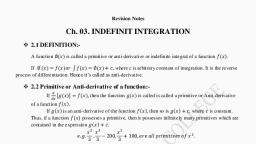
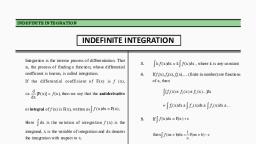
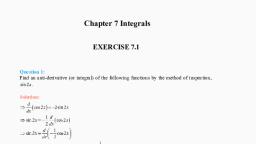
Revision Notes, , Ch. 03. INDEFINIT INTEGRATION, 2.1 DEFINITION:A function, , is called a primitive or anti-derivative or indefinite integral of a function, , ., , If, , where c is arbitrary constant of integration. It is the reverse, ∫, process of differentiation. Hence it’s called as anti-derivative., , 2.2 Primitive or Anti-derivative of a function:If, , [, , ], , then the function, , is called is called a primitive or Anti-derivative, , of a function, If, is an anti-derivative of the function, then so is, where is constant., Thus, if a function, possesses a primitive, then it possesses infinitely many primitives which are, contained in the expression, , Comparison Between Differentiation and Integration:, 1. Differentiation and integration both are operations on functions and each gives rise to a function., 2. Each function is not differentiable or integrable., 3. The derivative of a function, if it exists, is unique., The integrable of a function, if it exists, is not unique., 4. The derivative of a polynomial function decreases its degree by 1, but the integral of a, polynomial function increases its degree by 1., 5. The derivative has a geometrical meaning, namely, the slope of the tangent to a curve at a point, on it., The integral has also a geometrical meaning, namely, the area of some region., 6. The derivative is used in obtaining some physical quantities like velocity, acceleration etc. of a, particle., The integral is used in obtaining some physical quantities like Centre of mass, momentum etc., 7. Differentiation and integration are inverse of each other., , 2.3 Indefinite Integral:, If, , [, , ], , , then the function, , is called the indefinite integral of, , and it’s denoted by ∫, Thus, ∫, , where, , Here, the symbol ∫ is the integral sign,, the differential of, , 1|P ag e, , and, , is any arbitrary constant., , is the variable of integration,, , is the constant of integration., , is the integrand,, , is
Page 2 :
Revision Notes, , 2.4 Theorems on Integration:If, , are two integrable functions of, ∫[, , is a constant, then, , ], ], , ∫[, ∫, , ∫, , ∫, , ∫, , 2.5 Integration Formulae:, i., ii., , ∫, ∫, , iii., , ∫, , iv., , ∫, , v., , ∫, , vi., , ∫, , vii., viii., ix., x., xi., xii., xiii., xiv., , ∫, ∫, ∫, ∫, ∫, ∫, ∫, ∫, , xv., , ∫, , xvi., , ∫, , xvii., , ∫√, , xviii., , ∫, , xix., , ∫|, , (, , (, , )), , (, , ), , |√, , 2.6 Integration by Substitution:, 1. Integrals of the form ∫, If ∫, , :, ∫, , Note That: In any of the fundamental integration formulae given above, if in place of, , then the same formula is applicable and we must divide the obtained answer by ., ∫, , 2|P ag e, , we have
Page 3 :
Revision Notes, , 2. Integrals of the form ∫[, [, , ], , ∫[, , ], , ], , In this type of integral we put, , and convert into a standard integral., , ∫, Solution: Put, ∫, , ∫, , 3. Integrals of the form ∫, , :, , ∫, In this type of integral we put, , and convert into a standard integral., , ∫, Solution:- Put, ∫, , ∫, , 4. Integral of the form ∫, In this type of integral we put, , and convert it into a standard integral form., , [, , ∫, , ], , ∫, Solution:- Put, ∫, , ∫, , 5. Integral of the form ∫, , √, , In this type of integral we put, , ∫, , and convert into a standard integral., , √, , √, , ∫, , √, Solution:- Put, ∫, 3|P ag e, , √, , ∫, , √, , √, , √
Page 4 :
Revision Notes, , 6. Integral of the form∫, In this type of integral we put, , and convert into a standard integral, , ∫, ∫, ∫, , 7. Integral of the form ∫, In this type of integral we put, , and convert into a standard integral, , ∫, ∫, ∫, , √, , 2.7 Standard Substitutions:Sr., No., 1., , Integrand Form, Put, , √, , 2., , √, Put, , √, , 3., , Substitution, , √, Put, , √, , √, , 4., , 5., 6., , Put, √, , √, , √, , √, , √, , √, , √, , √, , √, , √, Put, √, Put, √, , 7., , Put, √, , 8., , √, , √, , 2.8 Standard Formulae:1. ∫, 4|P ag e, , ( ), , √, Put
Page 5 :
Revision Notes, 2. ∫, , |, , |, , 3. ∫, , |, , |, ( ), , 4. ∫, √, 5. ∫ √, , |, , √, , |, , 6. ∫ √, , |, , √, , |, , 7. ∫, , ( ), , √, , 2.9 Integral of the form ∫, , ∫, , ∫√, , √, , :, , To evaluate this type of integrals, we use the following steps:, , Step-1 : Make the coefficient of, , unity, if it is not., , ∫, , √, , √ ∫√, , ∫, √, , Step-2 : Add and Subtract the term ( ), ∫, , ∫, , and, (, , √, , ∫, , √, , √, , ), , (, , ), , ∫, , and, √(, , ), , (, , √ ∫ √(, , √ ∫√, , ), , ), , (, , ), , Step-3 : Use of the suitable formulae to evaluate the integral., :- which can be in any one of the forms ∫, , ∫, , :- which can be in any one of the forms ∫ √, , ∫√, , i.e., , :- which can be in any one of the forms ∫ √, , ∫, ∫√, ∫√, , ∫√, , 1.∫, Solution:-, , 5|P ag e, , ∫, , ∫, , ∫, , ∫, , (, (, , ), , )
Page 6 :
Revision Notes, 2. ∫, , √, , ∫√, , Solution:-, , √, , ∫√, , [(, , ∫, √(, , ∫, √, , √(, , ), , √ ∫ √(, , ), , ), , ], , ), , 3. ∫ √, ∫√, , Solution:(, , ) √(, , [(, , ), , ), , √(, , ), , ], , 2.10 Integral of the form, ∫, , ∫, , ∫, , ∫, , ∫, , To evaluate this type of integrals, we use the following steps:, , Step-1: Divide numerator and denominator both by, Step-2: Replace, , , if any, in denominator, by, , Step-3: Put, After performing these steps, the integral will reduces to the form ∫, ∫, Solution:- let, , ∫, , ∫, , ∫, , ∫, , ∫, Put, ∫, , ∫, , ∫, , ( ), ( ), , 6|P ag e, , :
Page 7 :
Revision Notes, , 2.11 Integral of the form ∫, , ∫, , ∫, , ∫, , To evaluate these type of integrals,, Put, , Also,, And, The above substitution, , reduces the integral to the form ∫, OR, , Integral of the form ∫, , ∫, , ∫, , ∫, , To evaluate these type of integrals,, Put, , Also,, And, The above substitution, , reduces the integral to the form ∫, , 2.12 Integral of the form, ∫, , ∫, , √, , ∫, , √, , To evaluate these types of integrals, we may use the following steps., , Step-1: Express, , Step-2: Find A and B by comparing the coefficient of and constant term on both sides., Step-3: Replace, , in the given integral., , ∫, , ∫, ∫, , 7|P ag e, , ∫
Page 8 :
Revision Notes, ∫, ∫, Solution:- Step-1: Put, , Step-2: comparing the coefficient of, , and constant term on both sides, we get, , and, , Step-3: Replace, , in the given integral, , ∫, , ∫, , ∫, ∫, , ∫, , ∫, , ∫, (, , ), , ∫, (, , ), , √, , (, , ∫, ), , ( ), , (, √ ⁄, , √ ⁄, (, , 8|P ag e, , ), )
Page 9 :
Revision Notes, , 2.13 Integration by Parts:, If, , are two functions of, , ∫, , ∫, , ∫[, , then, ∫, , ], , i.e. The integral of the product of two functions = ( First function)×( Integral of Second function ) –, integral of {(Differentiation of First function)×(Integral of Second function) }, Before applying this rule proper choice of first and second function is necessary. Normally we use the, following methods:, , Rule to choose the first function:, First function should be chosen in the following order of preference:, : Inverse trigonometric function, : Logarithmic function, : Algebraic function, : Trigonometric function,, : Logarithmic function, ∫, ∫, , Solution:, ∫, , ∫(, , ∫, , ), , ∫, , Note That: For the function of logarithmic or inverse trigonometric functions alone, take unity (1), as the second function., , 2.14 Some Special Integrals ∫ √, , ∫√, ( ), , 1. ∫ √, , √, , 2. ∫ √, , √, , (, , √, , ), , 3. ∫ √, , √, , (, , √, , ), , 2.15 Integrals of the form ∫, ∫, , 9|P ag e, , (, , ), , ∫√
Page 10 :
Revision Notes, , 2.16 Integrals of the form ∫, ∫, , 2.17 Integrals of the form ∫, , ∫, , To evaluate these types of integrals, we may use the following steps., , Step-1: Express, Step-2: Find A and B by comparing the coefficient of, , on both sides., , Step-3: Replace, , in the given integral., , ∫, , ∫, , *, , +, , ∫, , ∫, [, , ∫, , ], , 2.18 Integrals of the form ∫, To evaluate these types of integrals, we may use the following steps., , Step-1: Express, Step-2: Find, , by comparing the coefficient of, , and constant term on both sides., , Step-3: Replace, , in, , the given integral., , ∫, , ∫, , *, , +, , ∫, ∫, , 10 | P a g e, , ∫, [, , ], , ∫, ∫
Page 11 :
Revision Notes, , 2.19 Method of Partial Fractions:, 1. Proper Rational Functions: Functions of the form, and, , are polynomial, , are called rational functions of ., If degree of, , is less than degree of, , , then, , 2. Improper Rational Function: If degree of, then, , , where, , is called a proper rational function., is greater than or equal to degree of, , , is called an improper rational function and every improper rational function can be, , transformed to a proper rational function by dividing the numerator by the denominator., , is an improper rational function and can be expressed as, the sum of a polynomial, , and a proper function, , , which is, , ., , 3. Partial Fractions: Any proper rational function can be broken up into a group of different, rational fractions, each having a simple factor of the denominator of the original rational function., Each such fraction is called a partial function., If by some process, we can break a given rational function, denominators are the factors of, decomposition of, , into different fractions, whose, , then the process of obtaining them is called the resolution or, , into its partial fractions., , Depending on the nature of the factors of the denominator, the following cases arise., , Case-1: Denominator is expressed as a non-repeated linear factors:, Rational form, , Partial form, , Case-2: Denominator is expressed as repeated linear factors:, Rational form, , 11 | P a g e, , Partial form
Page 12 :
Revision Notes, , Case-2: Denominator is expressed as product of linear factor and non-repeated, quadratic factors:, Rational form, , Partial form, , Where, further, , 2.20 Integrals of the form ∫, (Where, , ∫, , √, , cannot be factorised, , √, , are linear or quadratic expressions), , 1. Integrals of the form ∫, , ∫, , √, , √, , To evaluate this type of integrals, we put √, ∫, , √, , √, , Or ∫, , √, , √, , ∫, , √, , Solution:- Put √, ∫, , √, , ∫, , √, , (, , ∫, (, , ), , (, , √, , ), , √, , 2. Integrals of the form ∫, , √, , To evaluate this type of integrals, we put, ∫, , √, ∫, , √, , Solution:- Put, ∫, , √, ∫, , √, , √, 12 | P a g e, , ⁄, , ∫, √(, )∫, , (, √, , ), , √, √, , ∫, , |, , |, , )
Page 13 :
Revision Notes, , 3. Integrals of the form ∫, , √, , To evaluate this type of integrals, we put, ∫, , ∫, , √, ∫, , √, , Solution:- Put, ∫, , ⁄, , ∫, , √, , ∫, , (, , √, , √, ∫, , [, , ], ∫, ∫, (√ ), , After solving, we get, √, , 13 | P a g e, , |, , √, , √, , √, , √, , √, , |, , )√, , √, , √