Page 1 :
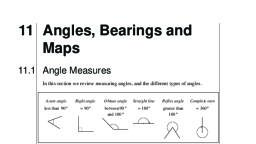
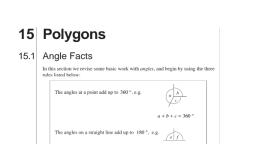
MEP Y8 Practice Book A, , 11 Angles, Bearings and, Maps, 11.1 Angle Measures, In this section we review measuring angles, and the different types of angles., , Acute angle, , Right angle, , Obtuse angle, , Straight line, , Reflex angle, , Complete turn, , less than 90 °, , = 90 °, , between 90 °, and 180 °, , = 180 °, , greater than, 180 °, , = 360 °, , Example 1, Measure the angle in the diagram., , Solution, Using a protractor, the angle can be measured as 35 ° ., , 170 180, 160, 10 0, 150, 20, 30, , 40, , 0 10 2, 0, 30, 180 170 1, 60 1, 50 40, 14, 0, , 0, 14, , 100 1, 80, 10, 70, 90, 80 70 120, 0, 60, 0, 1, 0, 11, 60 130, 50 120, 50, 0, 13, , 35 °, , Example 2, State whether each of the angles below is acute, obtuse or reflex., , A, , B, , C, , 189, , D, , E
Page 2 :
MEP Y8 Practice Book A, , 11.1, Solution, A, , Obtuse as it is between 90 ° and 180 ° ., , B, , Reflex as it is greater than 180 ° ., , C, , Acute, , D, , Reflex as it is greater than 180 ° ., , E, , Obtuse as it is between 90 ° and 180 ° ., , as it is less than 90 °, , Exercises, 1., , 2., , Measure the following angles:, (a), , (b), , (c), , (d), , Measure the following angles:, (a), , (b), , 190
Page 3 :
MEP Y8 Practice Book A, , (c), , (d), , (e), , 3., , (f), , State whether each of the following angles is acute, obtuse or reflex., (a), , (b), , (c), , (d), , (e), , (f), , 191
Page 4 :
MEP Y8 Practice Book A, , 11.1, 4., , (a), , Measure the angles in the triangle below:, , (b), , What is the sum of the three angles?, , (a), , Measure the angles in the quadrilateral, opposite:, , (b), , What is the sum of the four angles?, , 6., , (a), (b), , Without using a protractor, try to draw an angle of 45 ° ., Measure your angle to see how accurate you were., , 7., , (a), , Draw the angle shown in the diagram., , (b), , Measure the acute angle that you also draw., , (c), , Check that the two angles add up to 360 ° ., , (a), , Measure the three angles marked, in the diagram., , (b), , Check that they add up to 360 ° ., , 5., , 8., , 280˚, , a, , c, , 192, , b
Page 5 :
MEP Y8 Practice Book A, , 9., , (a), , Measure the two angles in, the diagram., , (b), , Check that they add up to 180 ° ., y, x, , 10., , (a), , Without using a protractor, try to draw an angle of 300 ° ., , (b), , Check your answer by measuring the angle with a protractor., , 11.2 Parallel and Intersecting Lines, When a line intersects (or crosses) a pair, of parallel lines, there are some simple, rules that can be used to calculate, unknown angles., The arrows on the lines indicate that they, are parallel., , c, , d, , e b, a f, , a = b (and c = d , and e = f ), , These are called vertically opposite angles., , a = c (and b = d ), , These are called corresponding angles., , b=c, , These are called alternate angles., , a + e = 180 ° , because adjacent angles on a straight line add up to 180 ° ., These are called supplementary angles., Note also, that c + e = 180 ° (allied or supplementary angles), , 193
Page 6 :
MEP Y8 Practice Book A, , 11.2, Example 1, , d e, , In the diagram opposite, find the unknown, angles if a = 150 ° ., a c, b, , Solution, To find b:, , a+b, , = 180 °, , (angles on a straight line, supplementary angles), , 150 ° + b = 180 °, , b, , = 30 °, , To find c:, c, , = b, , c, , = 30 °, , (vertically opposite angles or angles on a straight line), , To find d:, d, , = a, , d, , = 150 °, , (corresponding angles), , To find e:, e, , = c, , e, , = 30 °, , (corresponding angles), , a, , 70˚, , Example 2, Find the size of the unknown angles in, the parallelogram shown in this diagram:, , b, , Solution, To find a:, , a + 70 °, , = 180 °, , a, , = 110 °, , (allied or supplementary angles), , To find b:, b+a, , = 180 °, , (allied or supplementary angles), , b + 110 ° = 180 °, b, , = 70 °, 194, , c
Page 7 :
MEP Y8 Practice Book A, , To find c:, , c + 70 °, , = 180 °, , c, , = 110 °, , c, , = 360 ° − ( a + b + 70 °), , or, , (allied or supplementary angles), , (angle sum of a quadrilateral), , = 360 ° − 250 °, = 110 °, or, c, , = a, , (opposite angles of a parallelogram are equal), , Exercises, 1., , 2., , a b, d c, , Which angles in the diagram, are the same size as:, (a), , a,, , (b), , b?, , e f, h g, , Find the size of each of the angles marked with letters in the diagrams, below, giving reasons for your answers:, (a), (b), a, b, 40˚, , b, a c, , 70˚, , (c), , 99˚, a, b, , (d), c, d, , b 110˚, a, , c, , d, , a, , 3., , b, , Find the size of the three unknown, angles in the parallelogram opposite:, 65˚, 195, , c
Page 8 :
MEP Y8 Practice Book A, , 11.2, 4., , One angle in a parallelogram measures 36 ° . What is the size of each of the, other three angles?, , 5., , One angle in a rhombus measures 133 ° . What is the size of each of the, other three angles?, , 6., , Find the sizes of the unknown angles, marked with letters in the diagram:, , 50˚ a 30˚, , b c, , 7., , (a), , (b), , 8., , In the diagram opposite, find the, sizes of the angles marked in the, triangle. Give reasons for your, answers., , d e, , 37˚, a, c, , What special name is given to the, triangle in the diagram?, , The diagram shows a bicycle frame., Find the sizes of the unknown angles, a, b and c., , b, , 143˚, , 46˚, 20˚, , 62˚, , A, 72˚, , 9., , BCDE is a trapezium., B, , 126˚, E, , (a), , Find the sizes of all the unknown, angles, giving reasons for your, answers., , (b), , What is the special name given to, this type of trapezium?, , C, , D, , 196
Page 9 :
MEP Y8 Practice Book A, , 11.3 Bearings, Bearings are a measure of direction, with north taken as a reference. If you are, travelling north, your bearing is 000 ° ., N, If you walk from O in the direction shown in the, diagram, you are walking on a bearing of 110 ° ., Bearings are always measured clockwise from north,, and are given as three figures, for example:, , O, , 110˚, , N, , N, , N, , 240˚, , 60˚, , 330˚, , Bearing 060 °, , Bearing 240 °, , Bearing 330 °, , Example 1, , N, , On what bearing is a ship sailing if it is heading:, (a), , E,, , (b), , S,, , (c), , W,, , (d), , SE,, , (e), , NW ?, , NW, , NE, , W, , E, SW, , Solution, (a), , S, , (b), , N, , 90˚, , N, , 180˚, , E, , Bearing is 090 ° ., , Bearing is 180 ° ., N, , (c), , S, , W, , Bearing is 270 ° ., , SE, , 270˚, 197
Page 10 :
MEP Y8 Practice Book A, , 11.3, N, , (d), , N, , (e), NW, , 135˚, , 315˚, , Bearing is 315 °, SE, , Bearing is 135 °, , Example 2, A ship sails from A to B on a bearing of 060 ° . On what bearing must it sail if it, is to return from B to A?, , Solution, , N, , The diagram shows the journey from, A to B., , N, , Extending the line of the journey allows, an angle of 60 ° to be marked at B., Bearing of A from B = 60 ° + 180 °, , 60˚, B, , = 240 °, and this is called a back bearing or a, reciprocal bearing., , 60˚, A, , Exercises, 1., , 2., , What angle do you turn through if you turn clockwise from:, (a), , N to S,, , (b), , E to W,, , (c), , N to NE,, , (d), , N to SW,, , (e), , W to NW ?, Direction, , Copy and complete the table:, , N, NE, W, SW, 198, , Bearing
Page 11 :
MEP Y8 Practice Book A, , 3., , The map of an island is shown below:, N, , Mine, , Quay, , Church, , Tower, Beach, , Lighthouse, , What is the bearing from the tower, of each place shown on the map?, 4., , 5., , N, , The diagram shows the positions of two, ships, A and B., (a), , What is the bearing of ship A from, ship B ?, , (b), , What is the bearing of ship B from, ship A ?, , N, A, , B, , The diagram shows 3 places, A, B and C., Find the bearing of:, (a), , A from C,, , (b), , B from A,, , (c), , C from B,, , (d), , B from C., , N, , N, , B, N, A, , C, , 6., , An aeroplane flies from Newquay to Birmingham on a bearing of 044 ° . On, what bearing should the pilot fly, to return to Newquay from Birmingham?, , 199
Page 12 :
MEP Y8 Practice Book A, , 11.3, 7., , On four separate occasions, a plane leaves Exeter airport to fly to a different, destination. The bearings of these destinations from Exeter airport are given, below., Destination, , Bearing, , London, , 077 °, , Glasgow, , 356 °, , Leeds, , 036 °, , Guernsey, , 162 °, , N, , Copy and complete the diagram to show, the direction in which the plane flies to, each destination., London, Exeter, , 8., , A ship sails NW from a port to take supplies to an oil rig. On what bearing, must it sail to return from the oil rig to the port?, , 9., , If A is north of B, C is southeast of B and on a bearing of 160 ° from A, find, the bearing of:, , 10., , (a), , A from B,, , (b), , A from C,, , (c), , C from B,, , (d), , B from C., , If A is on a bearing of 300 ° from O, O is NE of B, and the bearing of B, from A is 210 ° , find the bearing of:, (a), , A from B,, , (b), , O from A,, , (c), , O from B., , 200
Page 13 :
MEP Y8 Practice Book A, , 11.4 Scale Drawings, Using bearings, scale drawings can be constructed to solve problems, , Example 1, A ship sails 20 km NE, then 18 km S, and then stops., (a), , How far is it from its starting point when it stops?, , (b), , On what bearing must it sail to return to its starting point?, , Solution, The path of the ship can be drawn using, a scale of 1 cm for every 2 km, as shown, in the diagram., , Scale: 1 cm = 2 km, , A 180˚, , N, 20 km, 18 km, , 45˚, O, , B, , (a), , The distance BO can be measured on the diagram as 7.3 cm which, represents an actual distance of 14.6 km., , (b), , The bearing of O from B can be measured as 285 ° ., , Note: Remember to always put the scale on the diagram., , Example 2, A man walks 750 m on a bearing of 030 ° . He then walks on a bearing of 315 °, until he is due north of his starting point, and stops., (a), , How far does he walk on the bearing of 315 ° ?, , (b), , How far is he from his starting point when he stops?, 201
Page 14 :
MEP Y8 Practice Book A, , 11.4, Solution, , A scale drawing can be produced, using a scale of 1 cm to 100 m., N, N, , B, , Scale: 1 cm = 100 m, , A, 315˚, , 750 m, , 30˚, O, , (a), , The distance AB can be measured as 5.4 cm, which represents an actual, distance of 530 m., , (b), , The distance OB can be measured as 10.2 cm, representing an actual, distance of 1020 m., , Exercises, 1., , 2., , A girl walks 80 m north and then 200 m east., (a), , How far is she from her starting position?, , (b), , On what bearing should she walk to get back to her starting position?, , Andrew walks 300 m NW and then walks 500 m south and then stops., (a), , How far is he from his starting position when he stops?, , (b), , On what bearing could he have walked to go directly from his starting, position to where he stopped?, 202
Page 15 :
MEP Y8 Practice Book A, , 3., , An aeroplane flies 400 km on a bearing of 055 ° It then flies on a bearing, of 300 ° , until it is due north of its starting position. How far is the, aeroplane from its starting position?, , 4., , A captain wants to sail his ship from port A to, port B, but the journey cannot be made directly., Port B is 50 km north of A., The ship sails 20 km on a bearing of 075 ° ., It then sails 20 km on a bearing of 335 ° and then, drops anchor., (a), , How far is the ship from port B when it, drops anchor?, , (b), , On what bearing should the captain sail the, ship to arrive at port B?, , B, N, Sea, Land, , A, , 5., , Julie intended to walk 200 m on a bearing of 240 ° . Her compass did not, work properly, so she actually walked 200 m on a bearing of 225 ° . What, distance and on what bearing should she walk to get to the place she, intended to reach?, , 6., , A hot air balloon is blown 5 km NW. The wind then changes direction and, the balloon is blown a further 6 km on a bearing of 300 ° before landing., How far is the balloon from its starting point when it lands?, , 7., , Robin and Jane set off walking at the same time. When they start, Robin is, 6 km NW of Jane. Jane walks 3 km on a bearing of 350 ° and Robin walks, 4 km on a bearing of 020 ° . How far apart are they now?, , 8., , An aeroplane flies 200 km on a bearing of 335 ° . It then flies 100 km on a, bearing of 170 ° and 400 km on 280 ° , and then lands., , 9., , 10., , (a), , How far is the aeroplane from its starting point when it lands?, , (b), , On what bearing could it have flown to complete its journey directly?, , Brian is sailing on a bearing of 135 ° . After his boat has travelled 20 km, he, realises that he is 1 km north of the port that he wanted to reach., (a), , On what bearing should he have sailed?, , (b), , How far from his starting point is the port that he wanted to reach?, , A pilot knows that to fly to another airport he needs to fly 500 km on a, bearing of 200 ° . When he has flown 400 km, he realises that he is 150 km, from the airport., 203
Page 16 :
11.4, , MEP Y8 Practice Book A, , (a), , On what bearing has the pilot been flying?, , (b), , On what bearing should he fly to reach the airport?, , (Note that there are two answers.), 11., , Four planes take off from Exeter airport, each one flying on a different, bearing to another UK airport. The bearings and the distances from Exeter, to these airports are given in the table below., Destination, , Bearing, , Distance, , London, , 077 °, , 255 km, , Glasgow, , 356 °, , 575 km, , Leeds, , 036 °, , 390 km, , Guernsey, , 162 °, , 150 km, , Using a scale of 1 cm to represent 50 km, draw a map showing the positions, of the five airports., , 204