Page 1 :
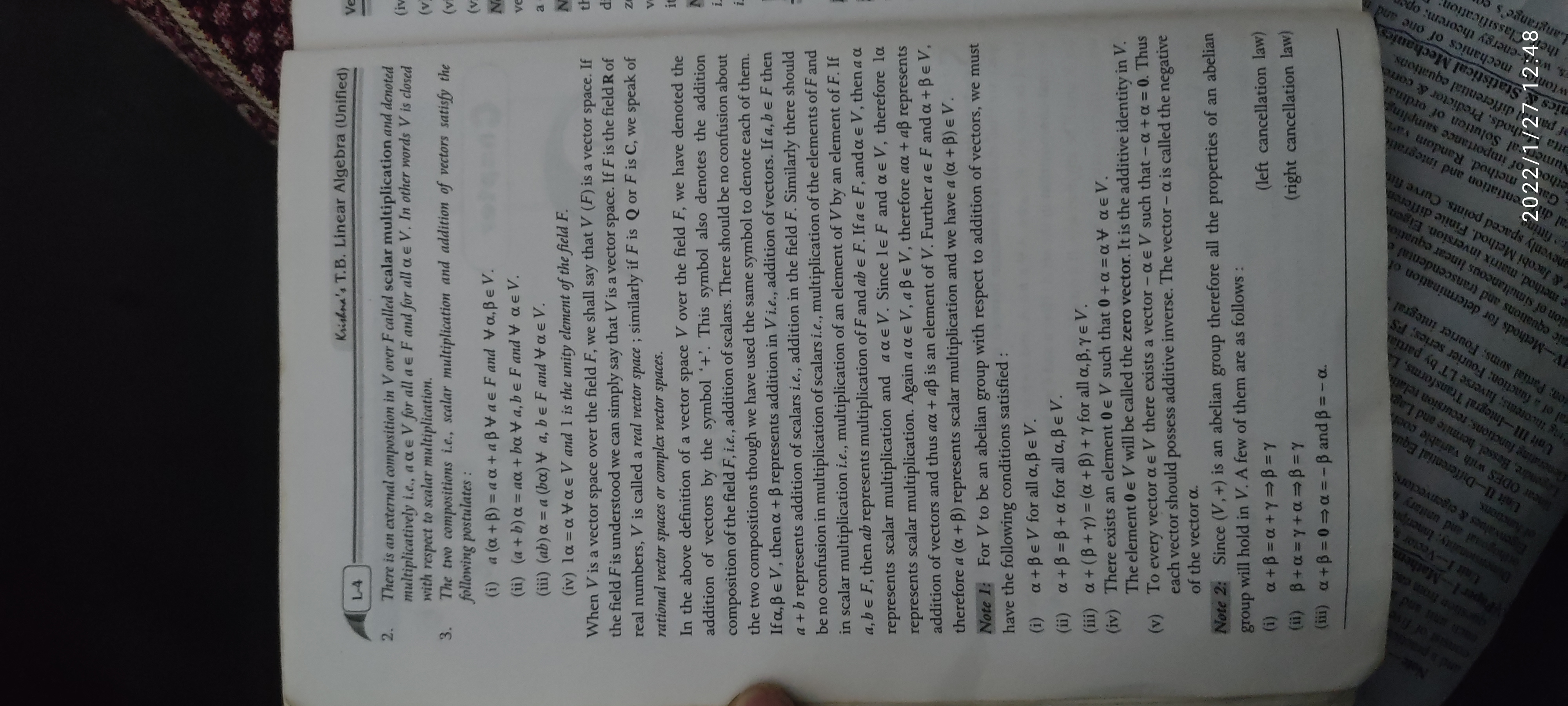
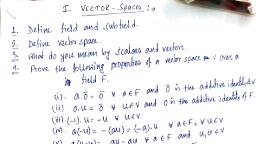
from cac, Matherm, Unit 1-Vector, wenality, Innerip, es&cigenvectors, nctions, Unit I1-Differential Equa, ear ODES with variable coeh, gendre, Bessel. hermite and Lag, enerating functions: recursion relati, Unit III-Integral Transforms,, ng theorems; uverse LT by parti, al of a fuaction: Fourier series;, on; Partial sums; Fourier integral, TV-Methods for determit, ic equations and transe, ion of simultaneous, emethod, matrix inv, & Jacobi Meth, nevenly spaced points. Curve fit, fitting, al di entiation and integratic, Ga method. Random var, etho of importance saimpling, Numerisal Solution of ordina, atta -thods, Predictor & core, of pa differential equatioos., nics & Statistical Mechanies, wton mechanics of one and, s. work-energy theorem; ope, ther oClassification, Langrange's, Krishna's T.B. Linear Algebra (Unified), 2., There is an external composition in V over F called scalar multiplication and denoted, multiplicatively i.e., a ae V for all a e F and for all a e V. In other words V is closed, with respect to scalar multiplication., 3., (iv, The two compositions i.e., scalar multiplication and addition of vectors satisfy the, following postulates :, (i) a (a + B) = a ɑ + a ß ¥ a e F and Va,ß e V., EN, ve, (ii) (a +b) a = aɑ + bɑ V a, be F and ¥ e V., (iii) (ab) a = a (ba) V a, bɛ F and Va e V., (iv) la = a Va e V and 1 is the unity element of the field F., a., When V is a vector space over the field F, we shall say that V (F) is a vector space. If, the field Fis understood we can simply say that Vis a vector space. If F is the field R of, real numbers, V is called a real vector space ; similarly if F is Q or F is C, we speak of, rational vector spaces or complex vector spaces., EP, it, In the above definition of a vector space V over the field F, we have denoted the, addition of vectors by the symbol +'. This symbol also denotes the addition, composition of the field F, i.e., addition of scalars. There should be no confusion about, i-, the two compositions though we have used the same symbol to denote each of them., If a, Be V, then a + B represents addition in V i.e., addition of vectors. If a, b e F then, a + b represents addition of scalars i.e., addition in the field F. Similarly there should, be no confusion in multiplication of scalars i.e., multiplication of the elements of F and, in scalar multiplication i.e., multiplication of an element of V by an element of F. If, a, be F, then ab represents multiplication of F and ab e F. If a e F, and a e V, then a a, represents scalar multiplication and a ae V. Since le F and a e V, therefore la, represents scalar multiplication. Again a a e V, a ße V, therefore aa + aß represents, addition of vectors and thus aa + aß is an element of V. Further a e F and a + BeV,, therefore a (a + B) represents scalar multiplication and we have a (a + B) e V., Note 1: For V to be an abelian group with respect to addition of vectors, we must, have the following conditions satisfied :, a + Be V for all a, Be V., (), (ii) a +B = B + a for all a, Be V., (iii) a + (B+Y) = (a + B) + y for all a, B, y e V., (iv) There exists an element 0 e V such that 0+a = a ¥ a e V., The element 0e V will be called the zero vector. It is the additive identity in V., (v) To every vector a e V there exists a vector - ae V such that - a +a = 0. Thus, each vector should possess additive inverse. The vector - a is called the negative, of the vector a., Note 2: Since (V,+) is an abelian group therefore all the properties of an abelian, group will hold in V. A few of them are as follows :, (left cancellation law), (ii) B+a=y+a =B = Y, (iii) a+B 0 a =-B and B = - a., (right cancellation law), %3D, 2022/1/27 12:48