Page 1 :
ROLE OF BOARD UNIVERSITIES:INTRODUCTION:Higher education is a form of tertiary education. Higher education refers to education being, offered in institutions leading to graduate & postgraduate degrees& institutions preparing, people with higher level skills, knowledge & competencies, , THE ORGANIZATIONAL STRUCTURE OF UNIVERSITIES:, , , Court/ senate., , , , Executive council/Syndicate/Board of management., , , , Academic council, , , , Board of studies., , , , Finance committee., Boards or committees, , THE UNIVERSITY COURT/SENATE:, , It is the supreme governing body of university. In the case of central universities it is, known as COURT, while in cases of state universities it is called SENATE. But it doesn’t, exist in IGNOU. It has about 100 members. It has some ex-officio members, &, representative of various professions/ industries, principals of affiliated colleges,, students, non teaching staff alumni & some teachers, nominated members., , FUNCTIONS:, , Controls the budget of university., , , , Considers the annual reports & passes resolution thereon., , , , Major decision making process., , , , Review the act of university, , , , Examines the role of major bodies of university., , , , Modifies & repeals the statues, , , , Passes ordinate in establishing new colleges, & maintaining new & old one., , , , Supervises the establishment of teaching & administrative posts.
Page 2 :
, , Responsible for conferring degrees., , EXECUTIVE COUNCIL/ SYNDICATE/BOARD OF MANAGEMENT:-, , , , In the central universities, the principle governing body is known as Executive Council & in, state universities it is called as Syndicate/Board of management. It has representative from, both alumni’s principals & the faculty., , FUNCTIONS:, , Manages & regulates finances, accounts, investments, property, business of the university &, all other related administrative affairs., , , , It passes ordinance for the constituents of colleges, & monitors effective management of, these colleges., , , , Regulates & maintains the publication department & university press., , , , It enjoys the power to entertain, adjudicate & redress grievances of the staff of the, university., , , , It also has the power to delegate authority in certain matters of university for the effective, & efficient management of university., , ACADEMIC COUNCIL:, , All the senior officials of the university including Dean & Head of the departments of, studies/ schools are ex-officiating member of Academic council. Students also get, representation on this body in some universities., , FUNCTIONS:, , Responsible to take important decisions on programmes & courses to be offered for the, students., , , , Responsible for the maintenance of the standard of instructions, examination, evaluation., , , , It works as an advisor to the Executive council/Syndicate/Board of management on all, academic matters including the control & management of libraries, laboratories, workshops, etc., , , , Make proposals to the Executive council/Syndicate/Board of management for the, establishment of new departments, colleges, special centers etc., , , , Promote research activity within & outside the university., , , , Recognizes diplomas & degrees of the other universities & appoint committees for, admission of various courses.
Page 3 :
, , It promotes welfare of students., , BOARD OF STUDIES:Universities have Board of studies in different subject disciplines. It consists of the head of, University Departments, representatives of head of departments, in affiliated colleges & of teachers, & co-opted members., Coordinates teaching & research work in departments., Appoints committees to organize teaching & research work in subjects/ areas, Approves the courses of studies., Takes active part in examination & evaluation process., Forwards the research report to academic council., Acts on the matters referred by vice-chancellor, Executive council/Syndicate, Academic, council from time to time., , FINANCE COMMITTEE:, , The vice chancellor is the chairman of this committee. The finance officer of the university is, normally the member secretary of the finance committee., The finance officer prepares annual accounts & financial estimates of the university & lays, it before the finance committee for considerations & comments thereafter submit it to, executive council/syndicate/board of management for approval., The finance officer holds & manages the property & looks into investments., , BOARDS OR COMMITTEES:, , These Boards or committees can have members from the respective statutory bodies or, from outside. The main function of such a committee is to deliberate & make, recommendations on issues assign to it. Board spectrums of responsibilities are assigned to, statutory bodies of the University for its Smooth functioning, , THE UNIVERSITY FUNCTIONARIES:, , The responsibility for the smooth functioning of any institution depends upon its staff. They, are the pivotal links between the public & institute’s authorities.
Page 4 :
CHANCELLOR:In case of central university the president of India (visitor of university) appoints the, chancellor who is elected or nominated by central government. The functions of chancellor, are generally two types: statutory & non-statutory. The statutory functions are normally, laid down in the act of university., , , Non-statutory functions evolve more or less from custom & convention. He/she has the, power of appointing vice-chancellor of the university & nominate members of other, decision making body. He also intervenes in the matters of general administration of, universities & also in academic matters., , VICE CHANCELLOR:Vice chancellor is the lynch pin of a university., He/she is the keeper of the university’s conscience., He/she is the key person of the whole university system., A university is able to function efficiently & effectively to its full objectives on him depends., The term of office of Vice-Chancellor is normally of 5 yrs in case of central universities & 3, yrs in case of state university., , FUNCTIONS ARE:The vice chancellor is the chairman of important statutory bodies of the, university. He/she presides over meetings, controls proceedings & keeps, constant vigil on the discussion in the meetings., He is responsible for the implementation of decisions taken by various, statutory bodies., He/she see the provisions of the Act, statutes, ordinances & regulations., , PRO-VICE-CHANCELLOR OR RECTOR:, , The pro-vice-chancellor or rector is the second executive & administrative officer in a, university., In central universities the P.V.C./rector is appointed by the executive council on the, recommendation of the vice-chancellor & is elected from the senior professors of the, university., , , , In State University, the PVC is appointed by the Chancellor from a panel of names, recommended by Vice-Chancellor. The term of office of PVC/Rector is generally co-terminus, with the Vice-Chancellor.
Page 5 :
, , The PVC/Rector is expected to share the responsibility of Vice-Chancellor. The prime, function is a sort of partnership with Vice-Chancellor to make the whole operation of, university system more effective., , REGISTRAR:, , The next in the hierarchy of university system is Registrar, who traditionally has been the, permanent administrative head of university., , , , He/she must sign all contracts & agreements made on behalf of university. He/she, convenes the meetings of all the bodies as per advice of Vice-Chancellor., , , , He/she is responsible for the annual report on the activities of university., , , , The Vice-Chancellor & the Registrar pull together the greater strength of the university., , DEAN OF FACULTY/SCHOOL:, , THE Dean is appointed by the Vice-Chancellor from amongst the professors of a, faculty/school for 2 yrs., , , , The Dean is responsible for the conduct & standards of teaching & research. He/she, coordinates & supervises these through heads of departments., , , , His/her responsibility is to arrange for the examination. He/she also performs the duties, assigned by Vice-Chancellor, executive council or by academic council., , HEAD OF DEPARTMENT:, , Also known as Chairman of department & is appointed by Vice-Chancellor for a period of, specified in the statutes, on rotation basis., , , , He/she may be from among Professor or Readers in the department. The head convenes &, presides over the meetings of the department under the general supervision of Dean., , , , He/she organizes teaching & research work in the department & is in-charge of maintaining, discipline in the classroom, labs, etc., , , , he/she plan execute & monitor the working of his/her department in the field of teaching,, research & extension activities.
Page 6 :
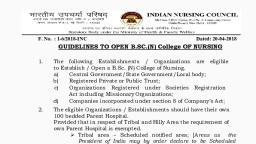
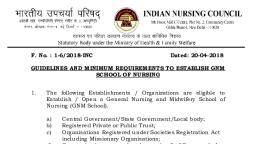
INDIAN NURSING COUNCIL:The Indian nursing council is an autonomous body under the government of India, ministry, health and family welfare. INC Act 1947 enacted by giving statutory powers to maintain, uniform standards and regulation of nursing education all over the country., , Aims and objective of INC, To regulate the training policies and programmers in the field of nursing., To bring about standardization of training course, To prescribe minimum standards of education and training of various nursing, programmes, To regulate these standards in all training institutions uniformly through out the, country., To recognize institutions/organization/ universities imparting degree/bachelors, Degree/P.G diploma/ diploma /certificate courses in the field of nursing, To recognize degree/diploma/certificate courses in the field of nursing, To promote research in nursing, To maintain Indian nurses register for registration of nursing personnel, Training programme., , Functions, To establish and monitor a uniform standards of nursing education for nurses midwife,, and health visitors by doing inspection of the institutions., To recognize the qualification under section 10(2)(4) of the Indian nursing council Act,, 1947 for the purpose of registration and employment in India and abroad, To give approval for registration of Indian and foreign nurses possessing foreign, qualification under section 11(2) (a) of the INC act 1947, To prescribe the syllabus and regulations for nursing programs, Power to withdraw the recognition of qualification under section 14 of the act in case, the institution fails to ,maintain its standards under section 14 (1), To advise the state nursing councils, examining boards, regarding nursing education in, the country.
Page 7 :
State nursing & registration council, The purpose of nursing license is to protect society from unskilled and in competent person, who would practice nursing each state has its own nursing council. Respective state, nursing council has the responsibility to issue license and to ensure maintenance of, standards as laid down by Indian nursing council., , FUNCTIONS OF STATE NURSING AND REGISTRATION:-, , 1., 2., 3., 4., , It helps maintain nursing standards and provide legal protection to nurses., Accredit and inspect schools of nursing in their states., Conduct examination., Maintain registers of graduate nurses, nurses holding degree in nursing, midwives, revised auxiliary nurse midwives or multipurpose workers and health visitors., 5. At reqular intervals inspections of all the associated nursing educational institutions, are held by the state nursing council., 6. All the decisions taken by the state nursing council are approved by the state, government., 7. Renewal of registration helps the council to keep control on the registration, certificates serve a legal proof of registry which denotes that nurse is still in active, practice in the profession.
Page 8 :
BIBLIOGRAPHY:Rao racheal 2002 “ward management for nurses”(first edition) Mumbai Vora Medical, Publications Page number 129-133., , Samant kusum 2003 “hospital ward management” (first edition) Mumbai Vora medical, publications Page number 60., , TNAI 2001 “History and Trends in nursing in India” (first edition) New Delhi Trained, Nurses Association of India Page number 265., , TNAI 2000 “Hand Book of the Trained Nurses Association of India” (thirteenth edition), New Delhi The Trained Association of India Page Number 125.