Page 1 :
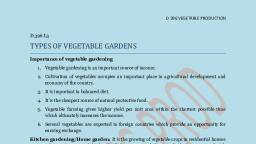
J 1061 FUNDAMENTALS OF VEGETABLE PRODUCTION, , J 1061 UNIT I EL3, , TYPES OF VEGETABLE GROWING, Importance of vegetable gardening, 1. Vegetable gardening is an important source of income., 2. Cultivation of vegetables occupies an important place in agricultural development and, economy of the country., 3. It is important in balanced diet., 4. It is the cheapest source of natural protective food., 5. Vegetable farming gives higher yield per unit area within the shortest possible time, which ultimately increases the income., 6. Several vegetables are exported to foreign countries which provide an opportunity for, earning exchange., Kitchen gardening/Home garden: It is the growing of vegetable crops in residential houses, to meet the requirements of the family all the year around. Every individual is concerned with, home or kitchen garden. Irrespective of the fact that the individual is a villager, a city dweller,, live in town. Kitchen garden should be a future of his home., Importance:, 1. Efficient and effective use of land for growing essential vegetables for use of family., 2. Saves some money as vegetables are quite costly in the market (fresh vegetables)., 3. Play important part in vegetable production., 4. Constitute a very healthy hobby and the spare time of the family is well utilized., 5. Kitchen gardening should be aimed at giving a continuous supply of vegetables to a, family throughout the year., 6. Pesticide residue free vegetables (health point of view)., 7. Training/education of children and to develop a sense of co-operation., Design of Kitchen Garden: Design of kitchen garden depends upon the character of the, particular piece of land, its extent, situation etc., The following principles should be followed in designing the layout of kitchen garden, •, , Location and site, , •, , Proper layout, , •, , Cropping pattern, , •, , Size 25 x 10 m for family of 5 persons., , Dr R Chandra, Assistant Professor, Department of Horticulture, Amar Singh College, Lakhaoti, Bulandshahr
Page 2 :
J 1061 FUNDAMENTALS OF VEGETABLE PRODUCTION, , •, , Shape should be rectangular and South east aspect is the most preferred for having more, sun light., , ➢ For kitchen garden land should be selected in the backyard of the house (easier to work, & make use of kitchen waste water., ➢ Layout of the garden should be such that it looks attractive and allow access to all the, parts., ➢ The land should be laid out in small plots with narrow and path borders., ➢ In homes where no space is available one can grow vegetables in pots or boxes., Preference should be given to such vegetables which produce more number of fruits from, an individual plant e.g. cucurbits, tomato, brinjal, chilli etc., ➢ Climbing type vegetables like cucurbits, pea beans etc. can be trained on the fences., ➢ Several sowings of one particular crop at short intervals should be done to ensure a, steady supply of vegetables., ➢ Quick growing fruits trees like papaya, banana, lime etc. should be located on one side of, the garden, preferably on Northern side so that there shading effect on the vegetables is, on minimum side., ➢ Ridges which separate the beds should be utilized for growing root crops like radish,, turnip, beet, carrot., ➢ Early maturing crops should be planted together in continuous row so that the areas may, be available for putting next crop., ➢ The inter-space of some crops which are slow growing and take long duration to mature, like cabbage, cauliflower, brinjal should be used for growing some quick growing crops, like radish, turnip, palak, lettuce., Market Gardening /Peri-urban vegetable farming: Peri-urban farming is known for its, important role in providing self-employment besides enhancing the food security, helpful in, poverty alleviation, waste management, community resource development and environmental, sustainability., ➢ This is a type of garden which produces vegetables for local market., ➢ This type of garden was confined to the near vicinity of the cities when a quick transport, was not developed., ➢ Most of the market gardens even today are located within 15-20 km of a city., ➢ The cropping pattern of these gardens will depend on the demand of the local market., ➢ The most important consideration is to develop a clearly focused marketing plan before, any vegetable crops are planted., ➢ The land being costly, intensive methods of cultivation are followed., ➢ A market gardener will like to grow early varieties to catch the market early., ➢ He should be good salesman as he may have to sell his own produce., Dr R Chandra, Assistant Professor, Department of Horticulture, Amar Singh College, Lakhaoti, Bulandshahr
Page 3 :
J 1061 FUNDAMENTALS OF VEGETABLE PRODUCTION, , ➢ He must be a versatile person as he will have to grow a number of vegetables throughout, the year., ➢ The high cost of land and labour is compensated by the availability of municipal, compost, sludge and water near some cities and high return on the produce., The preference of Indian consumers is mainly to have fresh and lush green vegetables and least, for processed products. This provides a business opportunity to the growers living nearby the, big cities or towns, generally referred as peri-urban areas to meet the requirement of consumers, and earn higher profit. This production system focussing nearby big cities is also called as, market gardening. Thus, peri-urban vegetable cultivation provides the possibility to cultivate a, small piece of land on commercial line to generate income to meet the basic needs of a family., Large quantity of solid waste is generated in cities during handling and marketing of fresh, vegetable produce and otherwise also which in general creates health and environmental, hazards. This can be recycled to produce manure for use in organic vegetable production., Many farmers try to maximize their income by selling directly to consumers, thus bypassing, wholesalers and other middlemen. Common marketing strategies can be adopted such as, farmers stall in weekly vegetable market, roadside stands and sale agreement to restaurants,, modern retail stores. Sometimes, organically grown vegetable produce in general get higher, prices in the market. So, farmers may go for raising vegetable crops organically., Considering the high cost and small size of farm land in the vicinity of a city and high cost of, labour, water and energy, it is necessary for the farmer to have high productivity per unit area., Diversified crops are grown in peri-urban vegetable farms which also include specialty, vegetables like red and yellow coloured sweet pepper, cherry tomato, broccoli, Brussels sprouts,, baby corn, sweet corn, gherkin, leek, bunching onion, celery, parsley, chive, pak-choi, asparagus,, artichoke etc. The specialty vegetables are becoming popular to meet the demands of, consumers, restaurants and hotels in big cities., The other important considerations are choice of vegetables adapted to soil and climatic, conditions, facilities of labour, water for irrigation and transport, proximity to market, and, preferences of market and consumers. It is often profitable to have intercropping, succession of, crops, relay cropping, mixed cropping and early maturing cultivars for continuous supply and, for obtaining high price by bringing early produce in the market. Peri-urban production is either, fast diminishing or moving farther from the city because of expansion of urban areas., Truck Gardening:, This is a type of garden which produces special crops in relatively large quantities for distance, markets., ➢ Truck gardens, in general, follow a more extensive and less intensive method of, cultivation than market garden., ➢ The word truck has no relationship with a motor truck but it is derived from French, word „troquer‟ means “to barter”., ➢ The location of this type of garden is determined by the soil and climatic factors suitable, for raising a particular crop., Dr R Chandra, Assistant Professor, Department of Horticulture, Amar Singh College, Lakhaoti, Bulandshahr
Page 4 :
J 1061 FUNDAMENTALS OF VEGETABLE PRODUCTION, , ➢ The commodities raised are usually sold through middle man., ➢ The truck gardener should be a specialized person., ➢ He should be proficient in large scale cultivation and production and handling of some, special crops., ➢ He follows the mechanical method of cultivation hence cost of cultivation is less., ➢ The net income is also less as this includes the cost of transport and the charges of, middle men., ➢ With the development of quick and easy transport system, the distinction between, market and truck garden is continuously diminishing., Vegetable Gardens for Processing:, ➢ These gardens come up around vegetable processing factories., ➢ Mainly responsible for regular supply of vegetables to factories., ➢ Emerging more rapidly now in India with the establishment of processing industries by, corporate sector., ➢ Earlier only a few factories existed which were dependent upon purchases from local, markets., ➢ The end product from such local factories was not good from such a heterogeneous, mixture., ➢ The prospects of future development are quite bright as people‟s interest in the, processing industry is growing., ➢ These gardens specialize in growing only a few vegetables in bulk., ➢ A heavier soil is chosen to obtain high and continuous yield rather than early yield., ➢ These gardens are required to grow particular varieties for canning, dehydration or, freezing., ➢ The prices are paid on contract basis on weight and quantity of the produce., ➢ The return may be low but the cost of marketing and the transport charges are negligible., Vegetable Forcing:, In the method known as forcing, vegetables are produced out of their normal season of outdoor, production under forcing structures that admit light and induce favourable environmental, conditions for plant growth. Greenhouses, cold frames, and hotbeds are common structures, used. Hydroponics, sometimes called soilless culture, allows the grower to practice automatic, watering and fertilizing, thus reducing the cost of labour. To successfully compete with other, fresh market producers, greenhouse vegetable growers must either produce crops when the, outdoor supply is limited or produce quality products commanding premium prices., , Dr R Chandra, Assistant Professor, Department of Horticulture, Amar Singh College, Lakhaoti, Bulandshahr
Page 5 :
J 1061 FUNDAMENTALS OF VEGETABLE PRODUCTION, , Tomato, cucumber and capsicum are commonly grown vegetables under these structures. These, are mostly used during winter in the temperate regions. These crops cannot be grown without, protection for their availability throughout year., In India this type of garden has very little chance to develop because the country being so large, and transport facilities becoming advanced, all vegetables can be grown normally throughout, the year in one or the other part., River bed cultivation is a type of vegetable forcing i.e. growing of summer vegetables on river, beds during winter months with the help of organic manures and wind breaks of dry grass., Sometimes, for early produce seedlings of tomato, brinjal, bell-pepper, chilli and cucurbits in, poly-bags are forced to germinate in small protected structures., Different kinds of vegetable forcing:, Protected Cultivation:, It refers to agriculture with human interventions that create favourable conditions around the, cultivated plants offsetting the detrimental effects of prevailing biotic and abiotic factors. Plants, in open field conditions experience short cropping season, unfavourable climatic conditions (too, cold, too hot, too dry and cloudy ambient) impairing photosynthetic activities, vulnerable to, predators, pests, weeds, depleted soil moisture and plant nutrients. In protected agriculture one, or more of these factors are controlled or altered, to the advantage of plants, where usually, factors such as temperature, C02 concentration, relative humidity, access to insect and pest etc.,, are controlled to desirable limits. The factors controlled and range of control is decided by, devises chosen and fitted on the structure. For economic reasons, protection or control is, provided against the most significant stresses. Structures and environment control measurers, employed separate this cultivated space and allowing cultivation in unfavourable ambient, conditions in reasonably close to optimal conditions., Advantages of protected cultivation:, •, , Crop production with high productivity under unfavourable agro-climatic conditions., , •, , Productivity levels could be significantly higher (sometimes two-three times of that in, open field agriculture)., , •, , Quality of produce is usually superior because of isolation and controls., , •, , Higher input use efficiencies are achieved in the production of plant and animal, products., , •, , Income per unit area significantly increases., , •, , Year-round production, , Production of crops under protected conditions has great potential in augmenting production, and quality of vegetables, in main and also during off season and maximizing water and nutrient, use efficiency under varied agro climatic conditions of the country. This technology has very, good potential especially in peri- urban agriculture, since it can be profitably used for growing, , Dr R Chandra, Assistant Professor, Department of Horticulture, Amar Singh College, Lakhaoti, Bulandshahr
Page 6 :
J 1061 FUNDAMENTALS OF VEGETABLE PRODUCTION, , high value vegetable crops like, tomato, cherry tomato, coloured peppers, parthenocarpic, cucumber, healthy and virus free seedlings production in agri-entrepreneurial models., Off season vegetable cultivation under walk-in-tunnels, Walk in tunnels are the temporary structures erected by using G.I. pipes and transparent plastic., Walk in tunnels are used for complete off season cultivation of vegetables like bottle gourd,, summer squash, cucumber etc. during winter season (Dec.- mid February) the basic objective, and utility of walk in tunnels is to fetch high price of the complete off season produce to earn, more profit per unit area. The ideal size of a walk in tunnel of 4.0 m width and 30m length (l20, m2) and total cost of fabrication may be Rs.12000-14000/-., Vegetable Gardens for Seed Production:, Good seed is the base of any successful farming industry., Seed production is a specialized field of vegetable growing., A thorough knowledge of the crop, its growth habit, mode of pollination, proper isolation, distance are of prime importance for quality seed production., Specialized knowledge is required to handle the seed crop i.e. curing, threshing, cleaning,, grading, packing and storage., Types of seeds:, 1. Nucleus/breeder seed is produced by the person or organization which gives out the, variety., 2. Foundation seed is multiplied by government departments or by organization like NSC., 3. Certified/Registered seeds usually multiplied by grower., This is an expanding industry in India and has a good future., India has varied climatic conditions extending from the temperate Himalayas to tropical South, where all the vegetable seeds can be profitably grown., There is an immense potential for exporting seeds to foreign countries, To expand foreign trades in this industry, the quality of seed produced must be raised., The seed act was enforced to maintain the quality of the seed, Floating Vegetable Gardens:, One more type of vegetable garden known as floating garden is seen on the Dal lake of Kashmir, valley. Most of summer vegetables are supplied to Srinagar from these gardens. A floating base, is made from the roots of typha grass which grow wild in some parts of lake. Once this floating, base is ready, seedlings are transplanted on leaf compost made of vegetations growing wild in, the lake. All the inter-cultural operations and occasional sprinkling of water are done from, boats. This type of vegetable cultivation is a specialized technique and an art itself., Organic Vegetable Gardening, , Dr R Chandra, Assistant Professor, Department of Horticulture, Amar Singh College, Lakhaoti, Bulandshahr
Page 7 :
J 1061 FUNDAMENTALS OF VEGETABLE PRODUCTION, , In 1980, organic farming was defined by the USDA as a system that excludes the use of synthetic, fertilizers, pesticides, and growth regulators., Approaches and production inputs of organic farming, 1. Strict avoidance of synthetic fertilizers and synthetic pesticides, 2. Crop rotations, crop residues, mulches, 3. Animal manures and composts, 4. Cover crops and green manures, 5. Organic fertilizers and soil amendments, 6. Biostimulants, humates, and seaweeds, 7. Compost teas and herbal teas, 8. Marine, animal, and plant by-products, 9. Biorational, microbial, and botanical pesticides, and other natural pest control products, 10. The Organic Foods Production Act, a section of the 1990 Farm Bill, enabled the USDA to, develop a national program of universal standards, certification accreditation, and food, labeling., 11. In April 2001, the USDA released the Final Rule of the National Organic Program. This, federal law stipulates, in considerable detail, exactly what a grower can and cannot do to, produce and market a product as organic., Container gardening:, In urban areas mainly in big cities, land is a big constraint for home/kitchen garden,many types, of vegetables can be grown well in containers and space available in backyard, terrace, varandah,, balcony can be utilized for this purpose where sunshine is easily available. Start with large, enough pots. The 14 inch pots are plenty large for brinjal and cucumber and the 20-inch pots, worked out well for tomatoes. Generally we should grow those vegetables which facilitate, multiple harvests like tomato, leafy vegetables etc. instead of single harvest like cabbage or, cauliflower etc., , Dr R Chandra, Assistant Professor, Department of Horticulture, Amar Singh College, Lakhaoti, Bulandshahr