Notes of B.Sc. Med 3rd, Inorganic Chemistry Cordination Compounds.pdf - Study Material
Page 1 :
2, Coordination Compound, o f the most important characteristies of transition elements is that, they, CmComplexes or coordinatlon compounas. These compounds play a vital role, , have ability, , lives, nhyll (Mg-complex) in plants and haemoglobin (Fe-complex) in the blood ofour, animals, o mast important coordinat1on compounds. The importance of these, ar, compounds can be, , o, , in, , alised from, , the fact that life would not have been possible without their, existence. In these, naunds the central metal atom or ion is surrounded by a group of ions or molecules. These, compo, are, , known, , as, , coordination compounds, , or, , complexes., , These, , applications in important area such as:, (i) treatment of water, (ii) plant treatment, , compounds have, , many practical, , on_ute, , (ii) Electroplating, , (iv) Analysis of trace elements, Lewt 20), (v) Protection of surfaces of matals, Further researches in the field of coordination compounds have, (i) brought revolution in industrial chemistry, (i) provide valuable in sights into functioning of components of biological system, , ii) provide new concept of chemical bonding etc., , Coordination Compounds, These compounds are formed by the donation of pair of electrons by the molecules of ligands, to, , the central metal atom, , or, , ion., or, , or example : When aqueous solution of ammonia is added to a green soluton, loride (NiCI,), the colour ofsolution changes to purple. The purple colour is due to formatio, ofN, , to green soluo, x, INE(NH)]Cl, During the addition of aqueous solution of ammonia, molecules form assoCiated, , Ammonia, , almost disappear from the solution., known as complex, product wit 1ons, 10n forming a n e w species of composition, | Ni(NH,),|2*, E, 1on. The, called as coordinat, solution, on evaporation, give purple crystal of |Ni(NH,),1OCl,, ution, Compo, evapo, , Cpounds or complex, , compound., , (95)
Page 2 :
96, , LAXMI, , Text, The ormation, of, , Book Series, , complex compound can be depicted as, NiCl, +6NH, - INi(NH,), Cl2, , Coordination complex, In aqueous, solution, the complex compound ionises as, , +, , Ni(NH)JC,HO Ni(NH+201, Complex ion, The species, , formed is known as complex ion. It does, |Ni(NH,),*t, solution. It remains, not ionise in, as a, single species., queo, Similarly, the formation of complex, can be, , [Ag(NH,),JCI,, AgC, [Ag(NH,),]+C, Silver, chloride+2NH,, , depicted as,, , -, , Soluble Complex, , Ag(NH),, , I CI, diammine silver (1) Chloride, , Difference between double salts, The double salts, , |Ag(NH,)+C, Complex ion, , and, , coordination compounds, , different from the coordination, compounds., Double salts. are the addition or, molecular compounds which, solution of two or more simple, are formed, when aqueous, salts are mixed with, stable, The, each, proportion. solution on evaporation, other in a, simple molecular, gives crystals of new, The formation of double, compounds, known as double salt, salts given as, , KC+, , are, , MgC,+6H,0, , K,SO+AlSO),, , +, , 24HO, , FesO, +(NH), S0+, Double salts, , on, , -, , MgCIL,, carnalite 6H,O, , K,SO, Al,(S0), 24H,O, potash alum, , 6H,0, , FeS0,tNH),SO, -6H,O, , dissolution in water,, , Carnalite, KCI., , example : Carn:, , KCI, , -, , of these ions (K", Mg* andMgCl,., C), , Mohr's salt, , ionizes, , They, dissolutioncompletely., in water, gives 1lose their identity. For, characteristics reactions, actions, KCL.MgCI,26H,0Lo, -K* +3C+ Mg?, , other hand,, , On the, the, At least complex;ion retain, , -K, , coordinate, , their, , KAgCN)J- H,O, , 6H,O on, , +3Cl + Mg, , compound not ionise, individual, characteer., completely in, , -|Ag(CN),t, Complex ioa +K*, , aqueous solutio
Page 3 :
The main, The main, , inorganic Chemistry [B.SC.I (Semester-ll), , of dif, difference between double salts and, point, point of, coordination, , Double 8alt, , Double salts exists only, , 1., , Coordination Compound, in solid state, , 1, , Coordination, state, , They ionises completely, , 2., , in aqueous, , 2., , solution, , in, , aqueous solution, , Double salts contain ionic bonds, In double salts the metals ions show, , 5., , as, , They, , well, , are, , compounds exists in solid, as, , in aqueous, , not ionize, , acqueous phase, , Double salt loses their identity, , 3., , compounds giver, , phase, , completely in, , 3, , Coordination compounda do not loses, their identity in aqueous solution, , 4, , They contain ionic as well as coordinate, , bonds, 5., , normal valency., , In coordination, compounds the valency, of metal is found to be differ, depends, upon the no. of ligands attached with, , central metal atom or ion., The properties of double salts are, , 6, , same as those of individual salts., , 6., , The properties of, are, , different, , coordination compoun, those of individual, , as, , constituent compounds, , Terminology of Coordination Compounds, Before further studied, it is necessary to explain some basic terms used in the study of, coordination compounds., , These are discussed as., , 1. Ligands: The word ligand' is derived from Latin word ligare meaning'o bind', The ligands are the neutral molecules or ions (cations and anions) which are, directly linked with the céntral metal atom or ion in a complex or comple, the, The attachment of ligands molecules to the central metal atom or ion occur through, , formation of coordination bond or dative bond., more pairs of electrons to the, The molecule of ligands act as donor as it donate one or, the, metal atom act as electron pairs acceptor. Thus,, central, The, ion., or, metal, atom, central, lewis, acid., the central metal atom or ion act as, as lewis bases while, act, molecules, ligands, atom or ion by the, metal, central, the, electron to, For examples : Donation of pair of, molecules of ligand given as, Metal, , Ligand, HN:+, , M:, , HN, , >Coordinate, bond formation, , M, , of electron, because it donate a pair, as ligand, act, molecule, the, ammonia, formation, In this reaction, the, coordinate, the, For, bond,, atom, form coordinate, to the central, central metal atom and, can donated, which, electrons, energy, should have pair of, orbital or nearly equivalent, Oecule of ligands, should have vacant, atom, while central metal, atoms, , of, , ne, , *0,, , o, , or ion, , electrons donated, , accomodate the, Ligands, ype of ligands:, , present in them., , are, , by the ligands., , on the, of many types depending, , bond,, metal, , number of donor
Page 7 :
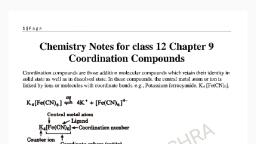
Inorganig, , numbern of central metalChemistry (B.80-1 (emester, 2., 1l)} |, atom or on in a, number of cmplexe, Table 2. C.No. of, »ome, complax lons, Complex/ Complex lon», C.No. of Complexes, ArCN,, CNo. of, Zn CN),, Ag' -2, , ber. The coordinati, ation, an, , in, , T'able, , PICI, , CNo.of Zn4, , FeC,0),1, , C.No. of P*4, , C.No. of Fe, C.No. of Co6, C.No. of Pd" 4, , Co(NH,),I, PdCl,1, |FelCO),|, , =, , C.No. of Pe =6, , Ni(CO),|, , C.No. of Ni4, , |CrCO),, , C.No., , Pt(NH,),Ci,|, , of Cr -6, , C.No. of P = 4, The most common coordination no., A few cases coordination number exhibited by metal atoms or ions are 2, 4 and 6. However, of 3, 5,7,8, 9 and 12 also exist., 3., sphere or counter lon :, ligands that are directly attached to it are enclosed inThe central metal atom or ion and the, bracket [I, together constitute as, sphere, while the ions present outsidesquare, the, sphere are called as counter ions., For example: Consider, a, K,, complex,, In, this complex, the metal iron, cvanide ion enclosed in square bracket called as, and, coordination sphere while K ions, side the coordination sphere are called as counter ion, present out, , Coordination, eoordination, , |Fe(CN),|., , KFeCN), , 4K, , *****"*****.., , FelCN), , Counter, , Coordination, , ions, , sphere, , 4. Oxidation Number or Oxidation state, of Central atoms: It is the charge carried, Dy the central metal atom., of, the, Knowing charge complex ion, the oxidation state of the central, , etal atom can be calculated by the use of relation-charge on the complex ion- oxidation, Bumber of metal, ion+charge on ligands., Or ezamples: Cu(NH,,1*, in this complex ion the charge carried by the Cu ion is,, , 2.charge, The charge carried by the molecules of NH, is equal to 0. The charge carried by the Cu-ion, can be, calculated as, Cu(NH,),1*, x +0x4 = + 2, ion can be calculated, , on the central metal, ilarly,, charge pre, ) DCharge, For Complex, present, [P(NH,),C,|. charge present on NH,=0, Cl = -1 etc., , atom or, , x+0 x 2-1x, , 2, , =, , x-2 0, , as-, , 0, , f o (-IKi):0
Page 8 :
tc, 0, C l = - 1 e, etc., , 102 LAXMI, (1), , -1, Text Book Series, 0, Cl=, 0,, =, NH,, on, For complex, |Co(NH,)CI, chargepresent, =, , 2, , e, , e, , n, , t, , r+0x6-1, * 6 - 1 = +2, -, , 1 = +2, +1+2, CO, , 3, , m, , o, , l, , e, , c, , u, , l, , =, , 0, , etc., , e, , on, p r e s e n t, , (ii) For complex |CrCO),I, charge, , - 1,, 1,I, I.=., B =, , 1+0x6 = 0, , -, , F = - 1 , d = - 1 ,, , on, present, , charge, , ( ) For complex,, , |PrBrKCIXFX)I,, , p, , 0, , etc., , =, 1 - 1r --1, 4 = 0, , r-1-, , - 2, , r complex, (v) o, For, complex -K,, , |Fe«C,O,),1,, , chargepresent, , :In, polyhedron, , with the, , Coordination, , central metal, , atom, , o r ion, , in, , C,0,, , etc., , the, , sphere,, coordination, , directions, , in, , giving a, space, , Or, arrangement, , the, , ligands, , a r e attache, , definite, , of ligands, , around, , the, , central, , definite geometric, , coordination polyhedron., , metal atom, , tetrahedral,, form such as, , complex ion o c t a h e d r a l etc., , or, , bipyramidal, , and, , planer, trigonal, tetrahedral, For examples:, Ni(CO),| is, of, |, geometry, i) The, square planer, of |Ni(CN),|2*is, geometry, (i) The, is trigonal bipyramidal, |FelCO),|, (ii) The geometry, octahedral., , of, , of Pt(CI,)|*is, (iv) The geometry, of complexes given, The different geometries, , |, , as, , in, , fig-8., , M, , M, , Tetrahedral, , t, , called, or ion is, , possesses, , The complex, , geometr., , definite, , the complex ion., The spatial, , +1,, , x3-2 x3, r+3-6 = 0, , 3, 5., , K=, , 0, , =, , r+1, , on, , Square planer, , Trigonal, , Octahedral, , bipyramidat, Fig. 8. Geometries of some complexes or compler ions., , as, , squae
Page 9 :
r-W))10, of chargen, , (Semester-, , Inorganic Chemistry (B.Sc.-I, on, 6. Charge, complex ion : The charge on complex ion is the R, rried by the central metal ion and the ligand attached with it., , gum, , ca, , For example: The charge carried, , on, , the, , |*, , PrC,, 1. Then charge on the complex is, , the Pt is, +2 while on CI, is -, , on, , complex, , can, , be calculated rA char, , +2-1x4 - r, +2-4, , -2, Thus, charge on the complex ion is, - 2., , Similarly, charge carried by the complex |FelCN),|""is given as, Charge carried by the,, , Charge carried, , Fe, , by the,, , +2, , CN=-1, +2-1x 6 = *t, , +2-6 x, -2, the complex is, 2., Thus, charge carried by, of, complexes, to only one kind, 7. Homoleptic and Heteroleptic, or ion bound, atom, metal, a, in which, homoleptic, Homoleptic complexes: Complex, complex, |PrCi,|*is, The, example:, known as homoleptic complexes For, ions., Pt bound to only C,, ligands is, element, the, complex,, this, because in, -, , complex,, , examples, Similarly,, |Hg1,1* and, other, , of homoleptic complexes, , |Fe(CN), I* ete., , are, , IP4CI,|* |Pt(NH,),|, than, bound to more, , one, , metal, orion, |PINH,,C,|, Complexes in which, complexes, Heteroleptic complexes:, example:, The, For, ions., complex., bound to NH, and C, is called as heteroleptic, Pt, element, kinds of lignads, because in this complex, |Co(NH,),CZ,|, complexes,, 1CoCl,len),|'., heteroleptic, are, is, complex, heteroleptic, examples, Similarly, other, etc., and |P{NH,),CI(Br), , CutNH,),1, , atom, , -, , of, , Felen),(C,O)I",, , 8. Mononuclear, Mononuclear, , and, , |, , polynuclear, , complexes, , Complexes with, complexes :, , one, , C, , ion is called, , atom or, central metal, because in this, , is monuclearcomplex, , complex, , |Cr{CO),|,, For example, mononuclear complexes. metal atom (CP), metal atom is present, one central, m o r e thanonecentral, there, which, only, polynuclear, is, Complexes in, |Co,(CO),| is, complex, complexes:, The, Polynuclear, are, Co)., , For example:, complexes., is, as polynuclear, number, metal atom equal, the, arecalledbecause, in this complex,, , of, , to, 2 (Both, , atoms, , complex,, , Werner's Theory of, , Coordination, , Compounds, forward, , to, , explain the, , structure, , put, work of Alfred, the brilliant, to, credit, goes, A number of, compounds., The main, compounds., in c o o r d i n a t i o n, coordination, bonding, the, known as, bonding of, successfully explain, which is commonly, Werner, theories, , by different, , scientists w e r e, , nd, chemistry, Alfred, awarded, Werner was, eDer, in 1893,, foundation of coordination, field,, this, the, in, work, laid, of his, Theory which, In recognisation, theory a r e thefollowings., theory., Werner's, ation, postulates, coordin, of, basic, er's, in 1913. The, N o b l e prize in, , chemistry
Page 10 :
04 LAXMI, , Book Series, Every metals exhibits two, types of valancies, valancies, secondary, valency., The, , 1., , Text, , known, , as, , rimary, , valency a, , primary valency is ionisable where as the secondary valency is non ionis, refers to the oxidation state ofisable., or ion terminology, the primary valency, an a, while secondary, ination number. Fig, aton, valency correspona, 9., NH, , modern, , >Primary, valency, , NH, , valency, , NH, , Cr-, , NH, , Secondary, , HN, --, , NH, , Fig. 9: Geometry represents the primary and secondary valenciea., , For examples: In complex, |Cr(NH),1*ion. The oxidation state of Cr is +3i, called its primary valencey while the central Cr ion is surrounded by six moleci, , of, NH, ie., the coordination no. of Cr ion is, 6, hence called is secondary valene, 2., , Every metal atom has a fixed number of secondary valencies is called its coordination, , number. For example: In the given complex, the secondary valencies, of Cr ion is 6, hence called is its coordination number., The metal atom tends to satisfy both its primary and, secondary valencies., valency ofmetal in a complex compound is always satisfied by anions e.g. the Primary, primary, valency of Cr in the given, to, +3, and, is, is, satisfied by, 3 Cl ions. While secondary valencies, satisfied, , |Cr(NH|3*ion,, , 3., , complex, |Cr{NH,)C equal, , either by negative ion or neutral, are, molecules., he primary valencies are, non directional where as secondary valencies are, directional. To satisfy the secondary, the molecules of ligands are directed, towards specific direction in space andvalencies,, this lead to definite, geometry of a coordination, compound. For example, if a metal has four, in either, square planer or tetrahedral secondary valencies, these are arranged, arrangement around the central metal ion., Ifa metal ion has six, secondary, valencies, these are arranged octahedrally around, the central metal ion, Fig. 10., , M, , M-, , (ii) Tetrahedral, , L, (i) Octahedral, , (i) Square planer, , Fig., , 10:, , Geometries represents, , the, , secondary valences., , L, , C, C
Page 12 :
106 LAXMI Text Book, Series, , (Co), , Complex: The primary valency of atom, , Cobalt, , primary valency of cobalt satisfied by the thrve Cl ionn, , he, , in e q u a l, , three, , to, , nttachement of, , he, , only, ly two chl,, ree Cl ions with Co, ion is shown by the broken line (.. .. ofAMNO,, When this complex, CoCI, bNIH, react with nn, Ons, ions get, get precipitated,as ApCl in the form of white precipi, 24, SNIMJ"**, BNI,J, CoC, 6NH, |Co, indicaten that, ionn, 2Ag' 2C1, 2AC, i v e molecl, o, , l, , u, , t, , i, , o, , n, , n q u e o u s, , pitaton, , o, , The formation ofnile, white precipitat, , (Whitept, two, the, ofAuC1, by, , precipitaten, , NH,, , chlorida, , one, , C, , ion, , and, , remalining, , sphere, , and, , present out side the coordination, are present inside the coordination sphe, , NH, , HN, , NH, H,N, , Cr, (or, , Fig., , 12:, , Structure, , [ C o f N H ) , C y Cl,, , ofCoCl,6NH,, by five NH,, , satisfied, ofsir is, , ofthese, , observations,, , Secondary, , and one, , valency, , CF ion., , molecules, , the, , can, , be written, , 6NH,, Co, is satisfied hu, v a l e n c i e s of atom, , structure, , of CoCl,, , The attachment, secondary, sphere., that the, coordination, the, Fig., inside, This, line, present, the solid, molecules of NH,, ( - - ) line, Co-atom shown by, solid-broken, five, ion to the, o n e Cl ion and, e, Co-atom by the, molecules, NH, and o nCl, attached with, ion is, of Co-atom., ions, one, secondary valency, Out three Cl, and, is three. The prima, (Co), satisfies both primary, Cobalt, ion, since this, primary valency, these three Cl ions, a t t a c h m e n t of, Complex: The, hence the, 3. CoCl 4NH,, and, satisfied by three Clions, valency cobalt, broken line ( . ., only one Cl ion, shown by the, solution, with Co ions is, react with an aqueous, 4NH,, When the complex,, , the, , Thus, on, Co(NH,), CHC,, , offive, , basis, , structure, , 12, , shows, , C, , of, , of, , of, , of, , of AgNO,,, , CoCl,, , get precipitated,, , as, , white precipitates., AgCl in the form of, , CoCl 4NH, ICoCl, 4NHI* +CF, AgCl, Ag' +Cl (White, ppt.), -, , Cl- ion, The formation of white ppt. by the C ion indicates that one, coordination sphere and remaining two Cl ions and four molecules, , present out side the, , of NH, are present in side, , the coordination sphere., , NH, , HN, , Ca, , H,N, Fig., , 13., , NH, Cr, , Structure, of sir is of CoCl, 4NH, or, , satisfied by four NH,[Co(NH),CljCL, Secondary valency, molecules, and two Cl ion.
Page 13 :
Inorganic Chemistry [B.Sc.-lI (Semester-I)] | 107, 107, can be written, of CoCl, 4NH,, of these observations, the structure, Thus, on the basis, valencies, of cobalt, is satisfed by, structure shows that the secondary, , ICo(NH,),C,1Cl. This, , inside the coordination sphere., and four molecules of, NH, present, Co-atom shawn by the, Clions, two, two Cl ion to the, and, of, molecules, NH,, four, of, Co--atom by the solid, The attachment, ions is attached with, of three Cl ions, two C, and secondary valency of, U.Out, solid line C, C ions satisfies both primary, two, these, lines. Since,, hroken (, The primary, Co-atom Fig. 13., of Cobalt (Co) is three., valency, The, primary, these three, attachement of, the, hence, 4. CoCl 3NH, Complex :, and, Co, satished by the three CIions, valencies of atom, line, broken, (., the, no precipitate, Co3 ions is shown by, solution of AgNO,,, Cr ions with, react with an aqueous, When the complex CCl, 3NH,, , getformed, , [CoClg 3NH,1°, , ICoC 3NH], No ppt., formation, , AgNO,, , AgClindicates that, , no, , C- ions present out, , side the, , coordination, , The non formation ofppt. of three molecules of NH, present inside the, three Cl ions and, sphere. All the, cr, NH solid i n, , HN, , coordination, , Sec, , Velle nlu, , C, , NH, , be, , o, , ko, , sphere., , o, n, , une, , faiman valtn, , C, , valency, [Co(NH),CIJ° Secondary, ion., or, CE, CoCl,3NH,, three, Fig. 14: Structure of by three NH, molecules and, as, c a n be written, of sir is satisfied, structure of CoCl,:3NH,, the, three, these observation,, of cobalt, is satisfied by, Thus, on the basis of, valencies, secondary, that, structure shows, , Co(NH,,CI. These, Cions and three, , The, , molecules, , attachement, , of, NH, present, , coordination sphere., inside the, Co-atom show, ions to the Fig. 14., and three, , ofthree molecule of NH,, , Cl, , solid-broken line ( - - ,, Co-atom by the, with, valencies of Co-atoms., the three C ions attached, and secondary, primary, both, satisfies, Since, all the three Clions compounds of CoCl, and NH, are summed up in the Table 4., coordination, structure, of CoCl, and NH,., coordination compounds, Table 4. Structure of s o m e, , by the solid lines (, , ., , All, , The, , of, , Molecular formula, , No. of Cl ions, , No. of ions, , Present structural, formulation, , precipitated, , CoCl 6NH, , 3, , CoCl 5NH, CoCl 4NH, , 2, , CoCl 3NH,, , ICo(NH,),3C, 3, , ICoNH,),C, 2C1, , 2, , ICo(NH,),C,, C, , 1, , ICo(NH,,C,
Page 14 :
108 LAxMI, , Text Book Series, , Similarly,, , e, , and, , theory was extended sucecesefully, , Werner's, , n, , plexes, , m, , p, , l, , NH,, , to, , CI,, PICI,, , metal,, , valoncien, , of, , four,, , and, , Pl are 6, Table, , the, in, , platinum-amminecomplexes. In all the complenes, primary, , Wmary, , NH, , given, and, , Secondary valencies are six The structures of these compleres are ,, are, , Omplexes, , PrCl,, , ot, Present structurFa!, , Table, , 6. Structure of some coordination, , compouns, , formulation, , No. o f l o n, , PMNH,J", 4C, , of Cl lons, preeipltated, , No., , Molecular, formule, , PMNH,),CI, 3C, , PC, 6NH,, , PMNH),J, 2C, , PrCl, 5NH,, , 3, , PrC, 4NH,, , 2, , PrC 3NH,, , 1, , PrC, 2NH,, , IPINH,,CJ, C, , PHCNH,),CJ, , secondary, , l e s o m e r i s m, , Theory, , the, , and, , theory,, , Werner's, , Werner's, , of, postulates, , ofthe, , d, According to one, , the, , tried to explain, the, , number, , t, , of, , geometrical, geometries., different, , no., , techniques, , time,, at that, noted that, method,, , were, , spectroscopic, , ATRy'st h e o n i t i c a lpossible isomers,, of, , numbers, , atom, ofmetal, Compounds, , is 4, , or ion, , modern, , of, , structure, the n o ., , compaired, , in, isomers, , Werner, , not, , known., , such, , a, , with the, 18omers, , ot, , which, , coordination, , These, , structures., , for, or, , different, , 6,, , discussed a s, , c o o r d i n a t i o n, , with, , number, (a), coordination, possesses, ion, or, atom, el^b, Square planer, ), , Ci), , d e t e r m i n a t i o n, , n g e m e n t s, , arrang, , isomers in, , may be, , and, , the, , the, , ofligands, , number, , dination, , also called, , central, , around, , determine, , coordir, , as, , chemistry, , stereo, , Werner, ndd predicted, ion a n, , complexes., , of the, , c o r d i n a t i o n, , Coordination, , alencies,, , vale, , p 2, , number four:, , offour,, , The, , complexes, , possible, have two, , in which, , structures., , MAsb, , metal, , These are,, , Werner was able, , to, , PENH,),C., oftype [MA,B,leg., complex, and t r a n s - | P ( N H ) , C , I ., coordinated, , Tetrahedral, , cis-|Pt(NA,),C,|, four, The, structuresi.e,, structrue is square planer., geometrical, two, and, isolate, plane, are in same, prepareand, , Consider, a, , all the four ligands, In these structures,, as in, trans) should be represented, two forms (cis and, , Pt, , P, , HN, , CiS, , Cl, , HN, , C, , HN, , Fig. 15., , C, , trang-, , NH, , Pig 16:Cis and trans forms ofthe compler [MABJ, eg. [PtNH),CL., The structure of this complex cannot have tetrahederal geometry. If structure of the, complex will be tetrahedral, only one geometrical isomer would be, possible, since all the four, position to ligands are adjacent, , of each other in tetrahedral arrangement. However, 10r
Page 15 :
ametrical, , Inorganic Chemistry [B.Sc.-I|, , (Semestor-ll, optical isomerism would also be possible. The, two opticat, type MA,B, are shown in Fig. 16, , structure, the, , of the compound, , of the, , ROwra, , A, , B, , M, ., , B, , B, , Fig. 16:Optical isomers for the, compound MA B,, Compounds with coordination number six i In six coordinated, , b), mast probable structures are Fig. 17., , compound, three, , )Planerhexagonal, (i) Tigonal prism, (ii) Octahedral, , 2, , 5, , Fig., , Octahedral, , Trigonal prism, , Planar, , 16: Possible structures for sir coordinated compounds., the metal, , are at equidistant from, In all the geometric form, all the six molecules ofligands, atom., was able to isolate only, Let us consider, the complex compounds [Co(NH,),CI,ICI. Werner, structures for different geometric form, two isomers of this complex. The theoritical possible, , are given as - in Fig. 18., , Cl, , HN, , C, 6, , H,N, , NH, Co, , Co., , Co, , NH, , HN, , HN, , NH, , HgN, , H,N, , C, , NH, , NH3, , 1,4, , 13, , 1,2, Number, , of possible isomers, (PLANER), , NH, , --, , =, , 3
Page 16 :
110 LAXMI Text Book Series, , CNNH,, , N,, , CHNNH,, HN, , Co, , Co, , NH,, NH, , H,N, , NH, 1.2, , NH, , NH, , 1.4, , 1.2, , =, , 3, , isomers, , of, , poasible, , Number, (TRIGONAL, , PRISM), , C, , ,C, , NH, Co, , NH, , HN, , NH,, , H,N, , HN, , HN, , NH, , 1,6, , 1,2, Number, , of possible, , isomers, , =, , 2, , (OCTAHEDRAL), , CIJCI, isomers of[Co(NH), , Fig., , predicted, structures, 18: Theoretically, difjerent types of, three, for, isomers, clear that number of possible, , is 3 for planer, 3, , it is, isolated by the Werner, From these geometries,, two isomer were, Actually,, octahedral., for, 2, coordinated compound., for trigonal prizm and, arrangement for six, geometrical, the, that, concluded, therefore, it may be, CoNH,,CJC, is octahedral, , such as MA B, MA B, and MA,B,, of six coordinated compounds, octahedral structure Table 6., , Similarly, for other types, the number of possible structures, , agreed only with, , and known, , Table 6. Comparison of theoretically possible isomers, isomers for sir coordinate compounds for different structures., , Theoretically possible strucures for, Formula, , Planar, , Trigonal prism| Octahedral, , Experimentally, , known isomers, , hexagonal, MA B, , 1, , MA,B,, MA,B,, , 3, , 3, , 2, , 2, , 3, , 3, , 2, , 2, , 1
Page 17 :
Inorganic Chemistry [B.Sc.-II (Semester-ll)] |, E, , x, , p, , e, , r, , i, , m, , e, , n, , t, , a, , Verification for Werner's Coordination Theory, , 11, , l, , There are many evidences that, , give support, , to the Werner, , theory, , of, , coordinatin, , compounds., , 1Precipitation, data: Whena given Cobalt ammine complex is treated with an aqueous, 1., , ation of silver nitrate, some of the Cl-ion get precipitated in the form of AgCl. The number of, , sol, , et precipitated is same as number of Cl- ions present outside the coordination sphere., , F o r example : The complex CoC, , 3NH, gives no precipitate of AfC, Showing that all, , e three Cl- ions present within coordination sphere, , CoCl, 3NH,+AgNO,, , -No., , precipitation, , Therefore, the possible structure of complex is [Co(NH),C], Similarly, for the complexes such as CoCI,4NH, CoCl, 5NH, and CoC,6NH, the number, an aqueous solution of AgNO, are 1,2 and 3 respectively., Cr ions get precipitated by adding, CoCl 4NH+AgNO, - [Co(NH,),CIJ+AgCI, , CoCl 5NH +2AgNO,-[Co(NH,),CI+ 2AgC!, CoCl 6NH, +3AgNO,- [Co(NH,)J3+ 3AgCI, , the coordination compound is directly related, The quantities of precipitates thus, formed by, ions ie. no. of CH ions present outside the coordination sphere., with the no. of ionizable Cl, measurements: The measurement of molar conductance (A), 2. From Conductance, ions, at its large dilution helps to estimate the number of, coordination, compound, of, solution, ad, value of the, the compound in solution. Molar conductance, (cations and anions) furnished by, conductance, molar, with those of sum known electrolytes. The, complex compound compared, the solution., idea about the number of ions present in, value of the complex compounds give, the molar conductance value, For uni-univalent electrolytes (NaCl, KCI),, , For example:, uni-bivalent (K,SO) for bi-univalent (BaCi,),, 150 ohm" cm mol-l and for, 100, of, order, ofthe, order of 200 250 ohm' cm?molH, ions, the molar conductance value of the, solution containing four and five, for, electrolytic, values, conductance, respectively., Similarly, molar, mol' and 500-600 ohm' cmmolcm, ohm, order, 400-500, the, in, of, ammines of Co, Tspectivelyis, furnished in the solution of, ions, of, number, The molar conductances and, 2and Pp* are given in table - 7., , Table 7. Molar, , Complex, , conductance, , furnished, and number of ions, , CoCl, and P:Cl,, , (ohm' cm* mol), , CoCl 6NH,, CoCl 5NH,, , CoCl; 4NH,, , CoCl, 3NH,, minee of PtIV), PHCI, 6NH, , 390, 262, , 102, , different, , and NH, complexes., , Molar conductance, , Ammines of Co(II), , in, , No. of ions, , Formulation, , indicatedd, 4, , ICo(NH,)JC,, , 3, , Co(NH)CICI,, , 2, , (Co(NH,),CIICI, , 1, , ICo(NH,C, , (neutral), 524, , 5, , [PtNH,)JC
Page 18 :
112 | LAXMI, , Text Book, , Complex, , Series, Molar conductance, , No. of ions, , (ohm-' cm2 mol-), , indicated, , PtCl, 5NH, , Formulation, (P(NH,)Ci]Ci, , 404, , PtCl 4NH,, , 230, , PrCl 3NH, , [Pt(NH)CICi,, [Pt(NH,),JCI,JCI, , 97, , [P(NH,),CLI, , PtCl 2NH, , 0, , PCl NH, KCI, , 108, , |PtCl, 2KCI, , 256, , K', [Pt{NH,CIJ2K, [PtCIJ, 3, , PtCl, 6N, 6NH, is 52%, refore,, the, possible, therefore,1, solution,, , value, conductance, , From the table it is clear that the molar, in the, of5 ions per mole, ohmcm mol-1, indicates that preser, , structure of complex is, |Pt(NH,),1C, , PE(NHIC-, , 1[Pt(NH,),]4* +, 5 ions per, , the, , mo, , value, , for, , complex, , 4C1, , mole, , conductance, , of molar, , is26, 262, , ohm'cm, , solution., mole in the, Similarly, for the complex CoCI,5NH,, ions, per, |Co(NH,),C|Cl,, presence of 3, will be, this indicates that the, , Therefore, the possible, , structure, , ofthe complex, , Co(NH,,CI|Cl,, , -, , CII *+2C1, , 1 1 Co(NH,),, , 3 ions per mole, , isomer, , and the number, , known, of numbers tof, r u c t u r e s of various complexes., 3. From the, was able to assign, isomers, Werner, a square planer geometry because, was assigned, of theoritically possible, |Pt(NH),C,|, complex, isomeric form Fig. 19., Forexample:The, trans geometrical, number isomers:, , he, , was, , On the basis, , and, able to isolate both cis, , HN, , HN, , C, , HN.-, , cis-(P(NH Cl, , . - - NHg, , trans-[Pt(NH3),Cll, , Fig. 19: Cis-and trans-isomer ofcompler [Pt(NH),C, Similarly, the complex ion [Co(NH),CI,', , was, , assigned, , has two geometrical isomeric form Fig. 20., C, , to be octahedral because it also, CI, , NH, , H,N, , NH, HN, , H,N, , NH, , HN, , NH, , 6CL, , 1,2, , 1,6, , Number of possible isomers, , (OCTAHEDRAL), , Fig. 20: Cis-and trans-isomers, , =, , 2, , of complex [ColNHJ,CJ



 Learn better on this topic