Page 1 :
Semester II -Paper II, :, , UNIT II, Chapter 8|, , CHEMIEAL BOND AND, REACTIVITY, Introduction, Elements usually exist in the form of aggregates (O2, P4 etc.) or in, combination with atoms of other elements as chemical compounds (NaCl, KNO, etc). Noble gases are an exception as they have most stable outer, electronic configuration (ns* or ns np") and hence exist not as aggregates, but as mnonatomic gases. The atoms of other elements either lose, gain or, share electrons to attain stable or nearest noble. gas configuration. In a, molecule, the atoms are held together by binding forces, called chemical, bonds. Therefore, chemical bonds are the, attractive forces which hold the, .atoms together in a molecule., , Types of Chemical Bonds:, The principal type of chemical bonds, are:, 1. lonic or Electrovalent bond, 2. Covalent bond., , They are also divided as. primary bonds, and secondary, (a) Primary bonds,, , bonds., , i.e., interatomic bonds namely, metallic, ionic and covaren, bonds. (b) Secondary bonds, i,e.,, weak intermolecular bonds are van, Waals bond and hydrogen bonds, which results from intermolecular, Y, attraction. Let us focus on primary, bonds and discuss them in detal, , (1) Ionicor Electrovalent, , bond, , The strong electropositive, and, and form compounds involving strong electronegative elemnents, ive, ionic, bonds., The, strong elecroive, elements lose electrons, which are accepted by, strong electronega, elements. Due to this transfer, the, ofelectrons from the electropositive elemen, e, to the electronegative element,, and, becomes a cation whereas the the former attains positive charge, an, later attains negative charge to form an, anion. The positive ions and, mbijc, the negative ions are attracted by coulombic
Page 2 :
mical Bond and, Chemi, , Reactivity, 197, , attraction. Since, ince the ions are attracted, f attraction., brcesof, to one another, the, bond, as, known, ionic, is, bond., the, hem, The, between, electrostatic forces, ofattraction, betveentheoppositely charged ions are called ionic, bonds., Schematic, hematie representation of ionic bonds, , example, when sodium and, chlorine react together, the, outer, electron of sodium atom is transferred to chlorine, atom to produce sodium, and chloride ion, CI. The, ion,, oppositely charged ions are, then held, otber, electrostatic, by, forces of attraction, i.e., by, og, an ionic bond. The, mation, NaCI can be illustrated, mation of NaCl, diagrammatically showing, only the, uter electrons as follows:, Eor, , Nat, , XX, , Na+Cl -, , :CIE, , XX, , NaCl, , Xx, , (2,8,1) (2,8,7), CI, Na, , (2,8), Nat, , (2,8,8), CI, , In a similar way, the outer, to chlorine atoms,, one each, , two electrons of magnesium are transferred, forming magnesium ion and chloride ion., , Formation of MgCl, can be represented, as:, , Mg, , 2,8.7, , 2,8,2, , Mg 2,8, , 2.8,7, , 2,8.8, , :C, , MgC, , 2.8.8, , Thus, in simple words, electrovalent, bond involves the transfer of, certain number, of eleetrons from electropositive element to electronegative, eement, so that, both aquire stable inert gas configuration. The number of, Ciectrons lost or gained, by an element during the formation of electrovalernt, 0ond is termed, as valency number, for e.g., Na, Ca, Al has +1, +2 and +3, Nere as Cl, S, N has -1,-2, and-3 valency numbers respectively., , he formation of ionic compounds depends upon the ease of formation, cation and anion and the forces of attraction between the oppositely, Marged ions. The, following three factors play a very important role in the, Tormation, of ionic compounds., (, lonization energy: Lower the value of ionization energy ofan atom,, , of formation of the canion., Electron affinity: Higher the electron aftinity of an atom greater, will be the ease of formation of the anion., , greater will be the ease, , (
Page 3 :
College Inorganic Chemistry, , 198, , Between the two opnocit, can be determined, charged ions, the forces of attraction, a, d, spheres., spheres, two, hard, If, as, imagine, ions, are, two, the, assuming, attra, with charges +e, and-e2, at a distant "r' apart, then the, ctive, as:, Law, Coulomb's, by, given, is, force, , attracilon:, itil Electrostatic forces oj, , F=, The electrostatic attraction always tends to decrease the potential, energy. Hence, the potential energy of the system is much léss than it was, before the formation of ionic bond., The ionic bonds are non-directional as the electrostatic field of an ion, extends equally in all directions. Therefore, an 1onic compound is a cluster, of ions in which a positive ion is surrounded by a number of negative ions, and each negative ion is surrounded by a number of positive ions., The, formation of an ionic compound depends upon lattice energy., The energy released when gaseous ions, are brought from infinity to, form a mole of solid substance at 0°K is known as, lattice energy or crystal, energy. It is a measure of the strength, the, of, ionic bond. Larger the lattice, energy, stronger is the bond, , + Cl, , e.g, Na, , NaCl, , General Characteristic of lonic, , AH=-769 kJ mol', , Compounds, , Ionic compounds have the, following characteristic properties, (1) Nature: lonic compounds, are hard crystalline solids. In the solid, state, oppositely charged ions, are closely packed in the crystal, lattice and, they are held together by, electrostatic forces,, hence the solid is hard., , (2) Melting and boiling, points: In the process of melting, ne, electrostatic forces holding, the ions have to be loosened., Considerable ener, is required for this, hence, the ionic compounds, In the process of boiling, have high melting pot, there is a complete, boiling points are also, breaking of all the bonds., quite high., (3) Conductivity: 1onic, solidstate due to all the ions compounds are not good conductors, being firmly held, slight conductivity due, to very little vibrationsin the lattice. There may, is heated and converted, of ions. But, when tne, to the molten, state, dissolved in water, the, conductivity increases. and also when the sO, This is due to the releas, free ions which can conduct, electricity.
Page 4 :
and Reactivity, icalBond, 199, Colubility: lonic.compounds dissolve readily, in polar solvents, hecause polar solvents, like, have high dielectric, Waler, constants, which, eaken the electrostati forces of attraction between, the, helpo, oppositely, Water is a good solvent for ionic, rged ions., compounds because, 1stant is very high (D = 30) and, its, dielectric, almost all ionic compounds, helecu, Also, with increase in charge and decrease, dissolh, in size of ions, solubility of electrolytes ends to decrease. Therefore,, NatCI has been, ore soluble than Mg*0-2 in water., , ore, , energy: When ionic compounds, are treated with a solvent,, react with the solvent. This process of, ions, solvation is accompanied, he, energy., In, of, release, the case of ionic compounds,, bythe, the solvation, enough, to, overcome the coulombic, energy ishigh, is, electrostatic attraction, between oppositely charged ions., (5) Solvation, , compounds like AgCi, BaSO, and, Ca,(PO,), are insoluble, in water. The hydration energy, of these compounds is not sufficient, to, avercome the coulombic electrostatic, attraction between their ions. Since,, te coulombic electrostatic attraction is nearly equal to the, lattice energy in, many cases, the insolubility, of these compounds can be explained on the, basis that the, hydration energy does not exceed the lattice energy., Some ionic, , (2), , Covalent Bond, In 1916,, , Lewis suggested that in some substances, the atoms, attain, noble gas configuration not by complete transference, of electrons as, n 1onic bonding, but by, sharing of electrons by covalent bonding., stable, , Lewis, , concepts of covalent bond, , ), , A, , covalent bond is formed when two atoms attain stability by the, of an electron pair, each contributing one electron to the electron, Or A covalent bond is represented by a single line (). For example,, On of Cl, molecule can be shown with Lewis electron dot structures, as., Snaring, , C+C», , : :, :, , 1.e.,, , CI-CI, , Each Cl, atom contributes one electron, i.e., in all 2 electrons (one, pair) are shared by the two Cl atoms and form a covalent bond. In, the process., stàble chlorine molecule is formed as each Cl atom has attained, OCer, Octet, i.e., stable, figuration, in the outermost shell., Similarly,, , electron, , .+:, , i.e,, , F-F
Page 5 :
College Inorganic Chemistry, , 200, , like Cl, and F molecules, the electron na:., In homonuclear molecules, the atoms. Such covalent bonds formed befue, , shared equally by both, are called non-polar covalent bonds, two atoms of the same element, atoms (i.e., in hetero nuclear, (ii) When the two electrons of different, the electrons are not shared, molecule) are linked by covalent bonds then, molecule, the electron, equally. For example, in hydrogen chloride (HCI), chlorine atom., pair is displaced more towards. the more electronegative, bond is called, Hence, the electron sharing is unequal and such a covalent, polar covalent bond, as polarity develops in the molecule., is, , H+.C, , H, , C:, , To indicate the polarity in the molecule, it is represented as, H* C., Polarity or ionic character ofthe molecule depends mainly upon, the electronegativity difference between the two atoms. Greater the, difference in electronegativity, more polar is the molecule. The extent of, polarity of a molecule is measured by the dipole moment of the molecule., , (ii) Single and Multiple bonding: When only one electron pair is shared, between two atoms, single covalent bond (H is formed between the two, atoms., In some molecules more than two electrons are shared between the, atoms forming multiple bonds. When four electrons, i.e., 2 electron pairs, are shared between two atom, the bond is called double bond (=) and, when three pairs of electrons are shared it is called triple bond (=). Double, and triple covalent bonds are collectively called multiple covalent bonds., , For example, in ethylene molecule, two electron pairs are shared, between the carbon atoms resulting in a double bond. It's structure can be, represented with Lewis electron dot structure asH, , H, , C:C, H, , H, , or, , H, , H, , H, , C=c, , H, , In acetylene and nitrogen molecules, three electron pairs are, forming a triple bond., , N:N:, , or, , suared, , N =N, , Covalency of an element is the umber of electrons which an atom, contributes for sharing in aformation ofcovalent bond with the neighbor, atoms. Carbon atom can contribute all four valence electrons for formng
Page 6 :
Chemic, , Bond and Reactivity, , valent bond,, O and N, , uofH,, , 201, therefore covalency, of carbon is four. Similarly,, atoms is 1, 2 and 3 respectively., covalency, , Coordinate bond, A, , cOvalent bond may also, be formed by one, , iding both the electrons., , of the, , two bonded atoms, In such a case, the bond is called, dative covalent bond, coordinate, or dative bond. Coordinate, b, bond, cOvalent bond, and they are indistinguishable., is similar to, The atom providing the two, electrons to form the, dative bond is called, the donor and the atom sharing, the pair, acceptor. The donor, lone pair., , of electrons with the donor, is called, should have a non-bonded, pair of electrons called, the, , A coordinate bond, is usually represented, by an arrow, arrow is pointed, from donor to the acceptor., ). The, For, coordinate bond, example,, formation of, between, , NH, molecule and H" can, , H, , be represented as:, , H, , X, , H, , X, , H N:+ H, , H N: H, , H-NH, , i.e.,, , x, , H, , H, , H, , In ammonia molecule,, there are eight electrons around N, molecule is stable., atom and the, However,, , there is a pair of non-bonded, electrons, i.e.,, pair with N atom., If a proton (H*) approaches NH,, then, nitrogen in, anmonia can donate, this lone pair of electrons and form a, dative bond with, H, resulting in the, formation, lone, , of NH,"., , can, , Similarly the formation, be represented, , as:, , H, H, , -N:, , of stable H,N> BCI, involving dative, bond, , CI, , + B., , H, Cl, XX, , H, , CI, X, , B. CI, , N, , XX, , X, , H, , CI, , H, , x x, , H, , H-N:, H, , CI, , +, , B, CI, , CI, CI, , CI, , H-, , N, H, , BCl, , CI
Page 7 :
College Inorganic Chemistry, , Covalent Bonds, and, lonic, Comparision between, , 202, , Covalent bond, , lonic bond, forces of attraction, The clectrostatic, chargecd ions, betwcen the oppositcly, , bonds. In an ionic, are called ionic, transference, bond formation complete, clectropositive, Qf clectron from, , clcment, clement to clectronegative, , 1., , covalent bond Is lormed when two, an, aloms attain stability by sharing of, electron pair, cach contributing onc, clectron to the electron pair., A, , H+H, , H, , * H>, , H-H, , takes place, for c.g.,, , Na+CI> [Na), (2&1), 2., , (28., , 7), , 2. 8, , NaCl, 2. 8,8, , lonic bond forms between atoms of, , electropositive clement and, electronegative element., , 2. Covalent bond forms between atoms, of the same element and also between, atoms of different elements. When the, covalent bond is formed between atoms, of different elements electron pair is, not shared equally and hence result in, , polar covalent bond., , 3., , lonic bond is simple forces of, , 3., , attraction between oppositely charged, ions, therefore it is non-rigid and, non-directional. The electrostatic, fields of ions extend in all directions., They are incapable of exhibiting any, type of space isomerism., , Covalent bond is rigid and directional., It offers opportunity for different, spacial arrangements and, stereo isomerism of molecules., , Compounds involving ionic or, 4. Covalently bonded compounds are, electrovalent bonds are called ionic or, volatile solids, liquids or gases. They, electrovalent compounds. They are, have low melting and boiling pons., hard, crystalline solids with high, melting and boiling points., , 5., , lonic compounds are usually soluble in, |5. Covalent compounds are insolu oic, polar solvents like water but, insoluble| waler but soluble in non-polar solvens., in organic solvents., , 6., , When dissolved in water or in, thec, molten state, ionic compounds, dissociate and therefore, conduct, , 0., , Covalcnt compounds do not dissocl, or conduct electricity., , electricity., , Thus, from the above discussion, ng, it is understood that ro, conditions are required for, the formation of, covalent bond., ) A covalent bond will be formed, when it is impossible for ait ionic, bond to be formed.
Page 8 :
bondae, Bond and Reactivity, , l, oical, 203, Twoelectrons are required to form a, bond., The, electro each is only necessary for, covalent bond sharing of one, formation, tWo atoms., between, There must be a maximu of eight electrons, in the valence, the majority of molecules. This, shell, is, The, the, octet rule suggested, Lewis. The total number, of bond pairs, by, and unshared, Dairs) must be equal to four., pairs (lone, Dond, Bondwill be formed in sucha, way that repulsion, is minimised., between electrons, ,Theresultant molecule after, bond formation, Overall energy., will have the, lowest, IMetallic bond, Metals consist, Angements, Rakedor, , of positive ions packed, together, namely, face, centered cubic close in one of the geometrical, , body centered, packed, hexagonal, cubic arrangement., close, Negatively, ions together and, charged, electrons, positive and negative, kaarding, to electron cloud, charges, are balanced., theory, metallic, dhaction between, bond, is, electrostatic, positively, , bidithe positive, , --, , guavely charged, , forces of, charged metal ions, embedded in a, as shown in afigure below. sea of, , mobile electrons, , --, , M-, , Thus, , Positively charged metal ions, , Negatively charge elements, , Metallic bond, , metallic, al, aliccations, bond can be defined as the force, of attraction between, and the mobile, fTm, electrons and this force holds the metal, i,teB,onaFe,Auogether, in the metallic crystals. Examples of metals are Mg,, etc. Meta, etc., Metals, , qUe and, and, Tues, , are, , good conductor of heat and clectricity. Metals, dV have metallic, metallic cluster., , They are maleable and ductile., , ns present, Dronductivity of metals can be explained on the basis of mobile, OnS, , in the metallic lattice. So when one end of metal is lieated,, bileelectrons, bile, ns absorb heat, , energyfrom this end and move very rapidly
Page 9 :
College Inorganic Chemistry, , 204, , through the etallic lattice towards the cooler end. All other properties, ca., can, electronns. s can, delocalised, mobile, or, basis, of, the, on, also be explained, , Van der Waals Forces, The Van der Waalforces are very weak compared to the normal valanco, ce, forces. These forces are very short-lived inter-molecular, attractive forces, which are believed to exist between all kinds of atoms, molecules and ions, when they are sufficiently close to each other:, , Hydrogen Bonding, The attractive, , force that binds a hydrogen atom, which, , is already, , covalently attached with strongly electronegative atom of a molecule, with, another electronegative atom of some other molecule is known as hydrogen, bond. The molecules AH and BH may be of the same or different elements, , ., , Hydrogen bond is represented by (..). e.g., ...Ho+- Fô- Hô*- fô... Ho* F. H,0, NH, molecules also involve of hydrogen bonding., -, , Nature of bond, The nature of bond between two atoms, A B, depends on the value of, electronegativity differences., , (a) If electronegativity values of the two atoms are same, as found in, case of homonuclear molecule, i.e., H- H, F- F, the bond formed betweern, two identical atoms is purely covalent., , (6) Whern electronegativity difference value is relatively smal, ne, bondformed between two atoms is covalent with some ionic character, polarity, i.e., bond is polar covalent bond. When the two atoms linked oy, covalent bonds are of different elements, i.e., HCI, HF etc. then the electro, are not shared equally and the electron pair is displaced more towards uthe, and, more electronegative element and polarity, develops in the molecue, ned, hence polar covalent bond has partial ionic character., The molecules l pure, are called polar molecules. Polar covalent, bond is more stable td",, covalent bond. The percent of ionic character, of a polar cova, depends upon two factors -(i) The clectronegativity difference f the, bonded atoms and (ii) Dipole moment of compound formed., alues, Dipole moment of a molecule arises due, to, , in elecironcB molec, the, mo, of two atoms bonded together. Polar covalent moleculesdifference poles, bond, in AB, have, two pol and, i.e,, it is represented as A, A°. ot and, charges are separated by a definite, dista, , -, , is or, length. If q is the charge (positive or negative) at each end of the dipole, ament, between positive and negative charges then the product q x l= H = dipoe, Shap*, called dipole moment of AB molecule. Dipole moment also helps to preahe metr cal, a given molecule, i.., whether the given molecule has symmetrical or unsy
Page 10 :
Chemical.Bond and, , Reactivity, , aSvmmetrical, , MoleCule with, shape has no (or, zero) dipole moment., angle, two, between, bonds., bond, shllate, Calculate, , shape., , 205, , It also helps, to, oh Value of electronegativityy, When, dijference between, amolecz le is very large, omplete transfer, two atoms, of, in, an, electron, place, then, takes, the, from, ond, alomB, atom, between, which, nay, , pass, , represented as AB., into a covalent bond., , Covalent, , e, , A to, purely, ionic, An ionic bond, under certain conditions, , A and B would be, , character of ionic bond, , Polarization, , of ions and Polarizability, , When two ions, a, , cation and an anion, are brought, closer to their, distance, the type of bond formed, between them will depend, upon the, effect of one ion on the other., The cation tends to attract the, electron cloud, of anion. Simultaneously, it will repel the positively, charged, ucleus of the anion., The combined effect of these forces is that the electron, Coud of, anion no longer remains symmetrical, but gets elongated towards, te cation as shown, in Fig. 8.1. This distortion is called polarization of the, anon by, the cation and the anion is said to be polarised., equilibrium, , >Symmetrical, , anion, , Cation, , Polarised anion, , Fig. 8.1: Polarization ofAnion, distorted, i.e., cation is, The, gets, also, cation, electron, polarise, arge cloud of, char, negligble. The, distortion by anion is usuallypovwer eation,, But, this, exten, of, anion., depends on the, of anion, polarization, distortio, or, Ion, (or tendency) of an, ,Polarizing, susceptibility, the, anion, Power of cation, and, is less, an ionie, polarization, bond todistortion is called polarizalhility. Ifthe, more and anions have, is, results., cations, more, polarization power of, When, ionic bond results., When, in, character, polariza, y then appreciable covalent, neighbouring cations, of, clouds, charge, the, in a covalent, And 'ithincreasing, polarization,, as, another, ng, anions w, with one, overlap, tendency of, to, Sompound.would, tend, u, the, u ultimately, measure, of, ofpolarization is thus a, thes, tent, , ons, , stem, , ", , to attain, , covalent character
Page 11 :
206, , College Inorganic Chemistry, , certai, The extent of polarization in an. 1onic compound is given by, polarization, rules called Fajans rules. The factors which a ffect the extent of, , below:, of ions and corresponding rules are given, ) Size of ions: Smaller the size of cation and greater the size of, anion, the greater is the extent of polarization in an ionic compound., The polarizing power of a cation to polarize an anion increase, with decrease in its size. When a cation is small, the density of, positive charge present on its Surface is more and hence can attract, the electron of the anion more efficiently as compared to a larger, catíon having the same charge. Polarising power of some cations, is in the order Be*> Mg* > Ca*> Sr*. Therefore, Be2 salts, show more covalent character than those of strontium. Another, example can be given of Li"Cl" and Na*Cl.Polarisation of LitCr, is more than Na'Ch because of the small size of Lif which has, more polarizing power than Nat., Polarizability of an anion increases with increase in size. When, anion is large, its outermost electrons experience lesser pull by its, nucleus and are more easily polarized. Therefore the polarizability, of halide ions in their calcium salts is in the order as follows:, I> Br> C> F, i.e., F has maximum polarisability (tendency, to get polarised by cation) and F has least polarizability. Therefore,, CaF, shows minimum and Cal, shows maximum covalent, character., (ii) Charge on ion: Higher the charge on cation and anion, greater, the extent of polarization in an ionic compound. In other words,, the polarizing power of cation to polarize an anion increases win, increase in its positive charge. As the charge on the cation increases,, the electrostatic force of attraction of cation for the outer electrons, of the anion also increases. Therefore, the polarizing power o, Some cations increases in the order Nat< Mg2t <Al*3, Therefore,, covalent character of chloride salts from NaCl to AICl, increases, AlCl, is more covalent than NaCl., tive, Polarizability of an anion increases with, increase in its negu the, charge. This is because, with the increase, in negative cnas, anion will be able to repel its outer most, electrons more elreen, Thus, among fluorides and oxides, O2- ion is more polarizcu, F. Therefore, oxide is more covalent, than the fluoride., (ii) Electronic configuration of cation: A cation with 16 ctrons, has, in its outermost shell (pseudo inert gas configuration, ns, its, greater polarizing power than a cation with 8 electro inin its, , has
Page 12 :
Chemical Bond and, , Reactivity, , 207, outermost shell (inert gas, configuration, nsnp°), even if both the cations, have the same size and charge., This, is because the ten d, shield the nuclear charge, electrons, of the cation less, effectively, than s and p, electrons of nsénp° shell. Therefore,, Cut, with 18 electrons in the, outer shel (3s-3p°3d") has greater, polarizing, C ion in anhydrous, cuprous chloride CuCl, power to polarize, than the cation Nat, with 8 electrons in the outer, shell (2s 2p), though, both the cations, have same size and charge. (Cu" =, 9.6 x 10² nm, Nat = 9.5 x 10², nm), , According to Fajans rules,, covalent bonding is favoured by:, (1) small cation size,, (ii) large anion size, (ii) large, charges on, either ion, (iv) cation having 18 electrons, in the outer shell., Lewis electron dot, , structures, , G.N. Lewis (1961) introduced Electronic, Theory to explain the concept, of covalent bond between atoms. According, to this theory a covalent bond, would be formed between two similar non-metallic, atoms A A or two, dissimilar atoms A B. Each of the two constituent atoms provide, one or, more valence electrons and shares equally. The shared, pair becomes their, common property. Because of this atoms attain the stable inert gas, -, , -, , configuration., , A picture of bonding in molecules/ions in terms of the shared pairs of, electrons and the octet rule is shown by Lewis dot structures. The picture, does not explain about the bonding and behaviour ofa molecule completely., Froperties of molecules are also not explained by Lewis dot structure fully., , of non-bonded or, SOws atom-to-atom connectivity and also the locationby, dots or a dash,, , electrons. Bonding electrons are represented, steps for arriving, Wnile lone pairs of electrons are shown by dots. The main, molecules or ions, aLLeWIS electron dot structure are outlined below for the, oI main group elements., , One pairs, , The skeleton structure of, structure:, skeleton, Formation of, ), atoms. The atom which is least, of, symbols, as, is, OeCule written, amongst atoms in a molecule s, eleciropositive), cronegative (or most, However, (a) hydrogen cannot, molecule., tten at the central position of, form more than one electron pair, , Placed at, bond., , cannot, the centre since it, , most, , the, at the centre as it is, occurs, never, fluorine also, ), appear at the centre unless, not, do, also, halogens, electr, is not, onegative'atom. Otherelectronegative, halogens (c) oxygen also ClLo,, link, atoms as in, 0xygen or more, o, to two other, connected, can be, place, the centre unless it isskeleton structure of BF, molecule, For e.g., The, written as:, , H20,.
Page 13 :
College Inorganic Chemistry, , 208, , F, , F, , B, F, , By following above steps, let us learn how to deduce or establish, Lewis electron dot structure:, , Steps followed, , 1., , NF, molecule, , Formation of, Skeleton, structure., [least electronegative atom, at centre], , FNF, , [o, , (), , O], , ion, , H, , HNH, H, , 5 es, , N, 3F 21es (3x7), Total = 26 valence, , electrons, , Distribution, electrons to, surrounding, atoms, , N, , F, , Total valence, electron count., , 3., , NH, , NO, ion, , N, , 5, , es, , N, , es, , 12 es (2x6) H= 4 es (Ix4), 17es, 9 es, for, +, e (for, negetive, 1eS, -1, positive, Total- 18 es charge) | Total=8 es charge), , 0, , =, , ofF- N-F:, , H, , H-NH, , Draw single, With this, Octet of nitrogen is, bond between structure 24e"s are, not completed. Hence|, central atom and used and 2e are, there may be double, surrounding, left which can be, bond between, atom, placed as lone pair nitrogen and oxygen., of electrons on the Therefore Lewis, central atom, structure is, , H, , s, , ) Complete the, , -N-, , Octet of, surrounding, atom, i.e., Total., of eight, electrons, including., bonded, electron pair., , -N, , -Or, , (2) Valency electrons of the combining, atoms are added to et, ure, the total number of electrons for writing Lewis electron dot structu, of a molecule. In BF, molecule, :
Page 14 :
nical Bond and Reactivity, , IB, , 3 valence electrons, , 209, , 3F, , 21 valence electrons, Total= 24 valence electrons, , skeleton structure, assign, electrons to the, octet including the, tosatisfy, bond pair to centre surrounding atoms, atom, i.e., in case of, BF it is written as:, ()In, , XX, , X, , F*, xx B *F >, , F-B-, , F, , F, , F, , After writing the number, of electrons as shared pair forming, bonds, the remaining, single, electron pairs are used either for, multiple bonds or for, lone pairs., (4) The most, inspection of the, , likely skeleton structure may also, be judged, formal charges on the atoms (which will be by the, discussed, later in this, chapter). The most likely structure is the, one that has uniform, and low, formal charges spread over all atoms., It is to be remembered that, for negatively charged ion add one electron, Jor each, negative charge to the sum, , of valence electrons obtained., , For a cation,, , similarly substract one electron for each positive charge, sum of valence electrons obtained. Following are some of the, xamples of molecules/ions represented by Lewis electron dot structure:, , rom the, , 0), , Formation of hydrogen molecule:, , t is the simplest example to understand formation of a covalent bond., formation of hydrogen molecule each hydrogen atom provides one, tron and then the two electrons are shared between the two atoms so, that b, the atoms aquire stable configuration of He (Fig. 8.2)., , ne, , hus, the covalency of hydrogen is one, Shared electron pair, , H+H, , HH, , or, , H- H, , molecule, Fig. 8.2: Lewis dot structure of H,, P. No. 199., Form, ormation of chlorine and fluorine is discussed on, , 7) For, Formation of xygen, atO, , molecule:, , shell. When two oxygen, outermost, the, in, 8en atom has six electronsoxygen atoms provides two electrons so, Orm O, molecule, each, , Oxy
Page 15 :
College Inorganic Chemistry, , 210, , that four electrons are shared equally between them as shown in figure 8.3, and also each of them attain stable configuration of neon., >two pairs of shared electrons, , O:+0, , xX, , XX, , 0-0, , O:o, , X, , Fig.8.3: Lewis dot structure of O, molecule, , Thus, covalency of oxygen is two. Covalent bond formed bythe mutual, sharing of two pairs of electrons between two atoms is called a double, bond and is indicated by two line (=)., , (iv) Formation of nitrogen molecule, , Nitrogen atom has five electrons in the outermost shell. When two, nitrogen atoms form N, molecule, each nitrogen atom provides three, electrons so that six electrons or three pairs of electrons are shared equally, between them as shown in Fig. 8.4 below and also each of them attain, stable electronic configuration of neon., , N, , +, , N, , N: N:, , Three pairs of, shared electrons, , N=N, , Fig. 8.4: Lewis dot structure of N, molecule, , Thus, the covalency of nitrogen is 3. A covalent bond formed by the, mutual sharing of three pairs of electrons between, two atoms is called a, triple bond and is indicated by three lines (=., , The Lewis representation of the chemical, bond between two atoms, can be extended for the bonding in polyatomic molecule., In other words, it, is not essential always that one atom be, bonded to another by one covalen, bond only. Polycovalent elements may form, molecules in which two atoms, are linked by two or more pairs of shared, electrons. We have already, discussed double bond and triple bond, formation in case of oxygen al, nitrogen molecules respectively. Now let, us discuss the Lewis dot struclures, of polyatomic molecules like CO,,, H,0, NHCI,, molecules., , (v Formation of carbon dioxide molecule, , C,H,, , In carbon dioxide molecule,, rmost, carbon has four electrons in outern, shell and each oxygen atoms has six, bon, electrons in the outermost shell., atom is common between two oxygen atoms., Carbon atom provIa, , a, , electrons two electrons to each oxygen atoms, and each oxygen ao, provides two electrons to central carbon, atom as shown in Fig. 8.).
Page 16 :
Chemical Bond, , and Reactivity, 211, , Lewis dot structure of CO,, molecule, , 2:0, , +C, , QCE0> ö-c-j, , -Shared pairs of clectrons, , Fig. 8.5: Lewis dot structure, , of CO, molecule, Formation of water molecule., In water molecule, oxygen, atom has six electrons in, the outermost, shell and each hydrogen atoms, has one electron. Oxygen, atom is common, hetween two hydrogen atoms. Oxygen, atom provides one electron, to each, hydrogen atoms and each hydrogen, atoms provides one electron, so as to, form one shared pair of, electron between each of them as, shown in, Fig. 8.6., (vi), , 2H+o -> HOBH, Shared pairs of., electrons, , H, , Fig. 8.6: Lewis dot structure of, , H,O molecule, , (vi) Formation of ammonia molecule, In ammonia molecule, nitrogen atom has five, electrons in the outermost, shell and each hydrogen, atom has one electron. Nitrogen atom is common, between three hydrogen atoms. Nitrogen, atom provides three electrons,, one electron to each, three hydrogen atoms and form three shared pair, of, electrons one with each of them as shown in Fig., 8.7., , 3H+N, , X, , H:N:H, , H-N-H, , H, , H, , X, , Fig. 8.7:Lewis structure ofNH, molecule, , However, the geometries of molecules, the quantitative aspects, of, chemical bond, the details of chemical reactions and most of the, physical, properties could not be explained on the basis of these models. Lewis theory, or Octet theory, could not explain why Be in BeCl, attains four electrons, contiguration, B in BF, attains six electrons configuration, P in PFgs and S in, Surrounded by ten and twelve electrons respectively. It failed to explain, stability of molecules with central atom containing less or more than eighit, eiectrons. It failed to explain the observed shape and geometry of a molecule., Ssprte of all these limitation the Lewis Octet theory is very usefiul in making, a two dimensional, description of the bonding in a large number of, Compounds non-transition electrons.
Page 17 :
College Inorganic Chemistry, , 212, , Although the Lewis dot structure does not directly convey the shape, a molecule from such, of a molecule, one can start to predict the shape of, structures. Many attempts were made to explain shapes of covalent, Valence Shell, compounds like: (1) Helferichs rule, (2) Hybridisation, (3), Electron Pair Repulsion Theory, hence covaleent, As explained earlier, covalent bond is directional and, molecules have definite 'shape. It is observed that each molecule has a, specific characteristic shape and geometry. Since each molecule can have, only one orientation of orbitals or electron pair which corresponds to, minimum energy, a moecule has a definite structure or geometry., A modern approach is orbital representation of chemical bonding (i.e., Valence bond, theory). It is based on Lewis concept of a bond being formed by the pairing of electrons. It, involves overlapping of two atomic orbitals with unpaired electrons which is shared between, two atoms to attain stable noble gas configuration. According to it the shape of the molecule, mainly depends on the direction of overlapping atomic orbitals. This theory failed to, , explain shapes and geometries of some molecules like water and ammonia., , Sidgwick and Powell Theory, relation between the shapes of covalent molecules and electronic, configuration of their central atoms was first pointed out by Sidgwick Powell, Theory. In 1940, Sidgwick and Powell suggested that the shape ofa molecule, is related to the number ofelectrons in valence (outer) shell of the centra, A, , atom., , It was assumed that pairs of electrons occupy the atomic orbitals, during the formation of covalent bonds. The occupied orbitals repel each, other due to the same charge on electron. To avoid mutual repulsion, the, orbitals orient themselves in space as far apart as possible. Thus, two orbitals, would arrange themselves linearly. Three will form plane triangle and four, would arrange themselves tetrahedrally. For five and seven orbitals, the, geometrical arrangement is less symmetrical. This arrangement applies, irrespective of the fact that the orbital has bonding pair or non-bondingS, (lone) pair. Once, the distribution oforbital around the central atom is known, then the shape and bond angles can be predicted (Tabl 8.1)., , Thus, according to Sidgwick Powell Theory. The geometry of a, molecule depends upon the arrangement ofthe orbitals around the cenira, atom and the angles they make with one another in space around the cenr, atom. Owing to electron repelling one another the orbitals tend to orien, themselves in space as far apart as possible so that they have miniml, repulsion which imparts maximum stability to the molecule.
Page 18 :
., , hemical Bond and Reactivity, , Table 8.1: Sidgwick Powell Table, Shape of molecule, , Number of, Orbitals, containing, , 213, , Bond angles, , electron pairs, in outer, , shell, Linear, , 180, , Plane triangle, , 120, , or, Trigonal planar, , Tetrahedron, , 109.5, , Trigonal bipyramid, , 120° and, , Octahedron, , 90°, , Pentagonal, , 72, , bipyramid, , 90°, , and 90°
Page 19 :
College lnorganic Chemistry, , 214, , (VSEPR) Theory, Valence Shell Electron Pair Repulsion, more accurate descriptions of malecala, A more refined model gives, by taking into account differina, shapes and variations of bond angles, , the, in the valence shell of the, repulsion among electron pairs of different Kinds, refined hu, central atom. The above theory was further developed and, molecular shapes and, Gillespie and Nyholm in 1957 to predict and explain, bond angles more exactly. The theory was developed extensively by Gillespie, theory., as the valence shell electron pair repulsion, , The shape of the molecule or ion depends upon all the number of, electrons, i.e., both bonded as well as non-bonded or lone pair of electrons, in the central atom. It is based on the effect of repulsion on the bond angle, , According to VSEPR theory, the geometry ofa molecule depends upon, the mumber of bonding and non-bonding electron pairs in the central atom, which arrange themselves in a such way that the molecule has minimum, energy and maximum stability., The Valence shell electron pair repulsion theory may be summarised, as follows:, 1., , The geometry of a covalent compound depends upon the number, and arrangement of electron pairs, both bonding pair and nonbonding or lone pair of electrons in the valence shell of the central, , atom., 2. When the central atom in a molecule is surrounded only by bonded, electron pairs (but not by lone pairs), then it will have a regular, , geometry of shape., 3. The shape of the molecule is determined by repulsions between all, of the electron pairs present in the valence shell, i.e., repulsion, between bond pair and bond pair, bond pair and lone pair and 10ne, pair and lone pair., Some molecules may have irregular or distorted geometry the electron, if, pairs surrounding the central atom are not equivalent, i.e., some are bonded, while remaining are lone pair electrons. Lone pair of electrons, repel adjace, electron pairs more strongly than do bonding, electron pairs., , as, , The repulsive interaction of electron pairs in decreasing, order, , Lone pair- lone pair > lone pair-, , is, , iv en, , bond pair > bond pair bondpuu, -, , i.e., lone pair lone pair repulsion is more than bond pair lone pa", which is more than bond pair bond pair. Nyholm and Gillespie cleary, -
Page 20 :
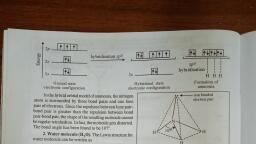
Bond and Reactivity, , Chemica, , 215, , difference between lone pairs and bond, eyplained, pairs of electrons., bonding pairs are under the influence of two nuclei, they, are confined, Since, hetween, two atoms. The lone pair, on, region, the other hand, is, the, d, othe, concentrated, near the central atom and is under the influence, of only one, Because of this, lone pair of electrons in a molecule, scompared to the bonding.pairs ofelectrons. This occupies more, Compared, results in greater, onhetween lone pairs of electrons as compared to lone pair, epulsion, bond, bond pair bond pair repulsion. The, and, expansion, and repulsion of, air, onepairs ofelectrons affec the other electron pairs, and accordingly the, aed, bond angles in the molecule change. Thus, molecules, with lone pair of, electrons gets distorted., fao, , -, , other words, when the valence shel of central, atom have lone pairs, electrons there is repulsion, between all the pairs of electrons present in, In, , f, , he valence, , shell and hence molecule gets distorted., , extent, , The, , of distortion, , in bond angles in a molecule, therefore,, the increase in number oflone pairs. The effect of presence, and number, of lone pairs, on the geometry of molecule can be observed by, the extent, of distortion of bond angle which can be explained as follows:, increases witlh, , ) Effect of presence of lone pair, As discussed, molecules, , epulsion., , uryl ion, , earlier, distortion in bond angle and irregular geometry in, are due to the presence of lone pair of electrons which causes, This can be explained by considering the three molecules, i.e.,, , (N0,t), nitrogen dioxide NO, and nitrite ion (NO,). In nitryl ion, , re are two bond pairs of electrons and no lone pair of electrons therefore,, CE, , no distortion in bond angle and it has 180° bond angle and linear, as shown in figure 8.8 below., , 1S, , structure, , 1ne nitrogen dioxide molecule, NO, is a free radical. It contains an, , unshared, , electron or single electron which repel, Clectron, , ursh, , less than two electrons or, , pair in, nitrogen N0,. Hence, there will be less distortion, Ciectron, n, NO,, , than in [NO ion as shown in figure below. Therefore, bond angles, NO,T, than, observed, , in NO,, , is 135° and that in, , No,, , is 115° and, , have bent structure., , N, , O=, , N=0, , Nitryl ion, , /, , 135, , O, , Fig. 8.8: Bond angles in, , O, , NO, NO, and NO, , O
Page 21 :
College Inorganic Chemistry, , 216, , on bond angle., (i) Effect of repulsion, , among electron pairs of different kinde, The differing repulsion, number ot lone pairs can be hee, , extent of distortion with the increase, Tn, methane, ammonia and water., examples, hane, of, giving, by, illustrated, so it shows bond angle f, of, molecule there is no lone pair of electrons,, there i, molecule,, ammonia, In, molecule., tetrahedral, 109.5° as expected for, distortion in bond angle is observed, ved, one lone pair on the N-atom present hence, there, are, two lane, molecule, since, and it has bond angle of 107°. In water, more distortion in bond anola, pairs of electrons, on oxygen atom there is, figure 8.9 below., and hence it reduces to 104.5° as shown in, , Ip-bp, , repulsionn, , H, , p- Ip and, p-, , bp, , repulsion, , 109.5, , HNH, , H HH, , 107, , H, , (6H, 04.5, H, , CH,(109.5), , NH,(107), , H,O(104.5), , No lone pair, , One lone pair, , Two lone pairs, , Fig. 8.9: Bond angles in CH, NH, and H,O molecules, 4. Effect ofelectronegativity on repulsion ofelectron pair, , and distortion, , of bond angle., Electronegativity of an atom is its capacity to attract electrons towards, it from other atoms. Electronegativity also can play an important role in, determining the arrangement of outer atoms around the central atom and in, influencing bond angles. Electronegativity of different atoms bonded to the, central atom largely controls the influence of bond pair and hence the extent, of bond pair bond pair repulsion., -, , Repulsion by a bond pair decreases as the electronegativity of the, atom bonded to the central atom increases. As the bonded atom becomes, more electronegative, the bonding pair is displaced further away from tne, central atom. Hence, the bond pair- bond pair repulsion decreases an, repulsion from lone pairs dominates to squeez the bond angle. It can be, explained by considering:, , i) Electronegativities of atoms bonded to the central atom. m the, in, molecule AB,. B A B bond angle, decreases with increase, electronegativity of atom B in AB, molecule, wherein A is the centrala the, This is due to the fact that with increase, in electronegativity, average position of bonding electron pair moves away from the ntral, creases., atomA and hence repulsion exerted, by bonding electron pairs of B uc, -, , -
Page 22 :
emjical Bond and, , Reactivity, 217, , pair expand or occupy larger volume in space, Thus, lone, and reduces, angle., , bond, , and, NF and NH, both have structures based on a tetrahedron, a, , corner, , O, , greater distortion, by lone pair, , bonded, , less distortion, by lone pair, , elcciron, , pair, pulled, nore, owards, tluorine, , Eia. 8,10:, , with one, , lone pair as shown in figure, 8.10 below., , 102.5, , 107, , H, , F, Effect of electronegativity of atoms, , The high electronegativity of fluorine, , H, , bonded to central atom, , in NF, pulls the bonding, , electrons, away from N, i.e., they move, away from nitrogen than in, NH,, Hence repulsion between bond pair, bond pair decreases and it is less, than, a NH,. As a result, lone pair expands, maximum, in, NF,, and, causes, a greater, istortion of tetrahedral, angle 109.5° and gives a F, N, F bond angle, 102.5° compared, to NH, with bond angle 107°. The same, effect is observed, inH,O (104.5°), krther, , -, , -, , -, , and F,O (102°) molecules. The, reduction of bond angle in, depends upon the electronegativity, of halogen atom. Electronegativity, decreases from fluorine, to iodine, diminishing attraction, for bonding, electrons. Hence, bond angle increases from PF, to, Pl, i.e., the bond angle, gets gradually, reduced with increase of electronegativity, from iodine to, Jjuorine as shown, in figure 8.11 below., PX,, , 102, , Br, , 101., Br, Br, , Cl, , 100.3, , Cl, , Cl, , F, , -F, , 97, , F, , Ig.8.11: Reduction in bond anglewith, increase in electronegativity of, halogen atoms in Px,, (u), , Electronegativities of central atom: The bond angles decreases in, s, Ties of hydrides of group 15, NH,> PH,> AsH,> SbH, and hydrides, hup 16, in the series H,O> H,S> H,Se > H,Te as shown in Table 8.2, below, the, , O, , down the series, i.e., from nitrogen to antimony and oxygen, btelmoving, turium,, , s1z increases and electronegativity ofthe central atonm decreases, SIZe, permit the bonding, electrons to be drawn out fiurther thus decreasing, Sion between, educe, bonding pairs and repulsion from lone pairs dominate to, cduce, Which, , the bond angle.
Page 23 :
College Inorganic Chemisiry, , 218, , group 15 and 16, Table 8.2: Bond angles in series of Hydrides of, Hydrides of Group 16, Hydrides of Group 15, Bond angle, , Molecule, , Molecule, , Bond angle, , NH3, , 107.20, , H,O, , 104.50, , PH3, , 93.20, , HS, , 92.2, , AsH, , 91.8°, , H,Se, , 91.00, , SbH, , 91.3, , H,Te, , 89.40, , Effect of multiple bond: Although the multiple bonds do not affect, the geometry of the molecules, the bond angles in molecules involving, single bond are generally smaller than those of multiple bonds. Double, bond causes more repulsion than a single bonds and triple bond cause more, repulsion than a double bond. This is because multiple bonds are thicker than, a single bond and hence repel the other single bonds as shown in figure below, in CF,O molecule., 5., , F, 108, , 124, , CC, , 0, , F, Expected geometry is trigonal planar molecules with bond angle of, F C- O which increases to 124° and reduces the bond angle between, halogens, i.e., X -C -X. Since the bond between C- O is double bond, which repels the other single bonds., , Repulsion between electron pairs in filled shell is greater than In, incomplete shell so the bond angle decreases. Elements, of third perioa, onwards have their valence shell only partly filled -3d,, 4d etc. Hence, they, do not fully participate in bonding. Accordingly,, these atoms, sulphur anu, phosphorous in H,S and PH, respectively, have, incomplete outer shell, offer lower bond pair bond pair repulsion, compared to N and O in Ni;, and H,O (second period elements with filled, shell, for e.g., N, 1s 2s 2P, has filled shell). The stronger lp-bp repulsion, dominates and squeez u, bond angles to near 90°., 6., , -, , -, , Incomplete Shell, stronger lp-bp, repulsion, , Filled, , NS Shell, H, , 107, , H, , H, , H, , H, H
Page 24 :
henical Bond and, , Reactivity, 219, , anlication of VSEPR Theory, , anplying, , A, , *****, , ", , the above mentioned points or rules, one can deduce the, eometry as well as distorted geometry in different, molecules or, helps to predict molecular shapes,, without knowing explicity, 10hridisation used, only considering the, Pauli principle and Coulombs, the lhy, , reaso, , law., , Regular geometry, A molecule, conditions:, , of covalent molecules, , will have a regular geometry, when it satisfies the following, , The, , censtral atom of the molecule is, bonded to all similar atoms,, e.g, CH. CCI, BeH2, AIClG, SF6, etc., ) The central atom of the molecule is surrounded, by bond pair of, electrons (and not by lone pair, of electrons)., All, the, (i), bond lengths should be the same., (iv) The central atom is bonded, to other atom by single covalent, bond, or same type of bonds, e.g., Cl, Be Cl, 0 = C = 0 etc., /rregular geometry of covalent molecules, -, , -, , A molecule will have irregular, or distorted geometry due to repulsive, interactions between, , the different kind of electron pairs. A molecule, will, distorted geometry if one, the, following, of, conditions, is, satisfied, the molecule:, by, show, , 1), , The central atom of the molecule is bonded, with dissimilar atoms,, i.e., it is not bonded with all the similar, atoms, e.g., CHCl, CH,CI., (1) The central atom of the molecule is surrounded by, both, bond as, well as non-bond pair (lone pair) of electrons, e.g.,, PCi, NH3, PH,, , etc., , 1), , The central atom of the molecule may be bonded with, similar atoms, but with different bond length, e.g., PF, molecule the, , equatorial., , P-F bond length is 2.04A° whereas the axial P - F bond length is, , 2.19A°., , The, , central atom of the molecule is bonded with surrounding atoms, by different types of bonds, for e.g., NO,, SO, etc., , 3. Predictio, , of shapes of molecules or ions, , theirccording to the VSEPR model, molecules adopt geometries in which, dlence electron pairs orient themselves as far apart from each other, possible., he theory is applied to predict the shape of molecules. A
Page 25 :
College Inorgunic Chemistry, , 220, , o, , to, , by the generic tormula AB,E, where, A is tho, molecule can be described, surroundin, the, any atom or group of atoms, for, stands, B, atom,, central, electrons., of, represents lone pair, central atom and E, ., hand., atoms, number, of, ed, mumber (SN = m + n) is the total, , muaThe steric, , pairs, the central atom and lone, , Steric, , Number, , =, , of electrons., , Number of atoms bonded, to the central atom, , t+, , LP, , Number of lone, pairs of electrons, , of positions occupied by bondad, The steric number gives the number, arrange themselves around the, atoms and lone pairs of electrons. They, repulsion between them, ne m., central atom in such a way that there is minimum, , Alternatively, the shapes of molecules also can be predicted by, Stereoactive pairs of electrons, i.e., the bond (or shared) pairs of electrons, effective in, plus non-bonded (or lone) pairs of electrons. These pairs are, ascertaining the stereo or structural arrangement of atoms., Stereoactive electrons pairs, , Number of shared pairs of, electrons +Number of lone pairs, of electrons, , Since, the number of atoms bonded to the central atom is same as, number of shared pairs of electrons both steric number and stereoactive, electron pairs around the central atom is same., One may also proceed to the geometry from the a valence pairs which, is equal to the steric number. The o valence pairs are obtained by counting, the total valence pair (bond pairs and lone pairs) and then subtracting the T, , valence pair., Sometimes, while discussing the geometry of molecules the electrons, Used in the formation ofo- and 7-bonds have been represented as o-bps, and T-bps representation and lone pairs are represented as lps. Snce, ne, presence ofT-bps does not influence the spatial arrangement of the ctron, eln, pairs, only o-bps are considered in discussion., imber., We will discuss shapes of molecules, by using term ster, Gillespie and Nyholm calculated theoretically (with the help or s, molecules, geometry) the steric number and, or, regular geometry or shape of, molecules, on the basis of valence shell, for, electron pair repulsion principie, le, containing two to eight pairs, valency shell., bonding electrons in the, of, the, the, They prepared a table which, f, can be referred to predict tne, given species in Table, 8.3., , nle, , ules
Page 26 :
Reactivity, , ChemicalBond and., , 221, , arrangenment suggested by steriC number gives electron geometry, species.and not its actual structure which is determined by the position, the, va, 'nuclei only and various types of forces acting upon the valence electrons., he, , of, , Table 8.3: Sterie number and shape of molecules, , Steric Number, , Arrangement of, electron pairs around, the central atom, Linear, , Steric number, , Arrangement of, electron pairs, around the central, atom, Octahedral, , 6, , Trigonal Planar, , Pentagonal, , Tetrahedral, , Square antiprism, , Trigonal bipyramidal, , predict the shape of a given molecule on the basis of valence shell, electron pair repulsion theory follow the steps given below:, To, , 1., , Count the number of valence electrons of atoms in a given molecule, or ion and write Lewis electron dot structure for it., , 2. From the Lewis structure find out number, , of atoms bonded to the, , central atom and number of lone pair of electrons in the valence, shell and calculate steric number of the central atom. The multiple, bonds are counted as a single bond., , Steric, number, , Number of lone pair of, Number of atoms bonded, +electrons in the valence, to the central atom, shell, , of central atom, , 3. Now, follow the Table 8.4 to predict the geometry and shape, , of a, , given molecule or ion. Then give explanation for the molecular, geometry on the basis of valence shell electron pair repulsion, principle., .n molecules containing lone pairs, the actual structure is determined, by the position of atoms only. The position of the lone pair(s) is, often important in deciding the relative positions of other atom., Let us predict the molecular geometry and shape of following two, , with the help of steps mentioned above., Co, molecule with no lone pair of clectrons., 1) NH, molecule with lone pair of electrons., , Cules, , in the molecules and, Ount the number of valence electrons of atoms, given below., Lewis dot structure for C0, and NH, molecules as
Page 27 :
College Inorganic Chemistry, , 222, , (number of atoms bonded to central atom, One, Table 8.4: Steric number, on the basis of VsrD, geometry, molecular, pairs of electrons) and, Molecular geometr, Calculated, Example, Arrangement of, Steric, shape, angle, bond, 1umber electron pairs around |, , 180, , 2, , 180, , AgLincar, , B, , CO, BeC, HgF2, , ZnCl,, , 3, , A, , B, , BC, 120, , NO,,, , co, , 120°, , B, , B, Trigonal Planar, , B, , CH, , 09.5, 4, , 109.5°, , B, , SiCl, , SO2, , B, B, , Tetrahedral, B, PCl, 5, , 120°, 90°, , B, , PF, , B, , BB, , Trigonal bipyramidal, B, , B, 90, , SF6, TeF, , B, , B, Octahedral, B, , BR, B, 7, , 720,90, B, , B, , B, Pentagonal bipyramidal
Page 28 :
and Reactivit, , ChemcadBond, , ial, , CO,, , 223, , molecule, , NH, molecule, , are 16 Valence electrons,, atom and 12, electrons of C, 4, two oxygen atoms., , () There are 8 valence electrons,, , ere, There, , 5, , electrons of nitrogen atom, and, 3 electrons of three, hydrogen, atoms, one each., , electrons of, , Lewis, , structure of CO, molecule, , (ii), , Lewis structure of NH, molecule., , 0=C=o HN-H, , :0::C::0, XX, , Lone pair, , H-N-H, , of, electrons, , H, GilSteric number SN = number of, atoms bonded to central atom +, number oflone pair, , SN=2 +0, , of electrons, i.e.,, , (ii) Steric number, SN = number of atoms, bonded to central atom + number of, lone pair of electrons, i.e.,, SN =, , 2, , 3+1 =4, , CO, the central C atom has no lone pair of electrons and only two, aygen atoms are bonded to the central carbon atom. Therefore, steric, umber of C0, is two. From the table 8.4 it is found out that expected, geometry of molecule is linear. There are four, electrons between carbon, and oxygen, atoms on both the sides of central atoms suggesting double, bonds between, carbon and oxygen atoms on both the sides of carbon., Kepulsion between the electrons in each double bond forces a linear structure, ot the molecule. Hence molecular geometry, i.e., shape of the molecule is, linear as shown, in figure beloW., In, , O =C=0, Fig. 8.12: Linear Structure of Carbon Dioxide, in, , NH, the central atom N has one lone pair and three hydrogen, , NH, is, the central atom. Therefore, steric number of, valence, from the table 8.4 there are four position occupied by, Shell, In molecules containing, electrons and, and 6expected geometry is tetrahedral., by the positions of the atoms, airs, the actual structure is determined, the shape. But the position of, describing, in, included, pairs, are not, the, other, lone pair is ofto important in deciding the relative positions of, often, Puur, Is, atoms., , are linked to, Sur, i.e.,, , rons, , positions are occupied by, three, structure,, umonia, andlone, shown below., pair is on fourth position as, , In, , H, , H, H, , hydrogen atoms
Page 29 :
College Inorgunic Chemistry, , 224, , the presence, Expected tetrahedral structure gets distorted because of, ammonia has trigonal pyranmid., of one lone pair of electrons. Therefore,, , geomeny, The same pattern of finding the Lewis structure and then matching it, energy of bonding electrons is, to a geometry that minimize the repulsive, followed for steric numbers three, five, six, seven and eight as shown in, table 8.4., , Molecular geometry and shapes of some simple molecules, To understand the molecular geometry and shapes of molecules, , on, , the basis of valence shell electron pair repulsion theory, molecules are divided, into two categories:, , pair of electrons: These molecules are, generally labeled as AB, type, AB, type and so on depending upon, the number of B atoms around the central atom A., (I1) molecules with lone pair of electrons: These molecules are, generally labeled as AB,E type, AB,E type, AB,E, type and so on,, where E is lone pair of electrons., (1) molecules without lone, , Let us first discuss molecular geometry of:, , (I) molecuies without lone pair of electrons., 1., , Species of AB, type:, , A probable geometry, , of triatomic molecule is either linear (-.-.) or, angular (A). Let us investigate the shapes of molecules like BeCl, and CO,, (i) BeCl, molecule: The electronic configuration of Be is Is*2s, and that of, Cn is ls*2s2p° 3s23p3. Be is central atom and has two, valence electrons and two chlorine atoms have seven valence, electrons each., , Therefore, the total number of valence electrons are 2+ (7, and Lewis structure can be written as:, , x, , 2)=, , 10, , X, , Clx, , BeCI;>, , CI-Be-CI, , Now, let us find out steric number, of the central atom, 1.6., of, Steric number = Number of atoms, bonded +Number of lone pair, to central atom, electrons, , 2, 2, , 0
Page 30 :
and Reuctivity, Bond an, Bond, , 225, , Chenical, , number gives the number of positions of electron pairs, numb, and expected geometry from Table 8.4 is linear., By, whichi, shell, electron, pair, shell, valence, repulsion, theory, the bond pairs of, shgyalence, ing, 0olyinrange, themselves as far apart as possible so there is minimum, betwe them and maximum stability. This is possible only when, repulsionbetween, bonding electron pairs are at 180° about the central atom. Since, the, the, repulsion among bond pairs would be equal, bonding electrons, fopce of, nosition, occupypositi on the opposite sides of Be atom forming CI-Be-Cl with, 180 Therefore, BeCl, molecule has linear, geometry as shown, bondangle.of, The steric, wO, BeCl, Bed, two in, , in, , figure 8.13, , below., , 80, , CIBeCI, Fig. 8.13: Linear geometry ofBeCl,, Similarly, the structure of CO, molecule, can be explained. Carbon, atom has four valence electrons and each oxygen atom has, six valence, electrons. Total number of valence electrons, x 2, 16., , 4+6, , Lewis, , structure is, , O;:C::0:, , 0-C=o, , XX, , Steric number, , =, , Number of atoms bonded, to central atom, , +Number of lone pair, , 2, , 2, From the table 8.4 expected arrangement, of electrons around the central, atom is linear., There are two positions, , of electron pairs around the central atom, applying VSEPR principle, these bonded electron, pairs should, De at 180°, about the central atom, i.e., they are on the opposite, sides of, drbon atom forming O - C 0 angle, of 180° and molecule has linear, 8cometry as expected, from steric number and as shown in figure 8.14, below., , carbon. By, , -, , 80, , oc0, , Fig.8.14: Linear geometry of C0, molecule, etc., , Other examples of lincar molecules, are Bell,, MgCl2. ZnCl, HgCl,, , 2. Species, , and BCI,, of, , of AB, type:, , molecule: The electronic configuration ofBs is ls- 2s5 2p*, 1s2s 2p 3s2 3p. Boron is the central atom and has, , Cis
Page 31 :
College inorganic Chemistry, ons, seven valence electran, have, 226, atoms, and, Two chlorine, are 3 +(7 x 3) = 24 d, electrons., electrons, valence, three valence, total number of, , each. Therefore,, written as:, be, can, Lewis structure, , Cl-B-Ci, , xX, , CI B *Cl, XX, , X, , X*, , ., , CI, , Cl, XX, central atom B., the, of, number, Now, let us find out steric, bonded + Number of lone pair, atoms, of, Number, =, Steric number, of electrons, to central atom, 0, 3, Steric number, From the table 8.4 expected geometry is trigonal planar., atom which, gives the number of position of electron pair around the central, principle,, is three for BCl,. By applying valence shell electron pair repulsion, these bonded pairs of electrons arrange themselves as far apart as possible, so that there is minimum repulsion and maximum stability. This is possible, only when these bonding electron pairs are at 120° about the central atorm, The force of repulsion among bonded pairs would be equal hence the three, B-Cl bonds get directed towards the corners of an equilateral triangle witn, bond angle 120° as shown in the figure 8.15 below., , C, , CI&.20, Fig. 8.15: Trigonal planar geometry, of BCG, Some other examples of AB, type, molecules without lonc P irof, electrons and having trigonal planar geometry, are BF,, BH2, Gatlz ^*, , etc., , ewis, Similarly molecular gcometry ofSO,, molecules can be explainea. Le, structure of SO, is given as:, , x0%:SS, XX, , O, , S, O
Page 32 :
ChencalBond, Like,, , and Reactivity, , 227, , BCl, steric number of SO, molecule= 3. There are three bond, , ectrons (beca, (because multiple bonds are counted as a single, electrons, bond)., geometry, molecular, of, like, SO,, BCI,, is, also, trigonal, planar, heretre,, geomelry, , S, Fig. 8.16:Trigonal planar geometry ofSO, molecule, , 3.Species of AB, type, (), , CH, molecule: The electronic configuration of C is 1s 2s, 2p, andthat of H, is Is". Carbon is central atom and has four valence, electrons., Four hydrogen atoms have one valence, electron each. Therefore, total, number of valence electrons are 4, +(1 x 4) = 8 and Lewis structure can be, Written, , as:, , H, , H Cx, , H, H, , H-C-H, , H, , H, , Now let us find out steric number, , Steric, , number= Number of, , of the central atom carbon, , atoms bonded, to central atom, , 4, , + Number of lone pair, 0, , 4, From the table 8.4 expected geometry is tetrahedral. Steric number, number of position of electron pair around the central atom which, ur for, for CHmolecule. This molecule can have any of two structures, shown, Fig., Fig. 8.17,i., 8.17, i.e., tetrahedral and square planar. By applying valence, , gves, , he, , urin, hin, , shellelectron, , pairs of electrons arrange, ccron pair repulsion principle, the bonded, there minimunm repulsion and, , Selves, , is, as far apart as possible so that, maxim, stability. This is possible only when the shape of CH, moleculeis, Pa, tetrahedral, carbon atom gets surrounded by four, Fig., , 8.17(a). The central, shared, pair of electrons. Therefore, the force of repulsion among bonded, electro, pair would be equal. Thus, CH, molecule is having regular tetraledral, Beompair, etry., towards four comers of regular, tetrahedralFourC - H bonds get directed, tetrahedral. Such of, is situated at the centre of, while, carbon, atom, thefour, shown in figure below:, ur, H bond analyse would be 109.5° as, , -C-
Page 33 :
College lnorganic Chemistry, , 228, , H, , H, , H, 90, 90, , H, , H, , T, , 90, , 90, , H, Fig. 8.17: (a) Tetrahedral geometry, , of CH, molecule, , (b)Square planargeometry, of CH, molecule, , ***, , Some other examples of molecules having tetrahedral shape are Sic, CCI NH,, SO; etc., , (ii) Lewis structure of NH," and SO, , can be written as:, , H, , H-N-H, , 0-S>0, , H, Since N atom in NH, ion and S atom in, SO2 ion are surrounded by, four electron pairs both these ions have, tetrahedral shape as shown in Fig, 8.18 below., H and, O bond angles are equal to 109.5., , H- N-, , O-S-, , 109.5, , H, , H, H, , NH, , ion, , Fig. 8.18: Tetrahedral shape, , so, , O, 1on, , of NH, and SO, , ions., , hence will, The species of AB, and AB, types, eometry, geomc, irregular, have, be discuss later., , 4. Species of AB, type, , and TeF are AB types of molecules. S(16) has, configuration Is*, 25, 2p°. 3s, 3p* there are six electrons, , SF, , electronic, valence
Page 34 :
al, , Bondand, , Reactivity, , 229, , 1s2, 2s 2p and has seven, Fluorine, Fo has electronic configuration, shell ectrons each. Total number of valence clectrons are 6+ (6 x, 7)= 48., tructure of SF, can be written as:, , ewis, , X, , F, X, , X, , F, , XX, X, , F, , XX, , F, , Fronn the Lewis structure,, , steric number SN = 6 + 0 6, i.e., There, are ssix positions of electron pair around the central atom. By referring, chle 8.4 it is found out, that expected molecular geometry ofSF, is octahedral., t can have three geometries as shown in figure 8.19 below:, F, , F, , F, , 460, , F, 90, , 90, , F, , (a), , (b), , Planar hexagonal, , Trigonal prismatic, Octahedral, Fig. 8.19: Probable geometry of SF molecule, , Now, on the, , basis of valence shell electron pair repulsion principle six, Cron pairs orient themselves in such a way that there is minimum repulsion, Ween them and maximum stability of molecule is obtained. The most, begeometry of SF, is octahedral. Since in this geometry sulphur, atom, at the centre of the square. One S F bond is above the, S andSituated, lane, other S- F bond is below the plane. Thus ali bond angles are 90., and ot, n this type of geometry all the, S- F bonds are equivalent, the repulsion, Ces between them become equa., onilarly, molecular geometry of Tef can be explained., 5. Species, of AB, type, -, , )PF, , mo, nolecule: The electronic configuration of P15) is lss, 2s5, 2p°,, has 3p and that ofF9 is 1s2 2s2 2p Phosphorous is the central atom and, Kas, CValence electrons. Five fluorine atoms have seven valence electrons
Page 35 :
College Inorganic, , 230, , Chemistry, , each. Theréfore, total number of valence electrons are 5 +(s, Lewis structure of PF, can be written as:, F, X, , XFxXX, , F, , F, , Y, , XX, , Steric number of the central atom P 5, +0 = 5, i.e., p atom, tom is, surrounded by five bonding electron pairs and has no, lone pair. Theoretically, PF. molecule.can have any of the three geometries, shown in figure 820, below. From table 8.4 expected geometry is, trigonal bipyramidal., F, , -., , 90, , P, , F, F, , Planar pentagonal, , F, , (c), , Square pyramidal, Trigonal bipyramidal, of PF molecule, , Fig. 8.20: Probable geometry, , On the basis of valence, most, shell electron pair repulsion theory, probable geometries of PF,, molecule is trigonal bipvramidal in which Dol, pair bond pair repulsion, are minimum. Other molecules, whicnna, bipyramidal shape are, PCl, SbCl. Though in PF, phosporou is, bonded with five similar, lar, egular, atom, i.e., F atóm by single bond it, has "hree, geometry. This is because, axial P - F bond faces repulsiou om, equatorial P, vhile, while, bonds at 90° and, F, one, bond, at, ld0, axial, P F, each equatorial P -F bond, nd, faces, quatorial, repulsion, from, 120° to it and two, two c, has to, axial bonds at 90°, pair, bond, to it. Thus each axial, axial, face greater repulsion, ulsion axia, tham equatorial bond, rep, axial, d pairs. To reduce, bond pairs move away from, ofax, gth of, the central P atom, thusreaungth, bo, P-F bond increases and hence, it results in irregular e, , -, , -
Page 36 :
Reactivity, , emial Bond and, 231, type, AB,, Species, of, 6., R.yDe includes molecule like, I,Central atom I has seven electrons, valence shell and seven fluorine atoms, have seven valence, inis, electrons, each. Total number of valence electrons are 7 +, (7 x 7) =, Cihen, , tructure can be, , 56 and Lewis, , written as:, , F, F, , F, , F, F, , ., , ****.***., , 90, , OR, , F-, , 12, , 180, , Fo, a, , Fig. 8.21: Pentagonal bipyramidal geometry of IF, molecule, , Steric nunmber, , 7 from the table 8.4, , expected geometry is, gonalbipyramida. In this molecule there are seven bonded pairs of, elect, and no lone pair around the central atom. There are five I F, Ons, bonds, on the plane of pentagonal and two I-F bonds are above and below, the, plane. On, On the basis of valence shell electron pair repulsion theory, the, plane., bond, angle on the plane is 72° while axial bonds are at 90° as shown in, 8.21. This arrangement gives maximum stability, i.e., there are, ninimum forces, of repulsion., ueometry of molecules without lone pairs of electrons can be, îmarised in a tabular form as given in a Table 8.5., 7, , +0, , -, , re
Page 37 :
College Inorganic Chemistry, , 232, , molecules without lone pairs of electrons, Table 8.5: Geometry of, Examples of, Actual shape, ofSpatial arrangementNo. oflpsbps, molecules with, =, of the species, and, , |7pe, , species, , ofbonded pairs, , 1with, , regular geometry, , bond angles steric number|, bps, , Linear (180°), , AB, , Triangular planar, , bps, , (120), , Is= 0, , BeF, BeCl,, MgCI,, ZnCl, HgCL, , Linear, , 2, , AB, , Is=, , Tetrahedral (109.5°)b, , ABA, , AB, , AB, AB, , planar, Tetrahedral, , = 4, , Is, , 0, , Trigonal bipyramidal, (120°, 90°), , bps, , = 5, , Is, , 0, , Octahedral (90°), , bps, , =, , Is, , 0, , Pentagonal, bipyramidal (72°,90°), , Triangular, , 3, , bps, , Trigonal, , bipyramidal, , BF, BCl BH,, GaCl, CH, CCI, SiCi, NH, BH SO, , PF, PCI, SbCI, , (Irregular geometry)|, , 6, , Octahedral, , SF, , 7, , entagonal, , IF, , bipyramidal, , Is = 0, , TeF, SbF, , (Irregular geometry), , (II) Molecules with lone pairs of electrons, As discussed above, according to the valence shell electron pair, electrons, repulsion theory, the presence and the repulsion of lone pair of, distort the bond angle of the molecule and results in an irregular geometry, of the molecule. Let us study some molecules with lone pair of electrons to, understand distortion of bond angle and irregular geometry of molecules., , 1Species, , of AB,E type:, , type, When AB, type molecule have central atom then it gives AB,E, species with one lone pair of electrons., has electronic configuration 1s252p° 3s* 5p, molecule:, , S16, , () SO,, , and O has electronic configuration 1s2 2s, both have valence electrons six., , 2p. Thus, sulphur and Oxygeu, , Therefore, total number of valence electrons are:, , 1S, , 6, , 20 12, 18, , Lewis structure of SO, can be written as:, , 0::S:0, XX, , XX, , >, , 0=š>0
Page 38 :
Reactivity, 233, and, Bond, henical, 4icates that central S atom is surrounded by two. bond pairs of, electrons., and one lone pair of, oronS, , Steric, , Number of atoms bonded, to central atom, , number, nber, , +, , Number of lone pair, , 3, , positions of electrons bond pairs and lone pair of, ledtrons around"tlie central atom. From the Table 8.4 expected geometry, There are three, , is, , trigonal planar., , According to VSEPR theory, the three electron pairs, i.e., two bond, pairs and one lone pair of electrons arrange around the central atom in such, a, way that there is minimum repulsion between them. This is possible only, when they are at less than 120° about the central atom, i.e., spatial arrangement, , three electron pairs around the central atom is trigonal planar. Due, to the presence of one lone pair which occupies one of, the three vertices of, triangular plane, the shape of molecule is not trigonal planar but, angular, with O- S-0 bond angle less than 120° as shown in figure 8.22 below., Other examples of AB,E type molecules are SnCl2,, PbCl,, O, etc., of these, , Repulsion, between lp, , -, , bp., , 120, , 120, , Fig. 8.22: Angular shape of SO, molecule, hus, presence of lone pair distort geometry of the molecule by, panding its volume in space and exerting repulsion between lone pair, ond pair of electrons. The structure of SnCl, molecule can also be explained, -, , In, , the same way., , has electronic configuration in the outermost or valence shell, 50, and Clyy has electronic configuration in its outermost shell or, a, aCnce shell 3s2, , Sn, 2CI, , =, , 4, , 14, 18, , 3p. Therefore, total number of valence electrons are:
Page 39 :
College Inorganic Chemistry, , 234, , as:, Lewis structure can be written, XX, , CI Cl-Šn-CI, , iSnCI:, Steric number, , =, , A, , Number of atoms bonded+, to central atom, , Number of lone'na:, , 2, 3, , There are three position of atoms bonded and lone pair of electe, around the central atomand referring table 8.4 expected geometry is triangular, planar. Since, there is one lone pair of electron which occupy greater angular, volume and because of lone pair bond pairrepulsion bond angle reduces, to 95 instead of 120° and the electron pair arrange themselves at 95, so that there is minimum repulsion of electron pairs and maximum stability, of molecule. Hence, SnCL, has geometry bent or V shaped as shown in, figure 8.23 below., , Sn, 95, , CI, , CI, , Fig. 8.23:Angular geometry of SnCl,, , 2. Species of AB,E, type:, , When AB, type molecule has central atom containing two lone pairs of, electrons then it gives AB,E, type species like H,O,, SCl, SeC1, NH, and, , ICl,t., , 1) H,O molecule: In water molecule, oxygen is central atom and, 8, has electronic configuration 1s 252p, i.e., there are six valence electros, and hydrogen H has ls' electronic configuration and one electron in valence, shell., , Therefore, total number of valence electrons are:, O, , 2H, , =, , 6, , 28, , Lewis structure of H,O molecule can be given as:, Two lone, pairs of, , H0HH-0-H->H$-H, , electronsS
Page 40 :
mical Bond and, , number =, Steric nber, , Reactivity, , Nun, Number, of atoms bonded, to the central atomm, , 235, , +Number of lone pair, of electrons, , 2, , 2, , 4, ric number four indicates that there are, four positions of atoms, kandea, d ta the central atom and, , lone pairs of electrons. From, the table 8.4, tedgeometry is tetrahedral but water molecule, axpec, shows V shaped or, geometry which can be explained, kontg, on the basis of valence shell, electron, reulsion theory. According to this theory, four electron pairs should, ane themselves in such a way, that they should experience minimum, Rulsion and give maXimum, stability to the molecule the two vertices, of, etrahedron., According to valence shell, electron pair repulsion theory the order, qulsion, , between electron pairs is as follows:, , lone, , of, , pairlone pair > lone pair bond pair > bond pair -bond pair, -, , .It is observed in the water molecule, since there are two lone pairs of, , eectrons, , repulsion between them (lp, , -, , lone pair-, , lp) is maximum and also there is, , bond pair repulsion which reduces the bond angle, -0-H to 104.5° which is expected to be 109.5° in tetrahedral., Ihus, water molecule has bent or V, , Sown, , in Fig. 8.24 below., , shaped molecular geometry as, , lp, , Ip-lp, , HK, I09.5, , repulsion, , lp-bp repulsion, , --, , lp, , H104.s, , H, V-Shaped molecule, , Fig. 8.24: Angular geometry of water molecule, , Similarly, y, AB,E, species, i.e., AB, type molecule witlh three lone pairs, Can, nbe, be, by, explained on the basis valence shell electron pair repulsion principle, of, an, 9eometry, omet, example of XeF. Steric number for it is five and expected, trigonal bipyranmidal but is shows linear structure as shown in, igure, Bure R, , sist, , 8.25.
Page 41 :
College lnorganic, , 236, , Chemistry, , e, , F, , Fig.8.25: Linear geometry of XeF,, 3. Species of AB,E, , type, , ABE type is AB, type molecule with one lone pair of electron., Structure of NH, molecule: In ammonia molecule nitrogen atom is a, central atom and has electronic contiguration 1s* 2s* 2p°, i.e., there are, seven valence electrons and hydrogen has one electron in valence shell., Therefore, total number of valence electrons in the molecule is:, N, 3H, , 7, 3, , 10, , Lewis structure can be written as:, , H-NH, , H-N-H, , H, H, There are three bond pairs of electrons and one lone pair ofelectrons, Steric number = Number of atoms bonded + Number of lone pair, to the central atom, of electrons, , 3, , 1, , 4, , There are four positions of atoms bonded and lone pair, around the central atom. By referring, to table 8.4 expec, geometry is tetrahedron., , electrons, , ular, four, , According to valence shell, electron pair repulsion theory one pairoof, clectron pairs, i.e., three bonded pairs of electron and one, ay that, electrons arrange themselves around the central atom in, stability0of, suetability, there is minimum repulsion amongst electrons and maximum, the four, of, molecule. Due to presence of one lone pair of electron at Oetrahedra, tetrahedral, not., vertices of the tetrahedrons, the shape of NH, molecule 1s
Page 42 :
hamjcal Bond and, , Reactivi, 237, , distorted and become trigonal pyramidal as, tgets, shown in Fig., 8.26, helow, , p-bp repulsion, , bp-bp repulsion, , H, , H, , N, 107, , 109.5, , H, , H, Fig. 8.26:, , -H, , Trigonal pyramidal geometry, , of ammonia molecule, , Inspite, , of the orientation of four, electron pairs around the central, 1om is tetrahedral H, N, H bond angle is not equal, to the expected, Ktrahedral angle, 109.5° and it is 107°. This is, because of repulsion of, bne pairbond pair and bond pair, bond, pair and also because of greater, angular, volume occupied by lone, pair of electrons which reduces bond, ngle to 107°., Other examples of AB,E, type molecules with trigonal, PHTamidal, shape are PH3, PCl,, CIO,, etc., -, , -, , -, , 4., , Species of AB,E,, , type, , ABE, type is AB, type molecule, with two lone pairs, Uure of CIF, molecule. Chlorine being less electronegative of electrons, then fluorine, central atom and has, electronic, configuration Cl, y., 1s 2s 2p° 3s*, -, , o has configuration Is2 2s2, 2p. Both of them have seven valence, OnS. Therefore,, total number of valence electrons are:, 7, , 3F=21, 28, Lewis, , Suructure of CIF,, molecule can be wrilten as follows:, 3, , F, There, Care, Steric, , three bonded pairs of electrons and two lone pairs ofelectrons., number, er, Number of atoms bonded t Number of lone pair, of electrons, to the central atom
Page 43 :
College Inorganic Chemistry, , 238, , 3, , 2, , 5, , atoms bonded and lone pair of lectrons, There are five positions of, table 8.4 expected molecular., metry, around the central atom. By referring, noicometry, electron, shell, valence, to, According, is trigonal bipyramidal., C, arrange themselves around th, theory, there five electron pairs should, ntral, repulsion amongst electera, atom in such a way that there is minimum, and, ways, to, are, arrange, lone., various, There, molecule., repulsion, maximum, pairs, heln, as, figure, in, geometry, shown, 8.27, bipyramidal, in, trigonal, ofelectrons, , Fo, CI, , ip, , 1, , p, , p, (a), , F, , b), Fig. 8.27: Three probable geometry of CIF, , Out of these three possibilities, arrangement shown in (c) in which, both the Ips of electrons occupy the equatoriac position, of the trigonal, bipyramidal involves minimum repulsion, i.e., maximum stability. Thus,, geometry (c) is most stable geometry for, ClF, molecule. Due to lone pai, repulsion, the axial CI-F bond bends slightly away, from lone pairs. Hence,, the molecule has bent T' shaped, structure. The angle reduces from >u to, 87.5° as shown in figure 8.28(b), below., F, , F, , F, , F, , Ci, F, , (a), , Fig. 8.28: BentT-shaped, , geometry of CIs, , Interhalogen compounds, ICl, IF, BrF,, of, AB,, type,, CIF,, i.e.,, are the examples of AB,E,, type species., , etc., ec
Page 44 :
mical, Chem, , Bond and.Reactivity, 239, , Similarly, AB,, , type species can be, explained on the, Sn, repulsion by giving, basis of valence, pair, examples of XeF,,, shellelectron, ICl,., delsallow us to predictmolecular geometry and shape Thus, VSEPR, without applying, hybridi ion in detail. There are various types, of molecules which, can be, jed by applying valence shell electron pair, theory to predict, the shape, olecular geometry. Table 8.6 shows the, types of molecules, nd, and their, geometry. Above discussion, mol, of effect of lone pairs, molecular, of electrons, geometry fmolecule can be summarised, on the, in a tabular from as, follows., Effect of lone pairs of electrons, 86:, (lps) on the geometry, of the molecule, arrangement, Type of Spatial, No. ofbps Actual, species, , due to (bps + Ips), with bond angles, , and lps, , Steric, , the, , shape, species, , Examples, , Number, AB,E, ABE,, , Trigonal planar, (120°), , bps2, , Tetrahedral (109.5°), , bps, , V-shape or, angular, , SnCL, PbCL, SO,, , 2, , V-shape or, angular, , H,0, HS,H,Se,, sCL, SeC1 NH,,, ICL, , 2, , Linear, , XeF2, , 3, , Pyramidal, , p=1, , p=2, AB,E, , Trigonal bipyramidal, , bps, lp=3, , AB E, , Tetrahedral (109.5°)bps, , =, , Ip=1, AB E, , AsX, AsH, , Trigonal bipyramidal|bps =3, , Ip=, , T-shape, , CIF, BrF,, , See-Saw, , SF, , Square planar, , XeF,1C, , 2, , AB,ETrigonal bipyramidal bps= 4, (120°, 90°), , Ip=1, , ABEOctahedral, , bps=, , 4, , Ip =.2, , AB,EOctahedral (90°), , ABE, , bps=5, , Ip, , 1, , Square, , pyramid, , Pentagonal, bps = 6Distorted, bipyramidal (72°, 90°} lp, octahedral, =1, , Isoelectronic, , NH, PH, PX,, , IF,, , IC, IF,|, , SeCl TeX,, , CIF, BrF5, SbF5, , TeF, XeF6, , Principle, , As it is known to us now that molecular geometry and shape of the, ecule depends on the number and positions of the electron pairs around, , ral, he, en, , atom, we may think in the direction whether ditferent molecules, same number of valence electrons can have the same structure? If, our study related to the structure and shape ofmolecules become
Page 45 :
College norganic, , 240, , Chemistry, , with same structure, very easy. Not only that but the reactions of molecules, it opens venue for the research., can also be predicted and studied easily. Also,, molecules/ions with, Isoelectronic species: Originallylit was defined as, same number of atoms usually have, the same number of electrons and the, chemical, similar electronic structures, similar geomtries and similar, properties. This is called isoelectronic principle.lsoelectronic species consist, same number öff, of a set of molecules/ions with same number of atoms and, electrons, for e.g., CH,, NH and BH are isoelectronicl These molecules/, ions have total numbëer of T0ë's, i.e., In CH, (6+4), NH (7+4-le) and BH, (5+4+ le) and there are five atoms. A molecule with a central atom, four, hydrogen atoms and a total of ten electrons should have the tetrahedral, structure like methane, i.e., NH and BH are isostructural with methane., Now, the definition of isoelectronic is modified and instead of same, total number of electrons in molecules or ions) it is defined as molecules or, ions with same number of atoms and same number of valence electrons are, isoelectronicj Such example are, ) CH, and SiH, (5 atoms and 8 valence electrons), , (i) CO, NO, and CS, (3 atoms and, , 10 valence electrons), , O, and SO, (three atoms and 18 valence electrons), (iv) BF, NO; and CO- (three atoms and 24 valence electrons), (v) NX,, PX, (X = halogen) and CIO; (four atoms and 26 valence, electrons), Gii), , The isoelectronic species are isostructural for example AB, type with, 16 valence electrons and three heavy atoms, i.e., heavier than hydrogen, atom have linear structure therefore CO, CS,, NO, are linear AB, type, with more than 16 valence electrons are angular, for example, NO, (17, valence electrons) valence NO; (18 valence electrons) CIO, (20 valence, , electrons)., , ., , Cl, , The molecules (O,) and sulphur dioxide (SO,) are isoelectronic on the, basis of number of valence electrons (18 valence electrons)., The structure in Fig. 8.29(b) gives all atoms zero formal charge., octet limitation prohibits two double bonds for oxygen but they are not, sam, isostructural since we can not represent both the molecules by the, resonating structure, given in Fig. 8.29(a) where X is O or S., , lt
Page 46 :
mical Bond and Reactivity, 241, , =ö, (a, Fig. 8.29, , 0=C=:, , N=C=0:, , H, , H, , CO, , HNCO, , H,NCO, , (isocyanic acid), , N=N=, , (ketenc), , N=N==N:, , C=N=N, , H, , N,O, (nitrous, , =C=0Q:, , H, , HN, , oxide), , H,CN,, , (hydrazoic acid), , Fig. 8.30:, , Structurally related molecules, 16 electrons, , (diazomethane), , with three heavy atoms, , and, , AB, types of molecules, (i) with 24 valence electrons, atoms have, and four heavy, trigonal planar structure,, for e.g., BF molecule, ions and, NO and CO, (i) with 26 valence electrons and four, heavy, atoms have pyramidal, structure, NX, PX, and Clog., , XeF, and IF, are isoelectronic, with linear structure as shown in, Fig., .51 Xenon and iodine, both, are surrounded, by ten electrons, , p, , Ip, , XeF, , -: lp, , -:, , 1, , lp, , F, , Fig. 8.31: Linear structure of XeF, molecule and IF, ion, haubstance with same formula type which appear isoelectronic do not, have, structures, for e.g., CO, (gas) and Sio, (solid) and N,O, and, 2Since their central atoms are of different periods., , Same, , Therefore, one must use reasonable caution in applying the isoelectronie, nciple because sometimes set of molecules show that they are, lectronic but they do not have same structure, for c.g, O, and sI0, and, 3ometime they may have same structure but do not have same number, , princi
Page 47 :
College Inorganic Chemistry, , 242, , CF4 and the, of valence electrons, for e.g., CH, and, , ions, , BH and BF diffa, , in valence electrons., , Limitations of VSEPR, The VSEPR approach is simple and provides principles whicha, easy to remember and requires no details oI hybrid orbitals and molecular, orbitals. However, there are certain limitations and difficulties arise under, the following conditions., , Effect of ionic character:The compounds having ionic character, -predominantly do not follow VSEPR rules, e.g, LiO (with 2 lone pair, on oxygen) is linear. ILi-0-Li has 2 bonding pairs and 2 lone pair of, electrons and the expected the geometry is tetrahedral but it is linear,, (i) Large deviation: A large deviation of bond angle is observed in, the molecules NH(107) : PH3(93.2 H,0104.5): H,S92 which cannot, be explained on the basis of VSEPR. It requires other concepts like, polarisation, hybridisation of the central atoms to be considered., ii) Pi bonding and lone pair of electron: N(CH,), or P(SiH, have, pyramidal structure as expected from VSEPR theory, but planar, structure of N(SiH,), cannot be explained by the theory., (iv) Stereochemical activity and inactivity of lone pairs: when the, .lone pairs of electrons on the central atom do not decide the geometry, of the molecule, they are known as stereochemically inert., For heavier main group elements, a number of species with six bond, pairs and one lone pair [AB,E], e.g., [Sb, Br,Se Cll |Se Br,°, [Te Br,] have octahedral structure suggesting that the, Te Cl, lone pair of electrons are stereochemically inert. The inactivation of, lone pairs is due to the presence of soft donor, atoms. Hard donor, atoms (O, F) result in stereochemical, active electron pairs. e.g, XeF, also possess six bond pairs and one lone pair ABE tyPe buu, does not follow VSEPR rule. XeF,, has distorted octahedral strucnurc, Similarly, the lone pair is SnCl, is stereochemically active but in, SnClis stereochemically inactive., )Effect of CFSE: VSEPR theory does not apply to compou nds of, transition metals having extensively delocalised pi electrons and, large CFSE., (), , () Questions, 1. What is a chemical, , molecule?, , bond? How and why it forms between two ato, , 2. Explain formation of an ionic bond by giving suitable example., , in a