Page 2 :
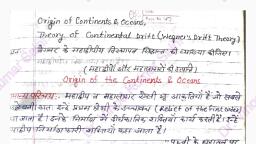
Origin Of Continents And Ocean, Basins, 1. Continents and oceans – relief features of 1st, order, 2. Result of plate collision or divergence – 2nd order, 3. Created by erosion and deposition – 3rd order, , ❖ Pantagonal Dodecahedral Hypothesis – Elie de, Beaumont –1st attempt, Tetrahedral Hypothesis, Continental Drift Theory, F.B. Taylor, Alfred Wegener, Plate Tectonic Theory
Page 4 :
Tetrahedral Hypothesis –, Lowthian Green , 1875, चतुष्फलकीय प रकल्पना, , His hypothesis is based on the characteristics of a, tetrahedron which is a solid body having a four equal, plane surfaces , each of which is an equilateral, triangle, Gap b/w upper and, inner part, , Sphere – very hot, , Upper part – Cooled and solidified, due to loss of heat
Page 5 :
na, a, , Ca, , ria, , be, , d, , Si, , 1, Europe, , 2 3, Antarctica, , 1-Arctic Sea, 2-Atlantic Ocean, 3-Indian Ocean, , The upper part collapsed on the inner part and, ultimately the earth
Page 6 :
Plane Faces – Oceans, , Coigns/apex -- Continents, , •Three coigns out of four, – located in the NH, •4th coigns –SH, (Antarctica Shield), •Other three shield –, Laurentian, Shield/Canadian Shield ,, Baltic , Siberian, , Evaluation, •It’s not possible to have balance for rotating tetrahedron, •The spherical earth cannot be converted into a tetrahedron, while contracting on cooling
Page 9 :
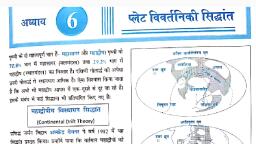
Continental Drift Theory – F.B. Taylor ,, 1910, , •Concept of ‘horizontal displacement of the continents’ -1908, •Published – 1910, •Objective – to explain the problems of the origin of the folded, mountains of Tertiary Period , the north-south arrangement, of the Rockies and the Andes of the North and South, America and west-east extent of the Alpine mts.(Alps ,, Caucas , Himalayas etc.), •He started from Cretaceous Period, •two land masses, Lauratia – near NP, Gowndwana Land – near SP, •Continents are made up of SIAL and it is absent in Oceanic, Crust
Page 10 :
•Continents move towards the equator, •Tidal Force of the moon, •Continents were displaced in two ways, Equatorward, Westward, , Lauratia, , Gondwanaland, , Baffin Bay ,, Labrador Sea ,, Davis Strait, , Great, Australian, Bright and Ross, Sea around
Page 11 :
Continental Drift Theory – Alfred, Wegener , 1912, , •Propounded in 1912 , but come in light 1922, •Objective – to explain the major variations of climate, in the past, •Climate change may occur in two ways :, 1. Continents remain stationary and climate zones, might have shifted from one region to another, 2. Climatic zones remained stationary and the land, masses might have displaced and drifted, • Wegener opted for the 2nd alternative
Page 12 :
Premise:, , •He followed E. Suess layer system for the earth’s, interior– SIAL , SIMA , NIFE, •Acc. To him SIAL is limited to continental masses only, whereas ocean crust is represented by upper part of, SIMA, •Continents are floating on SIMA without any, resistance, •His theory begins, From Carboniferous, Period, Panthalasa, Pangaea
Page 18 :
Evidences –, •Jig-jaw fit(justaposition) along both coasts of Atlantic, Ocean, •Geologically both the coasts of Atlantic Ocean are also, identical, •Fossils and vegetation remains similarity – eastern, coast of SA and western coast of Africa, •Caledonian and Hercynian mountain systems of the, western and eastern coastal areas of the Atlantic, Ocean are similar and identical, •Lemmings(small sizes Animals) of the northern part of, the Scandinavian have a tendency to run westward, •Distribution of glossopteris flora in India , South Africa ,, Australia , Antarctica , Falkland island etc.
Page 19 :
Process of the theory, 1. Force responsible or the drift –, • Westward – Tidal force, • Equatorward – Gravitational Force + Buoyancy Force, 2. Drifting Of the continents --• It begins in Carboniferous period, • ‘THE FLIGHT FROM THE POLES’, • Pangaea – broken into two parts i.e. Lauratia /, Angaraland, and Gondwanaland and the space b/w, them Tetyhs, Sea(Opening Of The Tethys), 3. Mountain Buildings, 4. Origin of island arcs, 5. Carboniferous Glaciation
Page 20 :
Evaluation, •Forces applied by him are not sufficient are not sufficient, enough to drift the continents so apart, •Several contrasting points -- SIAL is moving over SIMA, without any friction but later on he described forceful, resistance offerd by SIMA to explain the mountain, building, •Concept of justaposition cannot be validated
Page 21 :
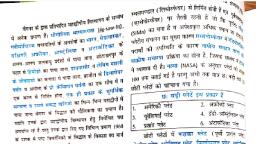
Plate Tectonic Theory – Harry Hess ,, 1960, ● In 1967, McKenzie and Parker suggested the theory of plate, tectonics. Morgan later outlined the theory in 1968., , •Plate – the rigid lithospheric slabs or rigid and solid crustal, layers, •Plate Tectonics – the whole mechanism of the evolution ,, nature and motion of plates and resultant reaction, •It’s based on two major concepts:, 1. Continental Drift, 2. Sea-floor spreading, • Six major Plates – Eurasian , Indo-Australian , American ,, Pacific , African and Antarctic Plate, • 20 minor plates – Juande Fucca , Nazca , Cocos , Scotia, plate etc.
Page 22 :
Force for plate movement, ● Convection currents in the mantle that are generated due to, thermal gradients., Rates of Plate Movement, ● The Arctic Ridge has the slowest rate (less than 2.5 cm/year),, and the East Pacific Rise in the South Pacific (about 3,400 km, west of Chile), has the fastest rate (more than 15 cm/year).
Page 27 :
Plates, , Location, , Movement, , Juan de Fuca, , West of North American Plate, , NE, , Cocos Plate, , West coast of Central America, , NE, , Nazaca Plate, , West coast of South America, , NE, , Arabian Plate, , b/w Africa & South America, , North, , Caroline Plate, , North of New Guinea, , North-west, , Philippine Plate, , Beneath Philippine Sea, , NW, , Scotia Plate, , Edge of South Atlantic & Southern, Ocean, , West
Page 28 :
PLATE (term) – J.T. Wilson , 1955, , Plate margins are generally divided into three, groups :, 1. Constructive/Divergent/Accreting Plate, margin, • Zone of divergence, • Continuous upwelling of lava, • New oceanic crust is continuously formed
Page 31 :
2. Destructive/Convergent/Consuming Plate, Margins, •Plates move towards each other, •Edge of one plate overrides the other plate and, overrides plate is subducted into the mantle, •Part of crust is lost in mantle
Page 34 :
3.Conservative /Shear Plate Margins, •Two plate pass or slide past one another along, transform faults and thus crust is neither, created nor destroyed
Page 36 :
Sea-floor Spreading, , सागर नतल प्रसरण, •1st propounded by Harry Hess , 1960, •He propounded that the mid-oceanic ridges were, situated on the rising thermal convection currents up, from the mantle, •The oceanic crust moves in opposite directions from, mid-oceanic ridges and thus there is continuous, upwelling of new lava along the mid oceanic ridges, •Molten lava cool down and solidify to form new crust, along the trailing ends of divergent plates
Page 37 :
Comparison: Continental Drift – See Floor Spreading –, Plate Tectonics, Continental Drift, , See Floor Spreading, , Plate Tectonics, , Explained by, , Put forward by, Alfred Wegener in, 1920s, , Arthur Holmes, explained, Convectional Current, Theory in the 1930s., Based on convection, current theory, Harry, Hess explained See, Floor Spreading in the, 1940s, , In 1967, McKenzie and, Parker suggested the, theory of plate, tectonics. Morgan, later outlined the, theory in 1968, , Theory, , Explains the, Movement of, Continents only, , Explains the, Movement of Oceanic, Plates only, , Explains the, Movement of, Lithospheric plates, that include both, continents and, oceans.
Page 38 :
Forces, for, movem, ent, , Buoyancy,, gravity,, pole-fleeing, force, tidal, currents, tides,, , Convection, currents in the, mantle drag, crustal plates, , Convection, currents in the, mantle drag, crustal plates
Page 39 :
Let’s, Crack, BHU, Come and Join, Us, Thank You…..