Page 2 :
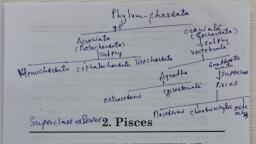
Chondrichthyes is a class of jawed fishes having a cartilaginous skeleton. The class, includes a diverse group of fishes including sharks, rays, skates and chimaeras. They, are mostly marine fishes., The other group of fishes are bony fishes, which are included in the class, Osteichthyes., CHONDRICHTHYES CLASSIFICATION (OUTLINE ), Chondrichthyes is a class of fishes included in the division Gnathostomata as they, have jaws. The division Gnathostomata includes all the vertebrates having jaws., Gnathostomata is divided into two superclasses, viz. Pisces (having fins) and, Tetrapoda (bear limbs)., Pisces is divided into two classes:, 1. Chondrichthyes- Cartilaginous fishes, 2. Osteichthyes- Bony fishes, Kingdom - Animalia, Phylum - Chordata, Subphylum - Vertebrata, Division - Gnathostomata, Superclass- Pisces, Class -Chondrichthyes, , Chondrichthyes is subdivided into two subclasses:, ● Elasmobranchii- Sharks and rays, skates, sawfishes, ● Holocephali- Chimaeras, also known as ghost sharks, , MKL
Page 3 :
GENERAL CHARACTERS OF CHONDRICHTHYES● They are mostly marine fishes., ● They contain a pair of jaws. Their jaws are very powerful., ● Whale sharks are the second largest vertebrate and the largest fish. Some whale, sharks measure up to 15 m in length., ● The mouth is present ventrally., ● They contain cartilaginous endoskeleton, the deposits of calcium salts provide, strength to it., ● The notochord is present throughout life., ● Most of them contain a heterocercal tail. The tail has two lobes, the upper lobe, is elongated and vertebrae extends into it and a shorter lower lobe, giving rise, to the distinct heterocercal tail., ● The skin is covered by minute tooth-like structures called placoid scales., ● Their teeth are modified placoid scales and are not attached to jawbones. They, are embedded in the tissue. Old teeth fall and are continuously replaced by the, new teeth formed behind it., ● They contain 5-7 pairs of gills. Gaseous exchange occurs through the water, current that passes over the gills., ● They lack air bladders so they swim actively to avoid sinking., ● They are poikilotherms or cold-blooded animals and lack the capacity to, regulate their internal body temperature., ● They are predatory fishes, they feed on other fishes, crustaceans and molluscs., They filter food particles like planktons from the water current that passes, through the mouth, pharynx and gills., ● The heart is two-chambered, contains one auricle and one ventricle., , MKL
Page 4 :
● They contain a brain and a spinal cord, which is protected by vertebrae., ● Sense organs are well developed. They have the ability to detect their prey, electrically. Sharks contain electroreceptors on their head, which can sense the, electric current generated by the movement of their prey. It also helps them in, navigation., ● It also has sensory cells in the lateral line organ, which detect all the kinds of, vibration, motion, water pressure surrounding them., ● Some of them possess electric organs or poison sting, which are used for, defence as well as predation., ● The digestive system comprises a mouth, pharynx, stomach, intestine (straight), and cloaca present on the ventral side. Cloaca has a dual function in females, and also acts as a reproductive organ apart from excretion., ● Male and females are separate and have internal fertilization. Skates and some, sharks are oviparous, most of the sharks are ovoviviparous and a few are, viviparous., ● Adult males bear claspers on their pelvic fins. These are used to transfer sperms, to the cloaca of a female., CLASSIFICATION OF CHODRICHTHYES, The cartilaginous fishes first appear in the Devonion period .They can be divided into, two group, , MKL
Page 7 :
The Elashmobranch is devided into as follows Pleurotremata:, 1. Gill slits lateral (on each side of the gill)., 2. Body more or less cylindrical., 3. Anterior margin of the pectoral fins free., 4. In the skull, cartilage is not attached to the olfactory capsule., 5. Two halves of pectoral girdle is separate., Ex. Sharks viz.; Scoliodon, Sphyrna,Charcharinus, , MKL
Page 8 :
Difference # Hypotremata (Batoidea):, 1. Gill slits ventral., 2. Body depressed; flat or disc-like., 3. Anterior margins of the pectorals fused with sides of the body and head., 4. Paired preorbital cartilage is attached to the olfactory capsule., , 5. Two halves of pectoral girdle are joined with each other or with vertebral column., Ex. Dasyatis (Sting ray), Torpedo (Electric ray).Pristis (Saw fish )Rhinobatus (Guitar, fish), , MKL