Page 1 :
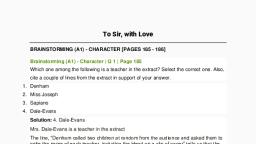
To Sir, with Love, BRAINSTORMING (A1) - CHARACTER [PAGES 185 - 186], Brainstorming (A1) - Character | Q 1 | Page 185, Which one among the following is a teacher in the extract? Select the correct one. Also,, cite a couple of lines from the extract in support of your answer., 1. Denham, 2. Miss Joseph, 3. Sapiano, 4. Dale-Evans, Solution: 4. Dale-Evans, Mrs. Dale-Evans is a teacher in the extract, The line, “Denham called two children at random from the audience and asked them to, write the name of each teacher, including the Head on a slip of paper” tells us that the, slips of paper contained the names of teachers., The line, “The names were called: Mr. Weston, Mrs. Dale-Evans, Miss Phillips” refers to, the names read out from the chosen slips of paper and thus identifies the names of the, teachers., The line, “Miss Joseph and Denham, the two most senior students,” confirms that Miss, Joseph and Denham are not teachers, but are in fact, students., The line, “Sapiano spoke of the study the class had made,” states that Sapiano, presented a report and since all reports were presented by the students, it can be, concluded that Sapiano was not a teacher., Brainstorming (A1) - Character | Q 2.1 | Page 186, Complete the table highlighting the various traits of the major character in the, extract., , Solution: Denham:, •, •, •, •, •, •, , confident, influential, fearless, determined, athletic, clever
Page 2 :
Brainstorming (A1) - Character | Q 2.2 | Page 186, Complete the table highlighting the various traits of the major character in the, extract., , Solution: Miss Phillips:, •, •, •, •, •, •, •, , calm, well-informed, honest, authoritative, skillful, helpful, tough, Brainstorming (A1) - Character | Q 2.3 | Page 186, Complete the table highlighting the various traits of the major character in the, extract., , Solution: Fernman:, •, •, •, •, •, •, •, •, , funny, strategic, dramatic, resourceful, innovative, confident, clever, charming, Brainstorming (A1) - Character | Q 2.4 | Page 186, Complete the table highlighting the various traits of the major character in the, extract., , Solution: Potter:
Page 3 :
•, •, •, •, , analytical, intelligent, insightful, wise, Brainstorming (A1) - Character | Q 3 | Page 186, The narrator played a crucial role in bringing a significant change in the students., Explain the statement by citing some references from the extract., Solution: When Braithwaite takes his place as a teacher for the senior class of, Greenslade School, he is met with a bunch of disrespectful, arrogant and ill-mannered, students. Though initially this angers him, he eventually resolves to take a different, approach in teaching. One of the most important aspects of this new approach is mutual, respect. Braithwaite understands that students can only learn something valuable in, their courses if they respect the teacher teaching them. Once the students respond to, his new methods and begin to open up to him, it becomes easier for him to get them, interested in their courses and they become good students., The half-yearly report proves to be the perfect chance to analyze the progress of the, students., The line, “It was entirely their day, arranged, presented and controlled by them” is an, example of their will to take responsibility. The narrator notes that on the day of the, report, “The children arrived smartly dressed and polished.” This indicates that the, students were aware of the importance of the event and took their roles seriously. Two, of Braithwaite’s students, Miss Joseph and Denham, were not only in charge of the, day’s program, but also “moved about among their colleagues ensuring that each one, was ready to play his (her) part” thus showcasing their ability to be good leaders. The, narrator observes with pride that “Denham used the term ‘Miss’ in addressing each of, the senior girls”. This transformation of Denham from an aggressive, rude student to a, respectful, decent young man is a clear example of the positive influence Braithwaite, has had on the students. Similarly, Potter, Sapiano, Miss Pegg, Jackson, Fernman,, Miss Dare, and Miss Dodd, each speak knowledgeably about their coursework and, exhibit confidence. Fernman’s dramatic report contrasted with his “clear and precise”, voice, his “adroit questioning” and Denham’s fearlessness in his “blunt criticisms” is, proof that the children took their academic progress seriously., Thus, as the students deliver their half-yearly reports, it becomes clear that they have
Page 4 :
progressed immensely from the naughty, rude children that Braithwaite first met, to, responsible, young adults, owing to the patience and respect with which Braithwaite, handled them., Brainstorming (A1) - Character | Q 4 | Page 186, Fernman brought comic relief in the Students’ Council programme. Explain., Solution: A comic relief is a character (or element), that provides humour in a serious, situation. The half-yearly report organized by the Students’ Council was a day of great, importance for the students and teachers of Greenslade School. The students were, assigned roles and responsibilities and they took their jobs seriously. When it was time, for the senior class to present their reports, Miss Joseph introduced the theme of the, class’ report by stating that their lessons had focused on the importance of the, brotherhood of mankind and interdependency among world nations. These were serious, and heavy topics. One by one, Potter, Sapiano, Jackson and Miss Pegg presented the, reports on their respective subjects and displayed a deep understanding of their, lessons. When it was time for Fernman to present his report on Physiology, he signalled, Welsh and Alison to carry a skeleton to the stage. This sudden shift of atmosphere from, the serious, analytical presentations of his classmates, to the image of Fernman on, stage, next to a skeleton hanging from a hook screwed into the top of its skull and, gently revolving at the end of a cord, immediately made the audience laugh. Through, his dramatic presentation, Fernman was able to relieve the tension of the audience by, providing a comical element. Thus, he brought comic relief in the Students’ Council, programme., Brainstorming (A1) - Character | Q 5.1 | Page 186, Give a brief character-sketch of Denham., Solution: Denham is one of the boys in Braithwaite’s class. Like all others, he too is, initially dismissive of Braithwaite and is rude and disrespectful towards him. He is, particularly aggressive and bad-tempered. Braithwaite’s patience and tolerance, transform Denham into a mature, young man who learns to be respectful of others and, takes up responsibility. This can be seen from his ability to host the Students’ Council, report and supervise its proceedings. While hosting the Students’ Council event, he, refers to the other senior girls as ‘Miss’ proving that he has transformed into an
Page 5 :
honorable young man. He is a trained boxer and enjoys athletic activities. He is a, natural leader, who enjoys influence over his classmates and is especially looked up to, by the other boys of the class. This is made clear from the support he receives from his, criticism of the P.T. class when the other boys cheer him from the audience. He is, assertive and confident as he presents his report and is blunt, but respectful in his, questioning of the need for the P.T. class. In his exchange with Miss Phillips, Denham is, not only clever and assertive but also determined in his argument, even though Miss, Phillips represents an authoritative figure., Brainstorming (A1) - Character | Q 5.2 | Page 186, Give a brief character-sketch of Miss Joseph., Solution: Miss Joseph is one of the senior girls in Braithwaite’s class. A natural leader,, Miss Joseph, along with Denham, is in charge of hosting the half-yearly report of the, Students’ Council. Besides helping in the organization of the event, Miss Joseph also, ensures its smooth functioning, by supervising the other students as they perform their, assigned tasks, thus displaying her leadership skills. She also delivers a short address, outlining the purpose of the Students’ Council activities. When it is the turn of, Braithwaite’s class to present its report, it is Miss Joseph who introduces the class’, theme of the brotherhood and interdependency of mankind to the audience. She is, confident by nature and delivers her report on Domestic Science with the utmost ease., Brainstorming (A1) - Character | Q 5.3 | Page 186, Give a brief character-sketch of The Narrator., Solution: The narrator of the novel is the author, E.R. Braithwaite, himself. The novel is, based on his real-life experiences, which particularly focuses on his life in England and, his job as a teacher at Greenslade School after the Second World War. Before, becoming a teacher, he worked as an engineer and even served in the Royal British Air, Force during the war., Though he is British, he is a victim of racial discrimination and prejudice because he is a, black man in post-war England. Because of his race, he has trouble finding employment, and reluctantly takes up the post of a teacher at Greenslade School, located in the East, End of London. The school is famous for its badly behaved students and from the first, day, Braithwaite finds it difficult to manage his class full of unruly children. As someone, who is easily angered, Braithwaite struggles to keep calm while dealing with them.
Page 6 :
Despite not a teacher by profession, Braithwaite is very insightful in his interactions with, the students. He recognizes that he lacks the experience of a professional teacher and, takes extra effort to improve his teaching skills. He soon learns to be patient and, compassionate towards the students and eventually manages to build a strong bond, with them based on mutual respect. He even tries to learn about their backgrounds so, as to be able to understand the reasons for their behaviour. Braithwaite is firm but, caring and brings about an extraordinary transformation in his students. He is the, perfect example of a good teacher, as his influence goes way beyond the classroom, and he ends up making a huge difference in his students’ lives. He is intelligent and, sensitive and shows genuine concern for the well-being of his students. By not giving up, on his students, Braithwaite shows resilience and confidence in his abilities and reaps, the rewards of his hard work as he watches with pride the young adults that graduate, from his class at the end of the year., Brainstorming (A1) - Character | Q 5.4 | Page 186, Give a brief character-sketch of Miss Dare., Solution: Miss Pamela Dare is one of the senior girls in Braithwaite’s class. On the day, of the half-yearly report, she is chosen to be present on the subject of Physiology along, with her classmate, Fernman. While Fernman displays a sense of the dramatic and is, humorous in his presentation, Miss Dare’s presentation is straightforward but insightful., Because of his over-the-top performance, Fernman manages to steal the show with his, presentation. With Miss Dare’s report lacking any such dramatic elements, she is aware, that as she delivers her report after Fernman, she may not receive the same amount of, attention from the audience, but nevertheless proceeds to present her report with, confidence. She outlines the problems that all humanity has to face in terms of sickness, and disease and states the benefits of exchanging knowledge, advice, and assistance, among countries. Thus, she speaks knowledgeably about her coursework., Brainstorming (A1) - Character | Q 5.5 | Page 186, Give a brief character-sketch of Miss Phillips., Solution: Miss Phillips is a teacher at Greenslade School and is one of three teachers, to be chosen, at random, for the panel discussion on the day of the half-yearly report., As she takes her place on the panel, the narrator describes her as a mousy, thin woman, who appears to be unintelligent. However, as the questioning begins, it becomes clear
Page 7 :
to the narrator and the reader that Miss Phillips is the best informed of the three., Despite being unprepared, she handles the questions with honesty and authority,, leaving the narrator and the reader impressed. She even comes to the rescue of the, other teachers when she finds them struggling with the questions and does so with, grace and skill, making sure to not cause them any embarrassment. She is unfazed by, Denham and Fernman’s blunt criticisms and maintains a calm demeanour, matching, Denham’s aggressive nature with her clever arguments and sweet tone. Her interaction, with Denham leaves the students impressed with her tough but honest nature and, establishes her authority as a teacher. This also completely transforms her image in the, eyes of the narrator, who by the end of the extract develops a sense of admiration and, respect for Miss Phillips., Brainstorming (A1) - Character | Q 6.1 | Page 186, Compare the following characters:, Miss Joseph and Denham, Solution:, Miss Joseph, 1. In-charge of the Students’ Council, programme and delivers a short address, highlighting the Council’s purpose and its, activities, 2. Representative of the subject of ‘Domestic, Science’, , Denham, 1. In-charge of the Students’ Council, programme and assigned the task of calling, out the names of the student representatives, of the senior class and displays genuine, courtesy while addressing them, 2. Representative of the subject of ‘P.T. and, games’, , 3. Speaks about the theme of the, interdependence of mankind, which was at, the root of all their lessons, , 3. Criticises the pattern of P.T. and games,, citing the limitations of obtaining space, the, monotony of the routine, and the scarcity of, time allocated to it, , 4. Qualities Highlighted: leadership skills,, calm, insightful, , 4. Qualities highlighted: leadership skills,, courteous, assertive, blunt, , Brainstorming (A1) - Character | Q 6.2 | Page 186, Compare the following characters:, Fernman and Miss Dare, Solution:
Page 8 :
Fernman, , Miss Dare, , 1. Representative of the subject of, ‘Physiology’ who brings comic relief by, displaying a skeleton, hanging from a, hook screwed to its skull and gently, revolving at the end of a cord, on the, stage and whose report is highly, appreciated for its dramatic style, , 1. Representative of the subject of, ‘Physiology’ who presents after Fernman, and whose report is plain,, straightforward and lacking in dramatic, elements, thus making it anticlimactic (in, comparison with Fernman’s report), , 2. Speaks in a clear and precise manner, and concludes, with the help of the, skeleton, that essentially all people were, the same, 3. Qualities highlighted: captivating,, persuasive, confident, innovative,, charming, clever, , 2. Speaks about the problems of, sickness and disease faced by humanity, and the benefits of exchanging, knowledge, advice, and assistance, 3. Qualities highlighted: empathetic,, smart, unenergetic, passive, , Brainstorming (A1) - Character | Q 6.3 | Page 186, Compare the following characters:, Miss Phillips and Denham, Solution:, Miss Phillips, 1. Bluntly criticizes the pattern of P.T., and games, citing the limitations of, obtaining space and the monotony of the, routine, 2. Exhibits impulsiveness, bluntness,, and aggression in his debate with Miss, Phillips but feels sorry when he has lost, the argument, 3. Represents a student’s perspective, and demonstrates that students should, be active participants in their academic, progress by fearlessly questioning an, authoritative figure, 4. Qualities highlighted: aggressive,, blunt, assertive, logical, determined,, smart, , Denham, 1. Tactfully answers all the questions, posed by the students and even assists, other panelists, 2. Tackles the students’ questions with, honesty, authority, skill and a calm and, composed attitude and eventually, outwits Denham with logic and presence, of mind, impressing the students and the, narrator, 3. Represents a teacher’s perspective, and demonstrates that teachers must, respect the perspectives of all students, and tackle their doubts with patience and, logic, 4. Qualities highlighted: calm, skillful,, persuasive, authoritative, well-informed,, tough, logical, witty, , Brainstorming (A1) - Character | Q 6.4 | Page 186
Page 9 :
Compare the following characters:, Narrator and the Head of the school, Solution:, Narrator, , Head of the school, , 1. Seated in the audience, a passive, participant in the event, , 1. Seated on the stage (at the beginning),, an active participant in the event, , 2. Silently observes as the event unfolds, , 2. Reiterates the aims and policies of the, school, the contribution that could be made, by each student in fulfilling those aims, and, praises the students while insisting that, there was yet a great deal to be done, 3. Has never been an outsider as he, identifies himself with the school and, everyone in it, 4. Feels proud of all the students and, expresses his appreciation of the efforts put, in by them, 5. Qualities highlighted: genuine,, appreciative, understanding, , 3. Was an outsider who eventually built a, place for himself in the school and in the, minds of the students, 4. Feels proud to see the transformation, that his students have undergone, 5. Qualities highlighted: observant,, insightful, pleased, surprised, BRAINSTORMING (A2) - PLOT [PAGE 187], Brainstorming (A2) - Plot | Q 1 | Page 187, , Arrange the incidents in the correct sequence as per their occurrence in the, extract., a., b., c., d., e., f., g., , Denham was outwitted by Miss Phillips., The head of the school closed the proceedings., Denham asserted that P.T. periods were a waste of time., The slips were folded and placed in a hat., Fernman was as usual a trump card., Denham called out the names of the representatives., Students’ Council was held every year on November 15th., Solution:, g. Students’ Council was held every year on November 15th., f. Denham called out the names of the representatives., e. Fernman was as usual a trump card., d. The slips were folded and placed in a hat.
Page 10 :
c. Denham asserted that P.T. periods were a waste of time., a. Denham was outwitted by Miss Phillips., b. The head of the school closed the proceedings., Brainstorming (A2) - Plot | Q 2 | Page 187, Describe in brief the purpose of organizing the half-yearly report programme of the, Students’ Council., Solution:, The half-yearly report programme was an important event for the Students’ Council. In, this report, the students would present what they had studied, to the teachers and other, students. The main purpose of the event was to analyze and discuss the academic, progress of the students. Through their presentations, the students would outline what, they had learnt in their classes and the teachers would thus obtain a clear picture of the, depth of their understanding. The report was thus crucial in deciding the structure of the, remaining academic year. Another significant aspect of the report was the panel, discussion. A panel of teachers would be selected by the students, to whom questions, about the reports would be asked. Not only did the students have complete freedom in, choosing the names and number of the teachers on the panel, but the teachers would, not be told about their selection beforehand. This served the purpose of assuring the, students that they too had the power to shape their academic progress. In addition to, these primary objectives, the programme also provided the students with the perfect, platform to showcase their organization skills, become more involved in the activities of, the school, voice their opinions as well as raise their concerns. Denham’s blunt criticism, of the P.T. class is a perfect example of how such programmes can help the students, voice their views., Brainstorming (A2) - Plot | Q 3 | Page 187, Write in your words the entire half-yearly report programme of the Students’ Council., Solution:, The half-yearly report of the Students’ Council, an event entirely arranged and, presented by the students themselves, was held on November 15th. Miss Joseph and, Denham, the two most senior students, were in charge of the day’s programme. The, meeting began with a speech by Mr. Florian, the headmaster, who outlined the aims
Page 11 :
and policies of the school. His presentation, though lengthy, was well-received and was, followed by a short address by Miss Joseph, who outlined the Council’s purpose and its, activities. Following this, each class took turns reporting, through their chosen, representatives, on what they had been studying in the first half of the year, which had, begun after Easter. Each subject had its own representative. The lowest class was the, first to present its report. Being the youngest, the children of this class were shy and, frightened but managed to present their reports honourably. As each succeeding class, presented its report, it became clear that as the students progressed through the ranks,, there was a noticeable increase in their ability to express themselves. Mr Braithwaite’s, class, being the oldest, was last to present its report. Once again, Miss Joseph took the, stage and began the class’ report by stating the common theme underlying all their, lessons − the brotherhood of mankind and the interdependence that exists among the, nations of the world. Potter presented the report on mathematics and observed that the, use of common weights and measures around the world was an example of the greater, understanding that existed among the people of different nations. Sapiano spoke about, the study of pests, the damage they could cause to important crops and the role of, collaborative scientific research among nations in reducing that damage. Miss Pegg and, Jackson discussed Geography. While Jackson focused on how the unequal distribution, of minerals and vegetables around the world led to interdependence among nations,, Miss Pegg outlined the problems faced by the post-war world, the state of refugees and, the role of the U.N.I.C.E.F. Fernman stole the show by displaying a model of a human, skeleton and stressing the conclusion that “all people were the same”. Miss Dare, focused on the importance of the exchange of knowledge among countries in order to, effectively deal with the problems of sickness and disease. Miss Dodd offered a, historical perspective, specifically, the Reformation in England, to emphasize the need, for tolerance towards other cultures and beliefs. Denham delivered a shocking report as, he criticized the structure and general pattern of the P.T. and games class. Finally, a, panel of teachers was chosen to answer any questions pertaining to the reports which, had been given. Mr Weston, Mrs Dale-Evans, and Miss Phillips were chosen, at, random, to form the teachers’ panel. Denham protested the need for all students to take, the P.T. class. Mr Weston responded poorly, by being loud and aggressive instead of, offering valid points. However, Miss Phillips stepped in and defended the need for all
Page 12 :
students to do P.T. Although Denham made some good points, he was soon outwitted, by Miss Phillips and gave up on the matter. The meeting ended with a final address by, the headmaster, expressing his pride in all the students and appreciating them for their, efforts., Brainstorming (A2) - Plot | Q 4 | Page 187, Describe the question-answer session that took place at the end of the extract., Solution:, An important feature of the half-yearly report was the panel discussion scheduled for the, end of the programme. Miss Phillips, Mrs. Dale-Evans, and Mr. Weston were chosen at, random to form the panel and were asked questions about the reports by the students, of the school. The questions were mostly from the senior students and the teachers had, not been made aware of the questions beforehand. As such, they were caught off guard, by the questioning and were struggling to answer them. Of the three, Miss Phillips was, the most informed and answered the questions with honesty and authority. She also, managed to skilfully tackle some of the questions posed to the other teachers in order to, help them and save them from embarrassment. In comparison, not only did Mr. Weston, put no effort in looking presentable, but also tried to escape Fernman’s and Denham’s, blunt questioning by talking loudly and pretending to be offended, so as to avoid offering, any valid explanations. He could not justify the need for the P.T. class when Denham, argued that the class offered no physical benefits. Once again, it was Miss Phillips who, stepped in and successfully defended the need for P.T. class, thereby outwitting, Denham, who then admitted defeat and gave up on the matter. This concluded the, question-answer session of the programme., Brainstorming (A2) - Plot | Q 5 | Page 187, Describe the discussion that took place between Miss Joseph and Denham., Solution: Following the class presentations, a panel of teachers was randomly selected, to answer questions that the students might have regarding the reports. This panel, included Mrs. Dale-Evans, Miss Euphemia Phillips and Mr. Weston. Denham’s class, report was a criticism of the P.T. class and as a follow-up to his report, he asked the, panel of teachers to justify the need for such a class, as he believed it offered no, physical advantages. Being a trained boxer, Denham was of the opinion that exercises, could only benefit the students if they were performed daily and for longer periods of
Page 13 :
time, thereby implying that as the P.T. class was only for twenty minutes twice a week, it, was a waste of time. While Mr. Weston could not offer any satisfactory explanation,, Miss Phillips stepped in and responded by reminding the students that because the, school had limited resources, the goal was to have a timetable that ensured maximum, benefit for maximum number of students. She argued that while Denham and other, physically fit students like him might not see the benefit of the P.T. class because of, their participation in other sports, but the school has many more students that could, benefit from it. In addition, she even called upon senior students like Denham to help, out in this respect. Denham, though impressed by Miss Phillips’ clever response, was, not ready to give up his questioning and further argued that if what Miss Phillips was, saying was true, then only those students who need P.T. should be made to take it and, boys like Denham, who don’t depend on it for the exercise, should be allowed to use the, time as they see fit. This question, as the narrator observes, was tricky, but Miss Phillips, was as calm as ever and responded by saying that the school prepares the students for, the real world, it was therefore important for them to get used to doing things they have, been told to do, even if they don’t like it. Miss Phillips argued that participating in the, P.T. class was an example of such a thing and that the boys could think of it as an, exercise of the mind as well as of the body. Knowing he had been outwitted, Denham, accepted defeat and gave up his line of questioning. Thus, Denham’s aggressive and, blunt probing proved to be no match for Miss Phillips’ patience and composure., [Note: There is no mention of a discussion between Miss Joseph and Denham in the, extract. However, a discussion does take place between Miss Phillips and Denham,, which has been described in the answer below], BRAINSTORMING (A3) - SETTING [PAGE 187], Brainstorming (A3) - setting | Q 1 | Page 187, Which event took place in the extract? Choose the correct one. Give reason/s to, support your answer., a. Annual Sports Day on November 15th, b. Annual Social and Cultural Gathering on November 15th, c. Half-yearly report of Students’ Council on November 15th, d. Farewell Programme on November 15th
Page 14 :
Solution: c. Half-yearly report of Students’ Council on November 15th, The first line of the extract, “The half-yearly report of the Students’ Council was on, November 15th, and was one of the important days in the calendar of Greenslade, School” gives us this information., Brainstorming (A3) - setting | Q 2 | Page 187, Choose the correct alternative. Give reason/s to support your answer., The event in the extract was held at the _______., 1. author’s house, 2. auditorium of the school, 3. market, 4. garden, Solution: The event in the extract was held at the auditorium of the school., The line, “A bell was rung at 10.00 a.m. and everyone trooped into the auditorium to sit, together in classes” confirms that the event took place in the auditorium of the school., Brainstorming (A3) - setting | Q 3 | Page 187, The incidents in the extract occurred at a particular place. Explain the significance of, that place in your own words., Solution: The incidents in the extract took place in the auditorium of Greenslade, School. Since the major theme of the extract is student-teacher relationship, the school, serves as the perfect setting. The students prepare and present their half-yearly reports, to the teachers and voice their concerns by questioning the panel of teachers., Throughout the extract, Mr. Braithwaite, is merely an audience member. As his students, take the stage, it becomes very clear that they have made considerable progress as not, only students but also individuals. Even if Braithwaite had been aware of how his, students had changed, the setting of the auditorium, with him as an audience member,, allows him to observe from afar, the rewards of his efforts. Through his narration, he, conveys to the reader his feelings of pride. Another aspect of the setting that is symbolic, to the students’ progress is the stage. The stage is symbolic of the students’ lives. By, presenting their reports, the students’ are not just taking active participation in their, school, but also coming forward to take control of their lives. Finally, the stage also, represents the perfect platform for the students to showcase their skills, and thus can, also be compared to the stage of the drama, with the students being given the chance
Page 15 :
to charm the audience. Thus, Braithwaite, as an audience member, is like the director of, a play, watching his work unfold on stage and beaming with pride., Brainstorming (A3) - setting | Q 4 | Page 187, Explain how the setting of the extract contributes to the theme of the novel., Solution: The extract is set in the auditorium of Greenslade School. The school itself is, situated in the East End of London and the story is set in the 1940s. The infamous East, End is a key aspect reflecting the theme of the novel. Though the extract focuses mainly, on the student-teacher relationship, the novel, as a whole, also tackles the issues of, racism and prejudice, as experienced by the narrator. In 1940s Britain, racism was quite, common. A narrator is a black man who is considered to be an outsider in British, society. He is denied a job, treated poorly, and endures discrimination in many ways, owing to his black heritage. It is with this bitterness at being left out that Braithwaite, enters his new role as a teacher. When he meets the students of Greenslade School,, he is shocked by their disrespectful and impolite behaviour. But after studying the, neighbourhood in which the students live, he begins to understand their actions. The, East End of London has historically been known for overcrowding, crime and poverty,, making it an unsuitable environment for growing children. The students’ behaviour is a, result of their neighbourhood and most teachers give up on teaching them. Thus, the, students are also outsiders to society, just like Braithwaite had been in the eyes of the, British. With both being rejected by society, the students and Braithwaite, eventually, learn from each other and become better individuals. In this way, the setting of Britain in, the 1940s and Greenslade School in the East End of London are significant to the, novel’s themes of racism, prejudice and student-teacher relationship., BRAINSTORMING (A4) - THEME [PAGE 188], Brainstorming (A4) - Theme | Q 1 | Page 188, ‘When the turn of my class came I sat up anxiously’., Why was the narrator anxious? Explain the statement by citing suitable references from, the extract., Solution: The half-yearly report of the Students’ Council was a measure of the, students’ progress in the first half of the year, which had begun after Easter. At the, beginning of that year, Braithwaite’s students had been rude, ill-mannered, and impolite
Page 16 :
and showed little interest in their courses. However, through innovative teaching, methods, Braithwaite had laid the foundations of a strong student-teacher relationship, based on mutual respect. He was patient and genuinely cared for the students and this, led to a transformation in their attitudes. Braithwaite knew that on the day of the event,, all eyes would be on the students. He notes that it “was one of the important days in the, calendar of the Greenslade School.” The reports to be presented by the students were, an overview of what they had learned with Braithwaite and were therefore a measure of, his hard work. In addition, they provided Braithwaite with the perfect chance to sit back, and observe them as an audience member. This made him “as excited as the children, as the day approached”. The day finally arrived and Braithwaite took his seat in the, audience. The reports would show if the students had actually learned something from, their courses as the “emphasis was on what they understood rather than on what they, were expected to learn”. Braithwaite thus realized that this was a test of his teaching, skills and whether he failed or passed, depended upon the report presented by his, class. Thus, when it was finally time for his students to present the class report, he was, anxious about their performance and sat up straight in his seat., Brainstorming (A4) - Theme | Q 2 | Page 188, Select two statements that describe the theme of the extract:, a. Half-yearly report of the Students’ Council was not an important event for the students, and teachers of the school., b. The writer was immensely pleased to notice the progress of his students., c. The students showed a remarkable change in their behavior and were progressing in all, the subjects., d. The head of the institution was against conducting such activities in the school., Solution: The statements that describe the theme of the extract are:, b. The writer was immensely pleased to notice the progress of his students., c. The students showed a remarkable change in their behaviour and were progressing, in all the subjects., Brainstorming (A4) - Theme | Q 3 | Page 188, The relationship between the teacher and the students is highlighted in the extract., Illustrate with suitable examples from the extract.
Page 17 :
Solution: Braithwaite, who is the teacher of the senior class, is pleased to note the, progress his students have made. When the students had first met him, they exhibited, poor behaviour and showed little interest in their coursework. However, with innovative, teaching methods and an abundance of patience, Braithwaite manages to develop a, strong student-teacher relationship based on mutual respect. Eventually, he helps the, students develop a sincere interest in their courses. His hard work is tested at the halfyearly report of the Students’ Council as the students are expected to present what they, have learned, to the entire school. As the day of the half-yearly report approaches,, Braithwaite is “as excited as the children” and observes, from a distance, how they, prepare for the day. He is impressed by their ability to take responsibility and this can be, inferred from the line, “I observed the activities of my class as they prepared for it,, nothing with pride the business-like way in which tasks were allocated and fitted into a, neat programme.” From the above line, it is also clear that seeing this transformation of, his students, from mischievous children to young adults, is a particularly proud moment, for Braithwaite and is proof of his hard work. On the day of the event, Braithwaite is, obviously nervous about the performance of his students. Not only is he worried about, the way they handle themselves, but he is also hoping that his efforts have paid off and, the students have actually learnt something in the past half-year. His nervousness is, revealed in the line, “When the turn of my class came, I sat up anxiously.” Like the, director of a play, watching the drama unfold, Braithwaite observes his students from, the audience. One by one his students take the stage and speak knowledgeably about, their courses. Miss Joseph and Denham impress Braithwaite with their leadership skills., The line “I felt terribly pleased and proud to see the confident courtesy with which, Denham used the term ‘Miss’ in addressing each of the senior girls; I felt sure that this, would in itself be something for the younger ones to aim at, a sort of badge of young, adulthood” shows how Braithwaite beamed with pride upon seeing that his lesson of, mutual respect had taken effect and held the ability to inspire the younger students., Potter, Sapiano, Jackson, Miss Dodd and Miss Dare offer intelligent insights into their, respective subjects. Braithwaite’s appreciation for Feynman's “dramatic” presentation is, made clear as he notes “Fernman was wonderful; he had them eating out of his hand.”, Lastly, Denham’s criticism of P.T. class was a sign of intelligent questioning, which is, the mark of every responsible student. Denham’s consequent argument with Miss
Page 18 :
Phillips, though blunt, was ultimately respectful as he gives up on the matter when, defeated by Miss Phillips. This, too, is a proud moment for Braithwaite as Denham’s, transformation from an aggressive, rude boy to an intelligent, questioning, young mind, is an important achievement. The extract draws attention to the emotions experienced, by Braithwaite as watches with pride the progress his students have made in the halfyear, thus highlighting the relationship between the teacher and the students., Brainstorming (A4) - Theme | Q 4 | Page 188, Explain in brief the theme of the extract., Solution: The primary theme of the novel is the student-teacher relationship. When, Braithwaite first accepts his job as a teacher at Greenslade School, he is met with a, bunch of arrogant, disrespectful and illmannered students who were well-known for their, bad behaviour. Though angry and frustrated at first, Braithwaite eventually learns to be, patient and tolerant towards their antics and develops a strong bond with each of them., Braithwaite is not only concerned with their academic progress but also takes a keen, interest in their development as individuals. He even takes the time to find out more, about their backgrounds and tries to understand the reasons for their behaviour. More, importantly, he builds a relationship with the students, which is based on mutual, respect. Braithwaite addresses the girls as ‘Miss’ and the boys by their last name and in, turn asks the students to refer to him as ‘Sir’, relaying the message that a healthy, student-teacher relationship is one which involves both, give and take. Though this, method is initially resisted by the students, they eventually warm up to it. This can be, clearly seen when Braithwaite expresses his appreciation of Denham addressing the, senior girls as ‘Miss’. The extract highlights the importance of a teacher’s role in the, lives of his/her students. Braithwaite’s influence extends far beyond his academic role., By choosing not to give up on his students, Braithwaite sets an example for how a, teacher should be someone who is tolerant and understanding. Through Braithwaite’s, role in shaping the personalities of his students, the extract demonstrates that a, teacher’s work is not merely limited to the classroom. An important aspect of the, student-teacher relationship is also the freedom to be honest. Braithwaite encourages, his students to be honest and fearless, which is clearly demonstrated in Denham’s, respectful but blunt criticism of the P.T. class, thus conveying the idea that students, must be active participants in their own progress. His method of developing a
Page 19 :
relationship based on mutual respect is effective and results in the transformation of his, students from mischievous children to young adults. Braithwaite witnesses this, transformation with pride as he watches his students present the class report and, admires them for the progress that they have made., Brainstorming (A4) - Theme | Q 5 | Page 188, Describe the atmosphere of the school described in the extract., Solution: The half-yearly report by the Students’ Council of Greenslade School was, scheduled to be on November 15. It was one of the most important days of the year for, the school. The programme was entirely arranged, presented and controlled by the, students. They were expected to deliver a report describing what they had learnt in the, half-year, which began after Easter. Thus, the report was extremely crucial for the, students and the teachers because it offered the perfect opportunity of determining the, academic progress of the students. In addition, it was a test of the organizational, abilities of the students. The students of Braithwaite’s class were excited about the, event and as the day of the event approached, Braithwaite found himself sharing their, excitement. In order to prepare for the event, the students divided the responsibilities, among themselves and drew up an official programme for the event. They took their, roles as organizers very seriously and performed their duties like expert professionals., Watching his students take responsibility and behave like young, mature adults,, Braithwaite was filled with a sense of pride. On the day of the event, the children made, sure that they were dressed smartly and looked presentable, indicating, once again, that, they were aware of the importance of the event. Miss Joseph and Denham, two senior, students from Braithwaite’s class were chosen as the student representatives who, would host the event and they made sure that every student was ready to play their, part, thus displaying their leadership skills. Thus, the half-yearly report had charged the, atmosphere of the school with excitement and anticipation and had provided the, students with a platform to showcase their organizational skills., BRAINSTORMING (A5) - LANGUAGE [PAGE 188], Brainstorming (A5) - Language | Q 1.1 | Page 188, Explain the following statement that enriches the language and create a powerful, impact., Miss Phillips is transformed into a very convincing personality.
Page 20 :
Solution: When the three teachers- Mrs. Dale-Evans, Miss Euphemia Phillips and Mr., Weston − are called on stage for the question-answer session, the narrator describes, Miss Phillips as “frilly” and “seemingly brainless”. However, he is taken by surprise when, he finds her to be the “coolest” and the “best-informed” among the three. This, transformation of Miss Phillips into a very convincing personality began when the, students of the top two classes questioned the three teachers on stage. Despite being, unprepared, Miss Phillips answered the questions posed to her with “candour” and, “authority”. In fact, she even came to the rescue of the other two teachers by, “intervening skilfully” without making them feel embarrassed. When Denham asserted, that scheduling P.T. only twice a week for twenty minutes was a waste of time, it was, Miss Phillips who “took the reins” and “her stock shot up a hundredfold”; meaning that, she took it upon herself to respond to Denham, which greatly increased her worth as a, panelist. She sweetly conveyed that the creation of P.T. and games schedule was in the, best interest of all the students and the schools limited resources. When Denham, continued the debate by questioning the need for all the students to attend P.T., Miss, Phillips was quick to tackle it by saying that P.T. was “as much an exercise of the mind, as it is of the body” and that the whole timetable had been created to help the students, in the real world, which meant that the need for doing something in spite of not liking it, was a part of that training. Denham was outwitted by this final argument made by Miss, Phillips and she broadly smiled − “this frilly, innocent-looking puss had gobbled her, canary without leaving the tiniest feather”. The authority and skill exhibited by Miss, Phillips while responding to the questions helped the narrator understand “how it was, that so slight a creature could cope so effectively with her class”. Thus, the language, used to describe Miss Phillips transformation enriched the narrative and created a, powerful impact., Brainstorming (A5) - Language | Q 1.2 | Page 188, Explain the following statement that enriches the language and create a powerful, impact., There are many features of language that contribute the smooth sailing of the plot., Solution: Braithwaite’s detailed description of the school’s atmosphere, before the, event, paints a vivid picture for the readers. The use of long and complex sentences,, suggestive of the narrator’s rich educational background, intricately describes the
Page 21 :
scenes on the day of the event. The narrator’s realisation that Mr. Florian associated, himself with the school and everyone in it, his use of the words like “condemnable, gravity”, when the students take their seats on the stage in all seriousness, and his, observation about the lowest class students being shy and frightened to stand before, the entire school, give the readers an insight into the minds of the characters and the, emotions felt by them. The narrator has employed a number of literary and stylistic, devices to make the plot elaborate. He uses a lot of negatives to emphasize a positive, point − “in no way remote from his school”, “it was an experience which I shall not easily, forget”, and “Denham was not to be put off by these sugary remarks”. Transferred, Epithet like “blunt criticisms”, “adroit questioning”, “innocent eyes” and “sugary remarks”, has also been used to beautify the narration. The narrator even makes use of Simile in, the line “I had heard quite a deal about these occasions and became as excited as the, children as the day approached.” Antithesis has been used by the narrator to describe, Denham’s character. On the one hand, he is proud to see Denham’s leadership, qualities, organization skills, and confidence, but on the other hand, he presents, Denham as blunt, aggressive and rebellious when Denham presents his report on P.T., The narrator’s antithetical view of Miss Phillips highlights his objectivity in describing her, character; because the narrator, who initially refers to Miss Phillips as showy and, apparently foolish, changes his perception about her as the event proceeds, and, describes her as well-informed, calm, tactful and authoritative. The literary technique of, Metaphor has also been employed when the narrator describes the discussion between, Miss Phillips and Denham as ‘crossing of staves’, thereby indirectly comparing it to, physical combat with wooden-sticks. The use of Metaphor is also evident when he, indirectly compares Miss Phillips to ‘a cat’ and Denham to ‘a canary’ at the end of the, question-answer session. The literary device of Symbolism has also been used to drive, the plot. The narrator and his students are symbolic of the outcasts, who have no place, in civilized society, and have now come to create their own community by bringing, about improvements in each other. The school is symbolic of mid-1940s East End, London, which was not an ideal environment for growing children. Thus, the various, features of the language, employed in this extract, contribute to the smooth sailing of, the plot., Brainstorming (A5) - Language | Q 2.1 | Page 188
Page 22 :
Following the given dialogue of the major character in the extract. Find out who, the speaker is, his/her tone, the style, significance etc. of the dialogue., , Solution: “Then why do we have to do P.T.? Why don’t they take only the kids, who need it?”, The above line is spoken by Denham as a response to Miss Phillips’ defense of the, need for the P.T. class. Through this line, Denham argues that students like himself,, who are physically fit or play other sports, should not have to do P.T. because it is, pointless for them. Such students already get more than enough exercise done and, forcing them to do twenty minutes of P.T. twice a week has no additional health, benefits. Even though Denham’s previous argument against the need for P.T. had been, defeated by Miss Phillips, Denham’s tone as he makes this second argument is, confident and reflects his determined nature. The style of the dialogue is interrogative., These questions posed by Denham are tricky and add to the tension between the, teacher, Miss Phillips and Denham, who is a student. Miss Phillips’ response to these, difficult questions is significant in establishing her position as a teacher., Brainstorming (A5) - Language | Q 2.2 | Page 188, Following the given dialogue of the major character in the extract. Find out who, the speaker is, his/her tone, the style, significance etc. of the dialogue., , Solution: “Let’s say it is as much an exercise of the mind as it is of the body,, Denham.”
Page 23 :
The above line is spoken by Miss Phillips in response to Denham’s argument against, the need for P.T. in which he questions the need for physically fit students like himself to, do P.T. Through this line, Miss Phillips notes that all students must take the class, whether they like it or not because doing something you don’t like is an exercise of the, mind. She goes on to add that it is a part of the training that the school wishes to, provide students so that they can deal with the real world. Though she is being, questioned by a student, Miss Phillips’ tone as she delivers this line is not one of anger, as might be expected. Instead, she responds calmly and is almost amused at the, interaction. The style of the dialogue is direct, making the tension between Miss Phillips, and Denham quite obvious. With this line, Miss Phillips finally wins the debate, as, Denham has nothing else to say in response. Hence, with this final argument, Miss, Phillips establishes her authority and wins the respect of the students.