Page 1 :
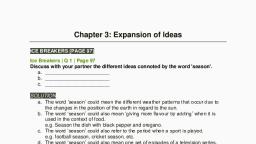
Expansion of an idea., , Expansion of an idea or expansion of a proverb is simple and, straightforward. It involves 5 easy steps. They are:, Step 1: Understand the symbol of the words in the proverb: Most proverbs or, ideas are symbolic. The name of place or animal or thing or person stands as a symbol, of some quality. We have to try to understand that in the context of the proverb.For, example take the proverb, ‘Rome was not built in a day‘. Here the noun ‘Rome’ is the, name of a place. We also (should) know that Rome was a great city. So what does, Rome stand for? It stands for Greatness or success. (Remember it was a great city).Or, take the example of ‘All that glitters is not gold‘. Here we have the noun ‘gold’. It is, the name of a thing. We know that gold is a precious metal. So what does gold stand, for? It stands for precious., Step 2: Substitute the meaning in the idea or the proverb: Take the two previous, examples.‘Rome was not built in a day’ and ‘All that glitters is not gold’. Now, substitute the symbols we found out earlier in the sentences. What do we, have?‘Greatness or success was not built in a day’‘All that glitters is not precious’The, proverb is now decoded and ready for understanding., Step 3: Look for a story or anecdote or example or illustration: Now that you, have understood what the proverb stands for or what the proverb means, we should, look for a suitable example to illustrate it.Where do we get these stories? There are, plenty of them. Aesop’s fables are ideal. So are the tales of India, the Panchatantra.We, can also look for example from today’s world. We could, for example, for the proverb, ‘Rome was not built in a day’, talk about the effort put in by Barack Obama to achieve, greatness, and that it took many years to build it, that it did not happen overnight., Step 4: Look for similar proverbs or ideas: “Patience, persistence and perspiration, make an unbeatable combination for success” by Napoleon Hill is similar to ‘Rome, was not built in a day’; so is the proverb ‘Do not judge the book by its cover’ similar, to ‘All that glitters is not precious’., Step 5: Sum up the paragraph: Use summing up words or phrases to indicate that, you have finished the expansion and intend to sum it up. You could use ‘Thus’ or ‘In
Page 2 :
fine’ or ‘So’ or ‘The proverb advises that’. Let the reader know that you are signing, off., So we have 5 Steps on ‘How to do expansion of an idea or expansion of a proverb’:, Step 1: Understand the symbol of the words in the proverb, Step 2: Substitute the meaning in the idea or the proverb, Step 3: Look for a story or anecdote or example or illustration, Step 4: Look for similar proverbs or ideas, Step 5: Sum up the paragraph, This is how I will do expansion of an idea or expansion of a proverb., Compiled by Prof. Mr. Sanju, Subhash Pardeshi., While writing Expansion of an idea the following points must be kept in mind., _________________________________________, 1) Understand the meaning of the of the given idea/proverb., 2) Write the Indirect meaning of the given idea/Statement in the first paragraph., 3) Write 2 to 3 small anecdotes that ends with the similar moral/idea., 4) In the concluding para write the conclusion of the anecdotes., _________________________________________Dos and Don'ts of Expansion of an, idea, Dos, , Don'ts, , 1.Begin Impressively, , 1.Do not go out off track., , 2.Clearly explain the symbolism of the, proverb, , 2. Don't be ambiguous while, explaining the idea
Page 3 :
3. Include anecdotes, examples and, experience as well as maintain the unity and, clarity of thoughts., , 3.Don't include too many ideas in one, paragraph., , 4 The important ideas should be given more, prominence and space., , 4. Don't forget to maintain the, coherence and logical link between, two sentences, , Examples of Expansion of an idea., As you sow so shall you reap., If the farmer wanted to reap the harvest of rice he has to sow the seeds of rice at the, time of sowing, if he wants wheat, he has to sow wheat. If he had sown Jawar and, thinking of getting the harvest of Bajara people may call him mentally ill as the law of, nature says that if one has desire to reap the harvest of specific grain he must sow the, same seeds. If we sow nothing we will get nothing as it's said that nothing will come, out of nothing. In our life also we have the similar principle if we want that people, should talk to us nicely and politely we need to be nice and polite to them. Even, Newton's third law syas the similar idea that 'Every action has equal and opposite, reaction'. Thus we have to face the consequences of our action irrespective of it's, goodness or badness. The right and good deeds are always rewarded with good and, the wickedness and wrong things are always punished. For the time being people fees, better but they have to pay for their every wrong deed. It's proved time and again. In, Mahabharata Kaurvas had largest arm force and the greatest warriors but they were, leading for wrong hence they were defeated by the small number of Pandavas who, were fighting for good and always deed the good., In the case of all humans it's said that man is the creater of his own fortune. It's in his, hands how his future will be. If the students worked hard and study properly he will, never face the failure. But if the tries wrong way getting marks for time being he may, succeed but the success will not last for long time., From the above example we come to the conclusion that if you require good, do. If, you deed bad you will get the bad. That's why it's rightly said "As you sow so shall, you reap., , Few most important proverbs with it's meaning.
Page 4 :
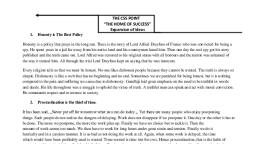
1. All that glitters is not gold., Meaning: Something might not be as valuable as it seems to be., 2. Appearances can be deceptive., Meaning: Something might be different from how they appear outwardly., 3.A stitch in time saves nine., Meaning: It is better to deal with problems immediately than letting them, become bigger., 4. As you sow, so you shall reap., Meaning: Your actions determine your results., 5. Beauty is in the eye of the beholder., Meaning: The perception of beauty varies from person to person., 6. Better late than never., Meaning: Getting something late is better than never getting it., 7. Blood is thicker than water., Meaning: Family relationships are always stronger than other relationships., 8. Don’t count your chickens before they hatch., Meaning: Don’t make plans based on events that have not yet happened., 9. Don’t judge a book by its cover., Meaning: Don’t form an opinion about someone by their appearance., 10 Early bird catches the worm., Meaning: One who arrives first gets the best chance at success., 11. Every cloud has a silver lining.
Page 5 :
Meaning: There is always a positive side to any difficult situation., 12. Honesty is the best policy., Meaning: Being honest is the best characteristic