Page 1 :
gl. Introduction to Thermochemistry, , a well known that nearly al}, ar, ordinarily, in the form o|, , , , , , chemica, f evolutic, , I reactions are accompanied by energy changes. These changes, S accompany, , Toei of energy change: On or absorption of heat. This branch of chemistry which deals with, the ceusholipegiiloeinetea: ing chemical reactions is termed as thermochemistry, , the energ} emi change, , ee the form of thermal, electrical = eae appears in the form of heat, while that which is absorbed may, wed change always remains care forth energy. The amount of energy evolved or absorbed dunng a, chemi ame ‘ne same quantities of reacting substance, , tre subject matter of thermochemistry is base : ny, , TF , d > w ; ;, feaical reactions are generally due to cain, the first law of thermodynamics. The energy changes in, , ¢ 3 up of the existing bonds between the atoms and the, i of new bonds. Thus, 2 5 bea nore ee seep, famation thermochemistry Provides important information regarding the bond, , , , 2. Thermochemical Equation, , An equation which indicates the evolution or a, , bsorption of heat in the reaction 85 15 a, +emachemical equation. For example, the follo a, , wing equation, C+O0, — CO, +393.5 ks, , / ay, weals that when carbon burns in oxygen to form carbon dioxide, 393.5 kJ of heat are set free per one mole, rbon diaoxide produced. Similarly the equation, , C+2S —s CS,-92.0kJ (2), zaeals that one mole of carbon combines with 2 moles of sulphur to form one mole of carbon disulphide with, re absorption of 92.0 kJ of heat. Thus, the equations (1) and (2) written above are the thermochemical, equations,, , , , 11 Conventions Used in Writing Thermochemical Equations, 1,, , , , , , , , , Physical states of reactants and products : The physical states of reactants or products have, been found to influence the magnitude of heat evolved or absorbed in the reaction., , Therefore, these are indicated by symbols (g), (/) and (s) placed after the chemical formulae. These, Sand for gaseous, liquid and solid states respectively. However, sometimes confusion arises in, , esenting the physical state of water forme as a chemical reaction. This can be understood by the, ing reaction at 25°C :, , , , , , Scanned with CamScanner
Page 2 :
oy,, 1 H20(1) + 286 My,, = O,(g) —> He 2kd 4, a H{g) Ae 2 2, , . i i t at 25°C, water is, ‘ ment is carried out a » Waler is obtain..., a vd Dee a temperature a little above 100°C er Med in, , the vapour state. The heat evolved in the, be written as follows :, , In the above reaction, 2, If the above reaction Is carrie on, the water produced will oe _, thermochemical equation will n, , Ha(g) + 5 Ox(g) —> H20(g)+ 245.5 ky, , Mospp ty, Teactigg Phat ey, , : As different allotropic forms of a sub,, f substances : As diffe Substang, 2. Allotropic nena energy, it means that in case of elements showing allot e, different amoui t be mentioned in thermochemical equation. For example, ;.” the ye, allotropic ot braisitotl we must mention the allotropic forms, thombic : ue ee ‘, ion i vin ’ ” es $5 + Oclins Moy“, , tel cacetion, thombic and monoclinic varieties of sulphur aie ‘ nig ee, 1, , haat ) and Sy (monoclinic) respectively. ; ; Present, , (x ts solutions : When a reaction takes place in a solution, the g Solve a, , 3. Reaction he symbol (aq) placed after the formula of a substance, reveals that Must bee, |, For example, the sy1 no heat change on addi at Substan le,, in large excess of water to ensure that there occu! 1 ge On adding futthes rei, 4. Heat changes involved in reactions : Two different conventions are Used to rep Ah, changes of the chemical processes : ; ese %, , (i) Old convention : According to this convention, the heat evolved oral, reaction is represented as a part of the equation on the Product side. A, heat is given out and negative sign (—) is used if heat is absorbed in a, , A+B — C+D+xkJ, A+B —> C+D-xkJ, This convention is out of date these days., , (ii) Modern convention : This convention is based on thermod, absorbed in a process may be represented by AH, the difference, products and reactants. It is not written as a part of equation bu separa, absorbed in a chemical reaction, + AH is employed and if ly, , fawof Carboni Olved, then -», employed. For example, the burning of carbon in oxygen to form carbon dioxide was 4, represented as Prag, , Coraphite + 02 (g) —> CO (g) + 393.5 kJ, At present it is represented as, , Coraphite + O2(g) —> COz(g); AH =~ 393.5kJ, Temperature and pressure of substances :, reaction has been found to depend upon the tempe, , carried out. These two quantities are therefore, also in the thermo chemical equation. If areeciz|, carried out under standard conditions i.e., 25°C or 298 K and 1 atm pressure, the heat chang, indicated as AH°. The superscript ‘°’ indicates that pressure is 1 atmosphere and reactionin$, standard state., , Sorbed ;,, POsitive sonst, chemucal Teac, , , , , yNamics, {hye Deat ey, , in the total heat cong she, t is written tidy, heat is ey the, , (Old conve:, , The heat absorbed or evolved in a chen!, ature and pressure at which the Teaction she, , || 3. Heat of Reaction or Enthalpy of Reaction, , When a chemical reaction is accompanied by evolution of heat, it is termed as exothermic andi!, accompanied by absorption of heat, it is termed as endothermic. The amount of heat evolved or ts", during a chemical reaction is called t, , he heat of reaction or enthalpy of reaction., From the definition of enthalpy,, , there always Occurs a definite enthal: it follows a, py change, it follo, whenever a system undergoes a change of state or a chemical reaction., , . . 4 ndattl, uae Ae consider a chemical system having two reactants A and Bin the initial state. Suppose wi, a chemical reaction at a constant temperature and Pressure, thereby forming the products C andD., , , , , , Scanned with CamScanner
Page 3 :
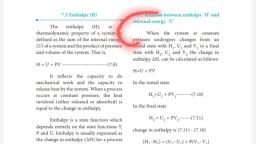
y A4+B—+ C+D, se Hi denotes the onary Teagan in the intial state (ie., enthalpy of reactants A and B) and, fe anthalpy © ? © at the same temperature and pressure (i.e., enthalpy of, ic and D). Then., q, , AH= Hy- Hy, d temperature the h. ,, { stant pressure an ire the heat of reaction or enth ion i, es at ofthe enthalpy change, AH. In simple words. enthalpy of reaction is regarded as a, sure, , ne action or enthalpy of reaction at a given tem t i i, 1 of re perature and pressure is the difference between, qhe hee! f tents of the products and the reactants when the number ‘, , n ;, s i. e the chemical reaction have completely reacted.” of gram molecules of substances, , fi matically, it may beiputas, ybthe \H = heat contents of the products — heat contents of the reactants., , =heat contents of 1 mole of C and 1 mole of D — Heat contents of 1 mole of A, is positive for endothermic reactions and negative for exot, , smochemical equation, q, , and 1 mole of B., hermic reaction. For example, the, , b 1, Hala) + 5 Oxlg) —s 2H,O(); AH = - 285.83 kJ, , indicates that when one mole of gaseous hydrogen combines with hal, , ne atmosphere pressure to form 1 mole of liquid water at the same t, , ait isgiven out to the surrounding. It is further assumed that the reac!, , uith no side products. ., , 1, Enthalpy of a reaction at constant pressure and at constant volume : The enth, reaction depends upon the condition under which the reaction is cartied out. There are two general, conditions under which thermochemical reasurements are made, namely (i) at constant volume and, (ii) at constant pressure. The magnitude of the anthalpy changes in these two conditions are, in, general, different., , 2, Heat of reaction or enthalpy of reaction at constant volume (AE): When a reaction is being, carried out at a constant volume. the heat change is called the heat of reaction or enthalpy of reaction at, constant nolume. Example is the combustion of a substance in a bomb calorimeter., , When a reaction is carried out under constant volume by canying out the reaction in a closed and rigid, container, no work is involved and from the first law of thermodynamics, we have, , AE = qv= enthalpy of the reaction at constant volume., Thus, the enthalpy of the reaction at constant volume is exactly equal to the change in the internal, energy AE of the reacting system. In other words. the thermal change that occurs in a chemical reaction, , isonly due to the difference in the sum of the internal energy of the products and the sum of the internal, energy of the reactants., , fa mole of gaseous oxygen at 298 K at, emperature and pressure, 285.83 kJ of, tion is fast and proceeds ww complection, , alpy of a, , AE=% Eeproducts — © Eveactants --Q), The importance of eq. (3) is that the amount of heat absorbed at constant volume can be identified, ; with the change in the thermodynamic quantity., , Heat of reaction or enthalpy of reaction at constant pressure AH : When pressure is kept, , constant throughout the reaction, the heat change is then termed as heat of reaction at constant, Pressure,, , At constant pressure, the system is either kept open to the atmosphere or confined within a vessel on, Which a constant external pressure is exerted. Under these conditions,the volume of system changes., ¢ thermal change at constant pressure not only involves the change in internal energy of the system, , ut also the work done either in expansion or in contraction of the system. Then, from the first law of, thermodynamics, we have, , gp =AE+w, Twis only pressure volume work, then, gp = AH + PAV = (SEp - SEx) + P (Vp ~ Vp) », , ~— =(ZEp + PVp)— (SER + PVa) wal, , Scanned with CamScanner
Page 4 :
a Misty,, ‘L,4, Where the subscripts P and R refer to the products and the reactants respectively, ty /, But H=E+PV, Therefore, eq. (4) becomes as follows : Iby dey, qp =2Hp-LHe= 4H ay, From the above equation it follows that at constant pressure, the heat of the Feaction ig ; (?, the enthalpy changes AH, of the reacting system. seas ; Cractly, “ly, Relationship between AH and AE: In the case 0} eae involving solids a lt, o, difference beiveen AH and AE is almost negligible. Thus, ‘or solids and liquids, AH .. nd liguig, hand, AF! inay not be equal to AE in reactions which involve gases. Suppose ame nie, reactions : he lt 0, 2NH3(g) —> Nola) + SHalg) ", 2moles 1mole 3moles, 2H2(g) + O,(g) — 2H 20(g) {, 2moles 2moles 1mole, When these reactions are carried out at constant volume, no work will be done by or onthe, there is neither expansion nor contraction. However, if the reactions are carried oyt ata, pressure, then the work will be performed by the system in the first case as there Occurs an in On, valume ease, (2NH; —> N2+ 3H), and upon the system in the second case, (2Hp + O72 — 2H,0) /, As there occurs a decrease in volume. Consequently, the heat of reaction at constant volume (8, be more than heat of reaction at constant pressure (4H ) when contraction occurs during the con ha, reaction whereas AE will be less than AH if expansion occurs during the course of rea es, consider the following gaseous reaction : Noy, cA+bB+... == cC+dD+..., Suppose n, = no. of moles of gaseous reactants i.e., a+ b+..., ng = no. of moles of gaseous products i.e., ¢ + d+..., An(g)=(ct+d+...)-(at+ b+...) = (ng =n), V, = volume of the gaseous reactants, P =the external pressure of the gas and, V> = volume of the gaseous products, T = temperature of the system on absolute scale, For an ideal gas,, PV =nRT, & PV, =n,RT, and PV, =n oRT, , Now, work done by the gas in expansion or contraction from volume V, to Vg in the reaction, aA+bB+... == cC+dD+..., is given by, w = pressure x change in volume, =P (Vo -V,) = PV, - PY, =noRT —nyRT, , = RT (np -m)=An(g)RT a, Thus, heat of reaction at constant pressure is given by,, AH = heat of reaction at constant volume + work done by or i, on the gas during change of volume \it!, = AE + An(g)RT ., ae, , Scanned with CamScanner